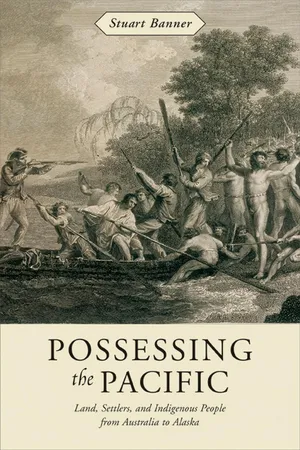
During the nineteenth century, British and American settlers acquired a vast amount of land from indigenous people throughout the Pacific, but in no two places did they acquire it the same way. Stuart Banner tells the story of colonial settlement in Australia, New Zealand, Fiji, Tonga, Hawaii, California, Oregon, Washington, British Columbia, and Alaska. Today, indigenous people own much more land in some of these places than in others. And certain indigenous peoples benefit from treaty rights, while others do not. These variations are traceable to choices made more than a century ago—choices about whether indigenous people were the owners of their land and how that land was to be transferred to whites.
Banner argues that these differences were not due to any deliberate land policy created in London or Washington. Rather, the decisions were made locally by settlers and colonial officials and were based on factors peculiar to each colony, such as whether the local indigenous people were agriculturalists and what level of political organization they had attained. These differences loom very large now, perhaps even larger than they did in the nineteenth century, because they continue to influence the course of litigation and political struggle between indigenous people and whites over claims to land and other resources.
Possessing the Pacific is an original and broadly conceived study of how colonial struggles over land still shape the relations between whites and indigenous people throughout much of the world.
eBook - PDF
Possessing the Pacific
Land, Settlers, and Indigenous People from Australia to Alaska
- 401 pages
- English
- PDF
- Available on iOS & Android
eBook - PDF
About this book
Information
Table of contents
- Cover
- Title Page
- Copyright
- Acknowledgments
- Contents
- Introduction: The Pacific World and Its Atlantic Antecedents
- Chapter 1. Australia: Terra Nullius by Design
- Chapter 2. New Zealand: Conquest by Contract
- Chapter 3. New Zealand: Conquest by Land Tenure Reform
- Chapter 4. Hawaii: Preparing To Be Colonized
- Chapter 5. California: Terra Nullius by Default
- Chapter 6. British Columbia: Terra Nullius as Kindness
- Chapter 7. Oregon and Washington: Compulsory Treaties
- Chapter 8. Fiji and Tonga: The Importance of Indigenous Political Organization
- Chapter 9. Alaska: Occupancy and Neglect
- Conclusion: What Produced Colonial Land Policy?
- Abbreviations
- Notes
- Index
Trusted by 375,005 students
Access to over 1.5 million titles for a fair monthly price.
Study more efficiently using our study tools.
Frequently asked questions
Yes, you can cancel anytime from the Subscription tab in your account settings on the Perlego website. Your subscription will stay active until the end of your current billing period. Learn how to cancel your subscription
No, books cannot be downloaded as external files, such as PDFs, for use outside of Perlego. However, you can download books within the Perlego app for offline reading on mobile or tablet. Learn how to download books offline
Perlego offers two plans: Essential and Complete
- Essential is ideal for learners and professionals who enjoy exploring a wide range of subjects. Access the Essential Library with 800,000+ trusted titles and best-sellers across business, personal growth, and the humanities. Includes unlimited reading time and Standard Read Aloud voice.
- Complete: Perfect for advanced learners and researchers needing full, unrestricted access. Unlock 1.5M+ books across hundreds of subjects, including academic and specialized titles. The Complete Plan also includes advanced features like Premium Read Aloud and Research Assistant.
We are an online textbook subscription service, where you can get access to an entire online library for less than the price of a single book per month. With over 1.5 million books across 990+ topics, we’ve got you covered! Learn about our mission
Look out for the read-aloud symbol on your next book to see if you can listen to it. The read-aloud tool reads text aloud for you, highlighting the text as it is being read. You can pause it, speed it up and slow it down. Learn more about Read Aloud
Yes! You can use the Perlego app on both iOS and Android devices to read anytime, anywhere — even offline. Perfect for commutes or when you’re on the go.
Please note we cannot support devices running on iOS 13 and Android 7 or earlier. Learn more about using the app
Please note we cannot support devices running on iOS 13 and Android 7 or earlier. Learn more about using the app
Yes, you can access Possessing the Pacific by Stuart Banner in PDF and/or ePUB format, as well as other popular books in History & Australian & Oceanian History. We have over 1.5 million books available in our catalogue for you to explore.