History

Realpolitik
Realpolitik is a political approach that prioritizes practical and realistic considerations over ideological or moral concerns. It emphasizes the use of power and diplomacy to achieve national interests, often through calculated and pragmatic decision-making. Originating in 19th-century Europe, Realpolitik has been influential in shaping international relations and foreign policy strategies.
Written by Perlego with AI-assistance
Related key terms
1 of 5


9 Key excerpts on "Realpolitik"
 eBook - ePub
- Mark Bevir(Author)
- 2010(Publication Date)
- SAGE Publications, Inc(Publisher)
Although it contended that conflict was inherent in the interactions of princes, Realpolitik did suggest a set of measures that might produce at least a temporary and tentative peace. These were the policy prescriptions of the balance of power, which held that, while rulers were not selfless, they were rational. A stable balance of power relied on two assumptions: first, that through the use of unemotional reason, leaders could calculate, roughly but accurately enough, the relative power held by each state in the system; and, second, that any leader considering attacking another state would be deterred from doing so if the relative power of the prospective object of the attack and its allies was so great as to render the likelihood of success too slender to make the action worthwhile. Ideological affinities or ethical hesitations would interfere with the unbiased calculation or the smooth transfer of affiliation among allies; these were matters that should be decided solely according to the rule that alliances ought to be directed against the strongest state, which was, because of its greater power, the player in the system most likely to attempt expansion at the expense of others. Although states naturally rose and fell over time in their relative power, if statesmen were alive to these changes and accurate and agile in identifying and diplomatically isolating the greatest power, general peace might be indefinitely preserved. This Realpolitik analysis gave no assurance, however, that smaller, local wars fought for reasons other than the general systemic balance would not take place. Moreover, it recognized that if a general war was necessary to prevent or undo an excessive concentration of power in the hands of one state or alliance—that is, if a choice had to be made between peace and the international balance—then the rational policy would be to employ war to preserve the balance that underpinned the entire system of independent states and prevented its replacement by a “universal empire.”In its reliance on rational calculation of power and its distrust of overscrupulousness and sentiment, Realpolitik presumed a cadre of diplomatic and strategic professionals who would determine and implement policy free from the influence of a broader public that lacked the expertise and the temperament to make rational decisions. There was, then, an almost automatic tension between Realpolitik and the ideological struggles that convulsed international politics at the end of the eighteenth and beginning of the nineteenth centuries, and again through most of the twentieth century, as well as the increasing democratic control over foreign policy. It was in reaction against these forces and the policies they generated that realism first developed as a self-conscious academic school, as opposed to a set of assumptions, drawn from experience, which in a general way guided the actions of those in positions of power. eBook - PDF
- Rahul Sagar, Andrew Sabl, Rahul Sagar, Andrew Sabl(Authors)
- 2018(Publication Date)
- Taylor & Francis(Publisher)
I do not wish to argue that Kant is a political realist, however, but rather to suggest that the ease with which the argument can be made reveals the vacuity of the expression ‘political realism’ as it is com-monly used. The concerns now identified as realist in fact arise wherever politics is practiced and discussed. Unlike those who suggest that realism should be understood as ‘a return to a more traditional way of doing political philosophy’ (Rossi, 2016, p. 417) – which implies the existence of an agreed view of political philosophy that Rawlsian liberalism had ruptured – I argue that realist ideas can be found within the discourses the new realists set out to criticise. Some meanings of ‘political realism’ A historian might identify several realist moments in modern political thought. One is the realism-idealism debate in international relations, beginning in the 1930s, about how to respond to Nazi and Soviet aggression, that pitted tradi-tional policies like the balance of power against relying on international law and institutions (Herz, 1951). Another is the behavioural revolution in American political science, which imagined a science of politics in which political theory would be ‘empirical’ rather than normative. Earlier moments include Marx’s crit-icism of what he and Engels called the German ideology, Hegel’s rejection of Kant’s idea of a universal morality in favour of the embedded moral practices of actual communities, Machiavelli’s suggestion that imagining an ideal polity is the surest road to ruin in governing, and the endless production of works on prudential statecraft throughout the modern period. The ascendance of political realism in political theory today can therefore be read as yet another ‘Machiavellian moment’ in the history of political thought (Pocock, 1975).
- S. Burchill(Author)
- 2005(Publication Date)
- Palgrave Macmillan(Publisher)
The main signpost that helps political realism to find its way through the landscape of international politics is the concept of interest defined in terms of power. This concept provides the link between reason trying to understand international politics and the facts to be understood. It sets politics as an autonomous sphere of action and understanding apart from other spheres, such as economics (understood in terms of interest defined as wealth), ethics, aesthetics, or religion. Without such a concept ... we could not distinguish between political and nonpolitical facts, nor could we bring at least a measure of systemic order to the political sphere ... . We assume that statesmen think and act in terms of interest defined as power, and the evidence of history bears that assumption out ... . A realist theory of international politics, then, will guard against two popular fallacies [for understanding foreign policy]: the concern with motives and the concern with ideological preferences. (Morgenthau 1985, p. 5) Realism assumes that its key concept of interest defined as power is an objective category which is universally valid, but it does not endow that concept with a meaning that is fixed once and for all. The idea of interest is indeed of the essence of politics and is unaffected by the circumstances of time and place ... . the kind of interest determining political action in a particular period of history depends upon the political and cultural context within which foreign policy is formulated. (Morgenthau 1985, pp. 10–11) For Morgenthau, the ‘concept of interest [is] defined in terms of power’. It ‘imposes discipline upon the observer’ of international politics, and ‘infuses rational order into the subject matter of politics, and thus makes the theoretical understanding of politics possible’ (Morgenthau 36 The National Interest in International Relations Theory 1985, p. eBook - PDF
Militarist Peace in South America
Conditions for War and Peace
- F. Martín(Author)
- 2006(Publication Date)
- Palgrave Macmillan(Publisher)
CHAPTER 2 POLITICAL REALISM: PEACE THROUGH POWER? P olitical realism and its contemporary derivative, neorealism, constitute one of the most influential analytical traditions in world politics. E. H. Carr places the origin of this school of thought “far behind utopianism and by way of reaction from it.” He affirms, nonetheless, that “the thesis that ‘justice is the right of the stronger’ was, indeed, familiar in the Hellenic world.” 1 While Carr traces the inception of realist ideas to ancient Greece, Robert Gilpin is more specific and asserts that “the classic history of Thucydides is as meaningful a guide to the behavior of states today as when it was written in the fifth century B.C.” 2 Such expressions are common among many contemporary realists who claim that Thucydides’s analysis of the Peloponnesian War and his focus on the concept of relative power are fundamen- tal pillars of political realism. Accordingly, it is reasonable to conclude that one of realism’s primary concerns has been the investigation of the causes of war and peace in interstate relations. Given the focus of this book, it will evaluate the causal relationship between the most relevant realist propositions and the prevalence of peace in South America. Various realist strands often yield contradictory propositions on the causes of war and peace. Nevertheless, the decision has been made to present realism in consistent and parsimonious terms, because it is treated frequently that way in the international relations literature. Clearly, unless such contradictions are identified and tested against specific cases, there cannot be much theoretical progress in that part of the field of International Relations, nor can realism be called a paradigm. The alternative to the approach taken in this study is to remain operating according to a number of loosely connected propositions that yield contradictory explanations of critical questions in world politics. eBook - PDF
The Hidden History of Realism
A Genealogy of Power Politics
- S. Molloy(Author)
- 2006(Publication Date)
- Palgrave Macmillan(Publisher)
Contrary to later definitions of Realism, there is for Morgenthau no permanent logic of international anarchy in IR, as the balance of power could be transformed into a stable and peaceful system for the com- peting interests of nations, as the competing interests of parties in national politics have been institutionalized in the domestic sphere. 35 The nation state is also a transitory historical phenomenon, “bound to disappear in the course of history.” Interest and power, not the system (i.e., the international society of states) or the unit (the state), are permanent features in the intellectual topography of political Realism. Any transformation of the international system that may take place is dependent upon a realization of the centrality of power in the achievement of change: the political Realist must work with the forces that dominate the political world in order to change it. The vexed question of the relationship between power and morality is the subject of the fourth principle of political Realism. Again, Morgenthau applies his historico-empirical criteria to the selection of a moral course in The Realist Truths of Hans Morgenthau ● 87 IR: political action must be conditioned not by an absolute moral scale, but rather upon the exigencies of the time and place in which an action takes place. Prudence, defined in terms of an ability to recognize the political con- sequences of a moral action and to act on the basis of political rationality is the foundation for a political ethics that serves the political Realist in his deliberations about the proper relationship between power and morality in international politics (in this Morgenthau would seem to be influenced by Machiavelli). eBook - PDF
After the Enlightenment
Political Realism and International Relations in the Mid-Twentieth Century
- Nicolas Guilhot(Author)
- 2017(Publication Date)
- Cambridge University Press(Publisher)
34 The Realist Gambit – or the End of Political Science postwar disciplinary debates. First, power was meant to separate political science from other disciplines, not integrate them. In the minds of those who thought in terms of “power politics,” power provided an organizing focus that would set a theory of politics apart from other disciplines. But power was not just any concept: It was also meant to protect political theory from being taken over by quantitative methods. These methods, Morgenthau suggested, were inadequate when it came to understanding “phenomena which are determined by historic individuality, rational or moral choice.” 28 Power was precisely such a phenomenon, which could not be satisfactorily analyzed in formal conceptual terms: It was “a quality of interpersonal relations that can be experienced, evaluated, guessed at, but that is not susceptible to quantification.” 29 In order to be understood, it had to be resituated within a concrete situation. Unless, as Judith Shklar correctly saw, one would adopt a radical view of power as something always indexed to an existential peril: “The only occasion in which it can be said to appear in ‘pure’ form, unconditioned by a host of circumstances, is in active combat. Here power means destroying an enemy physically or subordinat- ing him to one’s will by the threat of destruction. That is why the only perfectly clear definition of politics-as-power is that of Carl Schmitt.” 30 Some cognoscenti, such as Arnold Wolfers, quickly realized that the dra- matization of power politics and its associated vision of inimical interstate relations was essentially as a “German view” that could be traced back to Schmitt or Ratzenhofer and was a bit problematic (not least because of Wolfer’s own past, as we shall see). 31 Yet, American realists, Shklar noted, were “anything but fascists” and even though they longed for a central concept of politics, they did not want to pay “the full price” for it.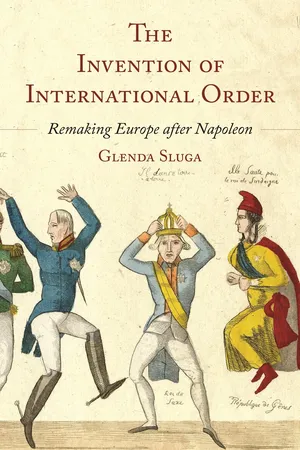 eBook - ePub
The Invention of International Order
Remaking Europe after Napoleon
- Glenda Sluga(Author)
- 2021(Publication Date)
- Princeton University Press(Publisher)
CHAPTER FIFTEENRealpolitik
Le roman est fini, nous entrons dans l’histoire.—METTERNICH TO LIEVEN, DECEMBER 1825What always seemed more important and serious to me … this grand drama of the Orient of which we haven’t yet seen the first act. If we are to commence this piece of drama we need to assemble the actors! Don’t you see?—DOROTHEA LIEVEN TO LORD ABERDEEN, PARIS, 27 FEBRUARY 1840IN 1825, while on a tour of the Russian Black Sea regions, Tsar Alexander mysteriously disappears and then is pronounced dead, likely the victim of an infectious virus. He is forty-eight years old. A wave of regret washes over Dorothea Lieven, now forty and wearing the tsar’s gift of the title “princess.” When she writes to Metternich in search of sympathy, his condolences are tempered. He takes the tsar’s death as a sign that the era of “romance” is over and that they have entered the era of “history.”1 The idea that European relations moved from a brief window of romance in 1814 to a cynical view of foreign policy and politics has shadowed the history of multilateralism at the end of the Napoleonic wars ever since. Some historians argue that to the extent this new society of states’ ideal manifests a romance, its death knell occurs not with the death of Tsar Alexander, who commits to it most consistently, but a quarter of a century later, in 1853, when the outbreak of the Crimean War pits Tsar Nicholas’s Russia against a coalition of the French, British, Austrian, and Ottoman empires. That same year sees the coinage of “Realpolitik,” a term that pits realism against idealism. Alternatively, British historian Harold Temperley locates the origin of this break in the months just prior to the tsar’s death: Dorothea Lieven convinces Alexander to prioritize Russia’s foreign policy interests over those of the Quintuple Alliance, thereby launching “the end of the Neo-Holy Alliance and the congressional or international system of government,” even “the beginning of the break-up of the Turkish empire.”2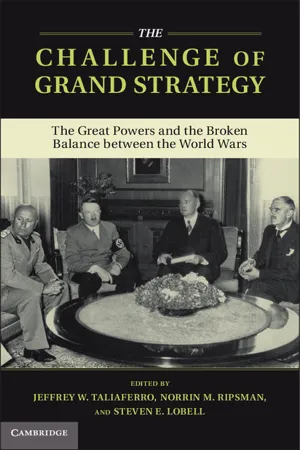 eBook - PDF
The Challenge of Grand Strategy
The Great Powers and the Broken Balance between the World Wars
- Jeffrey W. Taliaferro, Norrin M. Ripsman, Steven E. Lobell(Authors)
- 2012(Publication Date)
- Cambridge University Press(Publisher)
11 Soviet Grand Strategy in the Interwar Years Ideology as Realpolitik Mark L. Haas In October 1939, Winston S. Churchill, then First Lord of the Admi- ralty and a member of British Prime Minister Neville Chamberlain’s war cabinet, made what would become a famous statement about the nature of Soviet foreign policies: “I cannot forecast to you the action of Russia. It is a riddle, wrapped in a mystery, inside an enigma; but perhaps there is a key. That key is Russian national interest.” 1 Churchill’s analysis was at heart a realist one: despite Soviet leaders’ communist ideological beliefs, they would be guided by considerations of power in order to advance the enduring interests of Russia. Thus, Britain could treat the Soviet Union much like any other state and even cooperate with it when the two states’ interests overlapped. Churchill’s claims were a clear criticism of the views and policies of other key British decision makers, especially his predecessor, Chamber- lain. To Chamberlain, communism was central to the formulation of Soviet foreign policies. This ideology made the Soviet Union a partic- ularly aggressive and untrustworthy state. Britain, as a result, should minimize interactions with it. As Chamberlain wrote in a private letter to his sister Ida in March 1939, “I must confess to the most profound dis- trust of Russia . . . I distrust her motives which seem to me to have little connection with ideas of liberty and to be concerned only with getting everyone else by the ears.” 2 These opposing views represent two of the most prominent conven- tional wisdoms about Soviet foreign policies during the interwar period, namely whether Soviet leaders were guided by realist or ideological calcu- lations. The “realism versus ideology” discussion is also one of the most important theoretical debates in the international relations literature. 3 1 Winston S. Churchill, Never Give In!: The Best of Winston Churchill’s Speeches (New York: Hyperion, 2004), 199. eBook - ePub
Really Existing Nationalisms
A Post-Communist View from Marx and Engels
- Erica Benner(Author)
- 2018(Publication Date)
- Verso(Publisher)
These goals supplied a strategic rationale for Marx and Engels’ selective advocacy of nationalist movements. They enjoined support for the creation of independent nation-states only where the nations seeking to form them were sufficiently homogeneous to avoid sub-national fissures, and strategically well placed to resist reactionary influence or economic subordination. The two men vaunted the strategic realism reflected in this position as one of its chief advantages over the ‘idealistic’ national policies of contemporaries like Mazzini and Bakunin. 2 But the state-centred premisses of Marx and Engels’ Realpolitik are hard to square with their explanatory emphasis on nationalism ‘from below’. Their policy even appears, at times, to have been influenced solely by concerns about the balance of international power and the capacity of different nations to constitute themselves as powerful, economically buoyant states, and scarcely at all by the progressive nature of the aims or the class identity of nationalists. Marx and Engels’ reputation as exponents of an unbending Realpolitik has been bolstered by their stubborn silence on the problems addressed by mainstream international ethics. Successive commentators have deplored their apparent lack of interest in questions about how to arbitrate competing nationalist claims, how to differentiate acceptable forms of nationalism from those which should be opposed, and how to find grounds for mutual accommodation in cases of intense national conflict
Index pages curate the most relevant extracts from our library of academic textbooks. They’ve been created using an in-house natural language model (NLM), each adding context and meaning to key research topics.

