History

Religion in America
Religion in America has been a significant force shaping the nation's history and culture. From the early influence of Protestantism to the diversity of religious beliefs today, religion has played a central role in shaping American identity and values. The concept of religious freedom and the separation of church and state have been key themes in the ongoing evolution of religion in America.
Written by Perlego with AI-assistance
Related key terms
1 of 5


12 Key excerpts on "Religion in America"
 eBook - ePub
- Uzi Rebhun(Author)
- 2016(Publication Date)
- Columbia University Press(Publisher)
INTRODUCTION Religion in AmericaR ELIGION IS central in American life for members of all social and economic strata. Even if its potency may have diminished somewhat in recent times, religion today is more diverse than ever, omnipresent in the public domain including culture and politics, pluralistic and embellished with new forms of beliefs and practices. Americans’ religious identity is dynamic. People move freely among religious styles to maximize the meaning and role of religion and spirituality in their lives. Pluralism and individualism, however, also convey the possibility of challenging religion in the name of “Americanism” and turning toward secular worldviews (Bellah et al. 1996 [1985]; Campbell and Putnam 2010; Chaves 2011; Cohen and Numbers 2013; Eck 2001; Kosmin and Lachman 1993; Putnam 2000; Wuthnow 2004).RELIGIOUS CHOICESAffiliation with a religious denomination is immensely important in the United States; it evidences a commitment to the most exalted of American values and reflects full participation in civic life (Swatos 1981). Being part of a religion means “being American”—identifying with and positioning oneself in the American social structure (Greeley 1972). Thus religion provides Americans not only with meaning but also with a sense of belonging (Carroll and Roof 1993). Often, a religious denomination connects people to the community (Swatos 1981).Americans manifest their religious preferences in a society that, notwithstanding certain challenges, honors the separation of religion and state as well as freedom of religion. Despite these characteristics, which are deeply rooted in American democracy, and despite the free market of religious alternatives, Protestantism—particularly in its modern mainline denominations—has long been the country’s most durable and leading faith (Ahlstrom 1975; Hudson 1965; Marty 1986), the one that “set[s] the terms for the religious dimensions of empire” (Marty 1970:23). The American spiritual style attributes importance to the unity of, and adherence to, the minutiae of this grand theological or philosophical system (Roof 1993). Protestant Christianity established ethical norms and values that shaped American culture in literature, the arts, the theater, and scholarship. The Protestant ethic set the tone for public institutions and personal ways of life (as in the expression “Protestant culture”; Hollinger 1997). Insofar as this brand of Protestantism developed along pluralistic lines, it largely encouraged the proliferation of Protestant groups or churches, some liberal and others conservative, that recognize each other, respect each other, and, generally speaking, uphold the fundamental of freedom of choice (Greely 1972). Catholics, Jews, and African Americans, in contrast, often faced debilitating prejudices and social discrimination (Roof and McKinney 1987). eBook - PDF
Critical Issues in American Religious History
A Reader, Second Revised Edition
- Robert R. Mathisen(Author)
- 2006(Publication Date)
- Baylor University Press(Publisher)
In telling the story of American religion, then, one must tell both one story and many stories. The latter are as numerous as there are religious groups, perhaps even as there are religious individuals. These stories overlap and intersect, but are never identical, and no one can be accurately singled out as the paradigmatic story. Catholics now have more impact on the public realm than do Congregationalists, and one can only speculate on what role Muslims might play a half-century from now. The story to which all must be referred, though, is a more unified if extremely complex story, that of the evolution of a distinctly American social, political, legal, and economic order, which has provided both the explicit ground rules as well as the subtler cultural cues which it has been extremely difficult for any group living and 26 Critical Issues in American Religious History growing in the United States to screen out. The story of religion in the United States is that of the interaction of individual religious groups with the broader social order. . . . §3 History Texts and Why Is There So Little Religion in the Textbooks? Warren A. Nord Source: Warren A. Nord, Religion and American Education: Rethinking a National Dilemma . Copyright © 1995 by the University of North Carolina Press. Used with permission of the publisher. It has been claimed that (conscientious) students are likely to have read more than thirty thousand pages of textbook prose by the time they have finished high school; perhaps 75 percent of school classwork and 90 percent of home-work focus on textbooks. Needless to say, we are not likely to remember many of the dates and battles, the facts and formulas, the ideas and theories, that fill those pages. This does not mean we have not been deeply influenced by textbooks, however. Frances Fitzgerald suggests that what “sticks to the mem-ory” is “not any particular series of facts but an atmosphere, an impression, a tone. eBook - ePub
Religion and Politics in America
Faith, Culture, and Strategic Choices
- Allen D. Hertzke, Laura R. Olson, Kevin R. den Dulk, Robert Booth Fowler(Authors)
- 2018(Publication Date)
- Routledge(Publisher)
1 RELIGION AND POLITICAL CULTURE IN AMERICA: FROM THE HISTORICAL LEGACY TO THE PRESENT DAYOne cannot understand American politics today without knowing something about American religion. And one cannot understand either politics or religion without a sense of history, a sense of how the interplay among religion, politics, and culture has shaped the story of the United States. Since colonial days, religion has played a profound role in molding American culture, directly and indirectly, in ways that no one at the time of the founding ever could have imagined or predicted. To sort out the complex history of the relationships among religion, politics, and culture, we have organized this chapter around five themes: the Puritan temper, pluralism, the evangelical dimension, populism, and the contemporary growth of religious and spiritual individualism.THE PURITAN TEMPER
The United States was born of religious zeal. Its colonization coincided with, and was fueled by, dramatic upheavals in Europe that had been unleashed by the Protestant Reformation. The most important of these upheavals was the Puritan revolution that shook England and inspired many to immigrate to the New World. Today, the term “puritanical” connotes a narrow-minded, self-righteous rejection of anything pleasurable. But the Puritan legacy is something quite different. The Puritans bequeathed to Americans strong civic institutions, a sense of national mission, and a reformist impulse that continues to shape American society and political culture today.The Puritans earned their name from their desire to “purify” the Church of England and, more broadly, society itself in the late 1500s and early 1600s. Inspired by Calvinist Reformed theology, Puritans reacted vehemently against what they saw as laxity and corruption in Christian churches. Infused with a sense of moral urgency, Puritans threatened established political and religious elites, and they often suffered persecution as a result of their agitation. To many Puritans, America offered both an escape and a fresh start. Thus, many Puritans (along with other religious dissenters) found their way to American shores beginning in the early 1600s.1 eBook - PDF
For Zion's Sake
The Judeo-Christian Tradition in American Culture
- Fuad Sha'ban(Author)
- 2005(Publication Date)
- Pluto Press(Publisher)
It is obvious that one of the factors which have given the American nation (regardless of regional, ethnic or church orienta-tion) a sense of unity is this firm belief that it has been called upon to fulfill a divine mission, as shown in the previous statement by Lyman Beecher and others like it. The fact that the Constitution bans the adoption by the state of a certain church or religion has prompted students of American history to conclude that the United States is a strictly secular state where religion does not influence politics and the government, and where the state does not interfere in religious affairs. Further-more, the presence of so many churches and sects, in addition to 166 Religion in America non-Christians, agnostics and atheists, makes it appear inaccurate to speak of an American religion, official or public. Nevertheless, a number of prominent scholars have plausibly advanced the concept of an “American civil religion” which is an expression of a set of beliefs subscribed to by a majority of Americans regardless of church or sect affiliation. 11 Robert Bellah described civil religion as a religion obviously involved in the most pressing moral and political issues of the day … “God” has clearly been a central symbol in the civil religion from the beginning and remains so today.This symbol is just as central to the civil religion as it is to Judaism or Christianity … From left to right, all could accept the idea of God. 12 The concept of God or “the Supreme Being” remains at the core of civil religion, regardless of the religious affiliation of its adherents. This is the concept expressed by American presidents and on the National Seal and the currency of the US.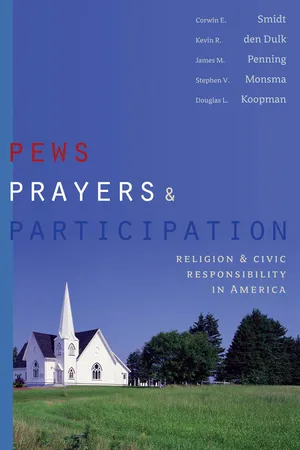 eBook - PDF
Pews, Prayers, and Participation
Religion and Civic Responsibility in America
- Corwin E. Smidt(Author)
- 2008(Publication Date)
- Georgetown University Press(Publisher)
Religion in Contemporary America I n this volume we examine the role of religion in fostering civic respon-sibility, and we do so primarily by analyzing four forms of religious ex-pression that reflect different ways in which Americans are religious. Because our analytical framework represents a new way to examine religion and because it constitutes a central feature of our analysis, it merits an ex-tended discussion. Although religious life in America manifests certain distinctive and stable patterns, it also exhibits some important patterns of change. Thus, rather than analyzing specific religious beliefs or religious affiliations, this study begins by examining the way in which people express their religi-osity in terms of four different forms (or modes 1 ) of religious expression. The second part of the chapter explicates these four forms of religious expression and the theoretical expectations associated with each. We specify the measurement strategy employed to tap such forms of religious expres-sion and examine whether such posited expectations are indeed captured through this strategy. Finally, we examine which types of people tend to exhibit these religious modes and whether the distribution of religious expressions has changed over time. Stability and Change in American Religious Life It is somewhat ironic that we seek to analyze the role of religion in fostering American civic responsibility shortly after the turn of the new 41 2 42 Chapter 2 millennium, as few concepts have occupied a more central position in mod-ern social science than secularization. According to secularization theory, religion is largely a vestige of premodern culture, a human expression that is destined to decline in importance and, perhaps, disappear altogether in an age of science and reason (Hadden 1989, 3; Bruce 2002). eBook - ePub
American Politics
A Beginner's Guide
- Jon Roper(Author)
- 2011(Publication Date)
- Oneworld Publications(Publisher)
Authoritarian governments or those based upon class structures that gave power to monarchs or aristocrats could restrict individual freedoms. In a republic, however, the people were sovereign, and they were deferential only to their own authority. Religion offered a countervailing power to supplement the constitutional system of checks and balances,preserving Americans against the potential damage caused by an excess of individual liberty. Tocqueville saw the problem: “how is it possible that society should escape destruction if the moral tie is not strengthened in proportion as the political tie is relaxed? And what can be done with a people who are their own masters if they are not submissive to the Deity?” The answer to both questions was to acknowledge the role of religion in shaping political life in America’s democratic republic. In 1836, the historian George Bancroft gave an Independence Day oration in Springfield, Massachusetts in which he argued that “the United States, eminently the land of democracy, is the most religious country on earth.” Political arguments in the United States are frequently articulated in a language combining what Tocqueville called the “spirit of religion” and the “spirit of freedom” in American life. Indeed, as Daniel Boorstin observed, there is a “mingling of political and religious thought” that he regarded as a characteristic of the peculiar and particular “genius of American politics.”The great moral causes that have impacted upon American political life have been often framed in a religious context. Before the Civil War, religious reformers were prominent among the advocates of the abolition of slavery. At the end of the nineteenth century they supported temperance and encouraged Americans toward sobriety. In 1920, the eighteenth amendment to the Constitution banned the production, sale and transportation of alcohol, although its unintended consequences might have given pause to those who believe in legal solutions to moral problems. Prohibition gave license to organized crime to supply the nation’s demand for what was now an illegal substance, and fortunes were made during the thirteen years before the amendment was repealed.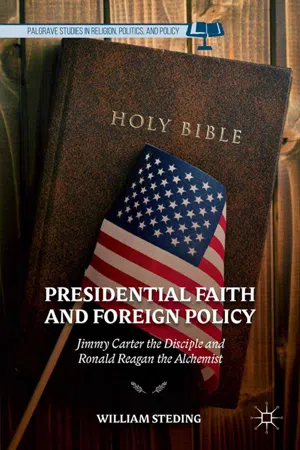 eBook - ePub
Presidential Faith and Foreign Policy
Jimmy Carter the Disciple and Ronald Reagan the Alchemist
- W. Steding(Author)
- 2014(Publication Date)
- Palgrave Macmillan(Publisher)
1 Religion in the American Political SphereLike other cultural phenomena, Christianity in America has a wide array of interpretations and a history of rising and falling in social and political significance. Yet, there are discernible and common threads that have prevailed across these varied interpretations over time.1 Before we can assess the religious heritage of Jimmy Carter and Ronald Reagan and its contribution to their respective cognetic narratives, we must identify these threads of American religious discourse and understand the importance of religion during their presidencies. Some scholars, like Denis Lacorne, have identified meta-narratives that describe broad interpretations of American Christianities throughout history; this chapter intends to take that a step further to the finer threads of religious-based narratives to enable the evaluation of presidential cognetics.2 In addition, this chapter will provide an overview of the ebb and flow of religion to and from the political sphere in American history and then a more thorough illustration of the rise of religion during the period preceding the election of Carter and Reagan.Narrative threads of American Christian heritageAmerican Christians have established five principal narrative threads since landing on the shores of today’s Massachusetts in the early seventeenth century. These threads include notions of individualism, perfectibility, exceptionalism, religious liberty, and particular if not peculiar contemplations of sin and salvation. The interpretation of these threads contributed to the differentiation and proliferation of sects, or strands. The Puritanism of early colonists, which was inspired by developments during the Protestant Reformation, was followed by evangelism and periods called “Awakenings,” which were followed by the development of a third progressive theological strand after the American Civil War. As we shall see in later sections of this chapter, these puritanical, evangelical, and progressive strands of Christianity went through periods of incrementally greater expression, until, by the mid-1970s when Carter ran for president, religion was fully ensconced in the political sphere where it was waged as a source of attraction and persuasion across the entire political spectrum, from liberal to conservative.
- Karen J. Johnson, Jonathan M. Yeager, Karen J. Johnson, Jonathan M. Yeager(Authors)
- 2024(Publication Date)
- University of Wisconsin Press(Publisher)
This chapter gives guidance on how to teach students about the American founders’ views on religion’s role in public life and, by exten- sion, to analyze controversies today regarding relationships between religion and civil government in the American constitutional order. The chapter begins with a few observations about religion in the American founding. This is followed by a discussion of the founding generation’s diverse views on and approaches to relations between religion and the civil state. A concluding section examines the specific provisions in the US Constitution pertaining to religion and church-state relationships. A good starting point for a unit on this topic is a discussion, or even a debate, among students on several broad questions regarding religion’s potential to be a beneficent influence or source of conflict in society. • What, if anything, can religion contribute to a political society? Do student responses depend on the specific religious sect and beliefs in question (in other words, do students think some religions are more beneficial or detrimental than others to a political society)? Does the degree to which a society is religious, secular, or culturally diverse inform student responses? • What, if any, are the legitimate restrictions the civil state may place on religious exercises and expression? Does it make a difference if religion is sponsored by the government or by a private entity? Is Part Two: Teaching Religion in Specific Periods 178 there something about religious exercises and expressions in public life that suggest they should be subject to more scrutiny and restrictions by the civil state than activities and expressions that are philosophical, political, economic, or artistic in content? Religion and the American Founding The expansive role of religion—specifically Christianity— in the political order of the founding era reflected the religious demo- graphics of the American people.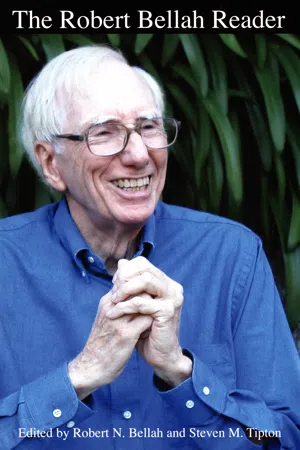 eBook - PDF
- Robert N. Bellah, Steven M. Tipton(Authors)
- 2006(Publication Date)
- Duke University Press Books(Publisher)
Yet the religious needs of a genuine republic would hardly be met by the formal and marginal civil religion that has been institutionalized in the American republic. The religious superstructure of the American republic has been provided only partially by the civil religion. It has been provided mainly by the religious community entirely outside any formal political structures. Here the genius and uniqueness of the American solution is to be found. At the 1976 Democratic convention Barbara Jordan called for the creation of a national community that would be ethical and even spiritual in content. This is what Talcott Parsons calls the ‘‘societal community.’’ It is what might be called in Europe the nation as opposed to the state. It is in a sense prepolitical, but without it the state would be little more than a mechanism of coercion. The first creation of a national community in America, it is now widely recognized, preceded the revolution by a generation or two. It was the re-sult of the Great Awakening of the 1740s, a wave of religious revivalism that swept across the colonies and first gave them a sense of general soli-darity. As the work of Nathan Hatch has shown, this religious solidarity 256 Religion and the American Republic was gradually given a more political interpretation from within the reli-gious community in the 1750s and 1760s with the emergence of what he has called ‘‘civil millennialism,’’ namely, the providential religious mean-ing of the American colonies in world history. 9 It is the national commu-nity with its religious inspiration that made the American Revolution and created the new nation. It is the national community that was, in my sense of the term, the real republic, not the liberal constitutional regime that emerged in 1789. The liberal regime never repudiated the civil religion that was already inherent in the Declaration of Independence and indeed kept it alive in our political life even though the Constitution was silent about it.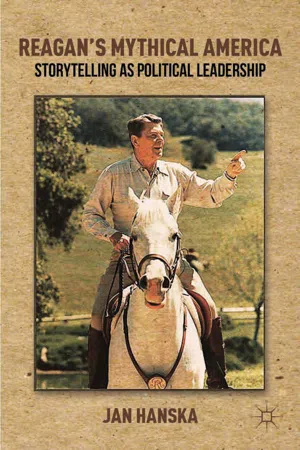 eBook - PDF
Reagan’s Mythical America
Storytelling as Political Leadership
- Jan Hanska(Author)
- 2012(Publication Date)
- Palgrave Macmillan(Publisher)
Civil religion can be understood only as a means of grasping the meaning of being American and a guide into how an American should see his role in the greater scheme of things in the reality that encompasses him. I stick to the definition of Herberg concerning civil religion because of its political potential. Bellah took Herberg’s claims about civil religion and used them in totally opposite way. The defini- tion of civil religion as a story web and a field of contesting sto- ries, vying for more prominent positions in producing meanings, allowed Reagan the means to pick and choose characteristics of one of the numerous definitions and play with these meanings. Thus, it is possible to view the highly politicized version of civil religion not only as an interpretative tool of the American experience and its highest ideals in the sense Bellah calls for but also as a validation for the society and its politics without any judgment as Herberg argues. What one views as interpretation of the American experience can be seen as something completely different by another. But an elaborate R e aga n’s My thic a l A mer ic a 120 storyverse where the American experience is not spelled out in detail can contain both interpretations and stories. The story web of inter- pretations that creates the storyverse can bring the narratee from Bellah’s idealistic starting point into the realm of civil religion and end in unquestioning love of one’s own country with the burning heat of a zealot. If the American experience is narrated as “democracy,” 248 the American civil religion can be used on a more global scale. The world civil religion of democracy and free markets would be a fulfillment of the American civil religion and not a denial of it. As Bellah argues, a world civil religion “has been the eschatological hope of American civil religion from the beginning.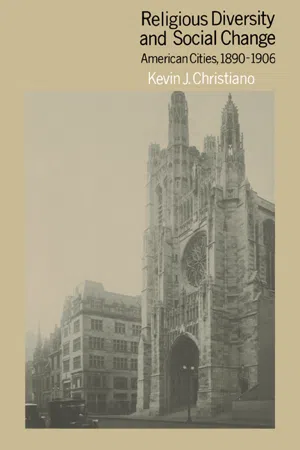 eBook - PDF
Religious Diversity and Social Change
American Cities, 1890–1906
- Kevin J. Christiano(Author)
- 1988(Publication Date)
- Cambridge University Press(Publisher)
1 Attention then turns to the difficult problem of measurement. Discus- sions in this and the first chapter testify to the importance of a recogni- tion of diversity for an adequate comprehension of religion through American history. The entire second chapter in turn was devoted to a lengthy analysis of the validity and utility of the largest single body of historical statistics on American religion. In the present chapter, the insights of theory and the technology of researchfinallybegin to meet, as two different measures of religious diversity in American cities are devel- oped from existing methods and are explained with illustrations from turn-of-the-century data. Historical Meaning of American Religious Diversity "Congress shall make no law respecting an establishment of religion, or prohibiting the free exercise thereof..." So promises the First Amend- ment to the Constitution of the United States, a simple litany of protec- tions for personal expression appended to the body of the main docu- ment in 1791. Simple in form though these provisions may appear, they in fact comprise a complex whole: part acknowledgment of the past and part hope for the future, part necessity and part virtue. They are first and most enduringly law, but they suggest an unreported scrutiny of Ameri- can life as much as they convey a widely spoken faith in it; for the "religion clauses" of the First Amendment required of their authors a "AN INFINITE VARIETY OF RELIGIONS" 51 realistic survey of divisions in the new American society, and joined the understanding so derived with their resolute commitment to its success. By placing these sixteen words at the head of a terse declaration of the liberties to be enjoyed by citizens of the new nation, the founders both tacitly recognized a diversity of religions across the land at the end of the eighteenth century and set up the legal and political grounds for the preservation of that diversity.
- James A Beckford, Jay Demerath, James A Beckford, Jay Demerath(Authors)
- 2007(Publication Date)
- SAGE Publications Ltd(Publisher)
5 Comparative analyses duly refer to Bellah’s work, but they are often confronted with the difficulty of relating the distinguishing features of American civil religion to the variety of more generic forms of religio-political relationships encoun-tered elsewhere (e.g., Regan, 1976; Reynolds, 1977; Cipriani, 1989; Zuo, 1991; Cha, 2000). Researchers can often point to a civil creed, with nationalistic and political significance, that has been given a religious quality through the introduction of specific beliefs, rituals, and public ceremonies, paralleling the situation in the United States. But problems often arise, at least from the vantage point of the largely American paradigm, because the civil religion in question does not exist independently of either the state or a specific dominant religious tradition, or it does not include a belief in God. But the American case is actually rather exceptional. In the face of existing pluralism, conceived both as an emergent social value and as a developing social fact (see Beckford, 2003: 73–4), and motivated by the religious and political advantages of institutionally protect-ing that pluralism, the United States sacralized the values, and the political and legal struc-tures, that afforded this protection. This meant the principle of the separation of church and state became a defining feature of American civil religion. Developing out of different cir-cumstances, from situations where a single religion was dominant or there was cultural warfare between two or more religions, other societies have tended to create civil and politi-cal systems premised on the complete disestab-lishment of religious beliefs and practices, or civil religions designed to assure social order either through the more overt sacralization of a specific political regime, or the de facto nationalization of a specific religious tradition.
Index pages curate the most relevant extracts from our library of academic textbooks. They’ve been created using an in-house natural language model (NLM), each adding context and meaning to key research topics.

