History

Religious Revival
A religious revival refers to a period of renewed interest and enthusiasm for religious beliefs and practices within a particular community or society. These revivals often involve large-scale gatherings, emotional religious experiences, and a heightened sense of spiritual fervor. They can lead to significant social and cultural changes, as well as the revitalization of religious institutions and traditions.
Written by Perlego with AI-assistance
Related key terms
1 of 5


12 Key excerpts on "Religious Revival"
 eBook - ePub
Longing for Revival
From Holy Discontent to Breakthrough Faith
- James Choung, Ryan Pfeiffer(Authors)
- 2020(Publication Date)
- IVP(Publisher)
1 trace back to biblical metaphors for the infusion of spiritual life in Christian experience by the Holy Spirit. Usually they are used synonymously.”So what is revival?The first set of definitions we found is clustered around personal or corporate reinvigoration of our spiritual experience. Charles Finney, a minister and leader in the Second Great Awakening, defined revival as “a renewed conviction2 of sin and repentance, followed by an intense desire to live in obedience to God.” Mid-twentieth-century British pastor Martyn Lloyd-Jones described it as “a period of unusual blessing3 and activity in the life of the Christian Church.”What they all are saying in so many words is this: in revivals, faith becomes “white-hot.”4 And although we liked these definitions as far as they went, we yearned to include more specifics about how revival would be expressed and how it might spill over to those who don’t identify as Christian.Others add more specifics to their definitions. In his book, Revivals: Their Laws and Leaders, James Burns highlights the amount of people involved: “Large numbers of persons5 who have been dead or indifferent to spiritual realities then become intensely awakened to them.” Pastor Tim Keller offered one along the same lines: “A season in which6 a whole body of believers experience gospel renewal together.” Lovelace adds a missional element: “Broad-scale movements7 of the Holy Spirit’s work in renewing spiritual vitality in the church and in fostering its expansion in mission and evangelism.” Author Mark Shaw adds a societal effect to his definition: “Global revivals are charismatic people movements8 that transform their world by translating Christian truth and transferring power.”We liked these additions as well but wanted to see them come together in a single definition. But I’d like to pause here and ask, Whatever misgivings you might have about the word revival No longer available |Learn more
- Charles H. Kraft(Author)
- 2005(Publication Date)
- William Carey Library(Publisher)
We live in a fallen world and the Church is still made up of sinners. Thus it is clear that every movement is disorderly around the edges and sometimes at the center, among its adherents, and even among its leaders. So there will always be criticisms of renewal movements, some justified, others unfair. Thus we want to avoid two unhistorical views. Advocates and participants in movements often fail to be self-critical, ignoring their exaggerations and blind spots. On the other hand, opponents often look only at the imperfections and fail to see the very real accomplishments, refusing to recognize the sovereign grace and power of God working in and through unexpected people and imperfect movements. 438 Appropriate Christianity Now for some definitions. Packer defines revival as a work of God by his Spirit through his word bringing the spiritually dead to living faith in Christ, and renewing the inner life of Christians who have grown slack and sleepy. In revival God makes old things new, giving new power to law and Gospel and new spiritual awareness to those whose hearts and consciences had been blind, hard, and cold (1990:36). Davies proposes the following; A revival is a sovereign outpouring of the Holy Spirit upon a group of Christians resulting in their spiritual reviving and quickening, and issuing in the awakening of spiritual concern to outsiders or formal church members; an immediate or, at other times, a more long-term effect will be efforts to extend the influence of the Kingdom of God both intensively in the society in which the Church is placed, and extensively in the spread of the gospel to more remote parts if the world (1992:15). I suggest four rubrics as a helpful way to understand such movements. The first is renewal , in which an individual or small group seeking a deeper and more authentic life with God receives a profound experience of His power and presence. eBook - ePub
Christianity Remade
The Rise of Indian-Initiated Churches
- Paul Joshua, Joel A. Carpenter(Authors)
- 2022(Publication Date)
- Baylor University Press(Publisher)
Edwin Orr, the prominent revivalist, historian, and theologian of modern revivals, “Christian revival” is “the revitalizing of a body of Christian believers.” 7 It is a specifically Christian phenomenon and, generally speaking, “means the coming of life to something that has already possessed life.” 8 For example, a tree revives when it sprouts leaves in spring after a long winter. While it is an intra-Christian process, Orr emphasizes that revival is not an end in itself, for it necessarily leads to Christian engagement in the wider world, via evangelism and social reform. A positive reception of such activity and a quickening of religious interest among the general population is then called an “awakening,” a “stirring of interest in the Christian faith in the related community of nominal Christians or unbelievers.” 9 Orr also stresses that while revivals rely on human agency, none of these effects are possible without the involvement of the Holy Spirit to quicken people’s sense of God’s presence and convict them of their need to be in right relationship to God. Revival, mission, and awakening, Orr insists, are all authored by the Holy Spirit. 10 Perhaps because this work of the Holy Spirit is erroneously thought of exclusively in terms of one’s personal relationship to God, Orr elucidates the working of the Spirit via human agency to effect significant societal impact. He cited the nineteenth-century European and North American revivals and their commitments to world mission, social reform, and humanitarian concern. 11 While affirming those observations, Bishop Appasamy deepened the theological analysis of revival. First, he emphasized the role of “spiritual pain that often accompanies revival.” He explained that “sinners convicted by the Holy Spirit often suffer agony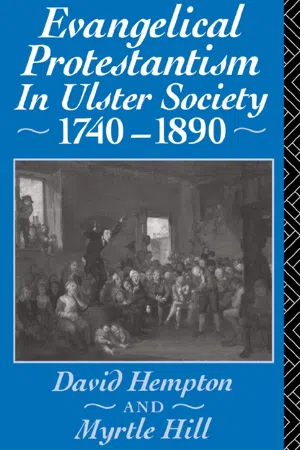
- David Hampton, Myrtle Hull(Authors)
- 2004(Publication Date)
- Routledge(Publisher)
PART FOUR From Religious Revival to provincial identity
 Passage contains an image
[8] Ulster awakened: the 1859 revival
And it shall come to pass in the last days, saith God, I will pour out of my Spirit upon all flesh: and your sons and your daughters shall prophesy, and your young men shall see visions, and your old men shall dream dreams. (Acts 2:17)And the Lord added to the church daily such as should be saved. (Acts 2:47)The phenomenon of Religious Revival, now that it scarcely troubles the Protestant churches of the northern hemisphere, has become an avid subject of inquiry for historians, sociologists and social anthropologists. Such intense study has thankfully improved our understanding of what are bewilderingly complex events. In the past social historians had a tendency to reduce explanations of revival to economic depression, political excitement, or chancy notions of societal modernization. Ecclesiastical historians responded by emphasizing the importance of theology, personal religious experience and the centrality of revivalistic preachers. Such explanations no doubt have their place, but they often fail to describe or interpret the process of Religious Revival in a way that would be recognizable to those who were revived. While admitting that human beings are not often the best judges of what is happening around them, it is surely churlish not to pay some attention to the human emotions, expectancy and experiences of those who engaged in the community rituals of Religious Revivalism. More recent work, by suggesting that Religious Revivals have an internal dynamic of their own, and by paying more attention to the laity and their religious experiences, has shed new light on old problems of explaining outbreaks of dramatic religious enthusiasm.1 In particular, a number of studies of transatlantic revivals have drawn attention to the way in which vibrant community-based rituals, such as the Methodist love-feast and the Presbyterian communion season, have acted as focal points of intense emotion.2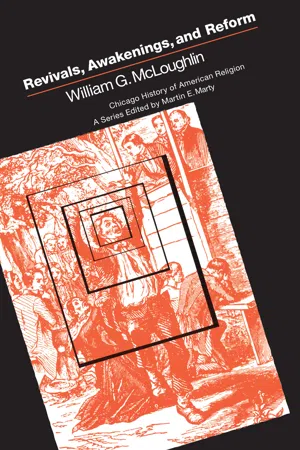 eBook - ePub
- William G. McLoughlin(Author)
- 2013(Publication Date)
- University of Chicago Press(Publisher)
Great awakenings (and the revivals that are part of them) are the results, not of depressions, wars, or epidemics, but of critical disjunctions in our self-understanding. They are not brief outbursts of mass emotionalism by one group or another but profound cultural transformations affecting all Americans and extending over a generation or more. Awakenings begin in periods of cultural distortion and grave personal stress, when we lose faith in the legitimacy of our norms, the viability of our institutions, and the authority of our leaders in church and state. They eventuate in basic restructurings of our institutions and redefinitions of our social goals.Great awakenings are not periods of social neurosis (though they begin in times of cultural confusion). They are times of revitalization. They are therapeutic and cathartic, not pathological. They restore our cultural verve and our self-confidence, helping us to maintain faith in ourselves, our ideals, and our “covenant with God” even while they compel us to reinterpret that covenant in the light of new experience. Through awakenings a nation grows in wisdom, in respect for itself, and into more harmonious relations with other peoples and the physical universe. Without them our social order would cease to be dynamic; our culture would wither, fragment, and dissolve in confusion, as many civilizations have done before.Revivals and awakenings occur in all cultures. They are essentially folk movements, the means by which a people or a nation reshapes its identity, transforms its patterns of thought and action, and sustains a healthy relationship with environmental and social change. To understand the functions of American revivalism and revitalization is to understand the power and meaning of America as a civilization. Until the present generation these periods of cultural readjustment have been associated almost wholly with the Protestant churches. The association of awakenings with revivalism derives from the fact that Protestant ideology has, until recently, been so dominant in our culture that other faiths have not really counted, or have not been counted, in measuring the growth of the nation in it efforts to redeem the world. eBook - PDF
- John Harvey, John Harvey (A)(Authors)
- 2009(Publication Date)
- Reaktion Books(Publisher)
24 The Spirit of Religion During the mid-nineteenth century, the mind sciences searched for a biological basis for apparitions of the supernatural, interpreting the phe-nomena as manifestations of mania rather than materializations of spirit: illusions, delusions and effusions resulting from neurological disorders, intoxication or the imbibing of chemicals. 1 At the same time, new approaches to biblical and theological study sought increasingly to under-stand Christianity’s spiritual aspects according to a naturalistic hypothesis. Higher Criticism – a scientific and rationalistic approach to interpreting biblical texts – questioned the nature of biblical inspiration, revelation and prophecy, traditional ascriptions regarding the authorship and date of manuscripts, the validity of miracles and narratives of miracles, and the divinity of Christ. Its demythologizing tendency made belief in angels, the Devil and evil spirits a matter more of folklore than of faith, turned phantoms into fantasies and, in its most excessive form, repudiated the existence of God, the idea of immortality and the supernatural in general. At a time when many of the traditional Christian churches capitulated in the face of the challenge to these old and established certainties, new Christian movements emerged as a result of the increasing fragmentation of Protestantism and revivalism. The term ‘Religious Revival’ was first widely used by Protestants to describe the spontaneous spiritual rousings that took place in America after the 1720 s – the period known as the Great Awakening. In New England, in 1734 , the Awakening was fostered under the preaching of Jonathan Edwards ( 1703 – 1758 ). Later, in the 1740 s, one Religion George Whitefield ( 1714 – 1770 ) brought the spirit of the Wesleyan revival from old England. eBook - ePub
Islam in Perspective (RLE Politics of Islam)
A Guide to Islamic Society, Politics and Law
- Patrick Bannerman(Author)
- 2013(Publication Date)
- Routledge(Publisher)
It is more helpful to define the revival more generally, as an increased consciousness of and reaffirmation of belief in the values and ethic of Islam in all aspects of life, and a more assertive and active expression of that consciousness and reaffirmation in most parts of the Muslim world. In particular, the re-emergence of Islam as the preferred framework for political and social activism suggests that the process has included a higher profile for the political and social sub-systems defined in Chapter 1. However, this must be qualified in three important ways. In the first place, although Islam has never, as suggested already, been abandoned as a system of belief, there has undoubtedly been a genuine reaffirmation of faith, an individual religious renewal, particularly among the more sophisticated and better-educated sections of society, many of whose members had earlier neglected or even rejected Islam as a political, social, and religious norm — those frequently described as ‘secularists’. As one authority observes: Educated people relaxed their observance of the Ramadhan fast, ate pork, rarely if ever prayed, and rarely entered a mosque. They had largely turned their back on Islam as a dominating force in their life, although remaining steadfast in their self-image as Muslims. As one observer put it, they were cultural Muslims but not pious believers. 7 Second, although it is tempting to seek to identify a unified, transnational leadership and movement, the ferment among Muslims and the current resurgence of Islamic fundamentalism, while widespread, do not appear to be the result of a universal Muslim revival movement, nor do they proceed from a single centre eBook - ePub
The Rise of the Global South
The Decline of Western Christendom and the Rise of Majority World Christianity
- Elijah Jong Fil Kim(Author)
- 2012(Publication Date)
- Wipf and Stock(Publisher)
260 Spiritual versus RationalThe “Protestant crisis” of secularism can be traced back to the 1730s. Concurrently, revival movements were being set in motion and international revival connections were forming even in the midst of religious and social tides of anti-Protestant sentiment. Political upheavals in continental Europe stemming from the expansion of Protestant territories, especially in Catholic countries, caused British and American authorities to pay close attention to several renewal and revival movements. In the early eighteenth century, just before the 1730s, some political positions held by Protestants did return to Catholicism. In one example cited by Crawford, “the Reformed house in the Palatinate had died out and had been succeeded by a Catholic branch.”261 But, on balance, the effects of revivals and awakenings in the transatlantic region were quite remarkable. As a result of the revival, Edwin Err reports, between 1740 and 1800, a momentous church growth took shape among non-conformist churches. Churches went from 27 to an astounding 926 and temporary chapels also sprang up from 506 to 3,491.262The eighteenth century revivals carried widespread ramifications throughout Western Europe. Individuals from all denominations were transformed by personal confession in Christ, commitment to God, and reliance on the Holy Spirit. These experiences motivated overseas missionary work and related efforts to share the gospel so that others might also have the joy of salvation. Those touched by the revival worked to eradicate slavery, reform child labor laws, and fight discrimination against those at the lower end of the social ladder. The expanding revival drew public attention for its spiritual vigor and for the involvement of laypeople. The revivals’ domino effect created a glowing optimism and caused the decline of conventional social authorities, the rigid Anglican hierarchy, and the values of individualism and secularization.263
- Nelson Rollin Burr(Author)
- 2015(Publication Date)
- Princeton University Press(Publisher)
A similar analysis of psychological origins and manifestations, from the viewpoint of modern liberal and social Christianity, is Whitney Rogers Cross, The Burned-Over District, the Social and Intellectual History of Enthusiastic Religion in Western New York, 1800-1850 (Ithaca, N.Y., 19JO), with bibliographical footnotes. He relates the emotional psychol- ogy of revivalism to economic, social, and political en- vironment, and to reform movements. An analysis of re- vivals and conversion by George Godwin, in The Great Revivalists . . . (Boston, 1950), with brief bibliography, de- fines revivalism as mobilization of emotions, with the preacher moved by inner conflict, the convert by the quest for personal and social integration. 15. REVIVALIST BIOGRAPHY. American Protestant revival- ists have always spoken an intensely personal message. The evangelist has been considered (and often has considered himself) as a special agent of the Holy Spirit, sent at a par- ticular time to arouse a renewed sense of redemptive mission in the world. Periods of revival usually have borne the stamp of peculiar personalities. The personal element and its rela- tion to the development of revivalism, as traced in previous sections, requires a selected bibliography of biographical sources. Biographical and autobiographical study kept pace with upsurges of revival, and during the Second Great Awakening became a popular literary form. Among the more important and typical examples of that era may be mentioned the fol- lowing titles: Gardiner Spring, Memoirs of the Rev. Samuel J. Mills, Late Missionary to the South Western Section of the United States . . . (New York, 1820)5 WilHam B. E V O L U T I O N O F A M E R I C A N R E L I G I O N Sprague, Memoir of the Rev. Edward D. Griffin, D.D., Comfiled Chiefly from His own Writings (Albany, 1838, New York, 1839)} Bennet Tyler, Memoir of the Life and Character of the Rev. Asahel Nettleton (Hartford, 1844); Cyrus Yale, Life of the Rev. eBook - PDF
Sociology of Religion
A Rodney Stark Reader
- Rodney Stark, Dedong Wei, Zhifeng Zhong(Authors)
- 2015(Publication Date)
- Baylor University Press(Publisher)
And, to the extent that religious innovation or dissent is possible, such faiths ought to thrive as a result of the secularization of the dominant religious organizations. This reaction against secularization is likely to take two primary forms: revival and innovation. Revival In response to an unmet demand for more efficacious compensators, move-ments will arise to restore the potency of the conventional religious tradi-tions. This pattern is typified by the vigor of evangelical Protestantism and the growth of the Catholic charismatic movement in contemporary America. 155 SECULARIZATION, REVIVAL, AND CULT FORMATION / The tactic involved is simply to reassert the validity of the general compen-sators of traditional faith because these have not been (and cannot be) inval-idated by scientific discovery. However, such a reassertion raises the problems that led to the extreme secularization of the major denominations in the first place. Many elements of the Christian-Judaic tradition have, in fact, been disconfirmed by science. Not merely lightning, but the literal interpretation of creation and of the flood, indeed, the underlying astronomical and geological assumptions of the Bible clearly are discrepant with secular knowledge: the sun does not go around the earth and it seems incredible that it ever was stationary in the sky, no matter what God wanted to signal to his people. Thus, the trouble with revival is that it is heir to a whole cultural history, and this history is replete with defeats of doctrine by science. Moreover, as soon as this problem is dealt with by picking and choosing those parts of the tradition that remain invul-nerable to disproof, secularization has been reintroduced as legitimate— science will dictate what doctrines can be accepted. Thus, revival seems to be chronically vulnerable to secularization and to lack long-term staying power, especially if there is an alternative. Such alternatives are created by the rise of new religious traditions.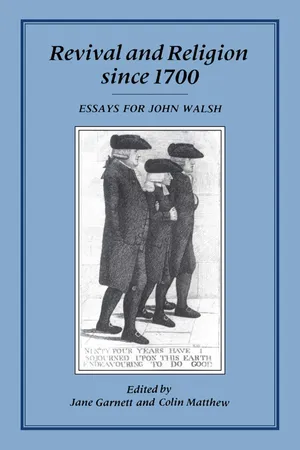 eBook - PDF
Revival and Religion Since 1700
Essays for John Walsh
- J. Garnett(Author)
- 1993(Publication Date)
- Hambledon Continuum(Publisher)
8 Religious Revival and Political Renewal in Antebellum America Richard Carwardine During the early decades of the nineteenth century the young American republic underwent a dramatic transformation. National boundaries expanded. The population burgeoned and spread. Steamboats, turnpike roads, canals and (eventually) railroads altered economic aspirations and relationships, and community horizons. Americans and their European visitors observed the emergence of a modern market economy and the beginnings of an industrial order. They saw a republican, egalitarian code of manners eroding eighteenth-century patterns of deference and patronage. No changes were more portentous than the development of uniquely American forms of religion and of politics. Evangelical Protestant churches, defensive through the Revolutionary era and its immediate aftermath, sufficiently recovered their confidence during the so-called 'Second Great Awakening' to establish themselves as the republic's primary religious force. Lacking formal state support in fashioning a Christian society, evangelicals turned with formidable vigour to church-building and soul-saving, reshaping their theology and methods in the process. Charles Grandison Finney and other 'new measure' revivalists challenged traditional Calvinist doctrines of election and moral inability, emphasising instead sinners' free will and ability actively to seek their own salvation. Methodist revivalists, preaching a democratic Arminianism, the most potent doctrinal force of the Awakening, proffered an even more emphatic theology of human equality and opportunity, and helped make Methodism the largest denominational family in the country by 1830. eBook - PDF
Expanding Religion
Religious Revival in Post-Communist Central and Eastern Europe
- Miklós Tomka(Author)
- 2011(Publication Date)
- De Gruyter(Publisher)
3. Revival? Crisis? Metamorphosis? Versions of religious Ė ange What is happening to religion? Is it ge Ĵ ing stronger? Weaker? Is it changing? On what grounds can we make any such statements in the ę rst place? And do our statements refer to the religiosity of people or to the strength and role of the Church? As indicated by the expression of a French sociologist, the Church is “a world of its own” (Poulat 1986). The Church needs to be examined in its many facets if we want to obtain a complete picture of it. Many people regard belief in a supernatural reality as the essence of religion and religiosity. Public opinion, on the other hand, tends to judge the extent of religiosity based on the number of churchgoers. Along with ideology and religious practice, there are other expressions of religiosity as well. In the past decades, the spread of emotional religiosity and the new religious communities that practice it in their worship have received considerable a Ĵ ention worldwide. Faith, religious practice and religious experience are equally de ę ning dimensions of religious life. In all three areas, there are objective facts by which it is possible to measure the extent of religiosity – at least in that respect. In everyday life, however, we do not concern ourselves with the complex nature of religiosity. We do not follow exact criteria. We call someone more or less religious or even non-religious based on a spontaneous summary of the information available to us. Should the occasion arise, we also label ourselves as one of these types. Even in the case of self-characterisation, is not clear which factors we take into account. We do not take time to consider what the component parts of the quali ę cation are. To label ourselves as religious or non-religious is not only an ideological statement but also a way in which we place ourselves in a network of social relations.
Index pages curate the most relevant extracts from our library of academic textbooks. They’ve been created using an in-house natural language model (NLM), each adding context and meaning to key research topics.

