History

Sinicization
Sinicization refers to the process by which non-Chinese societies adopt Chinese cultural, political, and social norms. This term is often used to describe the spread of Chinese influence and culture to neighboring regions and peoples. Sinicization has historically played a significant role in shaping the cultural landscape of East Asia.
Written by Perlego with AI-assistance
Related key terms
1 of 5

11 Key excerpts on "Sinicization"
 eBook - ePub
Sinicization and the Rise of China
Civilizational Processes Beyond East and West
- Peter J. Katzenstein(Author)
- 2013(Publication Date)
- Routledge(Publisher)
Chapter 6 , Chih-yu Shih examines the work of four world-class diasporic scholars (Akira Iriye, Samuel Kim, Chung Tan, and John Wong) writing outside of China and, for the most part, for English-speaking audiences. Their cultural and linguistic skills and varied life stories speak to their multiple, cultural–geographical selves. Their work illustrates both a liminal position between East and West as well as China and Asia, and meaningful choices that are shaped, though not determined, by different contexts. In Shih’s analysis, Sinicization is a set of multidirectional, multi-sited, discursive processes. Sinicization presupposes agents who appropriate and reappropriate Chinese symbols and practices for their own use and that of interested groups. Their transnational lives and work put into question an exclusive focus on territorially bounded nation states as the only unit of analysis in China’s rise. Shih inquires into how these four scholars have coped with their specific situations, and how their lives were adapted to different circumstances. The interaction between an imagined China and Asian diaspora extends well beyond China and its surrounding territories. Crucial for processes of Sinicization are scholars acting as cultural brokers who mediate between China and the world. Sinicization captures processes of self-discovery and self-interpretation that reconstruct China in various imaginations and languages to a broader world.At an individual level, rethinking and adaptation prompted by the encountering of ever changing life conditions are the cultural mechanisms that contribute to civilizational evolution. Shih examines these processes in the lives of his four scholars, whose professional lives centered on thinking deeply about China, in English as well as in their native languages, and for professional communities outside of China as well as Chinese audiences. Expressed in their writings and speeches, scholarly acts of imagination and conceptualization thus are components of Sinicization. It helps the effort to identify with China and to build bridges between different academic and national communities. In Shih’s analysis, China is a temporal rather than a spatial concept. The meaning of engaging China depends on the time and site of these four scholars’ lives and work rather than on what a tangible China is or does. A meaningful China lives in the scholarly imagination more than in its material manifestations. And there exists no central force or agency that in the name of China can harness or determine how these scholars represent China.Caroline Hau’s analysis of processes of hybridized Sinicization in Chapter 7 eBook - PDF
- J. Makeham, A. Hsiau, J. Makeham, A. Hsiau(Authors)
- 2005(Publication Date)
- Palgrave Macmillan(Publisher)
The proposal was passed swiftly with almost no objection. Despite this trend, the so-called Taiwanization movement has not replaced the Sinicization movement in the social sciences. Today people prefer the term indigenization to either Taiwanization or Sinicization. This is largely because the “Taiwan versus China” oppo- sition and its political connotations are viewed as politically con- frontational, and a threat to the free flow of ideas and scholarly exchange across political boundaries. Moreover, although locally the historical and cultural ties between Taiwan and China might be disre- garded for the purposes of self-assertion of Taiwanese consciousness, this goal would be more difficult to achieve in the transnational and global communities of the social sciences in which many non-Chinese, non-Taiwanese, and critical-minded scholars of diverse national back- grounds, participate in the same field of knowledge production. In reality, there are many Western institutions for China Studies in many disciplines which follow their own geopolitical interests and institu- tional logic, and which still hold on to the idea that places Taiwan Studies as a special part of, or a minor variation of, China Studies. 70 The influences of overseas institutions has been much greater in the 1990s than in the 1970s because of increasing scholarly exchange across boundaries, partially due to the invention of new communica- tion technologies and the increasing number of multilingual and transnational scholars. Three Indigenization Models Beginning from the mid-1990s, the dominant cultural and political discourse in Taiwan has moved toward embracing globalization 244 Maukuei Chang and strengthening competitiveness in the global “market.” The early Sinicization movement has already lost its appeal and dissipated into many strands. eBook - PDF
- Charles Holcombe(Author)
- 2001(Publication Date)
- University of Hawaii Press(Publisher)
One of America’s leading Korea experts, Bruce Cumings, pro-tests that “Korea was never ‘Sinicized.’ . . . The real story is indigenous Korea and the unstinting Koreanization of foreign influence, not vice versa.” He is, of course, correct (although his point is reminiscent of the old quibble about whether a glass of water is half full or half empty). David Pollack makes a similar case for Japan. Instead of pas-sively being “influenced” by China, the Japanese actively engaged in “selecting foreign cultural elements and synthesizing them into the native culture.” However, as Pollack also observes at an even higher 222 the genesis of east asia level of sophistication, “what we can perceive as a ‘native’ process is itself . . . already the product of countless earlier syntheses.” 18 Neither Korea nor Japan was simply Chinese-ized, nor is it, con-versely, sufficient to say that a handful of Chinese motifs, more mod-estly, were selected for Korean-ization or Japan-ization. Instead, Korea and Japan (and China too) are the end products (actually, still unfin-ished works in progress) rather than the starting points of the process. In the beginning, there was no Korea or Japan—nor even a China, either. At the risk of much oversimplification, we might say that Sini-fication, along the lines of the early Central Plain Chinese states and the later empire, was the force that gradually shaped the various emerging civilizations of East Asia out of what had once been a mo-saic of Stone Age tribes. Their final differences are, in part, the very product of their sustained interaction. The use of terminology such as “Sinification” or the “Confu-cianization of Korea,” it must be confessed, does imply a relatively one-sided process of interaction. There was a gross disparity in size (and degree of antiquity) between China and Korea, as the Korean diplomatic expression sadae (serving the great) makes painfully clear. eBook - PDF
Sociology and Anthropology in twentieth-Century China 中國社會學與人類學
Between Universalism and Indigenism
- DIRLIK, Arif; LI, Guannan and YEN, Hsiao-pei(Authors)
- 2012(Publication Date)
- The Chinese University of Hong Kong(Publisher)
It was one of the few books that was not only seriously influential in academia but also became a popular best seller. The guiding principles that moti-vated the book, as articulated in the introduction, were probably more ambitious than the essays themselves, judging by their content. As was clearly acknowledged at the outset, modern social scientific knowledge derived largely from the West and was to a large extent predicated also on its relevance to the study of the modern West. As most social scientists in Taiwan were also professionally either trained in the West or educated in those academic traditions, they recognized in turn that many of these Western theories and methods were ill-suited to the study of Chinese society. This crisis then became the point of departure for critical reflec-tion of their intrinsic Westernization and the need to develop their own models for the study of their own society. Sinicization in this sense can be seen as “postcolonial” in intent, insofar as it was predicated on the “Western” nature of social theory rather than its presumed scientific objectivity. By rallying native “Chinese” scholars to this cause, it also suggested that such Sinicization was best promoted by native scholars and not inherently relevant to Western social scientists studying China. Finally, if some form of native theory was the ultimate goal of siniciza-tion, it is clear that this resulted less from a spirit of primordial nativism than a recognition that a sinicized social science was still embedded a priori in a general (worldly) social scientific tradition. If anything, one can contrast the sinicizing impulse here, as a discursive formation, with 270 · Allen Chun its absence in traditional fields of sinology, such as Chinese literature and history, which seem immune to the need to rely on theories of any kind.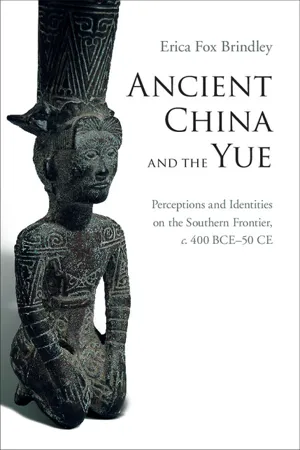 eBook - PDF
Ancient China and the Yue
Perceptions and Identities on the Southern Frontier, c.400 BCE–50 CE
- Erica Fox Brindley(Author)
- 2015(Publication Date)
- Cambridge University Press(Publisher)
21 One aspect of FitzGerald’s narrative, which helps explain his account of Chinese seepage into the frontiers, involves the initial transformation of culture by local elites. FitzGerald hypothesizes about the linguistic “sini- cization” of a region and infers from such a model a larger pattern of cultural change on the whole: 19 See especially the language of Sinicization used on pp. 159–161, 194, and otherwise throughout Wiens, China’s March Toward the Tropics. 20 FitzGerald, The Southern Expansion. 21 Ibid., p. xxi. Introduction: concepts and frameworks 15 The local language borrows from Chinese many terms which it did not use before, adds many new words for new artifacts and for ideas which it has now to express. Gradually it becomes a quasi-Chinese dialect, pronounced in a fashion almost unintelligible to Han Chinese, but none the less [sic] strongly marked by Chinese linguistic influence. It is not written, only spoken. As the wealthier members of the community begin to seek education, they turn to Chinese literature as the sole medium of expression open to them. They become bilingual, and later, perhaps, abandon the native language altogether. Those who have reached this stage are considered to be “Chinese.” In this sense many millions of southern Chinese are the descendants of peoples who were once quite alien both in speech and custom. 22 This fascinating passage reveals a few key claims about the alleged mechanics of Sinicization along the southern frontier. First, wealthier, intellectual natives wished to embrace Chinese language by borrowing previously unknown terms. eBook - ePub
Handbook of Asian Education
A Cultural Perspective
- Yong Zhao, Jing Lei, Guofang Li, Ming Fang He, Kaori Okano, Nagwa Megahed, David Gamage, Hema Ramanathan, Yong Zhao, Jing Lei, Guofang Li, Ming Fang He, Kaori Okano, Nagwa Megahed, David Gamage, Hema Ramanathan(Authors)
- 2010(Publication Date)
- Routledge(Publisher)
Part I Sinic Education Passage contains an image
1 A Cultural Overview of Education in Sinic Civilization
Guofang Li and Ming Fang He
Introduction
The Sinic civilization, or Confucian civilization, refers to the shared and related cultures of China and the Chinese communities in Southeast Asia, which includes China, Hong Kong, Taiwan, Singapore, Korea, and Vietnam. It also includes the Chinese diaspora, especially in relation to Southeast Asia. In the last few decades, education within Sinic civilization has experienced rapid changes. These changes have engendered some of the most vital, exciting, and revitalizing developments in education in these countries, in the midst of modernization, diversification, and globalization. This development is characterized by a dramatic resurgence of educational reforms, heated debates over educational practices, and ongoing struggles over highly contested educational policies in Sinic societies. This educational development in Sinic civilization is inextricably linked with the processes and impact of diversification of the world landscape which, in turn, further complicates the diversification of cultures, languages, communications, economies, ecological systems, and ways of lives in the East, in the West, and in-between. This diversity and complexity, though creating vitality, excitement, revitalization, and renewal in the field of education, has emerged as one of the most urgent challenges facing twenty-first century educational workers—learners, teachers, educators, parents, community workers, administrators, and policy-makers. Influenced by Confucian ethics, educational workers in Sinic societies have attempted to address diversity and complexity in their educational landscapes by searching for more holistic and eclectic approaches to educational reforms and practices. These efforts are of great significance to our understanding of the educational development in these societies and beyond in the era of diversification and globalization.
Passage contains an image
1 A Cultural Overview of Education in Sinic Civilization
Guofang Li and Ming Fang He
Introduction
The Sinic civilization, or Confucian civilization, refers to the shared and related cultures of China and the Chinese communities in Southeast Asia, which includes China, Hong Kong, Taiwan, Singapore, Korea, and Vietnam. It also includes the Chinese diaspora, especially in relation to Southeast Asia. In the last few decades, education within Sinic civilization has experienced rapid changes. These changes have engendered some of the most vital, exciting, and revitalizing developments in education in these countries, in the midst of modernization, diversification, and globalization. This development is characterized by a dramatic resurgence of educational reforms, heated debates over educational practices, and ongoing struggles over highly contested educational policies in Sinic societies. This educational development in Sinic civilization is inextricably linked with the processes and impact of diversification of the world landscape which, in turn, further complicates the diversification of cultures, languages, communications, economies, ecological systems, and ways of lives in the East, in the West, and in-between. This diversity and complexity, though creating vitality, excitement, revitalization, and renewal in the field of education, has emerged as one of the most urgent challenges facing twenty-first century educational workers—learners, teachers, educators, parents, community workers, administrators, and policy-makers. Influenced by Confucian ethics, educational workers in Sinic societies have attempted to address diversity and complexity in their educational landscapes by searching for more holistic and eclectic approaches to educational reforms and practices. These efforts are of great significance to our understanding of the educational development in these societies and beyond in the era of diversification and globalization. eBook - PDF
- Victor H. Mair, Liam Kelley(Authors)
- 2015(Publication Date)
- ISEAS Publishing(Publisher)
43 3 Sinicization AND BARBARIZATION Ancient State Formation at the Southern Edge of Sinitic Civilization Nam C. Kim Introduction Past researchers have traditionally viewed ancient Southeast Asia as having been influenced by a virtually unidirectional flow of culture and civilization. Prior to the mid-1960s, many researchers explained the development of large-scale, complex societies (e.g., kingdoms and states) in Southeast Asia by pointing to influence from the more “advanced” civilizations of ancient India and China, citing the transmission of advanced technology and political models by diffusion, migration, or simple military and cultural imposition. 1 Traditional perspectives from the early twentieth century viewed Southeast Asian societies as derivatives of Indian and Chinese counterparts. Intensified archaeological research efforts in recent decades throughout much of the region, however, have increasingly shown these sorts of positions to be untenable, demonstrating a model of unidirectional influence to be overly simplistic. To be sure, communities all over Southeast Asia were in either direct or indirect contact with one another and counterparts in India and China. But the 44 Nam C. Kim countries of “China”, “India”, and Vietnam of today did not exist at 2000 BP, and the wider region was home to a kaleidoscope of societies. Modes of interaction and resultant social changes were complex, multilateral, and multidirectional. Societies were engaged in significant forms of interaction that included extensive long-distance trade, the movement of peoples and ideas, and cycles of peaceful relations and warfare. This situation of complex interactions is evident throughout much of Southeast Asia, and the area of modern-day northern Vietnam is no exception. No longer available |Learn more
- Cheng-tian Kuo(Author)
- 2017(Publication Date)
- Amsterdam University Press(Publisher)
In the Ming and Qing dynasties, the court and of f ic ials referred to the ideal of a ‘Confucian civilizing mission’ in order to justify the violence of the colonization of the southern and southwestern regions for a Confucian audience. The real cause for the mission, – the acquisition of land and settlement areas at the expense of non-Chinese people – was downplayed. Against the background of the Chinese nation-building project, the ideal of a national and cultural superiority of the Chinese people was understood to inform a duty to guide others towards this superiority and thus include them in the nation-state. It was put forward to equally justify the military and political violence needed for this ‘nationizing project’ and to conceal the real cause for it, which was the strong belief in power politics based on the size of a state and its unity. As described, seemingly dif ferent discourses and approaches resemble each other and are linked to each other over time and space. In the Chinese discourses, the late imperial idea of ‘nationizing’ is closely linked to the Ming and early Qing approaches of ‘Confucian civilizing’. ‘Confucian civiliz-ing’ and its link to the conquest and colonization of non-Chinese regions, on the other hand, resembles European Christian missions in European-dominated colonies on other continents, especially South Asia, Africa, and South and Central America. All attempts to integrate the other through a change of identity with regard to ethics, morals, and other markers of the self within the framework of Christian missionizing, ‘Confucian civilizing,’ or Chinese nationizing are linked by a general assumption of the superiority of the self, versus the inferiority of the other, an understanding which seems to be a universal link between discourses on identity and integration. 64 Zarrow (2005, pp. 137-140). 114 JULIA C. SCHNEIDER Bibliography Anderson, Benedict. 2006. Imagined Communities: Reflections on the Origin and Spread of Nationalism . eBook - PDF
- Tan Ta Sen(Author)
- 2009(Publication Date)
- ISEAS Publishing(Publisher)
96 96 T an T a Sen 5 THE Sinicization OF ISLAM IN CHINA The dynastic change from the Yuan dynasty to the Ming dynasty in 1368 had a lasting impact on Islam and the Muslims in China. The Muslim ethnic groups crossed over to uncharted territories and their future was full of uncertainties. On the one hand, it signified the end of the golden age of Islam as they had lost the political patronage of the Mongol emperors and all the privileges attached to it. On the other hand, the founding Ming emperor Zhu Yuanzhang reinstated Han Chinese rule and the Chinese concept of world order. Within China, the vision and mission set by the Ming emperors demanded Chinese influence in all aspects of life among the Han Chinese and all minority groups such as the Hui Muslims. In other words, the Ming emperors set to Sinicize all non-Chinese ethnic groups within China. Why was the Sinicization policy conceived? How was it implemented? How did the Hui Muslims react to such a Sinicization move? How did they redefine their faith and position in the Chinese empire and Chinese society? These are some of the key questions this chapter will try to answer. In short, this chapter will explore the conception of the assimilation policy, the Sinicization process and the response of the Hui Muslims. THE FOUNDING OF THE MING DYNASTY AND ITS Sinicization POLICY In the beginning of the 1300s, the Yuan Dynasty began to face financial crisis caused by over-spending on the building of a majestic palace in Dadu 96 05 ChengHo Ch 5_Ch 5/28/09, 10:04 AM 96 97 The Sinicization of Islam in China 97 (Beijing), construction of Buddhist monasteries, and incurring large military expenditures. The treasury was virtually empty. The flooding of the Yellow River in the 1340s and 1350s which caused severe famine was the last straw that led to the fall of the Yuan dynasty. In 1351, the Yuan government conscripted thousands of men to work on rerouting the Yellow River and dredging the Grand Canal. eBook - PDF
Red Racisms
Racism in Communist and Post-Communist Contexts
- I. Law(Author)
- 2016(Publication Date)
- Palgrave Macmillan(Publisher)
Racial Sinicisation 119 which can be differentiated from that in other contexts and which involves domination through assimilation and sinicisation. Following the invasion, government by a Tibetan aristocracy was replaced by a Chinese communist-led administration, and working people were freed from their obligations to private landlords and the monastic system. Tibetan people were seen by the PRC to have ‘languished in abysmal darkness, poverty and backwardness’ and who ‘eagerly hope to free themselves from the darkest feudal serfdom in the world’ (PRC 1959). As Heath (2005) confirms, the Chinese forces wanted to secure politi- cal and military control without having to fight more than necessary and were not intent on genocide or the establishment of a ‘colonial’ system. Modern colonialism involves the establishment of a number of key elements, including an explicit racial hierarchy, exploitation of natural resources and labour, enrichment of metropolitan and colonis- ing elites subduing overseas lands, practising exclusionary authoritar- ianism, depleting and impoverishing native populations and cultural destruction (Sautman 2006). Sautman drawing on this definition and applying it to Tibet argues that this has not happened, as there is no ‘prejudice inscribed in the law or officially endorsed’, that there is no ‘exclusionary rule’ as half the Tibet region’s committee and prefecture party secretaries are Tibetan. This is contradicted by many testimonies and submissions on the official endorsement of a multi- tude of forms of officially endorsed racial discrimination (TCHRD 2000, TGIE 2001) and the power of Chinese control exerted on Tibetan repre- sentatives and officials throughout the TAR political structure. eBook - PDF
China Into Its Second Rise: Myths, Puzzles, Paradoxes, And Challenge To Theory
Myths, Puzzles, Paradoxes, and Challenge to Theory
- James Chieh Hsiung(Author)
- 2012(Publication Date)
- World Scientific(Publisher)
15 chapter 2 “Confucianization” of China, Rise of the Keju System, and the Aftermath 2.1. Confucianization: Definition and Overview “Confucianization” is a term I use to depict (a) the adoption, under official auspices (beginning 136 B.C.), of the school of thought iden-tified with the master sage 1 Confucius, to be the “national learning” for the whole of China; and (b) the enduring effects and conse-quences. It is synonymous, but not coterminous, with “Confucian transformation” of China, because the latter does not convey fully the impact of the official adoption of Confucianism. Besides, Confucius himself did not bring about the transformation, rather it was the result of the Chinese state’s adoption of his teachings. “National learning” ( ) is a cryptic Chinese term that defies precise defini-tion in English. In its general usage, the term conveys a wide range of meanings, including a body of first principles and postulated values and virtues; a state belief system; a set of behavioral norms (known as li , ) binding on all, from rulers to the ruled; a moral code governing social bonds and hierarchy; and a philosophy of life, imparting a sense of mission and holding up the standards and the goals to aspire to. To reiterate, a distinct function that Confucianism played in Chinese history, as noted in Chapter 1, was that of a cultural unifier, drawing together all segments of society within the reach of the Chinese imperial authority. While not a religion, Confucianism was 1 A sage, to the Chinese, is like a prophet in other cultures. 16 China into Its Second Rise embraced religiously by the Chinese elite and ordinary people alike, in all dynasties thereafter. And its influence on Chinese society was as extensive and far-reaching as the Christian Bible in the West over the ages.
Index pages curate the most relevant extracts from our library of academic textbooks. They’ve been created using an in-house natural language model (NLM), each adding context and meaning to key research topics.

