History

Buddhism in China
Buddhism in China refers to the spread and adaptation of Buddhism in Chinese society, beginning in the early centuries of the Common Era. It integrated with traditional Chinese beliefs and practices, leading to the development of distinctive Chinese Buddhist schools and art forms. Buddhism played a significant role in shaping Chinese culture, philosophy, and religious practices.
Written by Perlego with AI-assistance
Related key terms
1 of 5
12 Key excerpts on "Buddhism in China"
 eBook - ePub
- Antonio S. Cua(Author)
- 2013(Publication Date)
- Routledge(Publisher)
Buddhism in China: A Historical SurveyWhalen LAIBuddhism occupies a central place in the history of Chinese thought, as the system that attracted some of the best minds in the millennium between the Han and the Song (second to twelfth centuries). However, integrating Buddhist thought into Chinese philosophy poses some problems, because Buddhists worked from a different set of texts and spoke what seems to be a different language. Christianity began as a hellenized biblical faith whose theology combined theos and logos from the start; by contrast, long before Buddhism found its way into China there was an extensive history of reflection by Indians on the Buddhist dharma —so that Chinese Buddhists had to think through an inherited tradition before they could embark on their own Sinitic reading. As a result, much of the convoluted scholastic detail in Buddhism remains alien to most Chinese. The fact that the neo-Confucian Zhuxi (1130–1200) openly advised his students against debating with Buddhists (lest they be seduced into the Buddhists’ mind-boggling dialectics and thus defeated) also means that there was a calculated break between the two traditions. To this day, Chinese Buddhism remains isolated and is often left to Buddhologists. Also, because of the way the field has developed, Chinese Buddhism is often treated as an interim in a pan-Asian development beginning in India and ending in Japan. Integrating Chinese Buddhist thought into the history of Chinese philosophy did not begin until Fung Yu-lan. It is a formidable challenge to attempt integration while fully recognizing the emerging findings of Buddhologists.Certain paradigms describing the overall cultural interaction are still in use. People still speak of initial Indianization and subsequent Sinicization; of Buddhist conquest and Chinese transformation; of Indians as proverbially otherworldly and Chinese as, by inclination, down-to-earth. Under scrutiny, such generalizations often seem simplistic; but at some macrocosmic level they remain useful heuristic devices, and for certain ends they can even lend overall clarity. The same can be said of several periodization schemes. They all depict a rise, growth, and decline of Buddhism—that is, looking at it from the outside. For adherents of the faith, and for others who still perceive its vitality, the story is one of seeding, flowering, and continual tension or consolidation. The present overview will minimize historic and political details in order to suggest larger sociocultural implications. It will focus on the major developments and their contributions to a history of Chinese ideas and ideals. eBook - ePub
Chinese Buddhism in Catholic Philippines
Syncretism as Identity
- Ari C. Dy(Author)
- 2017(Publication Date)
- Anvil Publishing, Inc.(Publisher)
CHAPTER 3 Buddhism as a Chinese ReligionThe Chineseness of Chinese BuddhismBuddhism originated in India, and yet after ten centuries in China it had acquired a form that was unmistakably Chinese. Texts were translated, and in this very act, sinification or the process of “turning Chinese,” was at work as teams of translators struggled to express Buddhist ideas by using Chinese words or creating new ones (Zürcher 1989, 140, 146; Sharf 2002a, 5, 20; Sen 2003, 134). There was no canon of scripture that was transmitted from India, so even the selection of texts to be translated was an act that determined the mode of Buddhism that would be transmitted. There was no governing authority, so the process by which the Buddhism of India was propagated in China was very fluid. The India and China of the time were not static realities. Both were in a constant state of flux and it was in this kind of environment that Buddhism established itself in China. As Stephen Teiser says in his overview of Buddhism in China, “Native and foreign (or the various words authors used for Chinese and Indian ) were continually redefined in relation to each other; they were rhetorical claims rather than fixed identities” (Teiser 2005, 1160).The development of Buddhism in China is generally classified into four stages: the initial encounter of the first three centuries of the Common Era, the period of “domestication” or “formation” from the 4th to the 6th centuries when Indian texts were being translated into Chinese, the phase of independent growth from the 7th to the 10th centuries when distinct Chinese elaborations of Buddhism began to appear, and the period from the 10th century onward when Buddhism became a religion of the masses into the modern period.1Viewed as the gradual sinification of Buddhism, the growth of Buddhism in China can also be understood in terms of Chinese Buddhism’s relationship with India. Until the 10th century, there was sustained albeit scarce interaction between Indian and Chinese monks traveling in both directions, doing translation work and elaborating the teachings. But after the 10th century, Chinese Buddhism attained a maturity that made it unnecessary to depend any further on India for its growth. For a time, the link to India remained important, but eventually, Chinese Buddhism became independent (Sen 2003, 102–142). eBook - ePub
- Litian Fang(Author)
- 2018(Publication Date)
- Routledge(Publisher)
Buddhism’s introduction into China and its change and developmentSince Buddhism was introduced from India, after gradually adapting, it was slowly spread, and tended to flourish in the Sixteen Kingdoms and the Eastern Jin Dynasty. There were many factions in the Southern and Northern Dynasties, and eight sects formed during the Sui and Tang Dynasties, after Buddhism entered its peak stage. Extreme prosperity foreboded the beginning of its decline. Later, Buddhism gradually declined in the Han Dynasty, but Tibetan Buddhism, an important sect of Chinese Buddhism, emerged in Tibet, continuing to spread.In the long-term spread, evolution, and development of Buddhism, with the support and constraint of feudal state power, Chinese Buddhist scholars and the broad masses of monks engaged in religious theoretical activities, such as classics translation, classics annotation, classics interpretation and creation of the theory system, and religious practice, such as building temples and statues and engaging in meditation and practice, which made Buddhism increasingly adapted to the characteristics of the Han nationality and other ethnic minorities; Buddhism gradually become Chinese-style Buddhism. Over 2,000 years, Buddhism has not only expanded the breadth and depth of Chinese intellectual circles but also enriched Chinese people’s cultural life and religious life, and brought complex social impacts and multiple social consequences.The beginning of the introduction of Buddhism into China
There were two routes for Indian Buddhism to be introduced into the mainland of China: one was the land route to the Xinjiang region in China via Central Asia, and then deep into the mainland; the other was the sea route to Guangzhou via Sri Lanka, Java, the Malay Peninsula, and Vietnam – namely, being introduced into Chinese mainland via the route of the South China Sea. Since Emperor Wu of Han operated the Western Regions, the land route had become the thoroughfare for east-west traffic, where commercial trade and envoy exchange were very frequent. This land route included northern and southern routes. The southern route was from Dunhuang, across the desert, to Khotan via Shanshan, south of the Taklamakan Desert and north of the Kunlun Mountains, and then to Da Shashi in the northwest. The northern route was from Dunhuang (now Hami) and then Kucha (now Kuqa) via Turpan, and then to Shule (now Kashi City). In the Eastern Han Dynasty, An Shigao and Lokaksema came to the mainland of China via these two routes. Most of the Indian monks coming to China arrived in the mainland via these two routes, and seldom took the sea route, which may be because the sea route was developed later than the land route. According to historic record, in the Southern and Northern Dynasties, there were famous classics translation masters coming to China to spread Buddhism by sea. eBook - ePub
- Britannica Educational Publishing, Kathleen Kuiper(Authors)
- 2010(Publication Date)
- Britannica Educational Publishing(Publisher)
Buddhism flourished in parts of Central Asia until the 11th century, particularly under the patronage of the Uighur Turks. But with the successful incursions of Islam (beginning in the 7th century CE) and the decline of the Tang dynasty (618–907) in China, Central Asia ceased to be the important crossroads of Indian and Chinese trade and culture that it once had been. Buddhism in the area gradually became a thing of the past.CHINA
Although there are reports of Buddhists in China as early as the 3rd century BCE, Buddhism was not actively propagated there until the early centuries of the Common Era. According to tradition, Buddhism was introduced into China after the Han emperor Mingdi (reigned 57/58–75/76 CE) dreamed of a flying golden deity in what was interpreted as a vision of the Buddha. The emperor dispatched emissaries to India who returned to China with the Sutra in Forty-two Sections , which was deposited in a temple outside the capital of Louyang. However this may be, Buddhism most likely entered China gradually, first primarily through Central Asia and later by way of the trade routes around and through Southeast Asia.THE EARLY CENTURIESBuddhism in China during the Han dynasty was deeply coloured with magical practices, which made it compatible with popular Chinese Daoism, an integral component of contemporary folk religion. Instead of the doctrine of no-self, early Chinese Buddhists seem to have taught the indestructibility of the soul. Nirvana became a kind of immortality. They also taught the theory of karma, the values of charity and compassion, and the need to suppress the passions. Until the end of the Han dynasty, there was a virtual symbiosis between Daoism and Buddhism, and both religions advocated similar ascetic practices as a means of attaining immortality. It was widely believed that Laozi, the founder of Daoism, had been reborn in India as the Buddha. Many Chinese emperors worshiped Laozi and the Buddha on the same altar. The first translations of Buddhist sutras into Chinese—namely, those dealing with topics such as breath control and mystical concentration—utilized a Daoist vocabulary to make them intelligible to the Chinese. eBook - PDF
Buddhism in China
A Historical Survey
- Kenneth Kuan Sheng Ch'en(Author)
- 2020(Publication Date)
- Princeton University Press(Publisher)
CONCLUSION C H A P T E R X V I I I THE CONTRIBUTIONS OF BUDDHISM TO CHINESE CULTURE BOUT two thousand years in the life of a religion have been surveyed in this text. In such a sweeping history it has been impossible to explore all phases -of the religion; only the significant movements, im-portant episodes, and outstanding individuals involved have been discussed. We have shown the stages through which Buddhism passed in attaining growth and gaining acceptance by the Chinese. We have also depicted the role played by the religion during the period of its widest acceptance. Soon after that apogee Bud-dhism began to suffer from a slackening of intellectual and literary fervor; so that for the last thousand years, while the outward symbols of the religion continued to live, the inward dynamism was no longer present. Before Buddhism declined, however, it made important con-tributions to Chinese culture, and even after it declined, it con-tinued to exert an influence over many facets of Chinese life— its thought, literature, language, art, and science. N E O -C O N F U C I A N I S M As an intellectual movement Neo-Confucianism drew the at-tention of the educated Chinese away from Buddhism back to the Confucian classics. However, this Neo-Confucianism was influenced by Buddhism in more ways than one. The Indian re-ligion had become so intimate a part of the intellectual make-up of the Chinese that it was impossible for the Sung thinkers to give up Buddhism entirely. While the Neo-Confucianists used terms found in the Confucian classics, they interpreted those terms in the light of the dominant Buddhist atmosphere, and the Neo-Confucian system would be incomprehensible to one not familiar with the prevailing Buddhist ideas of the age. An example of this may be seen in Chang Tsai's extension of the meaning of jen to embrace all under heaven. It is more than likely that in this extension the Buddhist conceptions of the [ 471 ] eBook - PDF
- Jordan Paper(Author)
- 2012(Publication Date)
- Wilfrid Laurier University Press(Publisher)
Only those forms that had become fully sinicized sur-vived, and Buddhism continued as a minor aspect of Chinese religion. Not until the twentieth century did Buddhism again became popular among Chinese as an institutional alternative to Christianity, which was detested by the majority of Chinese for reasons that will become clear in the following. In present-day Hong Kong and Taiwan, Buddhism is surg-ing in popular appeal. But major aspects of Buddhism had become integrated into normative Chinese religion. By the time of the founding of the Kaifeng synagogue, Chinese religion had become partially transformed by Buddhism, par-ticularly with regard to concepts of life after death, although these were far removed from the original Buddhist concepts from India. Buddhism along with Daoism came to function as adjuncts to norma-tive Chinese religion. They became similar to the role of the mystery cults in relation to the family and civic rites of Hellenistic and Roman culture, or Masonry with regard to Christianity and Judaism in modern Western culture. The concept of the Bodhisattva led to a transformation of Chinese deities, who by the Song period were ghosts of particular deceased human beings who could shower divine beneficence on living humans. The Buddhist concept of Nirvana was transformed into one of salvation into a pleasant realm of the dead modelled on life on earth, a sino-Buddhist heaven. The integration of these institutional adjuncts into non-institutional Chinese religion saw the previously mentioned customs of bringing in Daoist priests to officiate at funerals and Buddhist monks or nuns to say masses for the dead. 22 Christianity to the Mid-Nineteenth Century Not until the Tang period is there evidence for Christianity in China. A stele (inscribed stone monument) dated to 781 was erected by a Syrian Nestorian Christian to commemorate the building of a monastery for twenty-one monks in the capital by order of the imperial government. eBook - PDF
- Peter D. Hershock(Author)
- 2004(Publication Date)
- University of Hawaii Press(Publisher)
If our presence as a whole is C H A P T E R 3 Early Developments in Chinese Buddhism oriented in the direction of samsara or further suffering and trouble, these gates appear as ignorance, habit formation, and clinging desires. When it is oriented, instead, in the direction of nirvana or the mean-ingful resolution of all suffering and trouble, then these same gates manifest as wisdom, attentive virtuosity, and moral clarity. The early history of Buddhism in China can be seen as a process of gradually framing these gates in distinctive and yet culturally Chinese terms. In India, a great many of the Buddha’s earliest recorded teachings were directed toward dissolving the commitments his audiences had to valuing permanence over change, their belief in the independent existence of the soul or self, and the supposed availability of a perspec-tive (that of the universal Atman or Brahman) from which the entire world is simply bliss. In China, although such teachings were also circulated, they did not play as controversially or importantly as in Indian cultural contexts. From earliest times, Chinese culture already assumed that change was the very nature of things and not an illusion that needed to be somehow overcome. Likewise, it tended to view all things in terms of dispositions and relationships rather than essential characteristics. A particular animal is not a horse because it possesses some ideal horse essence or form but because it conducts itself in a horselike way under most (if not all) circumstances. Finally, when Buddhism first arrived in China, there was no tradition of anything like an original garden of Eden or a future heavenly paradise. This consonance between many of Buddhism’s central teachings and traditional Chinese culture was a major factor in their rapid, mutual accommodation. Indeed, without such readily apparent con-sonance, Buddhism would not likely have been able to find sufficient accommodation in China to perform its countercultural function. eBook - PDF
- Edward Jabra Jurji(Author)
- 2015(Publication Date)
- Princeton University Press(Publisher)
One of the last schools arising was a sort of resurgence of the older monastic ideal and a pro- test against the whole trend of Chinese Mahayana by which Buddhism moved even further from its original basis and be- came one with its general environment. In this process Bud- dhism gained and lost. As it came to terms with the better as- pects of Taoistic philosophy and Confucian ethics it became more truly a religion fitted for the Chinese. But, on the other 127 BUDDHISM hand, it all too often made easy compromises with the super- stitious beliefs and practices of the masses and as a result Bud- dhism in its popular form would hardly be recognized by its original founder. How much of a real force Buddhism is in present day China is hard to say. Outwardly it has definitely deteriorated in recent years. There are still a few great monastic centers and in certain parts of south China and the lower Yangtze Valley temples are kept in fairly good repair, but in most parts of the country Buddhism seems to be losing out. It must, however, be added that there are a few great leaders who are trying to bring new life into this ancient faith. There is also a sort of revival of lay- man's religion here and there but it is too early to say how sig- nificant it is. 2. Tibet. Tibetan Buddhism, better known as Lamaism, is in so many ways such a radical departure that it can hardly be in- cluded in this chapter. Furthermore, it would require far more space than can be allowed to present it even in barest outline and so we mention merely a few characteristic features. Lamaism is, on the one hand, a form of Tantric Mahayana which originated in India when Buddhism was definitely degen- erating and when an elaborate symbolism and magic formulas were overshadowing the Buddha's real teachings.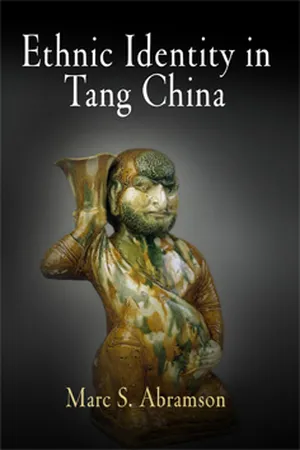 eBook - PDF
- Marc S. Abramson(Author)
- 2011(Publication Date)
- University of Pennsylvania Press(Publisher)
Buddhist motifs in painting, sculpture, architec-ture, and literature became ubiquitous, and apocryphal texts and entire schools of Buddhism were soon created in China. 1 The two great schools of Chinese Buddhism, Chan and Pure Land, though already popular in the Tang, did not become the dominant the-ological and institutional forms of Buddhism until the Song dynasty. 2 However, Buddhism was certainly permanently implanted in China as a mass religious and cultural phenomenon, with all its attendant social Buddhism as a Foreign Religion 53 and economic institutions, during the Northern Wei (386–534) in the north and under the Liang (502–557) in the south. However, Bud-dhism’s foreign origins were still clearly evident in the Tang. Buddhist Sanskrit and Pali terms were widely used in daily speech, and their for-eign origins had not yet been effaced. Many people were familiar with opaque Buddhist magical incantations, and even some of the most com-mon Buddhist religious utterances would have still seemed exotic to the Chinese speaker. 3 Chinese monks regularly returned from India and Central Asia with scriptures and holy relics that became the objects of popular acclamation and public festivals and could provoke frenzies of religious fervor, most famously a reputed bone from the historical Bud-dha’s finger that provoked an irate memorial from Han Yu (see below). Monks from virtually every part of Asia spread throughout China, so the figure of the “barbarian monk” ( huseng ) became a common sight, recorded in belles-lettres and sober historiography. It is thus not surpris-ing that Tang critics of Buddhism continued their predecessors’ argu-ments and claimed that the faith’s foreign origins were a primary source of its danger, justifying restrictions and even proscription. eBook - PDF
Trust in German-Chinese Business Cooperation
Insights and Lessons to be Learned
- Edgar Klinger, Hans-Wolf Sievert, Günter Bierbrauer, Michael Harris Bond(Authors)
- 2024(Publication Date)
- De Gruyter(Publisher)
3 Confucianism, Daoism and Buddhism and Their Influence on Chinese Culture In the last chapter, we suggested a profile of Chinese culture on the basis of the re- spective cultural theories. From a culture-historical perspective, China’s cultural sphere has evolved over a development that has lasted more than 5,000 years. Among the major influential factors that have shaped Chinese culture are Confucianism, Dao- ism and Buddhism. In the following, the constitutive characteristics of these world views will be presented. Specific examples will show how they are reflected nowadays in daily Chinese life. Confucianism 安分守己 – Follow the rules and be modest. (Confucian proverb) Life and Teachings of Confucius The term “Confucianism” stands for a world view developed by a Chinese thinker who lived in the fifth century BC Confucianism is regarded “as one of the main trends (三教) in Chinese intellectual history” (Woesler, 2010, p. 21). The school named after Confucius offered an “ethically justified response to the question concerning the meaning of life and the social order” (Küng & Ching, 1988, p. 94). In Chinese, Confu- cianism is denoted as “儒学 (ru xue, school of the meek).” This denotation suggests a fundamental humanist attitude that portrays a constituent feature of the Confucian philosophy (Küng & Ching, 1988, p. 89). Its overriding goal is to blend in with the world and not to detach from the world (Schluchter, 1983, p. 36). Confucius’ work does not cater to a transcendental perspective; it is geared towards life in this world. As a consequence, Confucianism should not be regarded as a religious, but rather an ideo- logical system. Confucius was born in 551 BC, the son of an impoverished aristocrat in the Lu Commandery, around the same time as Buddha in India and Socrates in Greece. Now situated in the province of Shandong, the Lu Commandery of the time formed part of the Zhou Dynasty when Confucius was alive.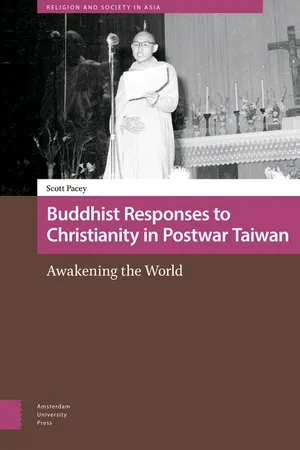 No longer available |Learn more
Buddhist Responses to Christianity in Postwar Taiwan
Awakening the World
- Scott Pacey(Author)
- 2019(Publication Date)
- Amsterdam University Press(Publisher)
Over the course of his research, he determined that Buddhism had declined in India rather than China, as it became gradually more distant from the Buddha’s original teachings. He maintained that the stages of Buddhism’s Indian development could be compared to periods of youth, maturity and old age. 102 This explained why 98 Gong Tianmin, Gong Tianmin wenji sanshipian (Taipei: Xiaoyuan shufang chubanshe, 1993), 7-8. 99 Du Xiaoan, Jidujiao yu Zhongguo wenhua de ronghe (Beijing: Zhonghua shuju, 2010), 246. 100 Gong Tianmin, Fojiaoxue yanjiu: yi wei mushi yanjiu Foxue de baogao (Hong Kong: Jidujiao wenhua gongsi, 1958). 101 See Wu Mingjie’s introduction in ibid., 3. 102 Bhikkhu Bodhi, “Master Yinshun,” The Buddhist World , ed. John Powers (London: Routledge, 2016), 621-622. BUDDHISM AND CHINESE CULTURE 115 Buddhism had degenerated, in his view, to the point where it could later be criticized as superstitious and unmodern. According to Yinshun, later philosophical developments in the Three Treatise School (which, if we recall from earlier in this chapter, he became set on as representing the essential, fundamental truth of Buddhism) could also be found in the earliest strata of Buddhist teachings. In other words, the writings attributed to the philosopher Nāgārjuna, which form the basis of the Three Treatise School, were a particularly clear explication of the Buddha’s original doctrine. 103 Over time, though, Buddhism was gradually influenced by Brahmanical ideas, and a general trend of deif icat ion and supernaturalization. In China, this later strata of Mahayana Buddhism had proliferated, later leading modernist intellectuals to be dismissive of the religion. He maintained that if Buddhism was purif ied of these later, “superstitious” and historical accretions, intellectuals would see it was in fact unlike the degraded form of Buddhism he observed prior to joining the clergy. eBook - PDF
Curiosities of Superstition
And Sketches of Some Unrevealed Religions
- (Author)
- 2012(Publication Date)
- The Floating Press(Publisher)
Chapter VI - In China:—Confucianism, Taouism, and Buddhism * The creeds in vogue amongst the Chinese may be regarded as three:— Confucianism , the religion of the state; Taouism , the religion of the philosophers; and Buddhism , the religion of the people. It has been justly said that a religion which, like Confucianism, has exercised for twenty-four centuries a potent influence over the Chinese mind, though owing its name and origin to a simple citizen, must possess in it something well worthy of consideration. There must be in it a spell which strongly attracts the popular sympathies. This spell is said to be, though possibly we ought to search deeper and farther for it, the purely practical character of its tenets, and the harmony which exists between those tenets and the patriarchal character of the government and the institutions of the country. And in fact it is not so much a religion as an ethical system,—something such as Christianity would be, if we took out of it JESUS CHRIST. Or we may distinguish it as a system of ceremonies on a moral basis, and, as such, admirably adapted to the tastes and needs of so ceremonial-loving a people as the Chinese. To this day the Ly-pou watch with jealous vigilance the maintenance of all the old traditional rites, and rigidly enforce the observance of the traditional details in the construction of the temples. Moreover such particulars as the six kinds of sceptres, 141 the five kinds of mats, and the five kinds of stools are strictly insisted upon; and it is known that the innumerable prescribed sacrifices offered to the various gods of the heaven and the earth, to a man's forefathers, to the hills and the rivers, the sea and the central mount, the god of the south pole and the god of thunder, are the same now as they have been for upwards of 2,000 years. The founder of Confucianism, Kong-foo-tse, or Confucius, (as the Jesuits latinised the name,) was born about 550 B.C.
Index pages curate the most relevant extracts from our library of academic textbooks. They’ve been created using an in-house natural language model (NLM), each adding context and meaning to key research topics.

