History

Smoot Hawley Tariff
The Smoot-Hawley Tariff, enacted in 1930, was a U.S. legislation that significantly raised tariffs on imported goods. Intended to protect American industries during the Great Depression, it led to retaliatory tariffs from other countries, exacerbating global economic downturn. The tariff is often cited as an example of the negative impact of protectionist trade policies on international trade and economic stability.
Written by Perlego with AI-assistance
Related key terms
1 of 5

9 Key excerpts on "Smoot Hawley Tariff"
 eBook - PDF
Guide to U.S. Foreign Policy
A Diplomatic History
- Robert J. McMahon, Thomas W. Zeiler, Robert J. McMahon, Thomas W. Zeiler(Authors)
- 2012(Publication Date)
- CQ Press(Publisher)
The vast majority of farmers . . . would lose. . . . Our export trade, in general, would suffer. Coun-tries can not permanently buy from us unless they are permitted to sell to us. . . . America is now facing the problem of unemploy-ment. Her labor can find work only if her factories can sell their products. Higher tariffs would not promote such sales. . . . Finally, we would urge our Government to consider the bitterness which a policy of higher tariffs would inevi-tably inject into our international relations. . . . The higher duties proposed in our pending legislation . . . plainly invite other nations to compete with us in raising further barriers to trade. A tariff war does not furnish good soil for the growth of world peace. SOURCE: Congressional Record , May 5, 1930, pp. 8327–28, or Douglas A. Irwin, Peddling Protectionism: Smoot-Hawley and the Great Depression, pp. 222–25. The passage of the Smoot-Hawley bill into law highlighted two linked ideas: that the origins of the Depression lay outside the United States; and that by imposing a high protective wall, the worst effects of the global economic downturn could be kept out of the United States. Smoot-Hawley was a protectionist measure that was not singular to the United States. In 1932, Britain, its dominions, and its colonies introduced the Imperial Preference system, which raised tariffs on goods originating outside the Empire and Commonwealth. The passage of Smoot-Hawley on June 17, 1930, symbolized the beggar-thy-neighbor zeitgeist that defined the low, dishonest decade. There was a different way of thinking about international trade, emphasizing mutual economic gain as well as politi-cal goodwill through trade. eBook - ePub
Battles Over Free Trade, Volume 3
Anglo-American Experiences with International Trade, 1776-2009
- Mark Duckenfield, Gordon Bannerman, Anthony Howe, Cheryl Schonhardt-Bailey(Authors)
- 2017(Publication Date)
- Routledge(Publisher)
7 The Smoot-Hawley Tariff, 1930Throughout the latter half of the nineteenth century and the early decades of the twentieth century the United States pursued protectionist policies. The high tariff levels stemmed from many sources: developmental, ideological and political. As a largely agrarian economy in the nineteenth century, the United States had specialized in the export of raw materials and foodstuffs to Europe. Many Americans saw dependence on British and European manufactures as detrimental to national development. American policymakers since Alexander Hamilton at the end of the eighteenth century had argued that a range of policies including a national central bank, state-sponsored infrastructure development and restrictive tariffs were necessary to encourage industrialization and economic development. While economists might have disagreed with his analysis, many voters found themselves in agreement with the succinct argument of Republican campaign literature – apocryphally attributed to Abraham Lincoln – that ‘when we buy manufactured goods abroad, we get the goods and the foreigner gets the money. When we buy the manufactured goods at home, we get both the goods and the money.’1The Republican Party – the party in favour of a protective tariff – was the dominant political force in the seventy-two years from the time of the American Civil War through the start of the Great Depression (1861–1933). During that time period, the Republican Party controlled the House of Representatives for forty-eight years, held the presidency for fifty-six years and the Senate for sixty years. All told, for sixty-four of the seventy-two years, the Republicans controlled a minimum of one house of Congress or the presidency. This placed them in a position to promote higher tariffs when they were in complete control (forty years) and limit downward adjustments of tariffs in times when the Democrats controlled either the White House or the Congress. Indeed, during that entire period, it was only for a period of six years (1893–5 and 1913–17) that the free trade Democrats controlled all of the Congress and the presidency simultaneously. Upon regaining control of the executive and legislative branches in 1921, the Republicans soon passed the Fordney-McCumber tariff, which increased tariffs at the expense of income taxes implemented by the Democrats in 1913. eBook - PDF
Unbalanced
The Codependency of America and China
- Stephen Roach(Author)
- 2014(Publication Date)
- Yale University Press(Publisher)
Astonish-ingly, they argued, instead, that tariffs were a “domestic matter.” 16 America’s trading partners, of course, saw it differently—especially Canada, Cuba, Europe, and the United Kingdom. They all countered with reciprocal measures—either explicit retaliation or, more frequently, thinly veiled dis-crimination against American-made goods. This added to a worldwide out-break of protectionism that deepened the downturn in global trade in the early 1930s and exacerbated the Great Depression. While Smoot-Hawley had broad international repercussions, that out-come was not intentional and was more a result of politicians’ naïveté and ignorance. The mindset is very different today. Unlike the Trade Act of 1930, which raised tariffs on a broad cross section of America’s trad-ing partners, current trade actions are aimed directly at country-specific objectives—focusing on Japan in the late 1980s and China today. What’s similar, however, is the failure to appreciate these actions’ unin-tended consequences. In the 1930s, the possibility of foreign retaliation was simply not on Washington’s radar screen. Today’s mindset is equally reckless. It presumes that the surgical strike of a bilateral currency “fix”— despite its fatal flaw as the wrong answer to a multilateral trade deficit—can succeed without having blowback effects on U.S. exports or foreign capital inflows that savings-short America relies on. Fourth, deflation in the early 1930s seriously exacerbated the increase in U.S. tariffs. As Irwin points out, a large portion of the existing U.S. tariff structure was set in fixed-dollar terms—say $1 per pair of shoes—that were independent of the absolute price of dutiable items. When prices started falling in the early 1930s, these fixed amounts added a far more onerous 204 W A R N I N G S H O T S tax on foreign imports. By Irwin’s estimate, fully two-thirds of the total in-crease in U.S. tariffs from 1929 to 1932 can be attributed to this deflation-ary force. eBook - PDF
Tariff Retaliation
Repercussions of the Hawley-Smoot Bill
- Joseph M. Jones, Jr.(Authors)
- 2016(Publication Date)
I REPERCUSSIONS OF THE HAWLEY-SMOOT TARIFF INTRODUCTION T HE Hawley-Smoot Tariff of 1930 has doubtless occasioned more comment, more controversy, more vituperation in the national as well as in the international sphere than any other tariff measure in history. National agitation in regard to a general tariff revision is a natural phenomenon in American history, but never has the United States in peace time experienced such an extended and violent foreign reaction to any piece of local legislation as that attending the Tariff Act of 1930. The often-quoted formal and official protests of thirty-three foreign nations to the United States Government sink into insignificance beside the general protest and indignation of the populations of the principal trading nations of the world as expressed through an outraged press, mass meet-ings, and resolutions of trade, industrial, and labor organizations in the various countries. T o the writer it seemed entirely illogical in a world composed of nations in which public opinion is of such powerful importance in directing national legislation and execu-tive action that public indignation against the United States so wide in extent, so intense in degree, and so long in duration could take place without leaving very definite traces. This investigation of the repercussions abroad of the Hawley-Smoot Tariff Act, un-dertaken as a result of this skepticism, discloses the effects of this act as wide and profound, repercussions which impose urgent re-flections upon our entire commercial policy. These repercussions fall logically into three classes, obviously progressing from the immediate to the more remote: Firstly, widespread retaliation and discrimination against American exports; secondly, very definite effects upon the commercial policies of the principal trading na-1 eBook - ePub
U.S. Trade Policy
History, Theory, and the WTO
- William A. Lovett, Alfred E. Eckes, Jr, Richard L. Brinkman(Authors)
- 2015(Publication Date)
- Routledge(Publisher)
Some writers have alleged that the 1929 to 1930 general tariff revision spooked the stock market and caused the Great Depression. Of course, the stock market collapsed in October 1929, about eight months before Smoot-Hawley cleared Congress and was signed into law. There is no evidence that the final act influenced the October equities sell-off and the resulting financial collapse. But there is testimony that the extended deadlock in Congress may have heightened business uncertainty, slowed investment, and complicated efforts to stabilize financial markets. It was not really fear of tariffs that spooked the market, but continued uncertainties. In 1929 to 1930 business overwhelmingly favored a substantial protective tariff, but deplored political logrolling and capricious decision making.How did Smoot-Hawley affect American commerce? Many economists and commentators continue to assert that the 1930 tariff disrupted world But official data show that higher U.S. tariffs had little impact on American imports. From 1929 to 1932 imports of dutiable and duty-free goods fell almost the same percentage, suggesting that higher tariffs had little impact on most trading partners. Nor did foreign governments protest and retaliate against U.S. exports, as many pundits seem to think. While newspapers did warn of foreign protests and retaliation, as they do whenever Congress considers a trade bill, U.S. diplomatic records show that only two or three countries actually lodged formal diplomatic protests. Others may have sought to influence the policy process through leaks to newspapers, but exports to the countries most concerned about higher tariffs—Austria, Canada, France, Italy, Spain, Switzerland, and the United Kingdom—fell less than average. The sharpest drop in exports involved commodity-exporting countries, including some like Brazil, largely unaffected by higher U.S. tariffs.34Finally, the political lesson of Smoot-Hawley. For years critics have alleged that the public was so dissatisfied with Smoot-Hawley protectionism that the authors of the act, Senator Reed Smoot of Utah and Congressman Willis Hawley of Oregon, lost their seats in the 1932 election. A review of local press, however, suggests that the tariff had little effect. Hawley, the chair of the House Ways and Means Committee, lost a primary battle to a much younger opponent. He did not return to Oregon to campaign. According to Oregon newspapers, a dispute over the location of a veterans’ home and the battle over Prohibition cost Hawley his elected position. Smoot, one of the leaders in the Mormon church, also went down to defeat in the 1932 general election. He was a victim of the Roosevelt landslide, although popular enough to outpoll President Hoover and the Republican candidate for governor. His opponent also endorsed protectionism for Utah products like lead, copper, and sugar.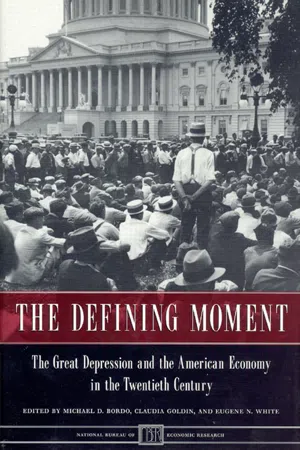 eBook - PDF
The Defining Moment
The Great Depression and the American Economy in the Twentieth Century
- Michael D. Bordo, Claudia Goldin, Eugene N. White, Michael D. Bordo, Claudia Goldin, Eugene N. White(Authors)
- 2007(Publication Date)
- University of Chicago Press(Publisher)
Instead, Smoot-Hawley became infamous as a result of the economic catastrophes that occurred in its wake. Smoot- Hawley was later blamed for the 40 percent plunge in the volume of U.S. trade in the two years after its imposition, for poisoning international trade relations by triggering a wave of foreign tariffs that put world commerce on a downward spiral, and even for turning a modest recession into the Great Depression. The Smoot-Hawley tariff, however, was almost surely not responsible for causing the Great Depression. There are no strong theoretical or empirical grounds for maintaining that higher average tariffs led to business cycle down- turns; the larger Fordney-McCumber tariff increase, for example, was followed by an economic recovery.’ Pushing up the average tariff from 40 percent to 47 percent, as in the case of Smoot-Hawley, we shall see, resulted in just a 5-6 percent increase in the relative price of imports at a time when imports were only 4 percent of GNP. It is not even clear whether the tariff exacerbated or ameliorated the depression. Two studies of the macroeconomic effects of Smoot-Hawley differ as to the direction of the effect, although they arrive at comparable magnitudes-which are small relative to the depression itself. Crucini and Kahn (1996) argue that tariff-induced distortions to capital accu- mulation and foreign retaliation could have brought about a 2 percent decline in U.S. GNP, while Eichengreen (1989) argues that the Keynesian-type stimu- lus from Smoot-Hawley dominated any foreign retaliation and could have in- creased GNP by about 2 percent. If Smoot-Hawley did not play a major role in promoting or inhibiting the Great Depression, it bears part of the responsibility for the collapse of trade in the early 1930s. Even here, however, Irwin (1998) finds that declining income rather than the higher tariff accounts for most of the observed 40 percent fall in import volume between 1930 and 1932.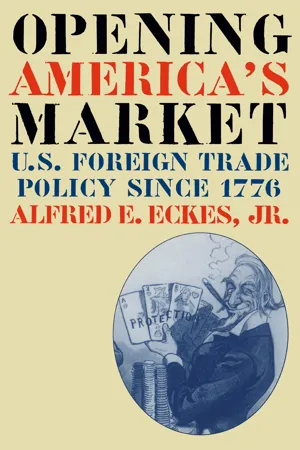 eBook - ePub
Opening America's Market
U.S. Foreign Trade Policy Since 1776
- Alfred E. Eckes Jr.(Author)
- 2000(Publication Date)
- The University of North Carolina Press(Publisher)
42Interestingly, Eichengreen questions the extent of actual retaliation, suggesting that contemporary writers proceeded “on the assumption that foreign tariffs were retaliatory, interpreting and selecting evidence accordingly.” He asserts that “in light of the biases of earlier literature” it is appropriate to “take a skeptical view of its generality.”43Reassessing Protests and Retaliation
Because it is not possible to demonstrate a causal relationship between higher tariff rates and reduced U.S. imports, those who believe Smoot-Hawley harmed world trade and other economies must demonstrate that foreign protests and retaliation actually depressed U.S. exports. Joseph Jones Jr., a twenty-six-year-old graduate student at the University of Pennsylvania, set out to prove this relationship in his 1934 book, Tariff Retaliation . In introducing the study, Jones boldly asserted thatnever has the United States in peace time experienced such an extended and violent foreign reaction to any piece of local legislation as that attending the Tariff Act of 1930. . . . The often-quoted formal and official protests of thirty-three foreign nations to the United States Government sink into insignificance beside the general protest and indignation of the populations of the principal trading nations of the world as expressed through an outraged press, mass meetings, and resolutions of trade, industrial, and labor organizations in the various countries.44 eBook - PDF
The End of Globalization
Lessons from the Great Depression
- Harold James, Harold JAMES(Authors)
- 2009(Publication Date)
- Harvard University Press(Publisher)
Poland had played a major part in the tsarist economy before the First World War, sending textiles and engineering goods, as well as skilled labor, to the rest of the empire. Between the wars, its trade with the Soviet Union was virtually insignificant, accounting for less than one percent of Poland’s total trade. fluctuating prices. As well as political and nationalistic calcula-tions, the violent and rapid price fluctuations immediately after the war in-creased the demand for protection. A traditional way of putting the pro-tectionist case is that it presented a way of adjusting costs of production internationally. But worldwide currency and financial instability in the early 1920s made for very rapidly changing cost calculations. Japan in 1920 brought in antidumping legislation, as did Australia, Britain, and New Zealand in 1921. (There had been earlier precedents for this kind of legis-lation: Canada in 1908, and the United States in 1916.) The U.S. Fordney-McCumber Act of 1922 introduced a “flexible provision,” which autho-rized the Tariff Commission, working in an “expert” and unpolitical way (and thus supposedly also independently of economic interests), to set rates so as to equalize the difference between American and foreign costs of production. This was to be the sole criterion for action by the commission. Choosing the appropriate time frame in which to make the comparison was invariably arbitrary. The wheat tariff included in the notorious Haw-ley-Smoot Tariff Act of 1930, for instance, was based on calculations made over a three-year period in which the rainfall pattern had been uniquely unfavorable to the United States and advantageous to Canada. And once tariffs had been raised in line with a dramatic disturbance to the structure of costs, reduction required a proportionately greater effort. eBook - PDF
Business, Politics and International Relations
Steel, Cotton and International Cartels in British Politics, 1924–1939
- Clemens Wurm, Patrick Salmon(Authors)
- 2020(Publication Date)
- De Gruyter(Publisher)
Great Britain, he said, had itself con-tributed to the breakdown of the international trading system and had refused to make any contribution to economic appeasement, by its rigid adherence to the motto, 'Home industries and agriculture first; Dominions second; foreigners last'. 4 The Conservative Party regarded tariffs as a 'vital national interest'. Whether tariff protection was to be introduced and what form it should take were, it argued, purely a matter for Britain to decide. Britain had, in the Conservative view, carried the burden of responsibility for the inter-national economic order for far too long. Having sacrificed its own inter-ests to those of other countries, Britain had all the more right to pursue its own objectives. Britain could, furthermore, point to the bad example set by others, notably the United States, whose tariff barriers had been drastically heightened by the Smoot-Hawley tariff of 1930 without regard for their impact on the rest of the world. Periods of political and economic instability or crisis, in which the old structures and ground-rules are dissolved, seem to be especially favourable to the growth of international cartels. The world economic crisis marked a turning point in the development of cartels during the inter-war period. Under its pressure conflicts were intensified both within 5 2 Business, politics and international relations the cartels and with outsiders. In the case of some products this led to the complete collapse of existing cartel agreements to the extent that by the beginning of 1930 it looked, according to one perceptive observer, 'as if the individualist laissez-faire system would be restored'. 5 Soon, however, existing agreements were not merely renewed but acquired much greater scope and importance.
Index pages curate the most relevant extracts from our library of academic textbooks. They’ve been created using an in-house natural language model (NLM), each adding context and meaning to key research topics.

