History

The Affluent Society
"The Affluent Society" is a book by economist John Kenneth Galbraith that critiques the post-World War II American economy. Galbraith argues that despite widespread prosperity, society's focus on consumerism and material wealth has led to neglect of public goods and services, such as infrastructure and education. He calls for a reevaluation of societal priorities to address these shortcomings.
Written by Perlego with AI-assistance
Related key terms
1 of 5
10 Key excerpts on "The Affluent Society"
 eBook - ePub
- Myron E. Sharpe, Sharpe M(Authors)
- 2017(Publication Date)
- Routledge(Publisher)
Chapter 3 The Affluent SocietyTHE AFFLUENT SOCIETY is a deeply critical book and marks a sharp turn in Galbraith's attitude toward the American economy and society. By 1958, the year of publication, the first flush of postwar prosperity had worn off. The economic impetus of the Korean War had been spent and the country was experiencing the doldrums of the Eisenhower recession of 1957-58. The passage of time had shown that deep-seated problems existed which could not be solved by conventional means. The Affluent Society was one of the first books to come to grips with a fundamental irony of modern capitalism. An enormously productive economic plant had been built up that had raised a majority of the population out of the depths of poverty for the first time in history. Technology enabled men to produce an abundance of goods. The expansion of the gross national product had become a test of economic success; and as it rose from year to year, albeit with some pauses in times of recession, economists and much of the public thought that the ultimate solution to economic problems had been found. The majority of People did not have to worry about food, clothing and shelter but instead were concerned with cars and home appliances. America had become an affluent society, but with all the abundance there was still something gravely wrong. Goods multiplied but the quality of life diminished. Cities became less liveable; clogged roads made travel more difficult; public transportation deteriorated; education and medical services faced a crisis; welfare services became manifestly inadequate. A substantial part of the population remained poor despite the annual rise in gross national product. To this grave social imbalance. Galbraith addressed The Affluent Society.The end of the economic problem?
Galbraith's analysis proceeded once more with a contrast between a competitive economy and a highly concentrated one. He again emphasized the insecurity inherent in a competitive society which no one but the economic theorist regarded with equanimity. He restated his rationale of business concentration. "The specter that has haunted the economist has been the monopoly seeking extortionate gains at the public expense. This has dominated his thoughts. The less dramatic figure, the businessman seeking protection from the vicissitudes of the competitive economy, has been much less in his mind. That is unfortunate, for the development of the modern enterprise can be understood only as a comprehensive effort to reduce risk" (p. 98). Available until 20 Feb |Learn more
The American Yawp
A Massively Collaborative Open U.S. History Textbook, Vol. 2: Since 1877
- Joseph L. Locke, Ben Wright(Authors)
- 2019(Publication Date)
- Stanford University Press(Publisher)
26 The Affluent SocietyLittle Rock schools closed rather than allow integration. This 1958 photograph shows an African American high school girl watching school lessons on television. Library of Congress.I. IntroductionIn 1958, Harvard economist and public intellectual John Kenneth Galbraith published The Affluent Society . Galbraith’s celebrated book examined America’s new post–World War II consumer economy and political culture. While noting the unparalleled riches of American economic growth, it criticized the underlying structures of an economy dedicated only to increasing production and the consumption of goods. Galbraith argued that the U.S. economy, based on an almost hedonistic consumption of luxury products, would inevitably lead to economic inequality as private-sector interests enriched themselves at the expense of the American public. Galbraith warned that an economy where “wants are increasingly created by the process by which they are satisfied” was unsound, unsustainable, and, ultimately, immoral. “The Affluent Society,” he said, was anything but.1While economists and scholars debate the merits of Galbraith’s warnings and predictions, his analysis was so insightful that the title of his book has come to serve as a ready label for postwar American society. In the two decades after the end of World War II, the American economy witnessed massive and sustained growth that reshaped American culture through the abundance of consumer goods. Standards of living—across all income levels—climbed to unparalleled heights and economic inequality plummeted.2And yet, as Galbraith noted, The Affluent Society had fundamental flaws. The new consumer economy that lifted millions of Americans into its burgeoning middle class also reproduced existing inequalities. Women struggled to claim equal rights as full participants in American society. The poor struggled to win access to good schools, good healthcare, and good jobs. The same suburbs that gave middle-class Americans new space left cities withering in spirals of poverty and crime. The Jim Crow South tenaciously defended segregation, and black Americans and other minorities suffered discrimination all across the country. eBook - ePub
Histories of Knowledge in Postwar Scandinavia
Actors, Arenas, and Aspirations
- Johan Östling, Niklas Olsen, David Larsson Heidenblad, Johan Östling, Niklas Olsen, David Larsson Heidenblad(Authors)
- 2020(Publication Date)
- Routledge(Publisher)
76 The notion of affluence could still be understood as a fairly straightforward promise.To sum up, The Affluent Society was published during a time that saw increased interest among Danish Social Democrats in terms of addressing societal challenges using economic science, but Galbraith’s economic theory was brought to public attention by a range of actors that included political scientists and journalists as well as politicians. Meanwhile, the notion of an affluent society (overflodssamfund ) spread beyond its original use in the political discourse. Before the end of the 1960s, the term was also used to denote the moral and ecological problems associated with modern consumer society. In Sweden, the problems described by Galbraith had to some extent been considered American in the sense that the Swedish welfare state was portrayed as markedly different. Such notions of a Scandinavian Sonderweg in relation to affluence were not as prevalent in a Danish context. Instead, commentators like Poul Meyer and Bent Hansen described Denmark as following the same Western trajectory of growth as the United States, albeit a few years behind.The Affluent Society in Norway
Unlike Sweden and Denmark, where translations of The Affluent Society were published during the years following its original publication, the Norwegian edition was published in 1970. By that time, three other books by Galbraith had already been translated into Norwegian: the 1967 publications The New Industrial State (“Det nye industrisamfunnet”, 1968) and How to Get Out of Vietnam (“To syn på Vietnam”, 1968) as well as the 1968 novel The Triumph
- Lydia Langer, Ralph Jessen(Authors)
- 2016(Publication Date)
- Routledge(Publisher)
2 Visions of material comfort and abundance, however, were not the preserve of market capitalism. All modern mass ideologies promoted them. Freedom of choice similarly gathered support from a range of cultural and political sources that stretched from democratic traditions and pragmatism, to youth culture. Supermarkets are held up as signs of a new monoculture bred by consumer society. Does a broader history bear out this dismal thesis? Placing affluence and choice in a longer, more comparative perspective shows the dangers of telling the story of consumer society as one of post-1945 affluence and rampant individualism. Self-service arises from a richer hinterland of values and practices.1 From the extensive literature, see Juliet B. Schor, The Overspent American: Why We Want What We Don’t Need (New York: Basic Books, 1999); Barry Schwartz, The Paradox of Choice: Why More Is Less (New York: Ecco, 2005); Avner Offer, The Challenge of Affluence: Self-Control and Well-Being in the United States and Britain since 1950 (Oxford: Oxford University Press, 2006).2 John Kenneth Galbraith, The Affluent Society (New York: Mentor Books, 1958). See also Daniel Horowitz, The Anxieties of Affluence: Critiques of American Consumer Culture, 1939 –1979 (Amherst, MA: University of Massachusetts Press, 2004).Affluence
No society has typified consumer society more than the United States after 1945. Anthropologists have stressed that affluence is a relative concept and can be found in many earlier societies. Nonetheless, it was post-war America that took ownership of the affluent society, the title of J.K. Galbraith’s bestseller, and that has set the terms of debate since. A progressive and Keynesian, Galbraith had been deputy head of the Office of Price Administration during the Second World War, before moving back to Harvard. Galbraith’s thesis had three core components. The Affluent Society, he wrote, amounted to a radical break with the past and was the result of a new growth-oriented production machine born by the war. Second, in his famous phrase, it spawned ‘private opulence amidst public squalor’. There was, he argued, a functional tie between the rising wave of private consumer goods and the draught of public services and civic-mindedness: one caused the other. Finally, Galbraith warned, The Affluent Society was unsustainable, financially, psychologically and environmentally. It was promoting an ‘inherently unstable process of consumer debt creation’. It favoured ‘tenuous wants’ over ‘solid needs’ in a way that left people barren and lost at the same time as they were ‘stockpiling’ consumer goods. And it polluted the environment; although only in a few passages, Galbraith was amongst the first to link the critique of consumer society to a concern for what is now called sustainability.3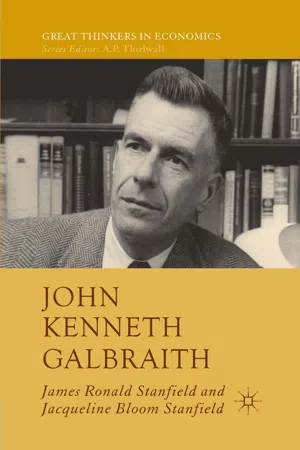 eBook - PDF
- James Ronald Stanfield(Author)
- 2016(Publication Date)
- Palgrave Macmillan(Publisher)
94 4 The Political Economy of Affluence I know not why it should be a matter of congratulation that persons who are already richer than anyone needs to be, should have doubled their means of consuming things which give lit- tle or no pleasure except as representative of wealth .... J. S. Mill, 1848 Fired by an emotional faith in spontaneity, the common-sense attitude toward change was discarded in favor of a mysti- cal readiness to accept the social consequences of economic improvement, whatever they might be .... Household truths of traditional statesmanship ... were ... erased by the corrosive of a crude utilitarianism combined with an uncritical reliance on the alleged self-healing virtues of unconscious growth. K. Polanyi, 1944 The Affluent Society (1958a) is one of the most famous books of the twentieth century. Once he focused on American affluence, the para- dox that production nonetheless remained the highest national priority came to Galbraith ‘with the force of a thunderclap’ (Parker, 2005, p. 280). Thus one of the two major themes of the book became the impediment to progress posed by obsolescent thought or cultural or institutional lag. Galbraith’s term for this was the conventional wisdom, an unforgettable phrase which has become ensconced in the popular idiom and is applied to any habitual interpretation of present circumstances to which its cor- respondence is dubious. The other major theme was that political eco- nomic thought needed to traverse this lag in order to examine the power of the great corporation in modern society and to contemplate the oppor- tunity afforded by affluence to enhance the quality of life. In this regard, The Political Economy of Affluence 95 Galbraith emphasized the need to address the issue of social balance in the allocation of resources between the pubic and private sectors. eBook - ePub
Moral Markets
How Knowledge and Affluence Change Consumers and Products
- Nico Stehr(Author)
- 2015(Publication Date)
- Routledge(Publisher)
the struggle for existence, always has been hitherto the primary, most pressing problem of the human race.… If the economic problem is solved, mankind will be deprived of its traditional purpose. Will this be a benefit? If one believes at all in the real values of life, the prospect at least opens up the possibility of benefit. Yet I think with dread of the readjustment of the habits and instincts of the ordinary man, bred into him for countless generations, which he may be asked to discard within a few decades.… Thus for the first time since his creation man will be faced with his real, permanent problem — how to use his freedom from pressing economic cares, how to occupy the leisure, which science and compound interest will have won for him, to live wisely and agreeably and well.An even more pervasive apprehension of the risks associated with any widespread material abundance and affluence — that is, not merely of an elite but of substantial segments of society whose families had never experienced being “well-off” — began in the early years of the late 1950s and early 1960s; that is, once the economic repercussions of the Second World War brought considerable prosperity, comparatively speaking, to postwar generations. Although the specter of “satiation” had been raised from time to time in the past, it now appeared that satiation was a real possibility and could only be deferred by a few years. The intensive debate about the virtues of material abundance of Western societies mutated into theories of “affluent societies” (Galbraith, 1958 ) or “mass consumption societies” (Katona, 1964 ), surrounded and haunted by “hidden persuaders” (Packard, 1957 ).The basic tenor of many influential discussions of mass consumption, or the homogeneous demand for standard commodities and services, did not see many beneficial societal outcomes in the growing private affluence. John Kenneth Galbraith, for example, deplored the growing asymmetry between public and private wealth to the detriment of public richness. He combines a critique of the prevailing consumer culture, and the absence of any public virtues from rampant spending patterns by newly affluent middle-class families, with the demand for the state to intervene and restore a balance between private and public spending. In a retrospective assessment of his study more than forty years later, Galbraith (1998) 2 eBook - PDF
The Politics of Egalitarianism
Theory and Practice
- Jacqueline Solway(Author)
- 2006(Publication Date)
- Berghahn Books(Publisher)
Affluent Society” continues to engage anthropologists and the wider public; it is good to think about. What more could we ask from a great idea? Acknowledgements. I wish to thank Marshall Sahlins for reading a draft of this essay. Aram Yengoyan provided me with critical points to ponder in preparing this essay and Michael Lambek read and critiqued an earlier draft. Notes 1. “Hunter-gatherer” is a contested term. At the “Man the Hunter” conference, it be-came abundantly clear that gathering supplied proportionately more food in most hunter-gathering societies than did hunting. New appellations, such as gatherer-hunter and forager, emerged. In this essay, the term “forager” is used interchange-ably with “hunter-gatherer.” 2. E. P. Thompson, in reflecting on “moral economy,” wrote: “In any case, if I did fa-ther the term ‘moral economy’ upon current academic discourse, the term has long forgotten its paternity. I will not disown it, but it has come of age and I am no longer answerable for its actions.” (1991: 351). 3. As evidence of the widespread currency of “The Original Affluent Economy,” a search on the website Amazon.com (12 September 2004) revealed that over 2000 books include the term in their text. 4. Consider, for example, the catchphrase “Earth Crash Earth Spirit: Healing our-selves and a dying planet” (available at: http://eces.org/articles/000790.php). Many websites include abridged and editorialized versions of “The Original Afflu-ent Society.” See for example: http://www.primitivism.com/original-affluent.htm; http://www.ecoaction.org/dt/affluent.html; http://www.insurgentdesire.org.uk/ sahlins.htm; and http://www.animana.org/tab1/11originalaffluentsociety.shtml 5. eBook - PDF
The Political Culture of the Left in Affluent Britain, 19 51-64
The Political Culture of the Left in 'Affluent' Britain, 1951-64
- L. Black(Author)
- 2002(Publication Date)
- Palgrave Macmillan(Publisher)
70 Affluence seemed fairer, an t>conomic miracle' even, thrown into relief by wartime devastation and post-war austerity. Crossman's 1950 discussion of egalitarianism was resonant for the encounter with affluence. It meant, he argued, that people are feeling .that they are getting what they deserve', which inay be very remote from strict, statistical equalitarianism. f71 The point was noted elsewhere. Stuart Hall agreed tonsumer capital- ism did genuinely - about the middle of the roaring fifties - break through some kind of sound barrier in public consciousness', though in the sense that prosperity'had become much more a question of how people could be made to see themselves .and much less a solid affair of genuine wealth and well-being.' Hall was then doubtful of 142 The Political Culture of the Left in Aftlent Britain, 195164 dealing with actual prosperity, but convinced of a powerful tnythology of prosperity.I72 Revisionism presented affluence in a socialist light - as fair shares' or an escape from the confines of class. History then was still progressing towards socialism, if in unexpected ways. The hew thinking' restored the notion that socialists were history's tribunes (as the revisionists would not have put it). Revisionism also hitched itself to affluence. Its thinking and project were contingent upon the persistence of affluence. Not coming to terms with affluence All this gave revisionism its characteristically optimistic tone, discor- dant with the more wary note struck by most socialists with regard to affluence. In a sense, revisionism clung to a vision of progress' that was in doubt elsewhere. The notion that economic progress would deliver social and cultural progress - as Sassoon puts it that things will get better" - was present in most socialisms. But the 1950s gave cause to reflect on Crossman's note that the tlelusion of progress'was deep in all of US.173 Some clung to old faiths. eBook - ePub
Encyclopedia of Political Economy
2-volume set
- Phillip O'Hara(Author)
- 1999(Publication Date)
- Routledge(Publisher)
The concern for the effective control of inflation continues throughout Galbraith’s later works, where he continued to advocate institutional adjustment to transfer the power to set prices away from the administered sector to public officials. Although he now admits that wage-price controls are not politically feasible, this leaves the dilemma of inflation versus recession unresolved in his model.Power and social imbalanceIn The Affluent Society, Galbraith elaborates other implications of power in the modern economy. He sets out the theory of social balance. The principle of social balance states that for a given level of private consumption there is an optimal size public sector; that is, public and private consumption are complementary goods. The increased utilization of automobiles must go hand in hand with increased collective provision of roads and traffic control. Suburbanization, in the wake of the automobile age, requires a far-flung government apparatus to service and protect dispersed neighborhoods. The resort to an ever-greater volume of packaged goods and disposable items necessitates more trash removal and solid waste disposal planning. Galbraith even anticipates the trend toward dual-earner households and notes that it too has implications with regard to social balance. Increased participation of both spouses in the paid labor force generates a need for more collectively regulated and provided environments to occupy the time of children.Galbraith maintains that the preoccupation with expanding production, and the process of the creation of consumer wants that sustains it, leads toward a penurious public sector. Added to the traditional anti-government bias of market capitalist ideology, the incessant attention to private consumption obscures the need for collective action in critically important areas. He cites many examples of the deleterious effects of insufficient public sector spending, such as lack of resources being devoted to poverty relief, environmental preservation, education, playgrounds, municipal services and medical care delivery (see SOCIAL AND ORGANIZATIONAL CAPITAL; COMMON PROPERTY RESOURCES). eBook - PDF
- Paul Boyer, Clifford Clark, Karen Halttunen, Joseph Kett(Authors)
- 2017(Publication Date)
- Cengage Learning EMEA(Publisher)
America at Midcentury, 1945–1961 Postwar Jitters and The Affluent Society (776) What were the main sources and consequences of the postwar economic expansion and affluence? The New Industrial Society The Age of Computers The Costs of Bigness Blue-Collar Blues Prosperity and the Suburbs (780) How accurate is the image of 1950s suburban life as one of contentment, conservatism, and conformity? Suburban America Consensus and Conservatism Togetherness, the Baby Boom, and Domesticity Religion and Education Postwar Culture The Television Culture The Other America (786) In what sense were there two Americas? Poverty and Urban Blight Latinos and Latinas Native Americans The Civil Rights Movement (790) What innovative strategies were developed by the civil rights movement in this era? The Politics of Race Jim Crow in Court The Laws of the Land Mass Protest in Montgomery New Tactics for a New Decade Seeds of Disquiet (795) What actions by minorities and youth foretold the movements for social change to come in the 1960s? Sputnik A Different Beat Portents of Change The Whole Vision (798) 27 POSTWAR WOMEN “It was unquestioned gospel,” feminist Betty Friedan would later write in The Feminine Mystique (1963), that postwar women “could identify with nothing beyond the home—not politics, not art, not science, not events large or small, war or peace, in the United States or the world, unless it could be approached through female experience as a wife or mother or translated into domestic detail.” (Courtesy of the State Archives of Florida) Copyright 2018 Cengage Learning. All Rights Reserved. May not be copied, scanned, or duplicated, in whole or in part. WCN 02-300 775 1955 ( cont. ) Elvis Presley ignites rock-n-roll. James Dean stars in Rebel Without a Cause. Montgomery bus boycott begins. 1956 Interstate Highway Act. 1957 Little Rock school-desegregation crisis. Soviet Union launches Sputnik. Peak of baby boom (4.3 million births).
Index pages curate the most relevant extracts from our library of academic textbooks. They’ve been created using an in-house natural language model (NLM), each adding context and meaning to key research topics.

