History

The Black Death
The Black Death was a devastating pandemic that swept through Europe in the 14th century, resulting in the deaths of an estimated 25 million people, or about one-third of the continent's population. The disease, most likely bubonic plague, spread rapidly through fleas infesting rats and was transmitted to humans through bites. The Black Death had profound social, economic, and cultural impacts on Europe.
Written by Perlego with AI-assistance
Related key terms
1 of 5
12 Key excerpts on "The Black Death"
 eBook - PDF
- Jonathan L. Heeney, Sven Friedemann(Authors)
- 2017(Publication Date)
- Cambridge University Press(Publisher)
The Black Death resulted in the deaths of between 25 and 50 million people in Europe, alone. It was the greatest demographic crisis of the medieval period and, in terms of the proportion of the population that was killed, the single most calamitous epidemiological event in all of human history. The term ‘Black Death’ was coined only much later, the word ‘black’ referring possibly to the sheer horror of the pestilence (from the Latin, atra mors, which can mean ‘terrible’ or ‘dreadful’ death, the connotation of which was the ‘black death’) or, as some have suggested, to the blackened bodies of its victims. Contemporaries called the epidemic the ‘Great Pestilence’, the ‘Great Mortality’ or the ‘Big Sickness’. They described a range of symptoms, including buboes – the size of eggs or even apples – on the groin and under the armpits, as well as blotches, boils, bruises, black pustules and the coughing up of blood, vomit and sputum. The poignant accounts writers left behind ring with the terrible sorrows it brought in its wake. The Italian poet Petrarch (1304–74) expressed the perplexity and loneliness that must have haunted those who survived: Where are our dear friends now? Where are the beloved faces? Where are the affectionate words, the relaxed and enjoyable conversations? What lightning bolt devoured them? What earthquake toppled them? What tempest drowned them? What abyss swallowed them? There was a crowd of us, now we are almost alone. 5 Giovanni Boccaccio (c. 1313–75), author of The Decameron (c. 1348–53) – set during the pestilence in Florence – also described its tragic consequences: How many valiant men, how many fair ladies . . . breakfasted in the morning with their kinsfolk . . . and that same night supped with their ancestors in the other world! 6 Plagues and History 37 Perhaps no other single ‘plague’ has so changed the world. eBook - ePub
Edward the Black Prince
A Study of Power in Medieval Europe
- David Green(Author)
- 2023(Publication Date)
- Routledge(Publisher)
2 The Black DeathDOI: 10.4324/9781003280934-3It [the plague] left hardly enough people alive to give the dead a decent burial…Ulcers broke out in the groin and the armpit, which tortured the dying for three days…And there was in those days death without sorrow, marriage without affection, self-imposed penance, want without poverty and flight without escape…In the end the plague devoured a multitude of people…Scarcely a tenth of the population survived.1John of Reading’s account is something of an exaggeration; it was probably a mere third and almost certainly no more than a half of the population of England that died during the plague of 1348–50. It has been ranked, if such events can really be assessed in this way, as the second worst catastrophe in history, falling only behind the Second World War in its appalling consequences.2Although it has long been suggested that The Black Death was bubonic plague, possibly with pneumonic or septicaemic variants encouraging the great speed of transmission, attempts have been made to explain certain aspects of the pandemic by offering alternative diagnoses.3 However, recent scientific analyses have proved conclusively that the plague which devastated Europe and beyond in the fourteenth century was, indeed, caused by the bacterium Yersinia pestis and that fleas carried by rodents, chiefly rats, provided the main means of transmission. Such work has also contributed a great deal to our understanding of the plague’s origins, in central Asia, and the route by which it entered Europe.4But, even if we have learned much about the nature of the plague and its spread within and beyond Europe, attempts to quantify its precise impact must remain somewhat speculative. There is, though, little doubt that the plague contributed enormously to the changing character of the continent and the ways by which power was wielded within it. Economic and social relations, agricultural practices, and land use were all affected by The Black Death. The plague also altered the way individuals conceived of their place in the world, in relation to their neighbours and their social ‘superiors’, both secular and ecclesiastic. Since, for the majority, the only conceivable explanation for the plague was that it manifested God’s wrath with a sinful people, the huge levels of mortality changed perspectives regarding the divine and His Church. (Because the plague influenced so many aspects of later medieval society, reference to it will be made throughout the remainder of this book. In particular, some of the religious implications of the pandemic are examined in Chapter Six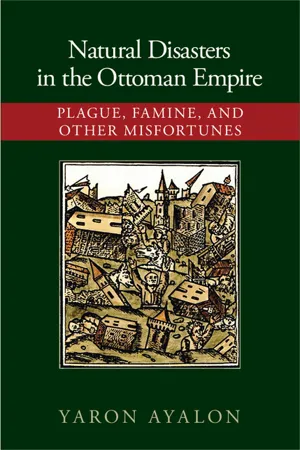 eBook - PDF
Natural Disasters in the Ottoman Empire
Plague, Famine, and Other Misfortunes
- Yaron Ayalon(Author)
- 2014(Publication Date)
- Cambridge University Press(Publisher)
30 Borsch, Black Death, 65–6. 31 David Nicholas, The Transformation of Europe, 1300–1600 (London: Arnold, 1999), 94–6. 32 Jordan, High Middle Ages, 297; John Hatcher, “England in the aftermath of The Black Death,” Past and Present 144 (1994), 3–35; Colin Platt, King Death: The Black Death and Its Aftermath in Late-Medieval England (London: UCL Press, 1996), 177–92; Ziegler, Black Death, 232–51; Klaus Bergdolt, Die Pest: Geschichte des Schwarzen Todes (Munich: C. H. Beck, 2006), 50–7; Klaus Bergdolt, Der Schwarze Tod in Europa: Die grosse Pest und das Ende des Mittelalters (Munich: C. H. Beck, 1994), 191–207. See also the many short articles that discuss how The Black Death changed Europe in William Bowsky, ed., The Black Death: A Turning Point in History? (Huntington, NY: R. E. Krieger, 1978). Natural Disasters in the Ottoman Empire 32 discourse, all took a sharp turn in the decades following The Black Death, but not so in the Middle East. A combination of preexisting conditions in one society that did not exist in the other, along with certain cultural and religious attributes, accounted for the differences. 33 To understand these differences properly, I shall first offer a closer scrutiny of The Black Death’s effects on European society. The Black Death in Europe: A Closer Look Much of the change that affected European society in the aftermath of The Black Death was borne by broader processes that had begun prior to it. The horrific plague cycles of the mid- to late-fourteenth century contrib- uted to a social transformation on many levels, but they were not its only, or even principal, promoter. The weakening authority of the church was perhaps the most conspicuous of these changes. eBook - PDF
On Our Way
The Final Passage through Life and Death
- Robert Kastenbaum(Author)
- 2004(Publication Date)
- University of California Press(Publisher)
At a “tipping point,” as Malcolm Gladwell would say, 1 the number and type of deaths can lead large populations as well as individuals to feel that the too many deaths are prelude to the total destruction of life. Even young children—the proverbial innocents living in an enchanted T O O M A N Y D E A D / 2 2 1 and protected domain—may be chanting, “Ashes, ashes. All fall down!” We begin, then, by passing through the gate of time to revisit some of the most terrifying days in human history. PLAGUE The word plague (from the Latin plaga, a forceful blow) has been ap-plied to many contagious diseases but has become associated primarily with the bubonic plague. In its most devastating appearance this pesti-lence was known as The Black Death. Every major lethal epidemic in the last three hundred years or so has been compared to the plague, and people with a sense of history have an abiding fear that a new form of this disease might yet again emerge and carve an appalling trail of death throughout the global community. What of the disease itself? How did it spread, how many lives did it end, and what measures were taken to control this horror? What was the world in which The Black Death struck, and what was its impact? And did the memory of this catastrophe die with its survivors, or has The Black Death continued to influence us hundreds of years later? First, the disease itself. We begin with first-person accounts from a devastating re-turn of the plague in the seventeenth century. The Plague and Its Victims Florence, 1631. A resplendent and sophisticated city. A scorpion stung a housemaid just above her knee. At least, that was what seemed to have happened. The wound was a little strange, though, not typical for scorpions. Perhaps it was a carbuncle, the name given to a painful infection under the skin that could become a serious problem if not treated promptly. A deputation of physicians was sent by the Pub-lic Health Magistracy.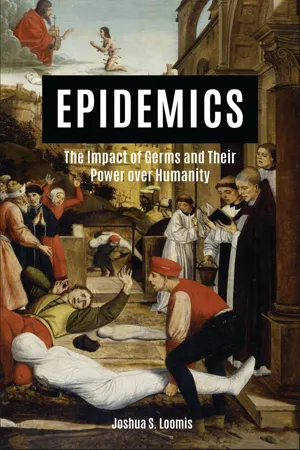 eBook - ePub
Epidemics
The Impact of Germs and Their Power over Humanity
- Joshua S. Loomis(Author)
- 2018(Publication Date)
- Praeger(Publisher)
Once in a new location, rats would jump off the ships, mate with local rats, and transmit the disease to a new population. It is believed to have spread very rapidly between humans through the inhalation of infected respiratory secretions (pneumonic plague) until there were no hosts left to infect. The devastating social impact that such enormous amounts death had on the people is best described by Giovanni Boccaccio, who in the Decameron (1353), wrote, “Citizen avoided citizen, kinsfolk held aloof, or never met or but rarely; in the horror thereof brother was forsaken by brother, nephew by uncle, brother by sister, and oftentimes husband by wife; may, what is more and scarce to be believed, fathers and mothers were found to abandon their own children, untended, unvisited, to their fate, as if they had been strangers.” 12 Much as it did 800 years previously, The Black Death produced deleterious effects on all facets of life, forever changing the way people lived, thought, and interacted with one another. Most historical analyses of the 14th-century Black Death primarily focus on how it affected Europe despite the likelihood that it killed millions in Asia before ever moving westward. Interestingly, there are very few documented accounts of plague activity in Chinese texts from the 14th century and even fewer from Indian sources. Some Chinese medical documents from that time period (the Song-Yuan Dynasty) describe a disease that had characteristic swollen lymph nodes and high fevers and produced a great number of deaths between 1331 and 1353. 13 Also, a census conducted during that time reported that the population of China was nearly cut in half during the second half of the 14th century, with some provinces reporting losses of almost 90 percent of its inhabitants eBook - PDF
Words, Words, Words: Philology and Beyond
Festschrift for Andreas Fischer on the Occasion of his 65th Birthday
- Sarah Chevalier, Thomas Honegger(Authors)
- 2012(Publication Date)
- Narr Francke Attempto Verlag(Publisher)
Cohn. 2003. The Black Death Transformed: Disease and Culture in Early Renaissance Europe . New York: Oxford University Press. The Black Death and the Development of English 225 the “truth”, and it tends to become the property of “everyman”. The common contemporary reaction is to brand those who challenge orthodox beliefs as “Deniers”. People during the plague years conceptualised life as having the quali-ties of a gamble, a burden, or a prelude to paradise/hell, so it stands to reason that they would translate these conceptualisations into narratives to explain, justify and ratify their behaviour under the constant threat of pla-gue. As soon as bubonic plague was given a rational explanation through Yersin’s discovery, the need for the narratives that were developed on the basis of such negative conceptualisations of life, at least with respect to the threat of plague, seemed to disappear. Plague was no longer a threat. It no longer imposed the burden of insecurity on human beings, and it no longer turned the course of life into a lottery in which one could more easily lose than win. Without sticking meticulously to the matter-of-fact details of the biology and epidemiology of bubonic plague, historians have claimed the right to be able to provide a fully “rational” explanation of the events by assuming that The Black Death was a pandemic of bubonic plague. But those who went through the horror of that pandemic and a succession of more local but no less lethal outbreaks in its wake instinctively knew that the disease, whatever it was, was transmitted through close human contact, i.e. in situations of emergent social practice. It was brought by strangers moving into the community or by community members returning to the community from outside. I turn now to an important strand of a discourse archive governing “the law of what can be said, the system that governs the appearance of state-ments as unique events” on the history of English.
- Paul Chrystal(Author)
- 2021(Publication Date)
- Pen and Sword History(Publisher)
THE MIDDLE AGES Chapter 8 Bubonic Plague: The Black Death: 1346–1353 (Start of the Second Plague Pandemic) ‘First pray, then flee.’ – From Dr Alonso de Chirino’s practical guide to the plague for the layperson (c. 1431) ‘The year of 1348 has left us alone and helpless. Where are our dear friends now? Where are the beloved faces? Where are the affectionate words? the relaxed and enjoyable conversations?’ – Francesco Petrarca, (b.1304), Petrarch T o the Florentine poet plague was a disease ‘without equal for centuries’; it had ‘trampled and destroyed the entire world’. It may well have all started in India, spreading through Asia, North Africa and then to Europe. Plague probably came to England courtesy of an infected rat or flea at Melcombe Regis (now Weymouth) at the end of July or beginning of August, 1348. It then spread through the south-west to Bristol and then eastwards to Oxford and London, which it had reached by the beginning of November travelling at the rate of about 1½ miles per day. In Europe, it is estimated around 50 million people died as a result of The Black Death, also known as the Great Mortality or the Great Pestilence. The population fell from some 80 million to 30 million. It killed at least 60 per cent of the population in rural and urban settings. It took the world population 200 years to recover to the level at which it stood in the early 1340s. The 1347 pandemic plague was not referred to specifically as ‘black’ in the 14th or 15th centuries in any European language. In fact ‘Black Death’ was not used to describe the plague pandemic in English until 1755, when it translated the Danish: den sorte død, ‘The Black Death’. As is usual, the poor were worst affected: they tended to live in single-storey thatched wattle-and-daub hovels. Rats burrowed under their earth floors and climbed the walls to build their nests in the roofs, from which blocked fleas could fall to infect the residents below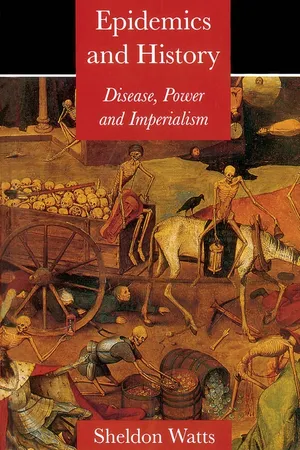 eBook - PDF
- Sheldon Watts(Author)
- 1997(Publication Date)
- Yale University Press(Publisher)
i The Human Response to Plague in Western Europe and the Middle East, 1347 to 1844 Introduction In the summer of 1347 rats and fleas infected with bubonic plague boarded Genoese merchant ships at Caffa on the Black Sea. Later that year some of these ships passed through the Dardanelles, touched down at Messina (Sicily) and then sailed to Pisa, Genoa and Marseilles: other Genoese ships sailed directly from Caffa to the mouths of the Nile in Egypt. Within a few months pestilence of a form unknown to contemporaries began killing men, women and children on both sides of the Mediterranean. As 1348 wore on, the plague began striking populations along the Atlantic and Baltic coasts. Then, travelling up rivers, along paths and across fields, it reached Europeans living deep in the interior. Though reliable information is scarce, it would seem that during the five years (1347-51) The Black Death was darting about, mortality varied from an eighth to two-thirds of a region's population. Overall it may have killed three Europeans out of every ten, leaving some 24 million dead. This remains the worst epidemic disease disaster in Europe since the collapse of the Roman Empire. 1 Also appallingly high was the casualty rate in the Muslim Middle East: between a quarter and a third of the population died. Writing in 1349, Ibn Khatimah, a medical writer from Andalusia (Muslim southern Spain), testi-fied that: This is an example of the wonderful deeds and power of God, because never before has a catastrophe of such extent and duration occurred. No satisfactory reports have been given about it, because the disease is new. . . . God only knows when it will leave the earth. 2 In the years after 1351, bubonic plague continued to make sporadic appearances, sparing neither lands to the north nor to the south of the Mediterranean. Though no category of person was immune, it seemed that on every second or third visitation the plague targeted a region's pregnant women and young children. eBook - PDF
- Joseph P. Byrne(Author)
- 2008(Publication Date)
- Greenwood(Publisher)
As opposed to that of the late medieval Black Death, the identity of the epidemic disease as true bubonic plague has not been contested. The waves of the plague certainly caused large-scale mortality and— especially in important urban centers such as Constantinople—a sharp demographic decline, but it is still difficult to translate this into more specific demographic terms. Figures estimating the overall loss of life at 20 to 30 percent of the pre-plague population are often cited, but their accuracy and value are questionable. Certainly, labor became sparse and more expensive, more and better land was available, and manpower shortages limited military operations, whereas on a spiritual level the scourge encouraged the intensification of religious ritual and may have affected the initial spread of Islam. 532 Plague of Cyprian There are abundant sources on the Plague of Justinian written in Greek, Syriac, Arabic, Latin, and Old Irish—mostly histories and chronicles and, to a lesser extent, nar- rations of saints’ lives. Several sixth-century authors were eyewitnesses to the pandemic, such as the historians Procopius (d. 565), Agathias (c. 536–582), and Euagrius (c. 536–600) writing in Greek; John of Ephesus (c. 505–585), a bishop writing in Syriac; and the bishop and historian Gregory of Tours (538–593) writing in Latin. Arabic authors such as al-Madaini wrote in the late eighth and ninth centuries, as did some of the Greek and Latin authors such as Theophanes (758/60–817) and Paul the Deacon (c. 720–799), who referred to plague waves in the seventh and eighth centuries. Several detailed descriptions of the disease enable us to identify it as bubonic plague. Procopius includes the longest account of the symptoms associated with the epidemic’s first visitation in 542. Its onset was sudden and accompanied by fever. In a few days at the most, swellings developed mainly in the groin, but also inside the armpit, beside the ears, or on the thighs. eBook - PDF
A History of the British Isles
Prehistory to the Present
- Kenneth L. Campbell(Author)
- 2017(Publication Date)
- Bloomsbury Academic(Publisher)
6 For example, geographical mobility, once thought to have been mostly a result of the plague, is now also known to have preceded it. Even before the plague, the authority that landlords held over their serfs or tenants varied according to individual personalities and circumstances; it was not uncommon for either free or unfree tenants to change residences multiple times in the course of a lifetime. Such geographical mobility, combined with the growing distinctions between free and unfree tenants, posed a threat to social harmony in country villages prior to the advent of the plague, but did not undermine it because social cooperation was still so important to the economic success of a village. Furthermore, as the earlier difficulties of Edward III indicate, expressions of political discontent did precede the arrival of The Black Death in England by several years. Nonetheless, it is hard to argue that a plague that swept away 40 to 50 per cent of the population (numbers that have been confirmed by recent archaeological research) was not the most significant development of the century, if not of the entire late medieval period. The plague had a tremendous psychological impact, providing a powerful reminder of the omnipresence and inevitability of death and bequeathing a burdensome emotional legacy to those who lost loved ones and survived the catastrophe. Kinship bonds remained important, while the general sense of community within medieval villages remained intact, if it did not get stronger, among the survivors of such a devastating epidemic. Support from family and neighbours took on added significance in changing economic times. Most people remained in their native villages and tried to carry on as best they could. Such geographical mobility as did exist merely brought people into an existing network of village relationships, as opposed to upsetting or overturning established communities. eBook - PDF
Lust for Liberty
The Politics of Social Revolt in Medieval Europe, 1200–1425
- Samuel K. Cohn Jr., Samuel Kline COHN(Authors)
- 2009(Publication Date)
- Harvard University Press(Publisher)
C H A P T E R 9 The Black Death and Change over Time Thus far this book has said little about change over the 225 years of its analysis. Little has been mentioned besides an increase in tax and peasant revolts and a decline in heretical and religiously motivated move-ments after The Black Death. The significance of The Black Death for a sup-posed clustering of popular revolts a generation afterward continues to puzzle historians. It prompted Mollat and Wolff’s investigation that became Ongles bleus. One of their conclusions compares the clustering of revolts of the late thirteenth and early fourteenth centuries with those of 1378–1382. Here, as with their title, they borrowed from the great historian of the Low Countries, Henri Pirenne, distinguishing the first cluster of revolts as “revo-lutions of the crafts,” or of skilled craftsmen. The second group of revolts, they argued, stemmed from misery, and the poor or nascent proletarians filled the rebellious ranks. 1 From Artisan to Protoproletarian Rebellion? If such a transition held, it would be difficult to square it with the general eco-nomic trends in postplague Western Europe. The ecological plight of over-population and the widest and most desperate waves of famine occurred not after The Black Death but before it, in the second and third decades of the four-teenth century. 2 After a decade or so of economic dislocation created by the plagues, the European economy not only began to recover but the conditions of those at the bottom improved the most rapidly: the abrupt demographic decline meant that their labor power came into greater demand. 3 From my databases of revolts, the rare cases of utter desperation and wild scrambles for grain came from Central Italy—Rome, Siena, and Florence—before The Black Death, with famines in 1327–1330 and the mid-1340s. 205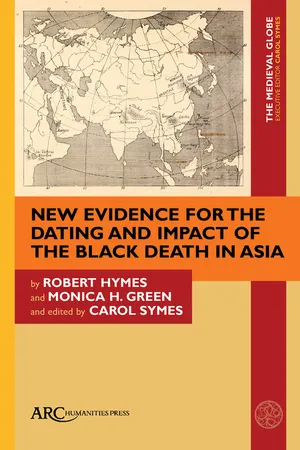
- Robert Hymes, Monica H. Green, Carol Symes(Authors)
- 2022(Publication Date)
- Arc Humanities Press(Publisher)
Plague was, for long stretches, invisible to human actors, and here we need to let the microbe tell its story. But that story must, in the end, be compatible with the story we construct from human sources. This is the biggest challenge in the field right now. In my conclu- sion (“Defining the Second Plague Pandemic”), I argue that the weight of seven hundred years of historiography needs to be recognized and, when necessary, set aside. We have more insight into the physical conditions of the past than ever before, and we can see the linkages that allowed a microbial agent to affect so many landscapes—precisely what we mean by “pandemic.” A global approach, which emphasizes patterns and linkages, is justified to investigate both the medieval pandemic’s enormity and its uniqueness. Sketching the Outlines of the Map Hymes’s present article, published in this volume, forms the third part of a trilogy. In his 2014 essay, he laid out his hypothesis that China’s later medieval history of pandemics could be correlated with a recent proposition coming from genetics. In 2013, biologists Yujun Cui and colleagues proposed that a Big Bang in plague dissemination—the sudden displacement of a single highly lethal strain of plague into new ecological niches, creat- ing four unique lineages which shared the same common ancestor—had likely occurred sometime in the century and a half prior to The Black Death’s conventional starting date, 1346. Hymes described the testimony of a Jin-era physician, Li Gao (d. 1251), who was not simply present during the siege and epidemic of 1232 in the Jin southern capital, Kaifeng, but had apparently altered his thinking about epidemic diseases in the years thereafter, devising what he called an Internal Damage theory to account for the new putting aSia on The Black Death map 63 symptoms he witnessed.
Index pages curate the most relevant extracts from our library of academic textbooks. They’ve been created using an in-house natural language model (NLM), each adding context and meaning to key research topics.

