History

The Crusades
The Crusades were a series of religious wars initiated by the Latin Church in the medieval period, primarily aimed at reclaiming the Holy Land from Muslim rule. Spanning from the 11th to the 13th century, the Crusades had significant political, economic, and social impacts, leading to the expansion of trade, cultural exchange, and the rise of powerful military orders.
Written by Perlego with AI-assistance
Related key terms
1 of 5
10 Key excerpts on "The Crusades"
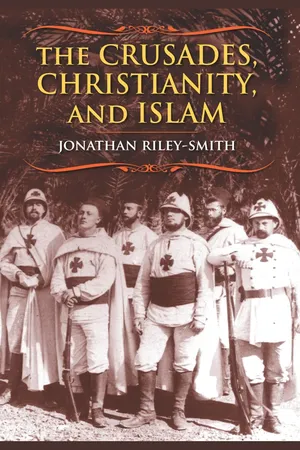 eBook - ePub
- Jonathan Riley-Smith(Author)
- 2008(Publication Date)
- Columbia University Press(Publisher)
CHAPTER ONE Crusades as Christian Holy WarsCrusades were penitential war pilgrimages, fought not only in the Levant and throughout the eastern Mediterranean region, but also along the Baltic shoreline, in North Africa, the Iberian Peninsula, Poland, Hungary and the Balkans, and even within Western Europe. They were proclaimed not only against Muslims, but also against pagan Wends, Balts and Lithuanians, shamanist Mongols, Orthodox Russians and Greeks, Cathar and Hussite heretics, and those Catholics whom the church deemed to be its enemies. The crusading movement generated holy leagues, which were alliances of front-line powers, bolstered by crusade privileges, and military orders, the members of which sometimes operated out of their own order-states.It is the length of time crusading lasted and its expression in many different theaters of war that make it so hard to define.1 It was adaptable and aspects of it changed in response to circumstances and even fashion, but certain elements were constant. To crusade meant to engage in a war that was both holy, because it was believed to be waged on God’s behalf, and penitential, because those taking part considered themselves to be performing an act of penance. The war was authorized by the pope as vicar of Christ. Most crusaders were lay men and women who made vows, committing themselves to join an expedition. When their vows were fulfilled, or when a campaign was considered to have ended, the individuals concerned resumed their normal lives. There were also crusaders of another type, the brothers (and in some cases sisters) of the military orders—such as the Knights Templar, Knights Hospitaller, and Teutonic Knights—who made vows of profession and were therefore permanently engaged in the defense of Christians and Christendom. The vows, whether specific and temporary, varying a little from place to place and over time, or permanent ones of profession into a military order, were symbolized by the wearing of crosses, either on everyday clothes or on religious habits. The lay men and women who made them were rewarded with indulgences, guarantees that the penitential act in which they were engaged would rank in God’s eyes as a fully satisfactory remission of the sins that they had committed up to that date.2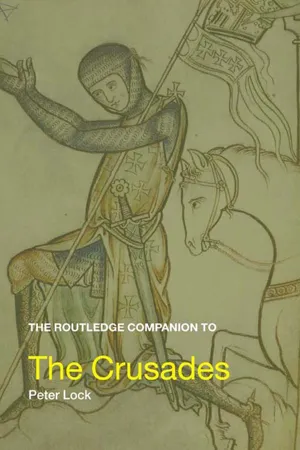 eBook - ePub
- Peter Lock(Author)
- 2013(Publication Date)
- Routledge(Publisher)
VI CRUSADES, CRUSADING AND THE CRUSADER STATES WHAT WAS A CRUSADE? The term ‘crusade’ is a modern not a medieval term. Its application as a title for the crusade movement seems to be no earlier than 1638 in Western Europe. Muslim sources did not distinguish between western pilgrims, crusaders, or settlers, labelling them all as Franks (al-Franj). It is only in the twentieth century that the literal term for crusade, al-salibiyyun, enters Arabic historical ‘riting. Interestingly, ‘rabic, Romance and Germanic words for ‘crusade’ derive etymologically from their word for ‘cross’, and thus emphasise the symbol of the cross in crusading activity 1 From the days of Gibbon there has been general agreement that The Crusades represented a turning point in European history, defining the nature of European identity and telling us as much about European medieval history as about the history of the Middle East. Until the present century this has led to a Eurocentric approach to crusading history. In the same vein Jewish historians thought that The Crusades exercised a profound influence on Jewish culture in Europe, and since the 1960s have traced the roots of the Holocaust back to the First ‘rusade. 2 Since the 1960s a debate regarding the unambiguous definition of the term ‘crusade’ has developed between the so-called traditionalists and the pluraliste The former hold that only those expeditions aimed at the recovery or defence of the Holy Land should be considered crusades, whilst the latter maintain that all expeditions authorised by the papacy with the concomitant crusade privileges, preaching and recruitment should be considered crusades. 3 The first approach privileges place — that is, the Holy Land — as the destination that made a true crusade. The second approach emphasises the procedural and organisational nature of crusading expeditions regardless of their destination eBook - ePub
The History of Christianity
Facts and Fictions
- Dyron B. Daughrity(Author)
- 2019(Publication Date)
- ABC-CLIO(Publisher)
The Crusades are misunderstood for a variety of reasons: they occurred a thousand years ago, few professors today are specialists in medieval Christianity, and they represent a time when Christianity was understood so differently than it is today. Nevertheless, the misunderstanding of this particular era in the Christian faith is conspicuous and pronounced, largely because it is built on assumptions that have been shaped in a context that abhors the idea of Christians voluntarily killing others in the context of holy war. People in the Western world today, in a postcolonial context, have little appetite for a kind of Christianity that was inextricably tied to the state. In the medieval era, there was hardly a war that was not a holy war on some level, due to the ubiquity of religion throughout the society and, therefore, its political institutions. That kind of Christianity is repulsive to many.Thus, today, The Crusades are associated with overzealousness, with a worldview in which there was no separation between church and state, and with violence. And while all three of these charges are true in some respects, they fail to include the broader context.How the Story Became PopularThe historiography of The Crusades is actually quite well-researched among those few scholars who specialize in this area, and what emerges is a fascinating story of how civilization can dramatically change its perspective on a person or event in history. During the era of The Crusades, Western Europeans tended to write about them in a “triumphalistic” way. However, by the end of the eighteenth century, that interpretation had completely changed to one of “skepticism and sharp criticism” (Peters 2004, 6).Muslim historians did not pay much attention to The Crusades while they were happening. They occurred in “a politically and economically marginal area” that attracted little attention. At the time, Muslims regarded the crusaders as “primitive, unlearned, impoverished, and non-Muslim people.” Muslim scholars “knew and cared little” for these Western warriors. Their view of the crusaders could be summarized with one word: indifference. Indeed, Arab chroniclers had no word for “crusades” until the mid-nineteenth century, when they began using the expression “wars of the cross” (al-hurub al-salibiyya) (Peters 2004, 6–7).The Ottoman Turks did write some on The Crusades, but by far the dominant concern of their historians during the thirteenth century was the Mongol conquests. Interest in The Crusades did not resurface in any significant way in the Muslim world until the mid-nineteenth century, when French histories of The Crusades began to be translated into Arabic and Turkish by Europeans. This period “marks the beginning of European revisionist historiography on The Crusades.” In the eighteenth and nineteenth centuries, some of Europe’s most prolific historians turned their attention to The Crusades. In the eighteenth century, Voltaire, Hume, Diderot, and Gibbon dominated European historiography and tended to characterize The Crusades as a papist concern to invigorate the finances of the Roman Catholic Church (Peters 2004, 7). Safe to say, their understanding of The Crusades was openly critical and terribly biased—against the church. eBook - ePub
Bullies and Saints
An Honest Look at the Good and Evil of Christian History
- John Dickson(Author)
- 2021(Publication Date)
- Zondervan(Publisher)
Holy Wars from the 1000s to the 1200s Lest we get on our high horse and think this is unique to some other place, remember that during The Crusades people committed terrible deeds in the name of Christ. —PRESIDENT BARACK OBAMA, 2015Ihave already talked about the First Crusade in some detail. Its themes and aims can, to some degree, stand as the model for later Crusades. It also represents a pivot point in the history of Christianity.First Crusade (1096–99)
Before Pope Urban II’s preaching campaign of 1095–96, warfare had an ambiguous status in Christian teaching. It was sometimes viewed as a necessary evil in a fallen world. And sometimes—especially in the early centuries—it waswholly rejected as a contradiction of the Gospel demand: “Love your enemies, do good to those who hate you” (Luke 6:27). I will discuss the backstory to Christian “sacred violence” later. For now, it is perhaps worth noting that historians typically speak about five different Crusades. This is, of course, a matter of convenience, an easy way to organise our thoughts on this subject. People in, say, the year 1203 did not talk about “Heading off to the Fourth Crusade”! Still, it is sometimes helpful to make our thoughts about history neater than the history itself.Several armies of European volunteers, amounting to something like one hundred thousand men, heeded the call of Pope Urban II to assist the Christian Byzantine emperor Alexius I against Muslim aggression. They hoped to protect Constantinople and win back Jerusalem for Christ. The campaign was a stunning success, from the Crusaders’ point of view. Even though only ten to fifteen thousand men reached Jerusalem in 1099, they were able to recapture the Holy City in a matter of weeks.Part of the First Crusade’s spiritual force, if I can call it that, came from a charismatic monk known as Peter the Hermit. His dishevelled appearance obscured a keen talent for recruitment and the management of soldiers, as well as a fiery preaching style. It is unclear whether he was the pope’s appointee or just a successful independent zealot who supported the cause. He rallied up to thirty thousand men from France and Germany, both peasants and some elites. He personally led them toward the Holy Land, across the Rhineland in central Germany, down the Danube River to the Balkans, across to Constantinople, and then on toward Jerusalem via Syria. “His message was revivalist,” explains Oxford’s Christopher Tyerman, “peppered with visions and atrocity stories.”1 Peter himself was the source of several atrocities. As he marched through the Rhineland, he and his men slaughtered Jewish communities, partly for their supposed responsibility for the death of Christ centuries earlier and partly for their alleged complicity in recent Muslim attacks on Christian sites in Jerusalem (more perversely, it may also have just been fighting practice).2 Anti-Semitism had a long history in Christianity, going back at least as far as the fourth century, but it rarely took the form of Peter’s full-scale pogroms in 1096. There were massacres and/or forced conversions in Mainz, Cologne, Regensburg, and Prague. The majority of armies organised by Pope Urban apparently did not participate in such violent persecutions of Jews. And, curiously, various otherChristian armies attacked and defeated some of Peter’s men for their indiscriminate violence.3 But Peter remained a major figure in the First Crusade, even preaching a sermon—a pregame pep talk—on the Mount of Olives overlooking Jerusalem on the eve of the sacking of the city.4 eBook - PDF
- Nicholas Morton(Author)
- 2016(Publication Date)
- Cambridge University Press(Publisher)
More detailed regional studies would be desirable going forwards and doubtlessly will add a greater level of detail, but this present chapter seeks to assess the widely-referenced but rarely-explained notion that the crusade provoked or dilated within Christendom a sense of antagonism towards the Islamic world. 5 It will begin by examining this relationship from a purely military perspective, enquiring whether the period from c. 1050 to 1150 saw an escalation in conflict between these two civilizations. It will then apply quantitative techniques to a range of sources to evaluate whether there is a discernible shift in Christendom’s interest in the Islamic world in the wake of the First Crusade. The Military Situation, 1050–1150 By the mid-eleventh century, Christendom had three major zones of mili- tary interaction with Islamic societies: western Mediterranean (Iberia and the western isles of the Mediterranean), the central Mediterranean (Italy, Southern France, Sicily, and North Africa), and the eastern Mediter- ranean (Anatolia, Egypt, and the Holy Land). The overall trajectory of Christian/Islamic military confrontations during the late eleventh and early twelfth centuries will now be assessed. Western Mediterranean (sustained warfare): The first of these zones remained the scene of intense fighting as the Reconquista gathered pace during this period. The advent of the Almoravids and subsequently the Almohads likewise ensured that Iberia remained a major theatre of war throughout the twelfth century. Naturally there were times of treaty, 4 Pope Urban II, ‘Epistolae et Privilegia’, col. 504. 5 Crawford explains this notion and discusses some of its proponents. He too does not find this thesis convincing and in the article here-cited he also offers counter-arguments: Crawford, ‘The First Crusade: unprovoked offense of overdue defense’, pp. 1–4. eBook - PDF
- Jonathan Riley-Smith(Author)
- 2014(Publication Date)
- Bloomsbury Academic(Publisher)
6 Crusading in adolescence, 1102–87 Crusaders or pilgrims Crusading came of age in the responses of western Europeans to the news of the disasters in Palestine in 1187. For most of the 90 years that had elapsed since the First Crusade the movement had been inchoate. I have already described how around 1107 three intelligent French monks, Robert the Monk, Guibert of Nogent and Baldric of Bourgueil, had reforged the crude ideas of the earliest crusaders into a theologically acceptable interpre-tation of their triumph, in which the events were shown to be evidence of God’s miraculous interventionary power and the crusaders were portrayed as laymen who had temporarily taken a kind of monastic habit, leaving the world for a time to enter a nomadic religious community, the members of which had adopted voluntary exile in a war for the love of God and their neighbours, were united in brotherhood and followed a way of the cross that could lead to martyrdom. This presentation was to be useful to the Church – the histories of Robert and Baldric were widely read – but it could not be a lasting solution to the theological issues surrounding the role of laymen, which required the greater understanding of their particular ‘vocation’ that developed in the course of the twelfth century. It was no real answer to treat them as though they were not laymen at all. This theorizing was anyway on a high plane and when we look at the crusading movement in practice we find such confusion that it has been possible for one historian to question whether it existed at all. In the first half of the twelfth century, men and women may have considered themselves free to take the cross at any time, without the precondition of papal proclamation. There was a tendency in the wake of the liberation of Jerusalem to transfer the ideas and extravagant language of crusading to any conflict about which the promoters or the participants felt strongly. eBook - PDF
- Jaroslav Pelikan(Author)
- 2008(Publication Date)
- Yale University Press(Publisher)
The crusaders never set eyes on the Holy Land for whose recovery they had taken their vows. Some stayed to defend Constantinople but most sailed for home. The Latin empire struggled to survive against heavy odds until 1261, when the Byzantine Greeks recaptured their capital and saw off the intruders from the West. Warfare or diplomacy? The Fifth Crusade and Emperor Frederick II Meanwhile the death of Saladin in 1193 had given the crusader states in Palestine and Syria a much needed breathing space. Saladin's lands were divided among his heirs, the Ayyubids, and they were soon immersed in constant quarrels which enabled the Christians to play one Muslim ruler off against the other. But Jerusalem remained in Islamic hands and the narrow coastal strip held by the Christians was vulnerable to attack. The situation remained fragile and the response of the faithful to this was highly emotional. This was demonstrated in 1212 by the popular surge of cross-taking tradition-ally called 'the Children's Crusade'. Contrary to its status in folklore, this was a 'popular' crusade like that led in 1096 by Peter the Hermit. The ambiguous Latin word pueri lies at the root of the idea of children setting out, and it's better translated as 'lads'. The crusade of the pueri wasn't sponsored by the Church, but just a year later Innocent III did launch another official crusade, and although he died in 1216 before the crusaders had set out, his successor Honorius III pushed the project ahead with vigour. The organization and 16 FIGHTING FOR THE CROSS co-ordination of Christendom's crusading efforts by the Church had reached their height: in 1215 the Fourth Lateran Council, the most glittering clerical assembly of the entire Middle Ages, passed legislation ('canons') that applied to the forthcoming crusade and to all future ones. eBook - PDF
The Crusades
An Encyclopedia [4 volumes]
- Alan V. Murray(Author)
- 2006(Publication Date)
- ABC-CLIO(Publisher)
Holt, Peter M., The Age of The Crusades (London: Longman, 1986). Humphreys, R. Stephen, Islamic History: A Framework for Enquiry, rev. ed. (London: Tauris, 1999). Irwin, Robert, “Usāmah ibn Munqidh: An ArabSyrian Gentleman at the Time of The Crusades Reconsidered,” in The Crusades and Their Sources: Essays Presented to Bernard Hamilton, ed. John France and William G. Zajac (Aldershot, UK: Ashgate, 1998), pp. 71–87. Kennedy, Hugh, Muslim Spain and Portugal: A Political History of alAndalus (London: Longman, 1996). Letters of Medieval Jewish Traders, trans. and ed. Shlomo D. Goitein (Princeton, NJ: Princeton University Press, 1973). Lomax, Derek W., The Reconquest of Spain (London: Longman, 1978). Münzel, Bettina, Feinde, Nachbarn, Bündnispartner: “Themen und Formen” der Darstellung christlichmuslimischer Begegnungen in ausgewählten historiographischen Quellen des islamischen Spanien (Münster: Aschendorff, 1994). Sánchez Alonso, Benito, Historia de la historiographía española, 2d ed., 3 vols. (Madrid, 1941–1950). Sivan, Emmanuel, L'Islam et la Croisade (Paris: Maisonneuve, 1968). Aragon The name Aragon can refer to two different realms in the Middle Ages: on the one hand, the county (later kingdom) of Aragon; on the other hand the larger polity formed by the dynastic union of Aragon and the county of Barcelona in 1137. In order to distinguish between them, the latter is more Page 85 appropriately referred to as the AragoneseCatalan Crown or the Crown of Aragon. The county of Aragon was established as a Carolingian border region at the turn of the ninth century, but it soon fell under the supremacy of Navarre. Only after 1035 did it achieve independence, and under its first king, Sancho Ramírez (1063–1094), the neighboring counties of Sobrarbe and Ribargorza were incorporated into the territory.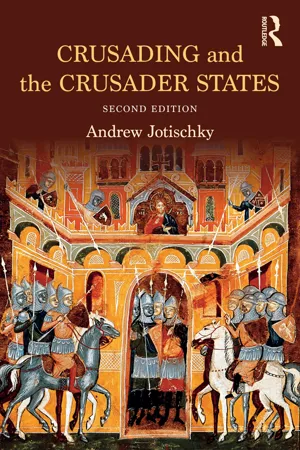 eBook - ePub
- Andrew Jotischky(Author)
- 2017(Publication Date)
- Routledge(Publisher)
Briefly, in the early months of 1300, it looked as though Jerusalem might be recovered for Christendom. The Mongol il-khan, Ghazan, won a dramatic victory over the Mamluks at Homs, in northern Syria. When the news reached the West, diplomatic efforts were launched to revive the Frankish–Mongol alliance, this time with Armenian help. This was the best opportunity for recovering the holy city since the 1240s, and it seemed particularly apt that in 1300, the year proclaimed by Pope Boniface VIII as a ‘Jubilee Year’ for Christendom, Christian forces – albeit Armenians rather than Franks – should have entered Damascus and Jerusalem in triumph (Schein 1979: 805–19). According to western chroniclers, Ghazan wrote asking for westerners to come and resettle the Holy Land. Henry II of Cyprus, eager to press the advantage, sent sixteen galleys to raid Alexandria, while Amaury of Tyre and a force made up from the Military Orders tried to occupy Tortosa. In fact, they maintained a small garrison off the island of Ruad, only a few hundred metres from the shore, for eighteen months, before a Mamluk fleet overcame them (Crawford 2001: 157). But if the Mongol victory showed that it was possible to defeat the Mamluks in battle, its aftermath demonstrated how ephemeral the results of such victories were in reality. After a brief and largely symbolic occupation of Jerusalem, Ghazan withdrew to Persia, and a year later was unable to coordinate his forces with the Cypriots. In 1303 he once again invaded Syria, but this time he was defeated by the Mamluks, and a year later he died. In fact, what looked in western chronicles like an apocalyptic liberation through the instrument of God was nothing more than an episode in the long-running struggle between Mongols and Mamluks for mastery of the Levant (Schein 1991: 167–75). The irony is that the instrument of God, Ghazan, had in 1295 converted to Islam. His ‘conquest’ was motivated by territorial rather than religious aspirations. Moreover, the kingdom of Cyprus, though a valuable asset as a potential base for a crusade, did not have the military resources to initiate an assault on the mainland, and in the early years of the fourteenth century the internal politics of the kingdom were not conducive to such activity. The installation of the Military Orders on the island gave rise to tensions that Henry II (1285–1324) was unable to calm; indeed, between 1306 and 1310 he lost his throne to his brother in an outbreak of dynastic civil war (Edbury 1991: 101–40).Crusade planning continued regularly throughout the first half of the fourteenth century, but it became increasingly difficult to put well-conceived projects for the recovery of the Holy Land into practice. In part, this was the inevitable consequence of the passage of time, for the longer the Holy Land was in Muslim hands, the easier it was for Christendom to become accustomed to the idea of not having possession of its spiritual treasures. By 1336, when the last serious attempt by the French monarchy to launch a crusade collapsed, only people in middle age could remember a time when any part of the Holy Land had been in western possession, and one would have had to be elderly to recall a flourishing state in the Levant. And of course, the Mongols’ failure to dominate western Asia as they did eastern, and the collapse of Armenian Cilicia as an effective independent power, meant increasingly that all the work of conquest would have to be done from the West. This had been the case also in 1095, but the First Crusade advantage of a moment of unique dislocation in the political climate of the Near East – and it had also been singularly lucky in succeeding even in such conditions. Turkish political unity more or less since the collapse of Fatimid Egypt in 1169–71 meant that those conditions were never again repeated.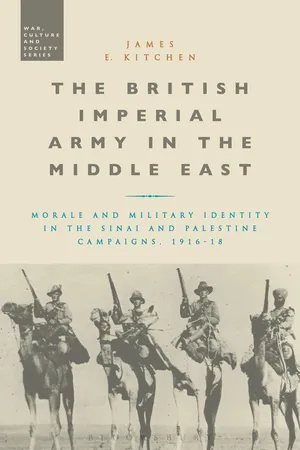 eBook - PDF
The British Imperial Army in the Middle East
Morale and Military Identity in the Sinai and Palestine Campaigns, 1916-18
- James E. Kitchen(Author)
- 2014(Publication Date)
- Bloomsbury Academic(Publisher)
It was not only noted publications, politicians and government propaganda that referred to the Middle Eastern campaign in terms of its crusading and religious elements. At a parochial level in Britain, community organizations and the regional press drew on similar rhetoric to portray the actions of local men and units in terms of a wider discourse on the aims of the war. The Northampton Independent , for example, produced a cartoon in April 1917, in a somewhat more simplistic style than those of Partridge, which depicted a British soldier shaking hands with a crusader in the Holy Land (see Illustration 2.3). The cartoon was headed ‘History Repeated after Eight Centuries’ and was followed by a brief article explaining the details of the medieval reference. The paper pointed to the fact that the 1/4th Northamptonshires were currently serving in Palestine and were on the same ground that the crusader Simon de Senlis, the first Earl of Northampton, had fought over 821 years before. It was described as ‘a romantic coincidence’ that the battalion, whose commander worshipped at the church constructed by returning crusaders in Northampton, should be ‘marching over the same hallowed ground, fighting against the same enemy, and for the same object as did the Crusaders of old’. 24 In Norwich similar sentiments were expressed during a May 1917 memorial service for Major W. H. Jewson and Captain S. D. Page of the 1/4th Norfolks, killed at Second Gaza. The Reverend Albert Lowe, of the Prince’s Street Congregational Church, stated that the regiment was fighting ‘against the Turk with a view to ridding the Holy Land of his corrupting presence’. 25 The rhetoric of The Crusades was thus prevalent among a number of communities whose local units were serving with the EEF in Palestine. It is also notable that both of these examples predate Allenby’s entry into Jerusalem by over half a year.
Index pages curate the most relevant extracts from our library of academic textbooks. They’ve been created using an in-house natural language model (NLM), each adding context and meaning to key research topics.

