History

Crusader states
The Crusader states were a group of feudal states established by Christian European crusaders in the Eastern Mediterranean during the 12th and 13th centuries. These states were set up in the aftermath of the First Crusade and included territories such as the Kingdom of Jerusalem, the County of Tripoli, the Principality of Antioch, and the County of Edessa. They played a significant role in the history of the Crusades.
Written by Perlego with AI-assistance
Related key terms
1 of 5
12 Key excerpts on "Crusader states"
 eBook - ePub
- Peter Lock(Author)
- 2013(Publication Date)
- Routledge(Publisher)
VI CRUSADES, CRUSADING AND THE Crusader states WHAT WAS A CRUSADE? The term ‘crusade’ is a modern not a medieval term. Its application as a title for the crusade movement seems to be no earlier than 1638 in Western Europe. Muslim sources did not distinguish between western pilgrims, crusaders, or settlers, labelling them all as Franks (al-Franj). It is only in the twentieth century that the literal term for crusade, al-salibiyyun, enters Arabic historical ‘riting. Interestingly, ‘rabic, Romance and Germanic words for ‘crusade’ derive etymologically from their word for ‘cross’, and thus emphasise the symbol of the cross in crusading activity 1 From the days of Gibbon there has been general agreement that the Crusades represented a turning point in European history, defining the nature of European identity and telling us as much about European medieval history as about the history of the Middle East. Until the present century this has led to a Eurocentric approach to crusading history. In the same vein Jewish historians thought that the Crusades exercised a profound influence on Jewish culture in Europe, and since the 1960s have traced the roots of the Holocaust back to the First ‘rusade. 2 Since the 1960s a debate regarding the unambiguous definition of the term ‘crusade’ has developed between the so-called traditionalists and the pluraliste The former hold that only those expeditions aimed at the recovery or defence of the Holy Land should be considered crusades, whilst the latter maintain that all expeditions authorised by the papacy with the concomitant crusade privileges, preaching and recruitment should be considered crusades. 3 The first approach privileges place — that is, the Holy Land — as the destination that made a true crusade. The second approach emphasises the procedural and organisational nature of crusading expeditions regardless of their destination eBook - PDF
- Ronnie Ellenblum(Author)
- 2007(Publication Date)
- Cambridge University Press(Publisher)
Aware of the military force they could muster against the Muslims, the Crusaders speedily began erecting a network of fortresses, some of them quite impressive, others less so, that were intended to defend their estates against incursions. The lords of these castles, together with their vassals, took up permanent residence in them to maintain guard. 26 Several scholars, such as Raymond Smail, also attributed administrative and organisational functions to the fortresses, but these were considered by most of them to be secondary roles and of limited importance. The Latin Kingdom of Jerusalem is therefore depicted as a sort of centralised state, with clearly delineated borders and the capacity to define clear and agreed-upon spatial policies aiming to secure the defence of the realm (by creating fortified centres in the right locations) and the rational distribution of population. Thus, the forging of a new historiographical approach to the Crusades by Smail and Prawer during the early 1950s was a major conceptual change similar to the one established 120 years earlier, when Jean Franc ¸ois Michaud first introduced the nationalist and colonialist discourses into 25 Prawer, 1980b, 102. 26 Richard, 1980, 556. Colonial and anti-colonial interpretations 55 Crusader historiography, and the even more important introduction of Rey’s ideas forty years later. During the second half of the nineteenth and the first half of the twentieth century, scholars tended to view both the Frankish settlers and the local inhabitants as forming different parts of one colonial society; there were constant disputes over questions such as who had greater influence on developments in armour, castles, ways of life, and laws, etc., the European newcomers or the indigenous populations, but they were both considered as forming the same society. eBook - ePub
The Crusades
A Beginner's Guide
- Andrew Jotischky(Author)
- 2015(Publication Date)
- Oneworld Publications(Publisher)
The Crusader states lasted about two hundred years on the Asian mainland before the Franks were themselves displaced by military conquest in 1291. Crusading itself, however, continued to take place well into the sixteenth century. Even before the fall of the Crusader states, crusading had been extended into other geographical areas: not only to places where Muslims lived, such as Spain, but into the north-east of Europe where the concept of holy war was applied against the pagan Livonians, and even into the heartland of Western Christendom, to aid in the Church’s struggle against heresy. In the fourteenth and fifteenth centuries, the rise of the Ottomans aroused fears of a Turkish invasion of Christendom, and crusading changed its focus to mobilize Europeans to meet this new threat. Crusades in the later Middle Ages were launched against a wide variety of targets: not only the Turks, but also political enemies of the papacy. The Spanish Armada of 1588 borrowed from the language developed centuries earlier for crusading. The concept of holy war for the purposes of converting the world to Christianity, which became one of the justifications for crusading in the Middle Ages, was also used to rationalize the conquest of the New World by Spain in the sixteenth century.Everyone knows, or thinks they know, what is meant by the term ‘crusade’, but even professional historians find it difficult to agree on a definition. One reason for this is that, surprisingly perhaps, the word ‘crusade’ was not used by or even known to the original crusaders. Instead, they were usually known simply as ‘pilgrims’, and the Crusades themselves as ‘the business of the cross’. The word ‘crusader’ first appears in the twelfth century to describe someone who had ‘signed himself with the cross’ – literally, adopted the sign of the cross on his clothing as a public sign of his vow to undertake the holy war – but did not become common until about a hundred years after the First Crusade. As a noun describing an event or phenomenon – the holy war – the term took even longer to emerge and was not in common use until the seventeenth century. The implications of this are worth dwelling on. For one thing, it could suggest that people at the time had no real need for a special word to characterize what they were doing. Moreover, it could mean that they did not regard what we think of as crusading as anything particularly special. Perhaps a crusade was simply a different kind of war, waged against a new enemy – the Muslims – or in a particular part of the world. But this does not seem wholly convincing, because, in fact, we know that people did eBook - PDF
- Jaroslav Pelikan(Author)
- 2008(Publication Date)
- Yale University Press(Publisher)
The Turks in Anatolia were now alert to the threat posed by crusaders and aware of their opponents' military shortcomings. They defeated the newcomers comprehensively in a series of engagements in 1101, so little assistance reached those who'd stayed behind in the Holy Land. Nonetheless, the capture of Tripoli in 1109 meant that a cluster of important cities were in Christian hands and these formed the nuclei for four states: the kingdom of Jerusalem, the principality of Antioch, and the counties of Tripoli and Edessa. The Latin East was born. The gestation of the Second Crusade In most respects the states that the first crusaders founded in the East lived separate lives, quarrelling with each other just like states in Europe. But they also had shared interests as a group, and these made it certain that crusading would enjoy a long future. Circumstances forced their rulers to become adept at lobbying for help. All too few Christians could be persuaded to settle permanently in what they called outremer ('beyond the sea'). It's been esti-mated that the total number of knights owing military service to the Latin rulers of Palestine and Syria reached no more than 2,000. It followed that if these lands, and above all Jerusalem, were going to be defended against the Muslims, then their fellow Christians in the West would have to come out to the East to help them on a temporary basis. There was never any credible alternative to this military assistance taking the form of further crusading. The need was established twenty years after Jerusalem's capture, when a brief period of Christian belligerence fizzled out, and was followed by a powerful 8 FIGHTING FOR THE CROSS Islamic counter-offensive. This stemmed not from Fatimid Egypt nor from the Seljuq heartland in Iraq but from a Turkish dynasty based at Mosul and Aleppo, whose first protagonist was the warlord Zengi. eBook - ePub
Saracens and Franks in 12th - 15th Century European and Near Eastern Literature
Perceptions of Self and the Other
- Aman Y. Nadhiri(Author)
- 2016(Publication Date)
- Routledge(Publisher)
7 Western Europeans in Muslim accounts of the Crusades The sudden appearance of thousands of soldiers from Western Europe in the Levant in 1097 was both wholly unexpected and militarily and politically devastating for the Muslims of the area. As a region, the Levant was disorganized, fragmented, and militarily vulnerable to outside interference, and had been so for a few years; the result of the Western European invasion was a number of sweeping, stunning European victories, and the establishment of “Crusader states” in relatively short order. The newly established Latin Kingdom of Jerusalem (comprised of Jerusalem, Antioch, Tripoli, and Edessa) was protected militarily by its supply of European soldiers in the Levant and its access to reinforcements on continental Europe, and politically by both the support it received from Europe and by the inter-necine feuding between the Muslim leaders in the surrounding areas, who appeared to prefer the existence of a kingdom ruled by Christian Europeans to the prospect of a Muslim ruler increasing his sphere of influence through the recovery of the Crusader-controlled areas at the expense of the territorial integrity of his Muslim neighbors. 1 The lack of unity among the Muslims not only ensured the continued existence of the Crusader states, it allowed for their expansion in the early twelfth century, as other parts of the surrounding area were conquered by the Crusaders, thus strengthening the nascent European community in the Levant eBook - PDF
Pilgrims’ Castle (‘Atlit), David’s Tower (Jerusalem) and Qal‘at ar-Rabad (‘Ajlun)
Three Middle Eastern Castles from the Time of the Crusades
- C.N. Johns, Denys Pringle(Authors)
- 2019(Publication Date)
- Routledge(Publisher)
This material may serve to illustrate the more per m anent aspect of the Crusades, the everyday life of the colonists in contact with the native population. The Crusading occupation lasted for nearly two centuries, from 1099 to 12 9 1 . It reached its greatest extent within the first twenty-five years, covering rather less territory than the modern mandates in Pales tine and Syria, but as four distinct feudal states: ( 1 ) The kingdom of Jerusalem, corresponding to the present British mandate with the addition of most of the Grand Liban, but with only the southern end of Transjordan, from the Dead Sea down to Aqaba. ( 2 ) The county of Tripoli, corresponding to the republic of the Alaouites under the French Mandate with the rest of the Grand Liban, but without the heart of the ‘Ansariya Mountains, and as to-day with out Damascus, Hom s or Ham a. ( 3 ) The principality of Antioch, now the west corner of the inland State called Syrie, then without Aleppo, but with a protectorate over the kingdom of Lesser Armenia, centring in the territory in Cilicia which the French relinquished to Turkey just after the Great W ar. ( 4 ) The county of Edessa, now almost altogether outside Syrie and part of the republic of Turkey. These four states included the whole coast from Gaza to Alexan- dretta, with the exception of Ascalon, which held out until 1 1 5 3 . But geographically the three southern states included only three of the zones covered by the modern mandates—the coastal plain, the coastal range, and the central rift valley, but not the eastern barrier or edge of the desert beyond. Generally speaking, the central rift valley, the line of the Orontes and Jordan, formed the boundary. The Latin kings of Jerusalem exercised a nominal suzerainty over the other three states, effective only under two energetic kings like the first two Baldwins. eBook - ePub
Controversial Histories – Current Views on the Crusades
Engaging the Crusades, Volume Three
- Felix Hinz, Johannes Meyer-Hamme, Felix Hinz, Johannes Meyer-Hamme(Authors)
- 2020(Publication Date)
- Routledge(Publisher)
crozata appears around 1215 as the designation for the royal army in the Albigensian Crusade. Over time, the concept of ‘Crusade’ has taken on a different meaning. It came to mean a holy war waged for control of the Holy Land, involving fighting against the ‘unbelieving’ occupiers of the Near East, Egypt and the Ottoman Empire. It then took on the meaning of a religious war to impose by force one dominant religious model over another (“Catharism”, 16th century Reforms); it was used to justify territorial conquests and, in the south of France since the 19th century, to legitimize resistance to the centralizing state; French vocabulary applies it today by extension to anti-Western ideologies of religious origin, Islamism or Hinduism. The example of the Latin Kingdom of Jerusalem (1101–1291) shows, from the first decades, the malleability of Western models. Early on, this idea was supercharged with religiosity; yet, its religiosity cannot cover up the reality of violence, not then and not today.The historian cannot remain silent in the face of the contemporary reclaiming and retelling that attempt to connect the far off past of the 11th and 12th centuries – which were characterized by uncontrollable actions of the world powers – with the present. Those who attempt to make this connection dream of restoring order in accordance with old and past ideas. Was this not the intention of those in the 11th and 12th centuries who created the concept that they called, ‘Christendom’?It is no longer possible to speak and to write about the Crusades without denouncing, indicting or clarifying a remarkable past, which Western societies too easily accept. This was not the problem of the French historians when they rekindled knowledge of the Crusades during Napoleon’s expedition to Egypt. They revived a topic that had been hidden ever since the Battle of Lepanto. In the very moment that the French took possession of Algeria (1830–1848), these historians resolved to take up the publication of the Recueil des Historiens des Croisades , which still influences contemporary academic research. This resulted in the concept being limited to the expeditions to the Holy Land for far too long. One of the consequences of this was that the concept of Crusade – typical for the 19th century – remained closely connected to the notion of ‘Christendom’, sharing a connection to the enterprise of colonialism. Both were conceived as advancing civilization. The activity of the future Cardinal Lavigerie in Algeria from 1868 and the intervention of the “Papal Zouaves” in the defence of the Papal States in 1869–1870 bear witness to this in two different ways. Moreover, structuralism – which dominated during 1960 to 1970 – had strongly affected the circles of French historians (or more simply: French historians). Here, the subject of ‘Crusades’ was largely marginalized, as it was equated with the history of slaughter (e.g. the founder of the Annales eBook - ePub
- John France(Author)
- 2023(Publication Date)
- Routledge(Publisher)
Warfare in the Mediterranean Region in the Age of the Crusades, 1095–1291 A clash of contrastsCrusading warfare in the twelfth and thirteenth centuries was marked by a fascinating clash between the Turks, who employed a highly mobile and fluid fighting pattern, and westerners, whose methods revolved around a relatively slow-moving style based on mass and solid formation.Medieval warfare in Western Europe in the age of the crusades is often symbolised by the castle and the knight, and this does express a certain reality. The economy of the west was overwhelmingly based on land, which does not produce much liquidity – cash. This meant that the medieval state could not easily collect taxes to pay for bureaucrats and standing armies. The soldiers had to have their own resources, land, to enable them to equip themselves and their followers.1 As medieval society was not an equal but a deeply unequal society, great men with great estates played the leading role in politics and warfare, and they were very difficult to control. They enjoyed de facto governmental power because kings without articulated administrations had to delegate power. In turn, great men could not be everywhere, and they had to delegate to others. In effect, society was dominated by the patronage-spheres of great men, their mouvances, within which those wealthy enough to serve as fully equipped soldiers were especially privileged and enjoyed a position of negotiation with, rather than full subordination to, their masters.2 Moreover, it is not sufficiently appreciated that their estates were not great blocks, but packets scattered across the countryside interpenetrating with the lands of others. An English example is Aubrey II de Vere (1108–41), who inherited the lands acquired by his father in the Norman Conquest in Essex, Suffolk, Cambridge, Huntingdon and Middlesex. His son, Aubrey III, was made Earl of Oxford, and in celebration he built the magnificent Hedingham Castle on the Suffolk-Essex border, where the family estates were densely concentrated.3
- David Jacoby(Author)
- 2017(Publication Date)
- Routledge(Publisher)
4 David JacobyThe Economic Function of the Crusader states of the Levant: a New ApproachFour Frankish states emerged in 1098–1099 in the Levant as a result of the First Crusade: the Kingdom of Jerusalem, the County of Tripoli, the Principality of Antioch, and the County of Edessa in northern Syria.1 The first three states, which extended along the Levantine coast, pursued their existence for more than a century and a half, although their borders changed repeatedly over time. The county of Edessa disappeared as early as 1150. This contraction of Frankish territory in the Levant was followed by a far more important one. In 1187 the Egyptian sultan Saladin defeated the Franks at the battle of Hattin, captured Jerusalem, and occupied large sections of the Frankish states. The Franks regained some territory in 1191–1192, in the wake of the Third Crusade, and again for two short periods in the first half of the thirteenth century. However, for most of that century they were limited to a strip of land along the Levantine seaboard. From 1265 onward the conquests made by the forces of Mamluk Egypt gradually reduced the territory of the Frankish states, and in 1291 they put an end to Frankish presence in the Levant.Various aspects of the economy of the Frankish Levant have been investigated. Most studies focus on maritime trade, following the lead provided by two great historians, Wilhelm Heyd and Adolf Schaube, whose respective books published in 1885–1886 and in 1906 paved the way for a detailed study of twelfth and thirteenth-century trade in the eastern Mediterranean, the period covering the existence of the Frankish states.2 Heyd and Schaube collected a considerable amount of information, yet exclusively from published sources. Their books remain indispensable, although much new evidence has come to light since they were published. The geographic and chronological range of Heyd’s work is broader, since in addition to the Mediterranean it covers the Black Sea and the Middle East and reaches the fifteenth century. On the other hand, Schaube limited himself to the Mediterranean and its fringe, which included the Frankish states, and to the period ending roughly in the mid-thirteenth century, before the full economic impact of the Mongol expansion was felt in the Levant. The two authors nevertheless shared the same approach, molded by the prevailing political and economic concepts of their times, the colonial era. Their emphasis was upon the expansion of the western maritime powers in the eastern Mediterranean, long-range trade and shipping, and the activity of traveling merchants. They treated separately each of the regions bordering the eastern Mediterranean, namely, Byzantium, the Frankish states, and the states of the Islamic East, in a context of bi-lateral commercial exchanges and shipping links between West and each of the eastern political entities. Heyd and Schaube viewed the trans-Mediterranean trade system as operating according to a ‘colonial’ pattern, in which the West had a dominant and dynamic role and exploited the resources of the underdeveloped eastern Mediterranean regions, including the Frankish states, which merely reacted to western stimulus and had an essentially limited function: they produced certain foodstuffs and raw materials, as well as some industrial commodities and mainly served as intermediaries between the West and Islamic Asia, which provided Oriental commodities largely in exchange of Western finished products. Within that framework the two historians considered the Frankish Levant a political and economic extension of Europe, at the edge of the region in which the West expanded. They viewed the Frankish settlers as western colonizers mainly furthering the interests of their respective cities of origin. The Eurocentric and bi-polar perspective adopted by Heyd and Schaube appears to be justified by the extant evidence, which will soon be examined. Their approach has been widely shared in the past and still is nowadays.3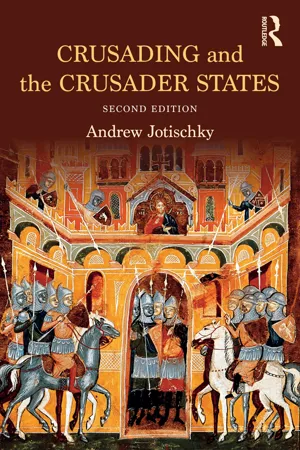 eBook - ePub
- Andrew Jotischky(Author)
- 2017(Publication Date)
- Routledge(Publisher)
9 Crusading and the Crusader states in the thirteenth century, 1217–74Key Dates 1217 Fifth Crusade attacks Mt Tabor 1219 Fifth Crusade captures Damietta 1221 defeat of Fifth Crusade 1225 Emperor Frederick II marries Isabel II of Jerusalem, assumes title of king 1228 excommunication of Frederick II 1229 return of Jerusalem to Frederick II 1232 imperialist forces routed in Cyprus 1239–41 ‘Barons’ crusade’ 1244 Kharazmian Turks recapture Jerusalem; kingdom of Jerusalem suffers heavy defeat at La Forbie 1249 Louis IX captures Damietta 1250 battle of Mansurah; failure of Louis IX’s crusade Crusading saw some new departures in the thirteenth century, among which was a shift in the focus and target of large-scale expeditions. The Fifth and Seventh Crusades were launched against Egypt rather than the Holy Land, although the intention was still the recovery of Jerusalem. This shift represents both new military strategies and a more subtle change in the western perception of crusading. In this chapter, three crusading expeditions are examined in turn and the reasons for their varying fortunes analysed. The main themes that emerge are:• conflicting interests of western crusaders and Frankish settlers in the East;• the narrow margin between military success and failure;• the continuing problem of dynastic succession in the Crusader states.The challenge of Egypt: the Fifth Crusade, 1217–21
The crusade that Innocent III had announced in his bull Quia maior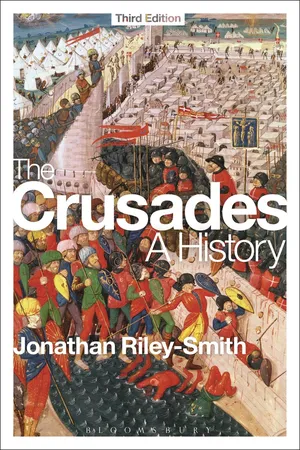 eBook - PDF
- Jonathan Riley-Smith(Author)
- 2014(Publication Date)
- Bloomsbury Academic(Publisher)
Few crusaders can be found in the region between 1102 and 1147, but there was enthusiasm for pilgrimages to Jerusalem, the lead being taken by Count Hugh I. One is left with the impression that in much of western Europe crusading became dormant after all the efforts associated with the First Crusade. To many armsbearers that expedition must have seemed a unique chance to engage in a particularly appropriate meritorious activity. Now they turned back to their traditional devotions, to be recalled only in 1146, when Bernard of Clairvaux preached the new crusade as another once-and-for-all opportunity of self-help on one’s passage to heaven: [God] puts himself into a position of necessity, or pretends to be in one, while all the time he wants to help you in your need. He wants to be thought of as the debtor, so that he can award to those fighting for him wages: the remission of their sins and everlasting glory. It is because of this that I have called you a blessed generation, you who have been caught up in a time so rich in remission and are found living in this year so pleasing to the Lord, truly a year of jubilee. The early crusades of the twelfth century Nevertheless, the years between the First Crusade and the so-called Second Crusade were eventful. They witnessed the definitive extension of crusading to the Iberian peninsula, although one of the most important campaigns CRUSADING IN ADOLESCENCE, 1102–87 141 there may not have been a crusade at all. In 1118 Pope Gelasius II formally legitimized a war, to be led by King Alfonso I of Aragon, against Saragossa (Zaragoza). The city, the most important prize to be seized since Toledo, fell on 19 December to a large army which included in its ranks the first crusaders Gaston of Béarn and Centulle of Bigorre, and also Alfonso Jordan, the count of Toulouse, who had been born in Syria, and the viscounts of Carcassonne, Gabarret and Lavedan.
- John France(Author)
- 2006(Publication Date)
- Routledge(Publisher)
There is no comparable study for any other crusader state, except for a significant work on the early history of Antioch, T. Asbridge, The Creation of the Principality of Antioch 1098–1130 (Woodbridge: Boydell, 2000). The most useful accounts of the early history of the crusader settlements are provided by H. S. Fink, ‘The Foundation of the Latin States, 1099–1118’ and R. L. Nicholson, ‘The growth of the Latin states, 1118–44’, in Setton, Crusades 1, 369–409, 410–48. For the strategic consequences of this, see France, Western Warfare, 204–29. There are biographies of most of the leaders of the First Crusade, and amongst these that of Yewdale, Bohemond I is perhaps the most useful for the present subject. On Zengi and the rise of the Muslim jihad there is an excellent short study by C. Hillenbrand, ‘“Abominable Acts”: the career of Zengi’, in J. P. Phillips and M. Hoch (eds), The Second Crusade. Scope and Consequences (Manchester: Manchester University Press, 2001). On the Byzantine interest in the area there is a detailed study by R. J. Lilie, Byzantium and the Crusader states 1096–1204, tr. J. C. Morris and J. E. Ridings (Oxford: Oxford University Press, 1994) and the wider diplomatic context of the crusader settlements the key study if that of J. P. Phillips, Defenders of the Holy Land. Relations between Latin East and the West 1119–87 (Oxford: Oxford University Press, 1996). Study of the ruling elite of the European settlements, and especially the Kingdom of Jerusalem, has generated a long-running controversy on the question of whether the lords dominated the crown or were dominated by it. Currently, opinion leans to the view that the monarchy was actually very strong. A very useful study of the European elite is provided by S. Tibble, Monarchy and Lordships in the Latin Kingdom of Jerusalem 1099–1291 (Oxford: Clarendon, 1989). The best introduction to the study of their castles is that of H
Index pages curate the most relevant extracts from our library of academic textbooks. They’ve been created using an in-house natural language model (NLM), each adding context and meaning to key research topics.

