History

Saladin
Saladin was a Muslim military leader and the first sultan of Egypt and Syria. He is best known for his role in the Crusades, particularly for his victory over the European Crusaders at the Battle of Hattin in 1187. Saladin's military prowess and his efforts to unite the Muslim world have made him a revered figure in Islamic history.
Written by Perlego with AI-assistance
Related key terms
1 of 5
12 Key excerpts on "Saladin"
 eBook - PDF
Saladin
Empire and Holy War
- Peter Gubser(Author)
- 2010(Publication Date)
- Gorgias Press(Publisher)
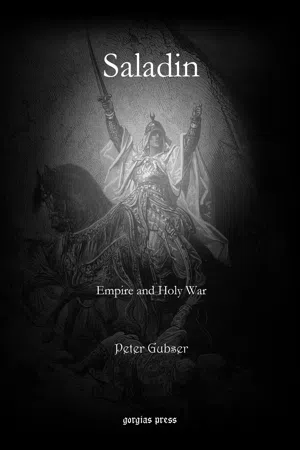
407 C HAPTER F IFTEEN S ALADIN : A N A SSESSMENT During his life, Saladin generated far-reaching change in the Middle East by profoundly altering the region’s landscape in political, geographic, religious, and ethnic terms. In the West, he is famous for sharply curtailing the Crusader presence in the region, but also for the chivalrous and honorable way he dealt with adversaries and neighbors. In Muslim lands, he is well known—even lionized by some—for his success vis-à-vis the Crusaders. His achievements in other spheres also notably influenced the course of Middle East history. First, Saladin built a new empire from Egypt, North Africa, and Yemen to Syria, Palestine, Lebanon, northern Iraq, and parts of Anatolia. Second, by eliminating Fatimid rule in Egypt as he built his Ayyubid Empire, he deracinated Shia Islam from that strategic country. Third, the Seljuk Turks and their Turkish successors had ruled large sections of the Middle East. With the ascendancy of Saladin, a man of Kurdish heritage, the role of the Seljuk Turks declined, to be replaced by a more varied group— Kurds, Turks, Arabs, and others—but with a unifying Muslim identity. To accomplish these various aspects of his career, Saladin used many assets and tools. He learned leadership and military skills from his suzerain Nur al-Din as well as his father Ayyub and his uncle Shirkuh. As his empire expanded, he quickly turned to family members—father, uncles, brothers, sons, and nephews—for support and relied upon them to administer his provinces and help lead his army. In a broad sense, to fund his military, the crucial institution for extending his realm, he depended on the Egyptian economic engine. In addition, as he established suzerainty over new territories, he acquired additional resources, men, and material, for further expansion in both Muslim lands and against the Crusaders. To gain the loyalty of certain key groups—his military, eBook - ePub
Downfall of the Crusader Kingdom
The Battle of Hattin and the Loss of Jerusalem
- W B Bartlett, W. B. Bartlett(Authors)
- 2011(Publication Date)
- The History Press(Publisher)
This is not the view that seized the imagination of the Islamic world. Here, Saladin was a warrior who fought himself to a standstill in the cause of his faith. The story has all the classic ingredients of a young, worldly man who later turned to religion to find greatness. In his early years, Saladin was headstrong, ruthless and ambitious. But then, late in life, he was the victim of a potentially terminal illness. As he hovered in the shadow lands between life and death he took a solemn vow that, should he recover, he would devote himself to the service of Allah. When the recovery was granted, he sought to make good his pledge.His timing was impeccable. His birth and meteoric rise coincided with a resurgence of the concept of jihad against the enemies of Islam in the Middle East. Such feelings had never gone away but the twelfth century had seen a re-emergence of the concept.2 Saladin did not ignite the flame – it had sparked into life long before he emerged – but he seized the moment and the prize that went with it: an assured place of honour among the annals of Islamic history as a religiously inspired warrior who restored pride to the Muslim world by the recovery of lands sacred to the faith.The conquest of the Holy City of Jerusalem by the Crusaders was an insult to Muslim sensibilities. The great slaughter that had attended the triumph of the First Crusade in 1099 also cut to the quick. The massacre of so many, regardless of age or sex, had horrified Islam. It also shocked because the Muslim world saw itself as culpable for the loss: its disunity at the time had allowed the atrocity to occur. Saladin, a devout Muslim, saw the continued Christian ownership of Jerusalem as a dark stain of dishonour that must be washed clean. He would devote his energies, and ultimately his life, to the recovery of Jerusalem, and it was for this that he is best remembered in Islam.But commentators from both sides painted a portrait of Saladin that is far from black and white. Frankish chroniclers, although they might recognise some of his chivalric traits, also sought to blacken other elements of his character. An early thirteenth-century chronicle, Itenerarium Regis Ricardi, as well as describing him as ‘this great persecutor of Christianity’, also tells how he made his fortune by acting as a pimp for prostitutes in Damascus. He then bribed his way into the good offices of key men in the Islamic leadership at that time: ‘the money he thus obtained by pimping he lavished on entertainers, purchasing the people’s indulgence for all his whims by displays of generosity’.3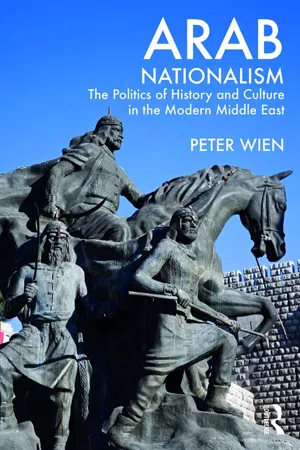 eBook - ePub
Arab Nationalism
The Politics of History and Culture in the Modern Middle East
- Peter Wien(Author)
- 2017(Publication Date)
- Routledge(Publisher)
23To add another dimension, there are also countless examples for a literary rendering of the Saladin myth in the twentieth century.24 Arab authors of the nahda prepared the way for a twentieth-century Saladin revival when they participated in the invention of a tradition that presented Saladin as the vanguard of Arab liberation. Writers experimented with literary genres they found in European culture (novels, plays, essays), picked up European themes and filled them with Middle Eastern content, as in the case of Saladin – half-myth, half-historical figure – who they used as a mirror for European Orientalism. In nineteenth-century romantic literature such as Sir Walter Scott’s Talisman , Saladin represented the opposite of the genre’s stereotypes that viewed the Oriental as a lazy, cruel, and voluptuous squanderer.25 Egyptian and Lebanese theater companies staged Saladin plays in the last quarter of the nineteenth century that were either translated from or based on works in European languages. An example is Nagib Sulaiman Haddad’s Riwayat Salah al-Din al-Ayyubi . Haddad (1867–1899), a Maronite Christian residing in Egypt, was an influential translator of European drama. His Salah al-Din , first staged in Alexandria in 1895 and printed in 1898, may have been “inspired” by Scott’s Talisman , but it is not a mere translation.26 Even a cursory reading of both works reveals that the Egyptian author merely used themes from Scott’s book, most importantly the topos of the immediate interaction between Salah al-Din and Richard the Lionheart, but constructed a new storyline to develop a new piece of art in elaborate Arabic prose and verse. In that, he and many other Arab writers did not differ from European playwrights who borrowed from Greek tragedy to express the concerns of current days. Al-Haddad adopted some of the characters of Scott’s play, but gave different names to some central figures. Some of the central elements of the plot in Scott’s novel recur in Haddad, such as the motif that Saladin cured Richard the Lionheart from a disease as a doctor in disguise, but while he followed the basic narrative line, he changed the perspective awarding Saladin the central position from the beginning of the play, giving him most of the play’s talking time in monologues and conversations with his friend ‘Imad al-Din, who is not part of Scott’s set of characters at all.27 eBook - ePub
Jinnah, Pakistan and Islamic Identity
The Search for Saladin
- Akbar Ahmed(Author)
- 2005(Publication Date)
- Routledge(Publisher)
Muslim heroes in history are sometimes men of ideas like Al-Beruni (in the tenth-eleventh century) and Ibn Khaldun (fourteenth-fifteenth century) but are usually men of action like Tariq, who conquered Spain in the eighth century, or Babar, who established the Mughal dynasty in sixteenth-century India. The heroes who are immortalized are those who combine Muslim tradition and a dramatic victory at a time of general crisis, such as Saladin.Saladin is the leader par excellence, as described in the preface to a popular book written by a Muslim author, Hundred Great Muslims: ‘Saladin the Great (Sultan Salahuddin Ayyubi)…was a symbol of Muslim unity and solidarity, piety and strength’ (J.Ahmed 1977 ). Contemporary Muslims everywhere look for Saladin, whether in Britain (Werbner 1990 :55) or in India (Kakar 1995 :221) or in the Arab world (see the article by David Hirst in the Guardian, ‘Divided Muslim peoples yearn for a new Saladin’, 12 December 1992); even Saddam Hussein exploited this yearning by encouraging his press to project him as another Saladin during the Gulf War.Among Muslims, Saladin’s name is synonymous with courage, compassion, integrity and respect for culture. My use of Saladin in the sociological imagination is not to be taken literally; it is a metaphor, a cultural construct, an ideal-type. In this manner an analogy can be made between Saladin and Jinnah.Saladin and Jinnah are both known in history for their victory—Saladin recapturing Jerusalem, Jinnah winning Pakistan. Although they are an unlikely pair, none the less they have much in common. Both were outsiders in mainstream Muslim society. Saladin was not an Arab in a world dominated by the Arabs and their language; indeed, he was a Kurd, a tribal people with their own culture and language. Jinnah did not belong to the culture of the United Provinces (UP) and Punjab which dominated the Muslims of India. He was from the Sind, originally Gujarat, and was a member of one of the minor sects within Islam. He did not speak Urdu, the main language of North India; nor did he dress or behave like those who lived in the UP and the Punjab. Both Saladin and Jinnah took on the most renowned opponents of their age, almost mythical in stature. Saladin fought against Richard the Lionheart and Jinnah challenged Mountbatten, Gandhi and Nehru.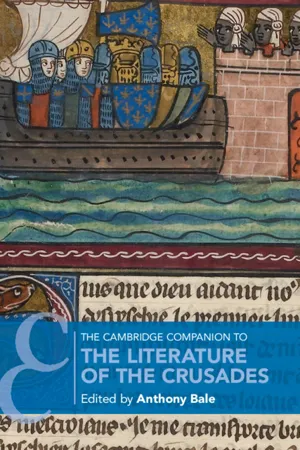
- Anthony Bale(Author)
- 2019(Publication Date)
- Cambridge University Press(Publisher)
5 Salāh al-Dīn was a Kurd rather than an Arab, who rose to prominence through service rather than illustrious birth, and within a century of his death, he was a footnote in Arabic sources. It was not until nineteenth- and twentieth-century decolonisations, that Salāh al-Dīn became lionised as a rallying symbol of pan-Arab unity and resist- ance to Western colonial aggression. 6 By contrast, the Latin Christian world gave both Richard I and Saladin almost instant legendary status. What is fascinating is how very different their Saladin and Richard I 171 171 legends quickly became. Richard Lionheart, especially in the Old French Pas Saladin and the Middle English RCL (c. 1300), continues as an orientalist’s dream – he enacts implacable cultural conflict between Latin Christians and non-Latin Christians – whether they are Muslim, Jewish, pagan, Saracen, or Eastern Christian. By contrast and more surprisingly, Saladin’s legacy is not cultural division but cultural entanglement. Saladin stories thematise relationships across enemy lines, beneficial mutual alliance, and economies of breath-taking generosity. Tales such as The Ordène de Chevalerie, the fifteenth-century romance of Saladin and its thirteenth-century prequel, La Fille de Compt de Pontieu from the Old French Crusade Cycle, and stories from Boccaccio’s Decameron, depict Saladin not simply as a canny and worthy adversary, but a patron, benefactor, and even a family member to Latin Christians who encounter him. Where Richard is romanticised into an intemperate destroyer of non-Christians, Saladin comes to incarnate kindness to (Christian) strangers. What explains this paradox? How does Saladin, who tore Jerusalem from Latin Christendom, evolve from the ultimate taker to the ultimate giver? I suggest that the surprising gift economies that come to bind Saladin to the west do several things. eBook - ePub
Perceptions of the Crusades from the Nineteenth to the Twenty-First Century
Engaging the Crusades, Volume One
- Mike Horswell, Jonathan Phillips, Mike Horswell, Jonathan Phillips(Authors)
- 2018(Publication Date)
- Routledge(Publisher)
38 Alongside these references to the medieval sultan’s faith and justice, the multiple naval battles of the sixteenth and seventeenth centuries had a strong sense of a crusading enterprise and were certainly seen, by both sides, as being in a continuum with the earlier period.In 1878, Sultan Abdul Hamid II commissioned a marble cenotaph to stand next to Saladin’s thirteenth-century wooden tomb in his mausoleum in central Damascus. The Ottoman was clearly aware of the resonances borne by the medieval hero, and the inscription linked him to the Ayyubid ruler who defended his people and his faith against invaders. There was probably a need for Abdul Hamid to boost his image in Syria after defeat in the Russian-Turkish War of 1878 and to tie himself to this champion of the past. Equally, for him to judge this a worthwhile exercise he must have believed that Saladin had a sufficiently high profile in his own right to warrant making the connection. The cenotaph itself is of an Ottoman baroque style, a mark of modernity at the time, and it remains in situ today.39From the early 1880s the sultan, who, it must be remembered, was also the Sunni caliph, embraced the idea of Pan-Islamism as he sought to draw his people together against the influences and the incursions of the West. A powerful voice in this call was Jamal al-Din ‘al-Afghani’ (d.1897). The roots of his ‘interest in jihad and bitter opposition to the British’ came from his time in India in the 1850s and 1880s, although this did not prevent him from later spending time in London, Paris and many other European capitals; he also travelled extensively in the Muslim world. Al-Afghani is described as a ‘neo-traditionalist’ who wanted national and then (especially) Islamic precedents for the reform and advancement of society, change sometimes prompted by Western influences.40 A picture of the West as hostile and dismissive of the Muslims characterised his writing. Thus, a spirit that was seen as nationalistic and patriotic in Europe was, he argued, branded as fanaticism in the East; likewise, national pride in the West was seen as xenophobia in the Orient. He suggested that the Christian world, in spite of its divergence of races and nationalities, was united in a desire for the destruction of Muslim countries. He felt the crusades survived as if nothing had changed and argued that Muslim nations did not have the same rights as Christian ones in international law. Westerners claimed the alleged barbarity and backwardness of the Muslims as a justification for attacking and humiliating them when in fact they were smothering awakening and reform in the Muslim lands.41 eBook - PDF
A History of the Crusades, Volume 1
The First Hundred Years
- Marshall W. Baldwin, Kenneth Meyer Setton, Marshall W. Baldwin, Kenneth Meyer Setton(Authors)
- 2016(Publication Date)
It is one of those rare and dramatic moments in human history when cynicism and disillusion, born of long ex-perience of the selfish ambitions of princes, are for a brief period dislodged by moral determination and unity of purpose. Without this foundation the Moslem armies could never have sustained the exhausting struggle of the Third Crusade. If that achievement is to be seen and understood in its historical setting, an attempt must be made to show how, using — as he had to use — the materials to his hand within the political circumstances of his age, Saladin triumphed over all obstacles to create a moral unity which, though never perfectly achieved, proved just strong enough to meet the challenge from the west. The childhood of Saläh-ad-Dln Yüsuf ibn-Aiyüb (Righteousness of the Faith, Joseph son of Job) was spent in Baalbek, where his father Aiyüb was governor, first for Zengi and subsequently for the princes of Damascus. In 1152, at the age of fourteen, he joined his uncle Shirküh at Aleppo in the service of Nür-ad-Dln, and was allotted a fief; in 1156 he succeeded his elder brother Turan-Shäh as his uncle's deputy in the military governorship of Damascus, but relinquished the post after a short time in protest against the fraudulence of the chief accountant. He rejoined Nür-ad-Din at The fundamental source for this chapter is Al-barq asb-Sba'mi of Saladin's secretary Mmäd-ad-Din al-I§fahäni (only vols. Ill and V extant in MS.; the others summarized with other contemporary materials in Ar-raudatain [The Two Gardens] of abü-Shämah, partially translated in RHC, Or., IV, V). Bahä'-ad-Din's biography of Saladin ( RHC, Or., III) becomes a direct source only from 1186; for 1187 onwards 4mad-ad-Din's earlier and shorter work Al-fatb al-qussi (ed. Leyden, 1888) is equally authoritative. Ibn-al-Athir's narratives in his general history ( Al-kämil, vols. X I and XII, ed. Leyden, 1851-1853; extracts in RHC, Or., I, II) are mostly derived from 'Imäd-ad-Din. eBook - PDF
Saladin
Empire and Holy War
- Peter Gubser(Author)
- 2010(Publication Date)
- Gorgias Press(Publisher)
Of particular interest to the history of Saladin, is the family of Imad al-Din Zangi Aq-Sinqor. Zangi, as he is commonly known, was the son of a Turkish military slave in Seljuk service. Successful and able as an officer, the Seljuks appointed him atabeg of Mosul in 1127 and he extended his territory to Aleppo in 1128. A religious man, he was popular with the ulama. In addition, he was the first Muslim leader to forcefully confront the Crusaders. In 1144, he captured Edessa, the most vulnerable of the four Crusader states. Upon his death, his sons divided his territories. Nur al-Din took Aleppo and Saif al-Din took Mosul. This minor dynasty became known as the Zangids. As we shall find, Nur al-Din played a major role vis-à-vis the Crusaders and it was in Nur al-Din’s service that Saladin rose to power. S TATE AND S OCIETY From the foregoing historical narrative, it is clear that, in the first centuries of Islam, the state took on different forms. At times, the state extended its power and authority far and wide. Also at times, such as during the first two centuries of Abbasid rule, the caliph was the senior leader in both the civil and religious sense. At times, though, the power of the strong, unified state deteriorated. In its place, several sultans as well as amirs and atabegs ruled separate realms. Although some amirs and atabegs were effectively independent, others answered to a more powerful sultan. This decidedly mixed and somewhat fluid system was the rule when Saladin was a young man. The basis for an amir’s or atabeg’s power was his standing military, his praetorian guard. He owned the monopoly of armed 20 S ALADIN . E MPIRE AND H OLY W AR force. With this power, the overall society expected him to defend the territory from external enemies and maintain internal order. eBook - PDF
- Samuel England(Author)
- 2017(Publication Date)
- Edinburgh University Press(Publisher)
Geopolitical events and the available metonymy between ifranj and rūm give the poet tools by which to inter-weave Saladin’s political leadership into that of the c Abbāsid caliphs and Muhammad himself. To compare the poem to sūrat al-rūm is to see a poem approach eschatology: the cyclical exchanges of military power described by the Qur’an take on a cosmic signifcance. Saladin becomes a force not just overwhelming but transcendent, reversing the cyclical course of events foretold by God and relieving the long-term anxieties of Islamic political life. From a point early on in Saladin’s career, authors cast the Crusades as a formative, even educational opportunity for him as he acquired a political identity. Al-Qā ∂ ī l-Fā ∂ il’s document of investiture, as it alternately lauds Not for distribution or resale. For personal use only. the sovereign and the foreign | 95 and instructs the new vizier, meditates upon jihad, here explicitly under-stood as a legal and martial organising principle of the empire. ‘You nurse its milk, growing up under its protection,’ the taqlīd declares to Saladin (al-Qalqashandī, Í ub ª 10:97), giving us a sense of the anti-Crusade’s impor-tance in administrative afairs and in the argument that Saladin was equipped to oversee them. Because waging war against the ifranj had initiated the ruler and would continue to legitimise his rule, the enemy played a criti-cal role in the evolving idea of Saladin, unacknowledged in the literature itself. As al-Qā ∂ ī l-Fā ∂ il marked the early stage of the process with his taqlīd and Mu ª yī l-Dīn celebrated its peak with his sermon, Usāma ibn Munqidh articulated its maturation. Late in life, Usāma heeded the invitation to join Saladin’s court in Damascus. Whether or not that move was related to the sultan’s reported admiration for Usāma’s poems is unknown, but extant texts indicate that the main compositions to come out of the patron–author relationship were in prose. eBook - PDF
Neglected Heroes
Leadership and War in the Early Medieval Period
- Terry L. Gore(Author)
- 1995(Publication Date)
- Praeger(Publisher)
As his strength and influence expanded, Saladin found himself in direct conflict with the Christian states in the Levant. This was the general and the army that Guy, Raymond, and Reynald sought to destroy in order to retain control of their lands. It was in the hands of these men that the Christian fate lay. THE CAMPAIGN OF 1187 Hattin demonstrates the possible consequences of a wrong decision. R.C. Smail As the Christian forces congregated at Sephoria in June 1187, word arrived of Saladin’s investiture of the city of Tiberias on the banks of the Sea of Galilee, a twenty-five-mile march from the Crusader encampment. It had taken only an hour for the Saracens to capture the city, but the garrison, along with the Countess Eschiva, wife of Raymond of Tripoli, held out in the fortress itself, awaiting the expected relieving force.29 Saladin had made a brilliant strategic maneuver that put the Crusaders in a di- lemma. Having knowledge of their political situation and knowing of their code of knightly honor, the Saracen leader not only caused the westerners to question their moral responsibilities in the light of tactical common sense; he also drove a wedge between the leaders, bringing them to the point of arguing logic versus the honor- able necessity of relieving a besieged city in which one of the leader’s dependents were at the mercy of the heathen. As Abu Shang noted, “[Saladin’s] sole design in laying siege to Tiberias was to lead the Franks to abandon their position at Saffaruriya [Sephoria]. The Moslems had set up camp near the water and the sum- mer was very hot.”30 Much as William had tempted Harold away from London by harrying the south of England, Saladin sought to draw out his foes. eBook - ePub
The Templars
The Legend and Legacy of the Warriors of God
- Geordie Torr(Author)
- 2020(Publication Date)
- Arcturus(Publisher)
Ralph of Diss, chronicling an eyewitness account, described the Templars’ charge thus: ‘Spurring all together, as one man, they made a charge, turning neither to the left nor to the right. Recognizing the battalion in which Saladin commanded many knights, they manfully approached it, immediately penetrated it, incessantly knocked down, scattered, struck and crushed. Saladin was smitten with admiration, seeing his men dispersed everywhere, everywhere turned in flight, everywhere given to the mouth of the sword.’Saladin only avoided capture by fleeing from the field of battle on a camel. Even before the Templars’ cavalry charge, many of his men had fled. When those who remained saw their leader escaping, the battle turned into a rout. By late afternoon, what was left of the Muslim army had taken flight, attempting to follow the sultan while pursued by the Christians, who followed them for some 12 miles (20 kilometres) until night fell. Only the arrival of nightfall stopped the battle turning into a complete massacre.Saladin and the surviving tenth of his army made their way back to Egypt across the Sinai Desert in pouring rain, harassed by Bedouin nomads, reaching Cairo ten days later on 8 December. Along the way, Saladin, who was worried about his hold on power, sent messengers on camels to inform Cairo that he was alive. Upon arrival, he ordered carrier pigeons to be dispersed far and wide with news of his return. The fact that Saladin was a Kurd rather than an Egyptian made his position as the Ayyubid sultan precarious. His popularity wasn’t helped by the fact that he had ruthlessly suppressed several rebellions in order to establish Sunni Muslim rule over Egypt’s Shia Muslim and Coptic Christian population. He was also unpopular in Syria, where he was viewed as a usurper who had stolen the sultanate from the rightful heir. Indeed, his control of Syria didn’t extend far from the capital – he had failed to take control of such key cities as Aleppo and Mosul, whose inhabitants remained loyal to Nur ad-Din’s son.For these reasons, Saladin’s conflict with the Crusader states was a welcome distraction, focusing people’s attention on an external enemy rather than on his apparent illegitimacy as ruler. And in truth, the Christians were a real threat. They could potentially cut off communication between Egypt and Syria and had invaded Egypt five times during the 1160s. To rally support, Saladin took up the cry of ‘jihad’ – holy war.
- Matti Moosa(Author)
- 2008(Publication Date)
- Gorgias Press(Publisher)
He seems to have ignored Saladin's repeated affirmations that he was only a servant of al-Malik al-Salih and would do everything in his power to protect him and his kingdom. Clearly he reneged on his profession of loy-alty and revealed his true intention, to become a Sultan or King, replacing his master as the rightful lord of Syria. Muslim writers often refer to Saladin as Sultan – in particular his companion Ibn Shaddad, who titled his biography of Saladin al-Nawadir al-Sultaniyya wa al-Mahasin al-Yusufiyya , describes him throughout the work as Sultan. Whether Saladin personally adopted such a title or not, those in his service considered him a Sultan. 13 Bar Hebraeus’s statement that upon ac-cepting the terms of peace, Saladin swore fealty to al-Malik al-Salih and kept his name on the coins is supported only by Ibn al-Athir. The other Muslim sources clearly indicate that he stopped proclaiming al-Malik al-Salih Isma’il as the lawful ruler of the Zangid state and removed his name from the coins. The Egyptian writer Sa’id Abd al-Fattah Ashur correctly says Sala-10 Isfahani, Sana al-Barq , 191–192; Yahya ibn Abi Tayy, in Abu Shama, Kitab al-Rawdatayn ,1: 250; Shaddad, al-Nawadir, 59–60. Athir, al-Kamil , 622, says that the caliph’s gifts were delivered to Saladin by an envoy; Bar Hebraeus, Chronography , 108 of the Syriac text, 304–305 of the English translation; Wasil, Mufarrij , 2: 33–34. 11 Stanley Lane-Poole, Saladin and the Fall of the Kingdom of Jerusalem (Beirut: Kha-vats, 1964), 142; W.B. Stevenson, The Crusaders in the East (Cambridge: Cam-bridge University Press, 1907), 210; R. Röhricht, Geschichte des Königreichs Jerusalem , 1100–1291 (Innsbruck, 1898), 365–366. 12 Lane-Poole, Saladin , 142. 13 G. Wiet, L’ Égypte Arabe ( Paris, 1937), 335–336; Sa’id Abd al-Fattah Ashur, al-Haraka al-Salibiyya , 1 (Cairo: Maktabat al-Anglo-al-Misriyya, 1963), 2: 746, n.
Index pages curate the most relevant extracts from our library of academic textbooks. They’ve been created using an in-house natural language model (NLM), each adding context and meaning to key research topics.

