History

The Tale of Genji
"The Tale of Genji" is a classic work of Japanese literature written by Murasaki Shikibu in the early 11th century. It follows the life and romantic exploits of Hikaru Genji, a nobleman and courtier, and provides a vivid portrayal of the Heian period in Japan. The novel is celebrated for its intricate narrative, rich character development, and exploration of themes such as love, loss, and the passage of time.
Written by Perlego with AI-assistance
Related key terms
1 of 5

8 Key excerpts on "The Tale of Genji"
 eBook - PDF
The Tale of Genji
A Visual Companion
- Melissa McCormick(Author)
- 2018(Publication Date)
- Princeton University Press(Publisher)
At the same time, without pow-erful maternal male relatives to occupy influential bureaucratic positions at court to support and pro-tect him, Genji’s position is precarious, prompting the Emperor to make him a commoner, thereby removing him as a potential successor. The Tale of Genji is thus a tale of the disinherited — the surname “Genji” being designated for such princes removed f rom the line of succession — in which the reclama-tion of this birthright and the redemption of Genji’s mother’s lineage subtends the entire work. Courtly narrative painting at its best employed architectural settings to convey social relationships, and the album painting for the Kiritsubo chapter is no exception. The Emperor’s role as the spiri-tual and political center of society is expressed by his transcendent position in the upper left, where Chapter 1 | The Lady of the Paulownia-Courtyard Chambers | 27 he observes the ceremony f rom behind the hang-ing blinds. Out of deference, his body is depicted only f rom the shoulders down. The three diagonal beams that traverse the picture demarcate sepa-rate hierarchical spaces within a building: the inner core ( moya ) in the upper left, the surrounding aisle ( hisashi ), where Genji sits, and the outer aisle, occu-pied by two courtiers in the lower right. Adjacent to the Emperor, and positioned directly behind Genji, is a curtained dais symbolically guarded by a pair of sculptural lion-dogs placed in f ront. The ensem-ble marks the site as the Seiryōden (Hall of Cool and Ref reshing Breezes), the Emperor’s residence within the palace. The setting is charged with polit-ical meaning: the initiation of Genji’s half brother, the designated Crown Prince born to the Kokiden Consort, took place in the offi cial Shinshinden (Hall for State Ceremonies). eBook - ePub
A History of Japanese Literature
From the Manyoshu to Modern Times
- Shuichi Kato, Don Sanderson(Authors)
- 2013(Publication Date)
- Routledge(Publisher)
By skilful disposition of a comparatively limited vocabulary they refined their own distinctive rhetorical style. Living as they did in a world where everyone was acquainted, they wrote about the life of that world and created a special form of literature in which, for all intents and purposes, the writer was the reader and the reader could identify with the characters. This, however, did not mean that there was none among them capable of writing a work which would transcend the particular time and place; indeed it was one of their number who wrote The Tale of Genji. The Tale of Genji The Tale of Genji, with fifty-four chapters the first long tale after The Tale of a Hollow Tree, was written by the Lady Murasaki early in the eleventh century, although the precise date of composition is unknown and the authorship of at least part of the book is disputed. The bulk of the novel (the first forty chapters) deals, broadly speaking, with the career and, in particular, amorous adventures at court of the idealized hero of the tale, the 'Shining' Prince Genji. it begins with a love affair between Genji and his step-mother Lady Fujitsubo (in the section called Wakamurasaki) and ends with adultery between his wife Onna San-no-miya and Kashiwagi (Wakana) and the death of Genji's other wife Murasaki (Minori). Between these, Genji's promotion at court, his exile (Sutna and Akashi) and return are described. The final thirteen chapters follow the fortunes of the characters surviving after Genji's abrupt death, though his death itself is not described in the novel, centring on the 'triangular' relationship between Kaoru (the child of Genji's wife and Kashiwagi, the son of Genji's best friend, Tō no Chūjo), Prince Niou (Genji's grandson) and the beautiful girl Ukifune eBook - ePub
Envisioning The Tale of Genji
Media, Gender, and Cultural Production
- Haruo Shirane(Author)
- 2008(Publication Date)
- Columbia University Press(Publisher)
Chapter 9The Tale of Genji, National Literature, Language, and ModernismTomi SuzukiAS JAPAN emerged as a modern nation-state in the larger global geopolitical world at the end of the nineteenth century, the notions of national literature and national language—which assumed a shared awareness of a tradition based on a common language, culture, and history—were thought by Japan’s new nation builders to be indispensable to the construction of a unified nation-state. In this discursive formation, The Tale of Genji became a crucial component, particularly in the establishment of the field of literature, considered to be a modern field of knowledge, along with science, political science, history, philosophy, religion, and art.National literature was defined in the context of two emergent notions of literature (bungaku): first, a broad one that, from the 1870s, meant a convergence of Confucian ideas of learning and Western conceptions of the humanities, and, second, a specialized one that was defined primarily in terms of aesthetics (beauty, imagination, and moral elevation). After the end of the Russo-Japanese War (1904–1905), the field of literature rapidly assumed an independent cultural status, in which the notion of aesthetic literature—now exemplified in the literary tradition by The Tale of Genji—prevailed.The Tale of Genji was first designated, in Tsubouchi Shō yō ’s Shō setsu shinzui (Essence of the Novel, 1885–1886), as a forerunner of the “artistic, realistic novel,” considered to be the most advanced literary form and an index of the level of a nation’s civilization. It was then praised in the first history of Japanese national literature—Mikami Sanji and Takatsu Kuwasaburō ’s two-volume Nihon bungakushi (History of Japanese Literature, 1890)—in relation to the notion of national language, which was now defined as phonetic and kana-based. But while the Genji was celebrated as a predecessor of the advanced realistic novel and as the earliest achievement of national literature, it was also viewed with much ambivalence. After the Russo-Japanese War, however, with the recognition of aesthetic literature and the elevation of the novel as the central literary genre, the Genji eBook - PDF
- Haruo Shirane, Tomi Suzuki, David Lurie(Authors)
- 2015(Publication Date)
- Cambridge University Press(Publisher)
j o s h u a s . m o s t o w 128 11 Genji monogatari and its reception s a t o k o n a i t o Genji monogatari (The Tale of Genji) was composed by Murasaki Shikibu (d. c. 1014) around the first decade of the eleventh century. The tale’s fifty-four chapters span three quarters of a century, intimately painting the intricacies of Heian court culture. The Tale of Genji largely comprises episodic stories, but there are clear overarching narratives and themes in the extensive romance, which follows a fairly straightforward chronology. The book is divided into two major sections: chapters 1 to 41, the story of Genji and the women in his life, and chapters 42 to 54, which focus on Genji’s progeny. The primary section can be further subdivided in two: chapters 1 to 33, telling the rise, fall, and rise again of the young Genji, and chapters 34 to 41, which show him, at the height of political power and social status, becoming increasingly contemplative and introspective. Much of the story is narrated in the voice of a highly observant and (perhaps overly) curious attendant lady, and thus honorifics are used for high-ranking characters, though they are at times omitted to underscore the intimacy of a scene. The tale is not a strict third-person narrative, as private thoughts and emotions are depicted as if in the first person. The story begins with a love affair between the emperor and Kiritsubo, a ko ¯i (junior consort) of “no great consequence.” Tormented by the vicious jealousy of other consorts, she dies shortly after giving birth to a boy. The emperor makes this son a commoner in order to remove him from the unfavorable position of a prince with no maternal backing. He does so by giving him the surname of Minamoto (the character for which is also read as Gen, as in Genji). Hikaru Genji (Shining Genji), as readers have come to know him, is the core of the story to come. eBook - PDF
Japan
History and Culture from Classical to Cool
- Nancy K. Stalker(Author)
- 2018(Publication Date)
- University of California Press(Publisher)
Letters were sometimes inscribed on fans or other materials. The calligraphy was at least as important as the message, and the writer made several drafts with differ-ent brushes to produce the exact effect wanted. The centerpiece of the letter was usually a poem with a central image of some aspect of nature that delicately symbolized the occasion. After finishing the letter, the writer would scent the paper appropriately and carefully fold it in one of the accepted styles. The next step was to select the proper branch or blossom to attach, depending on the season, mood, and imagery of the letter and the color of the paper. Finally, the writer would summon an attractive messen-ger and give him instructions about delivery. In Heian diaries and litera-ture, messengers constantly shuttle between aristocratic mansions, day and night, delivering these tasteful missives. Turning to narrative, the literary classic The Tale of Genji is undoubtedly a treasure of world literature. Written from around 1000 to 1012 and 64 / Lives of Heian Aristocrats attributed to court lady-in-waiting Murasaki Shikibu, it quickly became popular in elite circles, and hand-copied manuscripts were distributed throughout the provinces. Genji has been called the world’s first novel, the first modern novel, the first psychological novel, and the earliest novel still considered a classic. It has key elements found in the modern novel: a well-developed central character, a large cast of other major and minor characters, and a sequence of events over a period of time covering the central charac-ter’s lifetime and beyond. The work does not have a specific plot; over the course of fifty-four chapters, characters grow older, develop relationships, and experience events, much as in real life. eBook - PDF
The Father-Daughter Plot
Japanese Literary Women and the Law of the Father
- Rebecca L. Copeland, Esperanza Ramirez-Christensen, Rebecca L. Copeland, Esperanza Ramirez-Christensen(Authors)
- 2001(Publication Date)
- University of Hawaii Press(Publisher)
The Sarashina memoirist hardly mentions her husband at all until he dies (and potential lovers appear primarily as fantasy figures Towazugatari: Unruly Tales from a Dutiful Daughter 101 in fictional tales). Fathers, in these memoirs, receive by contrast a disproportionate amount of whatever positive sentiment the writers express toward real men. Yet the exact nature of their involvement with their daughters’ lives and texts seems vague indeed compared with the word-by-word, day-by-day detail we are provided in A Tale No One Asked For . What we are shown instead are scenes of intense emo-tional attachment, typically showcased at moments of parting. Both earlier memoirists were daughters of men who served as provincial governors, and both memoirs contain extended passages detailing highly charged farewells between daughters and fathers as the latter depart for posts in distant provinces. When it comes to the monogatari tradition, things get more com-plicated, both thematically and structurally. The Tale of Genji capitalizes on the erotic potential of the incest taboo in many of the major love affairs it depicts. Its use of the narrative strategy of shifting focaliza-tion allows the tale to serve as a forum for thinking through different perspectives on an erotic, quasi-father-daughter dyad: the yearning of a hero for a daughterlike lover who can replace his lost (mother-like) ideal love, and the longing of a heroine for a fatherlike lover who can replace her lost father or fatherly ideal. The working out of this dyad in The Tale of Genji has been discussed under various rubrics, ranging from the Freudian oedipal to philologically inspired meditations on the poetic image of the yukari (link, or erotic surro-gate). The lineaments of the yukari theme will be familiar to any reader of Genji . It has been usually presented in the secondary literature, however, from the basically masculine perspective foregrounded in the opening chapters of Genji . eBook - ePub
Rethinking Japan Vol 1.
Literature, Visual Arts & Linguistics
- Adriana Boscaro, Franco Gatti, Massimo Raveri(Authors)
- 2014(Publication Date)
- Routledge(Publisher)
miyako – the space created by man. In this sense the space is artificial. Nature was brought to the city of Heian, it was shaped and tamed there and only then its beauty and ‘tenderness’ were admired as natural. It was believed there was harmony between human life and nature so formed.Along with this ‘artificial nature’ there existed the ‘artificial’ time brought into being by way of human conventional activities, like annual celebrations. The natural, physical time was so abstract that it was never noticed.What the hero of The Tale of Genji perceives very clearly, and what he thinks important, are the seasons (shikï). The seasons are observed through the facts of cherry’s blossoming, birds’ singing or cicada’s chirping. However, the deepest sense of the passage of the seasons is rendered by the participation in traditional, ritual or aesthetic acts. That is how the heroes remember the past seasons. This ‘time-space’ is the place for the drama of passing, for the ecstatic performance evoked by the beauty of the impermanent world. So, in The Tale of Genji time is a current of emotional experience of the volatile show of life, and the process of contemplation of ‘impermanence’ as the fundamental category of being. In both cases it happens at a particular moment of the present time, sometimes involving past events. It is characteristic that the future is of slight interest for the hero.* * *The thirteenth century brought about political changes. The aristocracy lost its position and the samurai came to power. Among them, the Buddhist meditative teachings were gathering disciples. Most of them were attracted to Zen. At the same time, a new ethos was shaped from the processes of recognizing concrete reality, with a conscious contribution to life. The masters of Zen never forgot about mujō-impermanence, and this notion was vital for the world outlook of monks, the samurai, aristocracy, and probably other social spheres, too. The Zen thinkers also kept in mind the basic thesis of The Tale of Heike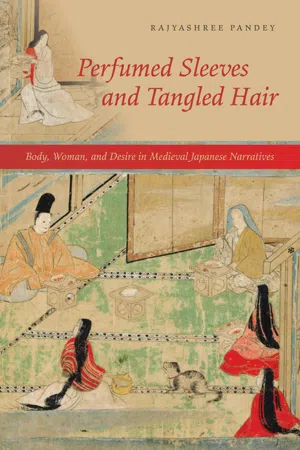 eBook - PDF
Perfumed Sleeves and Tangled Hair
Body, Woman, and Desire in Medieval Japanese Narratives
- Rajyashree Pandey(Author)
- 2016(Publication Date)
- University of Hawaii Press(Publisher)
31 C HA P T E R T WO The Erotics of the Body in The Tale of Genji . . . she was unusually small and pretty, and gave the impression of being nothing but robes ( hito yori ke ni chiisaku utsushige nite, tada on zo nomi aru kokochi su ) (Figure 4). The amorous entanglements of Genji, the eponymous hero of the eleventh-century romance The Tale of Genji, the unforeseen consequences of love and attachment, and the workings of desire and longing in all their dimensions—their generation, fulfilment, and ultimate frustration—are at the heart of the thematic structure of this famous text. And yet, of the vast majority of men and women who generate and experience erotic and affective intensities, there are very few whom we can conjure up in their fullness, as people comprised of flesh and bone. For the most part they are fleeting, shadowy, and dispersed forms, which drift in and out of the text, not amenable to a sustained gaze. We have come to accept as a commonplace that the body’s physicality is some-how integral to the generation of erotic desire. Although we would readily grant that different cultures and historical moments privilege certain aspects of the body, be it the ankle, the nape of the neck, or the foot, we are accustomed to assuming that the physical attributes of the body are central to the language of erotics. And yet, we are hard pressed to find in either monogatari or waka a material body, made manifest through the fullness of the breast, the rosiness of the cheeks, or the shape-liness of the leg. 1 How do we account for this curious “absence” of many of the elements that make the body readily recognizable to us, particularly in a text that has at its very center the workings of love and desire? Some explanations come to mind, all of which, upon reflection, must be rejected.
Index pages curate the most relevant extracts from our library of academic textbooks. They’ve been created using an in-house natural language model (NLM), each adding context and meaning to key research topics.

