History

University of Bologna
The University of Bologna, established in 1088, is considered the oldest university in the Western world. It played a significant role in the development of medieval and Renaissance legal studies and is renowned for its contributions to the field of law. The university continues to be a leading institution for academic research and education.
Written by Perlego with AI-assistance
Related key terms
1 of 5
7 Key excerpts on "University of Bologna"
 eBook - ePub
Higher Education and the Growth of Knowledge
A Historical Outline of Aims and Tensions
- Michael Segre(Author)
- 2015(Publication Date)
- Routledge(Publisher)
studium. These associations grew slowly, surrounded by tension, not least of which that between religious and secular factions; but eventually they were recognized as “universities” by the pope, the emperor, or other local authorities. Two centers of study are considered the archetypes of the university: Bologna and Paris.At the end of the 11th century, Bologna was a focal point of conflict between the pope and the emperor, and a number of teachers of trivium began to apply themselves to the study of law, above all to the exegesis of Roman law. As Olaf Pedersen (1920–1997) remarks (Pedersen 1997 , 126), “In accordance with old Roman usage, law was viewed as part of rhetoric, and could be formally incorporated into artes liberales,” being an awareness of the utility of interdisciplinarity at this early stage. Around 1080 a manuscript of the 7th century of Justinian's Corpus Juris Civilis reached Bologna and was examined by local scholars. The pioneer in this enterprise was one Irnerius (c. 1050–1130). Afterwards, Roman law came to play a much greater role both in teaching and in politics.When was a “university,” in the sense of a guild, established in Bologna? According to Charles Haskins (1870–1937), “The students of Bologna organized such a university first as a means of protection against townspeople, for the price of rooms and necessaries rose rapidly with the crowd of new tenants and consumers, and the individual student was helpless against such profiteering” (Haskins 1975 , 9). Historian and archeologist Corrado Sicci (1858–1934), in his I primordi dello Studio di Bologna (1887), points out how difficult it is to ascertain the date of the foundation of the university. Yet poet and (later) Nobel laureate Giosuè Carducci (1835–1907), who taught at the University Bologna, suggested to celebrate the 800th anniversary in 1888, implying that 1088 was the founding year. The celebration took place in the presence of the king of Italy, Umberto I (r. 1878–1900), and Bologna became, rightly or wrongly, the first European university (Tosi 1989 , 53–111). Around 1140, Franciscus Gratianus or Gratian, probably a Camuldulensian monk (the Camuldulensian monks are part of the Benedictine family of monastic communities; their name is derived from the hermitage of Camaldoli, on the mountains of central Italy, near Arezzo in Tuscany) and the bishop of Chiusi (also in Tuscany), systematized the many ecclesiastical laws that were produced through the centuries in Concordia Discordantium Canonum (Harmony between Discordant Rules of Laws), also known as Decretum Gratiani or Decreta, conferring canon law methods and principles of the Roman law. Gratian also taught in Bologna monasteries. In 1158, a number of jurists from Bologna convinced Emperor Frederick I (Barbarossa, 1122–1190) to promulgate a constitution, Authentica Habita, which protected itinerant students from interference by any local authorities and, in particular, prohibited their being taken hostage for debts accrued by their fellow citizens. Habita also established that every school was required to constitute a societas presided over by a dominus and that students were under the jurisdiction of their teacher or of the bishop, suggesting that some kind of guild already existed in Bologna before 1158. Be that as it may, Habita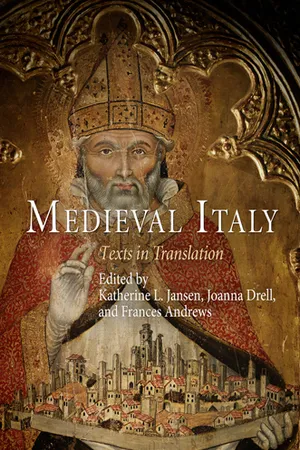 eBook - PDF
Medieval Italy
Texts in Translation
- Katherine L. Jansen, Joanna Drell, Frances Andrews, Katherine L. Jansen, Joanna Drell, Frances Andrews(Authors)
- 2011(Publication Date)
- University of Pennsylvania Press(Publisher)
The papal bull here captures a particular moment in the early quarrels between town and gown in Bologna. Following what was a nearly total dispersion of the city’s schools between 1217 and 1220 , Pope Honorius III—a former archdeacon of Bologna—has stepped in to defend the university’s rights. The settlement was, however, only temporary: by 1222 the scholars had departed again, this time for Padua, which would become the most prominent offshoot of the Bologna schools. TO THE PEOPLE OF BOLOGNA Having understood from the report of our venerable brother the Bishop of Ostia the devotion that you all bear toward the Roman Church, we are eager to procure those things that pertain to your salvation and honor, and also recognize that you are obedient children ever ready to obey the Church’s commands and are willing enough to pull yourselves back from those actions that cloud your reputation and may bring about your disadvantage and downfall. Since, beyond enjoying the infinite benefits that the study of letters has bestowed upon you, your city is famous above all others because of her studium [a center of learning], and her name is proclaimed throughout the whole world, and she is become another Bethlehem—that is to say, ‘‘the house of bread’’ that is broken for the little ones of this house, from which the leaders who guide the Lord’s people go forth, since those trained in this studium are appointed to the care of souls—you should not only stop punish-ing the scholars, but should, in fact, shower honors upon on them, being aware that they have freely singled out your city as their place of study, which was humble before but now surpasses nearly all the cities of the region Translated from Hastings Rashdall, The Universities of Europe in the Middle Ages , vol. 1 , Salerno, Bologna, Paris (Oxford: Clarendon Press, 1936 ), Appendix D. Universitas : Bull in Favor of the University of Bologna 467 because of the riches they have brought to her.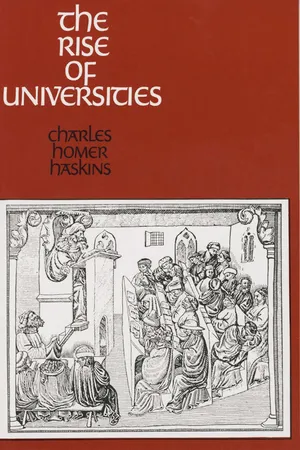 eBook - ePub
- Charles Homer Haskins(Author)
- 2013(Publication Date)
- Cornell University Press(Publisher)
licence. A Master of Arts was one qualified to teach the liberal arts; a Doctor of Laws, a certified teacher of law. And the ambitious student sought the degree and gave an inaugural lecture, even when he expressly disclaimed all intention of continuing in the teaching profession. Already we recognize at Bologna the standard academic degrees as well as the university organization and well-known officials like the rector.Other subjects of study appeared in course of time, arts, medicine, and theology, but Bologna was preeminently a school of civil law, and as such it became the model of university organization for Italy, Spain, and southern France, countries where the study of law has always had political and social as well as merely academic significance. Some of these universities became Bologna’s competitors, like Montpellier and Orleans as well as the Italian schools nearer home. Frederick II founded the University of Naples in 12 24 so that the students of his Sicilian kingdom could go to a Ghibelline school at home instead of the Guelfic centre in the North. Rival Padua was founded two years earlier as a secession from Bologna, and only in 1922, on the occasion of Padua’s seven-hundredth anniversary, I saw the ancient feud healed by the kiss of peace bestowed on Bologna’s rector amid the encores of ten thousand spectators. Padua, however, scarcely equalled Bologna in our period, even though at a later age Portia sent thither for legal authority, and though the university still shines with the glory of Galileo.In northern Europe the origin of universities must be sought at Paris, in the cathedral school of Notre-Dame. By the beginning of the twelfth century in France and the Low Countries learning was no longer confined to monasteries but had its most active centres in the schools attached to cathedrals, of which the most famous were those of Liège, Rheims, Laon, Paris, Orleans, and Chartres. The most notable of these schools of the liberal arts was probably Chartres, distinguished by a canonist like St. Ives and by famous teachers of classics and philosophy like Bernard and Thierry. As early as 991 a monk of Rheims, Richer, describes the hardships of his journey to Chartres in order to study the Aphorisms eBook - PDF
The European Research University
An Historical Parenthesis?
- Guy Neave, K. Blückert, T. Nybom, K. Blückert, T. Nybom(Authors)
- 2018(Publication Date)
- Palgrave Macmillan(Publisher)
When Uppsala University was founded in 1477 as the first studium privilegiatum in Scandinavia, the papal Bull referred to Bologna as its model, while the document from the Council of Sweden guaranteed the same kind of privileges as in Paris. "Bononia docet" was a common inscription on medieval coins from Bologna. It is tempting to use the phrase as a symbolic summary of the current debates on a unified structure of academic degrees within the European union, which has become known as "the Bologna model." Higher education in both Bologna and Paris originated in the activities of a few learned men, able to attract many students, in Bologna- Irnerius, the great jurist; in Paris, Pierre Abelard and others. However, the students, it was who administered the University of Bologna at first. The chairman of the stu- dents' union was in fact its rector. While Bologna remained exclusively a school oflaw for a long period of time, the traditional four faculties were early established in Paris, as well as the hierarchical structure of studies. The students had to begin at the faculty of philosophy, or to be more correct, the faculty of arts, since it was founded on the ancient liberal arts- program, and after many years of study there, a small elite might continue their studies at the higher faculties of theology, law, or medicine. In Paris we have also the origin 52 / INGE JONSSON of most of our present terminology, for example the very word "university." "Universitas" meant in medieval Latin a guild, which makes our Swedish expression "det /iirda skrdd' (the learned guild) a correct translation of "universitas magistrorum et scolarium," "the guild of teachers and students." But since the word "university" seems to denote something universal, it has over time come to denote complete insti- tutions of higher education, that is, those at which all disciplines are represented.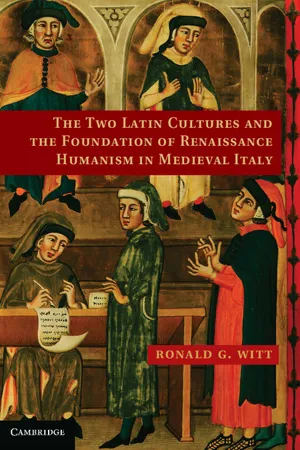
- Ronald G. Witt(Author)
- 2012(Publication Date)
- Cambridge University Press(Publisher)
1 of Storia della Università di Bologna, 2 vols. (Bologna, 1944), 156.The history of the University of Bologna has been artfully constructed in the form of dialogues, but without notes: Fabio Foresti, Arnaldo Picchi, and Anna L.Trombetti, Storie dell’antico studio di Bologna (Bologna, 1989). Augusto Gaudenzi, Lo studio di Bologna nei primi due secoli della sua esistenza (Bologna, 1901), 137, lists oaths taken by professors not to transfer their teaching elsewhere in 1197, 1198, and 1199. 50 Rossi, “Universitas scholarium,” 187–88. 51 Rashdall, Universities of Europe, 162; Albano Sorbelli, “La ‘nazione’ nelle antiche università italiane e straniere,” in Atti del convegno per la storia delle università italiane tenutosi in Bologna il 5–7 aprile 1940 e memorie in esso presentate (special issue), Studi e memorie per la storia dell’Università di Bologna 16 (1943): 108; and Rossi, “Universitas scholarium,” 191–93. The teachers opposed student organization on the grounds that Authentica habita had given masters jurisdiction over their students and on their reading of the Justinian Code to the effect that only those who exercised a profession could elect rectors or have civil and criminal jurisdiction (ibid., 192). 52 That the universitas scholarium predated the formation of the nationes is the position of Giorgio Cencetti, “Sulle origini dello studio di Bologna,” 252–53; and Rossi, “Universitas scholarium,” 184. The rival position is taken by Pearl Kibre, The Nations in the Mediaeval Universities (Cambridge, Mass., 1948), 5. Rossi is willing to recognize the existence of the nationes earlier as religious societies (194). See also Manlio Maffei, Saggio sull’università nell’età del diritto comune (Catania, 1979), 55–56, n. 119, who clarifies the division of opinion and opts for the position of Kibre. For other bibliography, see Cencetti, “Sulle origini dello studio di Biologna,” 252, n. eBook - PDF
- Christopher J. Lucas(Author)
- 2016(Publication Date)
- Palgrave Macmillan(Publisher)
Other southern universities followed Bologna's organizational and gover- nance structure. Students at Padua, for instance, also elected their consiliarii, as did those attending the Florentine studium generale established in 1321. In Orleans, proctors elected by their respective nations chose a rector in precisely the same manner as was done at Bologna. Other universities organized by nations included major studia at Pisa, Ferrara, Perugia, Salamanca in Spain (founded between 1220 and 1230 by Alfonso IX of Leon), Lerida, and else- where across southern Europe. Whatever their particular organizational structures, universities of all types proliferated throughout Europe at an increasing rate between the thirteenth and fifteenth centuries. By the year 1500 it has been estimated there were at least seventy-nine in operation. Some were short-lived; others proved more enduring. In Italy, in addition to those already cited, the more important higher studia included institutions in Reggio, Vicenza, Padua, Vercelli, Arezzo, Siena, Florence, and Naples, as well as the universitas at Bologna and several in Rome. In Spain and Portugal, practically every state could claim at least one university: Palencia-Valladolid in Castile, Salamanca in Leon, Huesca in Aragon, Lerida in Catalonia, and Lisbon in Coimbra. German universities were equally numerous, including schools at Prague (founded 1347), Vienna (1365), Cologne (1388), Erfurt (1379-1392); and after 1400, at Wiirzburg, Leipzig, and Rostock. The university at Cracow was chartered in 1364; Buda followed shortly thereafter, in 1389. Upsala and Copenhagen hosted the two most important medieval universities in Scandinavia. In the late 1400s new universities appeared in Scotland, including St. Andrews, Aberdeen, and 48 AMERICAN HIGHER EDUCATION Glasgow. The two most important institutions in England, of course, were Oxford and Cambridge. eBook - PDF
The First Universities
Studium Generale and the Origins of University Education in Europe
- Olaf Pedersen, Richard North(Authors)
- 1998(Publication Date)
- Cambridge University Press(Publisher)
n, p. 6. Rashdall, vol. i, p. 598 gives a summary of contemporary migrations from Bologna. 8 Rashdall, vol. 1, p. 170; Sorbelli, pp. i6if. 9 The bull of 1217 of Honorius III is printed in Rashdall, vol. 1, app. 1, p. 585, followed on pp. 586-8 by the bull of 1220. 162 Thefirstuniversities Venice. 10 Not long after there seems to have been a renewed application to the pope, who in 1224 f° r t n e third time urged the town of Bologna to give up its hard policy. 11 That the pope's appeal had a better outcome for the university this time, is probably connected with developments in southern Italy, where the Emperor Frederic II (1208—1250) ruled both Sicilies, neither of which had till then had an independent university of its own. The king of Spain, Alfonso VIII of Castile (1158-1214), had already founded the University of Palencia in 1208-1209 on the basis of a cathedral school that existed there previously. 12 With this example in mind, Frederic II issued a decree in 1224 for the foundation of a new university in Naples. 13 Its charter is clearly influenced by the imperial Habita of 1158 and the later developments in Bologna; thus a ceiling was put on rents, that were to be fixed by a commission of two students and two people of the town, just as in Bologna. Even if the emperor's love of scholarship was incontestable, the University of Naples should be seen before anything else as one more move in Frederic IFs constant battle against the papacy. Thus an ordinance forbade any of the emperor's subjects to study anywhere other than in Naples - a decree designed to rob the University of Bologna, which the pope supported, of a large part of its Italian students, and which is also the first example of the academic ordinance which later became a common measure to ensure the survival of a new foundation. In this threatening situation the Bologna town council must have realised the sense of going softly, and conditions now gradually improved.
Index pages curate the most relevant extracts from our library of academic textbooks. They’ve been created using an in-house natural language model (NLM), each adding context and meaning to key research topics.

