History

The Magna Carta
The Magna Carta, signed in 1215, was a historic document that limited the power of the English monarchy and established the principle that everyone, including the king, was subject to the law. It laid the foundation for constitutional government and the rule of law, and its principles have influenced legal systems around the world.
Written by Perlego with AI-assistance
Related key terms
1 of 5
11 Key excerpts on "The Magna Carta"
- Arkadiusz Górnisiewicz, Bogdan Szlachta, Arkadiusz Górnisiewicz, Bogdan Szlachta(Authors)
- 2018(Publication Date)
- De Gruyter Open Poland(Publisher)
Magna Carta was a symbol of liberty in early America and it remained so today. It is liberty understood as the absence of arbitrary power that could undermine the basic rights such as habeas corpus or free speech. The colonists’ fundamental claim to ancient rights was the best weapon to protect themselves from the British rule when injustice occurred. Magna Carta thus provided both a symbol and a tool to strengthen the claims of the people in their relationship with political authority, to make this relationship more contractual and consequently to establish constitutional norms as fundamental, sacred and demanding respect of all. 5.4 Conclusion Symbolic as it might be, Magna Carta, and especially its chapter 39, proved a lasting source of the doctrines which it launched on the mainstream of political thought and jurisprudence in Europe and America. By the seventeenth century such key concepts as trial by jury, the rule of law, limited monarchy, habeas corpus and Parliament’s right to control taxation were traced back to the English charter. Parallel statutes or charters issued in other parts of medieval Europe never gained such prominence, but Magna Carta and the Rise of Anglo-American Constitutionalism 73 they also played a very significant role in shaping the doctrine and institution of con-stitutionalism that is of fundamental law of a political community. It was especially so in Poland where the roots of constitutionalism were indeed to be found in various charters of rights and privileges granted to the regnum and more precisely to its citi-zens who not only secured legal protection against absolutism ( absolute dominium as they called it at the beginning of the sixteenth century) in the form of the rule of law and sovereignty of law, but above all established the foundations of a free politi-cal community – a monarchical republic whose citizens could enjoy liberty greater than that of most European societies at the time.
- Frank W. Thackeray, John E. Findling, Frank W. Thackeray, John E. Findling(Authors)
- 2004(Publication Date)
- Greenwood(Publisher)
Magna Carta must thus be discussed in multiple contexts, among them its mythic significance. By the late fourteenth century, although largely superceded by royal statutes, the Charter maintained its mythic power to inspire efforts to regulate the Crown. Even though it suffered a decline in significance in the years of Lancastrian and Tudor dominance, it was revived by the ideologues of "civil" government who needed a standard to combat the enormous success of absolutist systems in the seventeenth century. By this time, however, Magna Carta had taken on a biblical aura; it had become a universal manifesto of liberal egalitarianism and collec- tive governance, able to be interpreted infinitely. All of these issues must be addressed individually, but it is important to emphasize the historical significance of the Charter on the medieval political and legal community of the thirteenth and fourteenth centuries—the era in which both common law and Parliament developed. The original Charter of 1215 contains sixty-three clauses. By 1225, these clauses had been reduced to roughly half that number through a process of emendation and reduction. The Charter of Liberties of 1215 was itself an emendation of a draft charter now known as "The Articles of the Barons." Although clerical editors attempted to group the sixty-three clauses into general categories, they are not consistently organized. Clauses relating to the Church, for example, include the famous first 26 Events that Changed Great Britain from 1066 to 1714 clause guaranteeing that the "liberties" of the Church will be preserved, a reiteration of this promise in Clause 63, and a reference to the guardian- ship of abbeys being maintained in the hands of the founding families— not specifically a Church-related clause but, rather, one that upheld a customary privilege of the baronage. In the 1225 version of the Charter, a clause was added.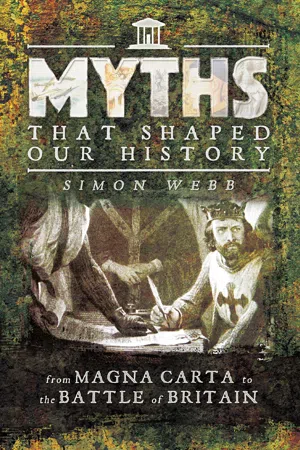 eBook - ePub
Myths That Shaped Our History
From Magna Carta to the Battle of Britain
- Simon Webb(Author)
- 2017(Publication Date)
- Pen & Sword History(Publisher)
Chapter 1
Magna Carta 1215: ‘The great cornerstone in England’s temple of liberty’?
B ritain was not founded or created at any particular moment, nor was there any event which marked definitely its becoming a nation, such as the signing of a declaration of independence. Instead, the British have The Magna Carta. Before Magna Carta, there are a few memorable dates such as 55 BC and 1066 AD, along with a handful of notable kings such as Alfred the Great, William the Conqueror and Richard the Lionheart. These rulers seemed to do pretty much as they pleased. From 1215 onwards though, following King John placing his seal on the great charter which the barons presented to him, we know that we have been living in a nation where the rule of law is paramount. Even the monarch is bound by the law to respect the rights of his or her subjects.Most of us think that we know the story of The Magna Carta, how the barons grew tired of King John’s arbitrary rule and the way in which he was riding roughshod over ancient liberties and oppressing the common people. They put together a set of principles, including habeus corpus, which guaranteed that from then on every person in the kingdom would have the right to a fair trial and nobody could be detained without a just cause. In fact if there is one thing most people know about Magna Carta, it is that it stops people being locked up without recourse to the courts. Isn’t that what habeus corpus is all about? That The Magna Carta was actually a reactionary document, specifically devised to deny ordinary people any rights and to reverse progressive changes made in the law some years earlier, sounds shocking and even absurd to modern ears. Before going any further, it might be helpful to look at the popular image of the events at Runnymede 800 years ago, just to remind ourselves of what we think we know about the matter. In other words, before examining the historical fact, let us look first at the myth, as we have received it today.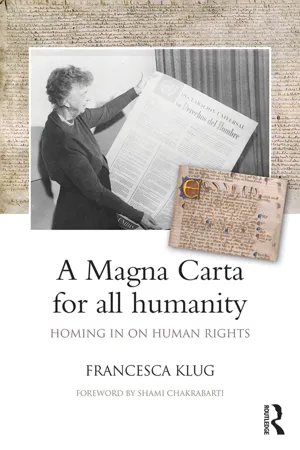 eBook - ePub
A Magna Carta for all Humanity
Homing in on Human Rights
- Francesca Klug(Author)
- 2015(Publication Date)
- Routledge(Publisher)
9 and has taken on a symbolic significance that far exceeds any legal effect.Although many people in the UK may only be vaguely aware of The Magna Carta, its symbolic status has endured. Regardless of the actual words of the text, its impact or legacy, The Magna Carta has come to stand for ‘the rule of law’, limits to monarchical or executive power and basic liberties.Whilst The Magna Carta’s remaining legal provisions have been superseded by more modern statutes, it lives on, in historian J. C. Holt’s words, as ‘propaganda’ as much as law.10 At a ceremony to kick-off the countdown to the 800th anniversary, Lord Neuberger, former chair of The Magna Carta Trust and president of the Supreme Court, described the medieval document as the foundation of modern liberties:It enshrined such noble concepts as freedom under law, democracy and the importance of limited government; it was a pre-cursor to many of the freedoms and liberties that humanity rightly expects their governments to respect today.11Yet most of The Magna Carta addressed specific grievances, rather than general principles, which have no relevance outside the feudal society they were drafted in. As the former Lord Chief Justice, the late Lord Bingham, pointed out with characteristic forthrightness in a speech delivered at St Alban’s Cathedral in June 2010, many of the Charter’s clauses are of local, particular or feudal interest only and ‘about as interesting as our rules for recycling rubbish are likely to be to our descendants 800 years from now.’ But he went on to assert that ‘this yellowing parchment, soon to celebrate its 800th birthday, can plausibly claim to be the most influential secular document in the history of the world.’12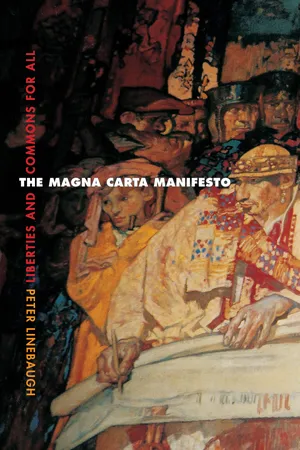 eBook - PDF
The Magna Carta Manifesto
Liberties and Commons for All
- Peter Linebaugh(Author)
- 2008(Publication Date)
- University of California Press(Publisher)
Its authority arose also in other symbolic forms. Representations of Magna Carta began to appear on the images of money in the re-bellious colonies well before the Constitution (1787), even before the Declaration of Independence. Paul Revere included Magna Carta in his 1775 design for the Massachusetts seal. Law and money are essential to the modern state, the one protecting prop-erty, the other signifying value. Magna Carta backs up each. It seems to signify equity in exchange and equality under law. How-ever, as Douglas Hay pointed out in Albion’s Fatal Tree, substan-tial equality under law is impossible in a society of great inequal-ity. Through a key phrase from chapter 39, as we’ll see, Magna Carta became a legal instrument justifying the characteristic American forms of exploitation. In Ex parte Milligan (3 April 1866) the Supreme Court named the sources of U.S. law as the Constitution, acts of Congress, Magna Carta, common law, and natural justice. The great charter’s Magna Carta and the U.S. Supreme Court / 179 180 / Magna Carta and the U.S. Supreme Court prevalence arises from the acknowledgment that it was an orig-inating source of American law, or one of its “fountains,” to use Justice Harlan’s timeless image. Magna Carta has often been used substantively as law; as a fountain it has watered many principles. This is perhaps clearest with respect to the jury. The jury is to consist of “twelve honest and impartial men of his neighborhood” ( Thompson v. Utah, 25 April 1898). eBook - PDF
- J. C. Holt(Author)
- 1997(Publication Date)
- Hambledon Continuum(Publisher)
15 Magna Carta, 1215-1217: The Legal and Social Context Does the prolonged history of Magna Carta reflect something unique in the document itself and in the circumstances from which it sprang? Was it all that important? How should we assess its importance in strictly contemporary terms. These questions still occupy me. They seem to me to be essential to any seri-ous consideration of the Charter both in general and in detail. Many of the answers lie in its subsequent history from 1217 onwards. They lie outside my present themes. Faith Thompson and many others have written of them; I have commented on them myself. 1 Much more remains to be done, especially on the minority of Henry III, on which we can look forward to an important work from David Carpenter. Yet this subsequent history raises a question very close to my present purpose: was the later development of the Charter, its rapid emergence as a founding statute for example, foreseen or in anyway intended in 1215? Or in 1217? What were they after, the men of 1215, when they chal-lenged the king at Runnymede? How did they think? How should we discuss and assess them? In attempting answers, which can only be sketchy within the limits of a short essay, I shall work from the Charter and the crisis of 1215 outward to other themes. This method underlies my differences with some recent work in which the Charter has been interpreted largely in the light of other arguments concerned with other phenomena. After being involved with it for so long, I am not very ready to make it fit anything. There is to hand a simple and straightforward explanation of the context of 1215 and of the objectives embodied in the Great Charter. It runs something like this. The Angevin kings were powerful and wilful monarchs directing an efficient administrative machine. As lords of the Plantagenet lands on the Continent they faced increasing difficulties, culminating in wars with the kings of France.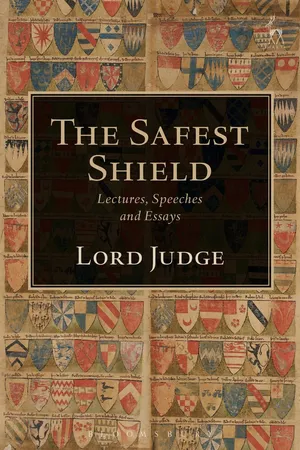 eBook - PDF
The Safest Shield
Lectures, Speeches and Essays
- Igor Judge(Author)
- 2015(Publication Date)
- Hart Publishing(Publisher)
The constant reissuing of the charter itself demonstrates its gradual evo-lution. As examples of the living instrument, the title Magna Carta des Libertatibus Angliae was first used in a statute in 1297, and thus formally linked Magna Carta to what we would now describe as fun-damental freedoms. By 1331, whatever the controversy may have been earlier, the justice and safety provisions were attached to every man in the land, whether a freeman or a villein or indeed a serf. The words ‘due process of law’, an essential foundation for our rights and liberties, emerged in 1354. Gradually, in social conditions and societies which are remote from our own, Magna Carta and what 2 WC Sellar and RJ Yeatman, 1066 and All That (London, 1930). 10 Towards a Constitution Magna Carta was believed to stand for became part of the fabric of our political thinking. And as the centuries unfolded it came to be exported to places which none of those assembled at Runnymede had ever heard of, like the future United States of America, and its ideas of constitutional legal freedoms came to be encapsulated in the Universal Declaration of Human Rights, which was described by Eleanor Roosevelt, one of its architects, as ‘a Magna Carta for the modern world’. This is portentous stuff. But the crucial fact to be grasped is that Magna Carta was sealed at the outbreak of a civil war, as a step to avoid its horrors. The apparently inevitable destiny was the scrap heap, not worth the vellum it was written on. Conceivably it would have provided an opportunity for a PhD for an excessively bright and geekish young man or woman on the way to an illustrious aca-demic career. After all, how many of us have heard of the Charter of Liberties of Henry I? That is its title. It contains aspirations of firm peace and the restoration of good old law. eBook - ePub
- Lysander Spooner(Author)
- 1998(Publication Date)
- Perlego(Publisher)
It would show also that the judicial tribunals, whenever it suited their purposes to do so, were in the habit of referring to Magna Carta as authority, in the same manner, and with the same real or pretended veneration, with which American courts now refer to the constitution of the United States, or the constitutions of the states. And, what is equally to the point, it would show that these same tribunals, the mere tools of kings and parliaments, would resort to the same artifices of assumption, precedent, construction, and false interpretation, to evade the requirements of Magna Carta, and to emasculate it of all its power for the preservation of liberty, that are resorted to by American courts to accomplish the same work on our American constitutions. I take it for granted, therefore, that if the authority of Magna Carta had rested simply upon its character as a compact between the king and the people, it would have been forever binding upon the king, (that is, upon the government, for the king was the government,) in his legislative, judicial, and executive character; and that there was no constitutional possibility of his escaping from its restraints, unless the people themselves should freely discharge him from them. But the authority of Magna Carta does not rest, either wholly or mainly, upon its character as a compact. For centuries before the charter was granted, its main principles constituted "the Law of the Land,"—the fundamental and constitutional law of the realm, which the kings were sworn to maintain. And the principal benefit of the charter was, that it contained a written description and acknowledgment, by the king himself, of what the constitutional law of the kingdom was, which his coronation oath bound him to observe. Previous to Magna Carta, this constitutional law rested mainly in precedents, customs, and the memories of the people eBook - PDF
- John Baker(Author)
- 2017(Publication Date)
- Cambridge University Press(Publisher)
1 The Legal Character of Magna Carta Magna Carta is universally considered to be one of the world’s great documents, ‘worthy to be written in letters of gold’, 1 treasured syllable by syllable, 2 quoted on the walls of law schools and courts, perhaps even on official notepaper, 3 taught to all schoolchildren and so forth. There is no doubt that it has had an immense influence on hearts and minds around the world. Yet it is not always understood that this influence has been achieved more by reputation than by the operation of positive law. The charter was not a constitutional document. 4 It did not address the law- making process at all, because it did not contemplate future legislative change. It did not specify in general terms what kinds of authority the king’s government could exercise; nor did it provide any remedies by way of an action at law against the crown if the government acted despotically. 5 Its purpose was more immediate: to restore, declare and preserve the previous common law. In many respects this was achieved rapidly and without the need for sanctions, in that Henry III did much of what was promised and stopped doing things which had been the source of complaint. 6 Whether it had a future was a very different matter. It was 1 So said Coke in the Case of Purveyance (c. 1605), cited in Ashley’s reading, fo. 24v (‘cel statute fuit digne d’estre escript en lettres de or’). It was actually the first English book to be printed in gold: Blackstone’s edition of 1759 was reprinted in gold on vellum, with hand-painted decoration, in 1816. 2 Co. Inst. ii. 57: ‘As the gold-finer will not out of the dust, threads or shreds of gold, let pass the least crumb, in respect of the excellency of the metal: so ought not the learned reader to let pass any syllable of this law, in respect of the excellency of its matter.’ 3 Lord Bingham suggested that the wording of c. eBook - ePub
Legal History Matters
From Magna Carta to the Clinton Impeachment
- Amanda Whiting, Ann O'Connell(Authors)
- 2020(Publication Date)
- Melbourne University Press Digital(Publisher)
A Nineteenth-Century View of The Magna CartaPhoebe WilliamsAs a legal document, The Magna Carta* remained untouched for 613 years. This chapter endeavours to analyse the period between 1828 and 1892, during which twenty-two clauses of the Charter were repealed.Popular historian Dan Jones wrote that by the nineteenth century, The Magna Carta was ‘enshrined in Western political thought as being a document of great and formative importance to modern ideas of freedom’.1 This certainly seems to have been the case in the United States of America, but it is questionable whether it retained the same significance in England, even as a symbol. Clare Simmons proposed that The Magna Carta was used as a concept rather than an actual legal document in the nineteenth century.2 This is undeniably true, but such usage is not unique to this period. Arguably, what is distinctive about the use of The Magna Carta in nineteenth-century England is the scrutiny of the Charter’s use as a ‘concept’ by people such as Major John Cartwright and Henry Brougham who found this use to be medieval and unnecessary for contemporary political regimes. Miles Taylor has suggested that The Magna Carta only became scrutinised and questioned towards the end of the nineteenth century.3 However, as Anne Pallister points out, by the beginning of the nineteenth century the Charter had already become divorced from its historical setting and was used instead as an icon representing a vague concept of freedom and justice.4This chapter argues that twenty-two clauses of The Magna Carta were repealed between 1828 and 1892 because, unlike previous centuries, nineteenth-century England was ready for modest political reform. This was, in part, due to the increased scrutiny of the Charter as a legal document, but this characteristically British approach to reform was also a result of careful navigation of a time of change. The French Revolution was spurring on reform from across the channel, but also scaring English conservatives into being cautious with their political aims. A balance had to be struck between political stability, veneration of the past and the ‘spirit of reform’ evident in both conservative and more liberal politicians as well as legal scholars of the time.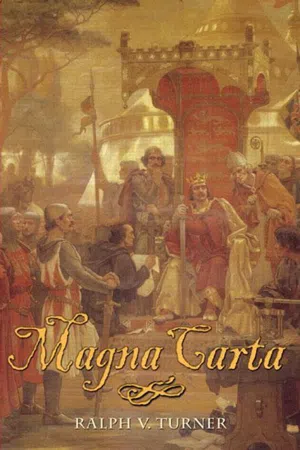 eBook - ePub
- Ralph Turner(Author)
- 2016(Publication Date)
- Routledge(Publisher)
The European Convention and the Human Bights Act mark the impact that Magna Carta's central principle of the rule of law has made throughout western Europe. At the dawn of the twenty-first century, the guarantees in the Great Charter and the 1689 Bill of Bights are again relevant in Britain's political debates. In the eyes of concerned citizens, the central idea that government and its officials must act within the law in dealings with individuals first expressed in Magna Carta still needs defending. Fears remain that Britons' liberties can be jeopardized under the present constitutionally sanctioned parliamentary sovereignty just as they were earlier under a despotic monarchy with a subordinate Parliament.Impact of the new scientific history on views of the Charter
The nineteenth century was a crucial period for the emergence of history as a distinct discipline, as it left its traditional place among the liberal arts as a branch of literature or philosophy and passed from the hands of learned amateurs into those of trained professionals. While this process was under way, several powerful intellectual movements were influencing historians, first romanticism and nationalism early in the century and later a scientific and materialist world-view. The romantic and nationalist movements sparked popular enthusiasm for medieval history, and illustrations of this infatuation are Sir Walter Scott's novels, which reinforced the notion of 'Bad King John' and his Norman officials inflicting their autocratic rule on the downtrodden Saxons. Yet these two trends also had serious consequences for English historians' views of Magna Carta.Rejecting eighteenth-century Enlightenment attitudes toward the past scornful of medieval society and glorifying Greco-Roman civilization, the romantics extolled the Middle Ages. They gloried in tribal villagers' sense of community, the spirituality of the saints, the mystery of medieval epics and romances, knights' code of personal honour and pursuit of fame. They contrasted medieval villagers' happy and harmonious lives with the misery of workers in the new industrial towns. For some writers, William Cobbett (d. 1835) for example, this nostalgia for lost English rural life made them advocates of radical political change. Other romantics' preference for gradual evolution over revolutionary change in history encouraged an organic view of nations, societies, laws and institutions. This view led them to reject the rationalists' pragmatic study of primitive cultures as results of trial and error, adopted for practical results; instead, they admired earlier societies as unplanned living and growing things, evolving gradually toward a predetermined end or purpose.
Index pages curate the most relevant extracts from our library of academic textbooks. They’ve been created using an in-house natural language model (NLM), each adding context and meaning to key research topics.

