History

Upton Sinclair
Upton Sinclair was an American writer and social reformer known for his muckraking novel "The Jungle," which exposed the harsh conditions of the meatpacking industry and led to significant food safety reforms. He was a prominent figure in the Progressive Era and advocated for workers' rights and socialism. Sinclair's impactful writing contributed to the public's awareness of social injustices and the need for reform.
Written by Perlego with AI-assistance
Related key terms
1 of 5

11 Key excerpts on "Upton Sinclair"
 eBook - ePub
- Intelligent Education(Author)
- 2020(Publication Date)
- Influence Publishers(Publisher)
“In a wheelchair, attended by a nurse, daughter, and son-in-law, Mr. Sinclair . . . stood with assistance through a special tribute to his own efforts at the start of the century and shook hands warmly after Mr. Johnson gave him one of the pens used in the signing.”And so President Johnson had carefully arranged to give Upton Sinclair the official recognition that an earlier president had deprived him of. This ceremony occurred just eleven months before Sinclair, an author admired the world over, died in November 1968. Passage contains an image
INTRODUCTION TO Upton Sinclair
THE JUNGLE: ITS PLACE IN AMERICAN HISTORY AND LITERATUREDUAL FAME OF THE JUNGLEFew works of fiction leave their stamp on political as well as literary history. In this connection, an American might think of Harriet Beecher Stowe’s Uncle Tom’s Cabin. In its serial appearance in a magazine (1851), in its publication as a book (1852), and in its long run as a stage play, Uncle Tom’s Cabin stirred America’s conscience, helping to bring about the abolition of slavery. A European would think of Ivan Turgenev’s A Sportsman’s Notebook (1852), which so dramatized the plight of Russian peasants that it induced Tsar Alexander II to emancipate the serfs.And in discussing fiction that has achieved such double impact, both Europeans and Americans would think also of Upton Sinclair’s The Jungle . A literary sensation in both its serialized version (1905) and its book version (1906), this novel has exerted tremendous influence on American life. Historians regard the exposes contained in The Jungle
Passage contains an image
INTRODUCTION TO Upton Sinclair
THE JUNGLE: ITS PLACE IN AMERICAN HISTORY AND LITERATUREDUAL FAME OF THE JUNGLEFew works of fiction leave their stamp on political as well as literary history. In this connection, an American might think of Harriet Beecher Stowe’s Uncle Tom’s Cabin. In its serial appearance in a magazine (1851), in its publication as a book (1852), and in its long run as a stage play, Uncle Tom’s Cabin stirred America’s conscience, helping to bring about the abolition of slavery. A European would think of Ivan Turgenev’s A Sportsman’s Notebook (1852), which so dramatized the plight of Russian peasants that it induced Tsar Alexander II to emancipate the serfs.And in discussing fiction that has achieved such double impact, both Europeans and Americans would think also of Upton Sinclair’s The Jungle . A literary sensation in both its serialized version (1905) and its book version (1906), this novel has exerted tremendous influence on American life. Historians regard the exposes contained in The Jungle eBook - PDF
- Claudia Durst Johnson(Author)
- 2006(Publication Date)
- Greenwood(Publisher)
6 Upton Sinclair's The Jungle In 1904, after a failed strike in the Chicago meatpacking industry, 26-year-old Upton Sinclair, a young man from a wealthy family and a recent convert to socialism, traveled to the community in Chicago called Packingtown. He lived there for seven weeks among the immigrant work- ers in the largest meatpacking industry in the United States. The Jungle, the novel he wrote growing out of his experiences, graphically describes work there in Chicago in 1904 and raises horrific but continuing workplace issues. Considered by many to be the most powerful social argument in an age of muckraking literature, The Jungle had been written as a brief for the working man. It did stun the public, including the president of the United States, Theodore Roosevelt. But the reforms it inspired had little or noth- ing to do with the condition of the workers. Instead, it instigated reforms in the way meat was slaughtered, packed, and inspected. The direct result was the passage of the Pure Food and Drug Act and the Meat Inspection Act, both signed into law on June 30, 1906, only months after the novel's publication in the same year. Sinclair later said that he had written the novel to touch the public's heart and instead had hit it in the stomach. The issues developed in The Jungle are so extensive that its main char- acter, Jurgis, is sometimes presented as symbolic of all those who labor with their hands in a system of rampant capitalism. The primary problems of the immigrant workers in the novel include the following: • long hours and poverty-level wages • the resultant squalid living conditions eBook - PDF
- David Goldfield, David R. Goldfield(Authors)
- 2006(Publication Date)
- SAGE Publications, Inc(Publisher)
Lincoln Steffens delved into the practices of city governments and their questionable methods of granting government contracts, specifi-cally examining the government of Minneapolis. Ray Stannard Baker discussed the problems confronted by working people in his 1903 piece entitled “The Right to Work.” These and other articles sparked the imagi-nation and ire of readers of the day. The practices of an unregulated patent medicine industry brought the concept of muckraking to the public eye. Although disclosures of the exaggerated claims made by the medicines started the muckraking era, it was the plight of workers that made another muckraking writer famous. The best known of the muckraking journalists was Upton Sinclair. His investigative work resulted in his book The Jungle. Set in Chicago’s stockyards district, it told a fictional story of how immigrants were treated by the larger packinghouses, such as Armour and Swift. It also described the inhumane conditions that led to many accidents, domestic problems, and early deaths for workers. One reason the book fared so well was that its description of events was realistic. When the pacers were ordered to speed up production on the cutting lines, the reader was a witness as the sharpened blades cut workers. People who could not see the actual “tourist attraction” of the stockyards (a major tourist stop during the late 1800s in Chicago, surprisingly enough) need only read the descriptions of the blood and filth on the floor. The depictions of the killing floor were such that many complained of the brutality. The book, which wrapped up with a call for a more socialist world (which many politicians did not like), was influential enough that it sparked a public outcry for reform in the meatpacking industry. Muckrakers ——— 501 Ironically, Sinclair had meant the book to be a call for socialism in the United States and not necessarily an exposé of the horrid conditions of the meatpacking industry itself. eBook - PDF
- John Hollitz(Author)
- 2016(Publication Date)
- Cengage Learning EMEA(Publisher)
Rather, he had spent seven weeks in Chicago ’ s stockyards and slaughterhouses to provide a realistic setting for a story about capitalism ’ s exploitation of workers. As he later put it, he had aimed at Americans ’ hearts and hit them “ in the stomach. ” Nonetheless, at twenty-seven, Sinclair was famous, and for the first time in his life, he was also flush with money. Determined to realize a Utopian vision, he used the royalties from The Jungle to estab-lish a cooperative community of some forty like-minded writers, professors, and artists in New Jersey. Unfortunately, Sinclair ’ s investment went up in smoke when the place burned down four months later. Sinclair soon joined a single-tax community * in Alabama, but communal living put a further strain on his marriage. At the New Jersey and Alabama communities, both Upton and Meta had extramarital affairs, and in 1911, the couple finally divorced. By then, Sinclair had been converted again. In 1909, he had visited a sanatorium run by Bernarr Macfadden, the Progressive Era ’ s leading prophet of fitness. While Macfadden convinced him of the value of vegetarianism and fasting, Sinclair fell in love with another “ patient, ” a Mississippi judge ’ s daughter named Mary Craig Kimbrough. Despite his belief that marriage was merely a middle-class convention, in 1913 he married Mary Craig, a union that lasted until her death nearly five decades later. The couple ’ s in-terest in health and fitness soon brought them to southern California, already home to many cultists and health faddists. They settled in Pasadena, where Craig dabbled in real estate while Upton pecked out an endless stream of books on his typewriter. None of Sinclair ’ s later works matched the success of The Jungle , but he never shied away from attacks on powerful, even sacred, institutions. Thus he wrote exposes of churches, the press, schools, and the arts — all institutions, he believed, corrupted by capi-talism. eBook - ePub
Sensing Chicago
Noisemakers, Strikebreakers, and Muckrakers
- Adam Mack(Author)
- 2015(Publication Date)
- University of Illinois Press(Publisher)
CHAPTER 4
A REVOLUTIONARY AND A PURITAN
Upton Sinclair and The Jungle
The Jungle is the best-known literary evocation of industrial Chicago. One hundred years after the novel first disgusted readers with its descriptions of the city’s meatpacking plants, it continues to inform discussions about food politics. Upton Sinclair’s gastric prose and his eye for revolting detail echo in contemporary exposés about industrially produced meat.1 Much like those exposés, The Jungle shocked readers’ senses, famously turning their stomachs with descriptions of rats tossed into sausage hoppers. However, Sinclair’s novel also had much to say about how the meatpacking industry robbed the senses of workers. This chapter analyzes The Jungle to explore the sensory politics of its author and the indictment of industrial capitalism he proposed. It traces how the author drew lines of class, ethnicity, and race in sensory terms in order to simultaneously express sympathy and solidarity as well as repulsion and social distance from immigrant workers in Back of the Yards.A good example of Sinclair’s discussion of how work in the meat factories dulled the senses of workers takes place about halfway through The Jungle , when the protagonist, the immigrant laborer Jurgis Rudkus, decides that his mother-in-law must take work in a sausage factory. Life and labor in Chicago’s stockyards district is tougher than Jurgis imagined when he left Lithuania, and things keep getting worse. It is a regrettable decision, but necessary, as more and more members of the extended family are forced to take jobs in the packing plants to help make ends meet.Elzbieta is no stranger to hard work, but she is tested when she becomes, as Sinclair put it, a “servant to the sausage machine.” The job requires her to stand in the same place for ten hours, with only a forty-five-minute break in the middle of the day. Worse, the room where she works amounts to a “dark hole,” lit dimly by electricity and constantly wet. “There were always puddles of water on the floor,” Sinclair wrote, “and a sickening odor of moist flesh in the room.” The meatpackers allowed tourists to pass through, but quickly. The machinery impressed tourists, especially the stuffing machines and their multiple nozzles, over which female workers like Elzbieta held casing. With the simple pull of a lever, the ground meat shot out into the casings like a “wriggling snake,” to be caught and twisted into links, an operation the women executed “so fast that the eye could literally not follow.”2 eBook - ePub
The Undeclared War between Journalism and Fiction
Journalists as Genre Benders in Literary History
- D. Underwood(Author)
- 2013(Publication Date)
- Palgrave Macmillan(Publisher)
Introduction—Norman MailerI was enlisted then on my side of an undeclared war between those modes of perception called journalism and fiction. When it came to accuracy, I was on the side of fiction. I thought fiction could bring us closer to the truth than journalism, which is not to say one should make up facts when writing a story about real people. I would endeavor to get my facts as scrupulously as a reporter.The Jungle is a book whose “facts” about the abuses in the meatpacking industry set the United States on a new course of health and safety regulation: the “muckraking” author Upton Sinclair spent seven weeks in 1904 investigating the sanitary and workplace conditions in the Chicago meatpacking yards; his publisher, Doubleday, Page and Company, would not publish the book until a group of legal detectives had checked out Sinclair’s allegations; President Theodore Roosevelt was so moved by the book that he set up a presidential investigatory commission; and finally Congress, acting upon the commission’s findings that confirmed most of Sinclair’s claims, passed the Pure Food and Drug Act of 1906. As a result, The Jungle has been deemed, along with Harriet Beecher Stowe’s pro-abolition Uncle Tom’s Cabin , to have had more political impact than any other novels in American history.1 However, for all this, it is sometimes forgotten that The Jungle eBook - PDF
The Economy of Religion in American Literature
Culture and the Politics of Redemption
- Andrew Ball(Author)
- 2022(Publication Date)
- Bloomsbury Academic(Publisher)
To them he is a revolutionary worker” (77–78). A brief look at three novels by Upton Sinclair will confirm 4 Mistaking “Shadows for Gods”: Class and the Christ Novel in the Progressive Era The Economy of Religion in American Literature 112 Rideout’s account. As with his mentor Jack London, “the image of Jesus as a revolutionary leader” was at “the core of Sinclair’s Christian doctrine” (Arthur 179). In Samuel the Seeker (1910), the young hero of the novel represents Jesus as a poor worker who was executed for being a revolutionary agitator: I don’t believe that [Jesus] was God . . . He was a man, like you and me! He was a poor man, who suffered and starved! And the rich men of His time despised Him and spit upon Him and crucified Him! . . . The church cast out Jesus! . . . And it was the rich and powerful in the church who did it . . . And if he were here tonight He would be on my side–and the rich evil-doers who sit on this board would cast Him out again! (Samuel 258) Not only does Sinclair argue that the leading lights of the modern church are the progeny of Jesus’s moneyed executioners, but, most importantly, that Jesus is on the side of the socialists; their economic and political doctrines, he argues, are sanctioned by God, they are sanctified. Similarly, in The Jungle (1906), Reverend Lucas insists that upper-class churches have perverted the true image of Jesus. “Our society churches,” he argues, have transformed Jesus, “the man of sorrow and pain, the outcast, despised of the world . . . this class-conscious working-man! This union carpenter! This agitator, law-breaker, firebrand, anarchist!” into an “elegant prince,” a “jewelled idol,” “a divinity of the respectable inane” (Jungle 375, 374, Carpenter 3).
- Chad Montrie(Author)
- 2011(Publication Date)
- Continuum(Publisher)
3 Missionaries Find the Urban Jungle: Sanitation and Worker Health and Safety Having made the long journey from their homes in Lithuania to the United States, Upton Sinclair’s central characters in his 1906 novel, The Jungle , were especially startled as a train carried them the last stretch of their journey, from the lush prairie to the hellish bowels of industrial Chicago. On the outskirts of the city there were still fields, but they were “parched and yellow,” and even-tually the landscape became “hideous and bare,” with the exception of ram-shackle sheds and houses. “Down every side street they could see, it was the same,” Sinclair wrote, “always the same endless vista of ugly dirty little wooden buildings.” Passing the first line of factories, with “immense volumes of smoke pouring from the chimneys,” the air grew darker and sooty filth covered the ground. The traveling party also began to notice a “pungent odor,” which seemed to be getting stronger, soon heavy enough to taste as well as smell. Then they were at its source, standing on a street corner in Back of the Yards, the South Side stockyards district. There were half a dozen chimneys now, “tall as the tallest buildings, touching the very sky—and leaping from them half a dozen columns of smoke, thick, oily, and black as night.” 1 Of course, The Jungle is a work of fiction and Upton Sinclair first began writing about the plight of immigrant workers in Chicago meatpacking houses on commission for a socialist magazine, Appeal to Reason , which explains why most of the last third is an unabashed ideological diatribe. Yet most of the novel is social realism, descriptive literary journalism that meticulously but poignantly characterizes a people and place in time. Sinclair did months of research for the book, walking the stockyards streets while a bitter meat packing strike played out, interviewing residents about living and working eBook - ePub
- Gregory Borchard, Gregory A. Borchard(Authors)
- 2018(Publication Date)
- Routledge(Publisher)
When he returned from his trip, an American financier reportedly asked Steffens to provide an account of what he had witnessed, and, as popularly told, Steffens said, “I have seen the future, and it works.” Steffens later wrote in his Autobiography that what he said was “I have been over to the future, and it works.” 11 Steffens’ optimism was short-lived. A global economic collapse brought on by the Great Depression followed by the rise of dictatorships throughout Europe contributed to Steffens loss of idealism. He in fact grew cynical about the role socialism and reform in general might play in improving the conditions of workers and lives in general. He died August 9, 1936, without seeing—similar to a number of other muckrakers—the reform he had hoped to achieve. Upton Sinclair’s The Jungle, and the Pure Food and Drug Act Upton Sinclair, born in Baltimore, September 20, 1878, both shared the socialist philosophy of Steffens and took an understanding of corruption to a new level. Sinclair concerned himself primarily with the inequalities brought about by capitalism in a system he described as “wage slavery” in which workers received only enough money to survive. His most famous piece, The Jungle, examined the sickening realities of this system through the experiences of laborers in Chicago’s meatpacking industry. He had prepared his report as a form of documentary fiction by first acting as a reporter who visited the stockyards, taking notes, and then writing in a third-person form of fiction that too closely resembled reality. While his goal in the piece was to awaken the American public to the inherent problems of economic oppression at the time, he instead awoke their awareness of the filthiness involved in creating the meat and food products they ate on a daily basis. Reform did ensue from The Jungle, but it came in the way of hygiene, not money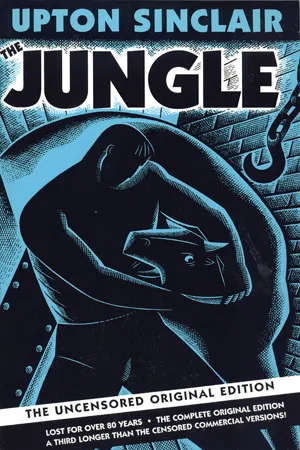 eBook - ePub
The Jungle
The Uncensored Original Edition
- Upton Sinclair, Earl Lee(Authors)
- 2003(Publication Date)
- See Sharp Press(Publisher)
NTRODUCTIONI . In 1905 Upton Sinclair wrote a powerful book, full of impassioned rhetoric against the excesses of capitalism, deeply empathizing with the immigrant worker, and boldly naming the perpetrators of crime. In 1906 a lesser book was published—one that certainly rocked the nation in its gruesome detail about meat processing, but that skirted the realities of disease and death among the poor, apologized to the rich and powerful by its silences, and pictured the immigrant worker as responsible in large part for his own degradation. Both of these books are called The Jungle . The 1906 version has been taught in the schools, sits on library shelves, and is easily available at the bookstore in the local mall. The original, 1905, version came out piecemeal in a socialist newspaper and a quarterly magazine at the time Sinclair wrote it, but essentially disappeared until 1988, when it was reprinted as a hardback book. That edition quickly went out of print under odd circumstances (see Foreword). Now, in 2003, the true first version of The Jungle comes to us again. Can we handle the truth this time?Both versions of The Jungle feature the story of Jurgis Rudkos and his wife Ona, Lithuanians who have come to Chicago to pursue the American dream. They work hard and try to make the best of bad living conditions, but they are beaten down relentlessly. Both versions show disturbing details of the turn-of-the-century meatpacking industry: meat processed amid blood and dirt, diseased animals cut up for food, inspectors letting rotten meat go by. At the same time, it is clear that there is a major difference between the two versions of the novel. The 1906 novel has 31 chapters, whereas the original has 36. In all, the newer version is about one-third shorter than the original (DeGruson xxvii). Of course, cutting text often happens when a writer revises a work, to tighten the style and eliminate redundancy of scene and character. Usually the second, more artful version is the one that gets published, and this is considered the official, final text. However, if a revision is not driven by a desire for artistic economy but is instead produced under coercion, directly or indirectly, for political or economic reasons, we must question which version should be the final and definitive text. In the case of The Jungle , two versions were published: one in 1905 as a serial by The Appeal to Reason , a socialist newspaper (and again in several issues of the quarterly One-Hoss Philosophy eBook - PDF
Home Front Heroes
A Biographical Dictionary of Americans during Wartime [3 volumes]
- Benjamin F. Shearer(Author)
- 2006(Publication Date)
- Greenwood(Publisher)
He was born in Baltimore on September 20, 1878, and was writing pulp fiction even before he graduated from the City College of New York. The Jungle established him as a writer and a muckraking socialist in 1905. Sinclair broke with his fellow socialists, however, over World War I. His 1919 book Jimmie Higgins was a somewhat veiled fictionalization of his personal disillusionment with socialism. Sinclair favored the war because of German aggression. Breaking with socialism did not mean ceasing social action. When over six hundred striking union longshoremen and dockworkers in southern California were arrested in April 1923 for peacefully protesting on the private property they named ‘‘Liberty Hill,’’ an outraged Sinclair applied for a speaking permit, Frank Sinatra in From Here to Eternity. Courtesy of Photofest. 761 Sinclair, Upton Beall which was denied, and continued the protest on May 15 by reading the Bill of Rights. He was promptly arrested, before he could finish the First Amendment. The charges against Sinclair and the three other men were dropped, and all but twenty-eight of the six hundred strikers were released from jail as a result of Sinclair’s public protest. Sinclair later ran for California governor 1934, and lost by a narrow margin. Sinclair’s Lanny Budd novels of World War II were pro-war. He eventually aban- doned socialism completely and became anti- communist. Sinclair died on November 25, 1968. Pamela Lee Gray SKILLIN, EDWARD JR. (1904–2000) Edward Skillin Jr. was editor and publisher of Commonweal, a lay Catholic magazine independent of the Catholic Church and founded in 1924. He was born in New York City on January 23, 1904, but was raised in Glen Ridge, New Jersey. After receiving a bachelor’s degree from Williams College, Skillin earned a master’s degree in political science from Columbia University in 1933, the same year he joined the staff of Commonweal.
Index pages curate the most relevant extracts from our library of academic textbooks. They’ve been created using an in-house natural language model (NLM), each adding context and meaning to key research topics.

