Law

Judicial Independence
Judicial independence refers to the principle that the judiciary should be free from undue influence or interference from the other branches of government or external parties. This ensures that judges can make impartial decisions based on the law and facts, without fear of reprisal. It is a fundamental aspect of the rule of law and essential for upholding justice and fairness in society.
Written by Perlego with AI-assistance
Related key terms
1 of 5

10 Key excerpts on "Judicial Independence"
 eBook - PDF
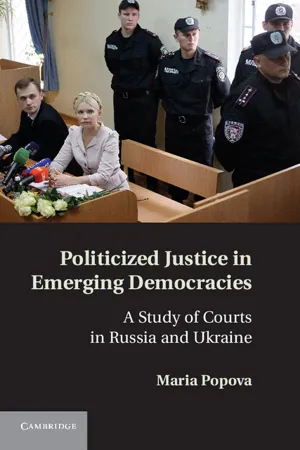
Politicized Justice in Emerging Democracies
A Study of Courts in Russia and Ukraine
- Maria Popova(Author)
- 2012(Publication Date)
- Cambridge University Press(Publisher)
14 1 What Is Judicial Independence? There are many definitions of Judicial Independence. This chapter explains why I use only one of them – an independent judiciary delivers decisions that do not consistently reflect the preferences of a particular group of actors. The emphasis is on consistently because each decision will reflect somebody’s preferences – the winner’s. The key is that when courts are independent, no one can expect to win all the cases that they would like to win. The chapter also proposes that we should be aware that independent judicial output can result either when actors are unwilling or incapable of imposing their prefer- ences in court. INSTITUTIONAL Judicial Independence In institutional terms, Judicial Independence refers to the insulation or auton- omy of the judiciary from the other branches of government or from the public (Fiss, 1993; Ferejohn, 1999; Russell & O’Brien, 2001; Chavez, 2004; Finkel, 2004). Institutional Judicial Independence is higher when there are more structural safeguards against interference by nonjudicial actors in judi- cial decision making. Institutional shields include life tenure guarantees for judges, judicial control over appointment, promotion and dismissal, as well as the drafting and administration of the judiciary’s budget. Institutional insu- lation definitions of Judicial Independence are particularly prevalent in pol- icy analysis of levels of the rule of law around the world. For example, in its annual reports on the East European states’ progress toward meeting the accession criteria, the EU has consistently criticized certain candidate states for providing institutional opportunities for executive interference in judicial affairs, such as vesting appointment powers with a political actor, rather than a corporate judicial body, such as a Judicial Council (Open Society Institute, 2001; ABA/CEELI, 2002a). eBook - PDF
- H. P. Lee(Author)
- 2011(Publication Date)
- Cambridge University Press(Publisher)
It must also encompass internal independence, namely, the inde- pendence of the judge from his or her judicial colleagues or superiors. The law and practice regarding judges and Judicial Independence in various countries reveal many common ideas and shared principles, but also sometimes sharp differences and even conflicts. These differences sometimes stem from a different conceptual approach, and at times, from a historical coincidence. The purpose of this chapter is to study the con- temporary concept of Judicial Independence in a comparative context. 3 This chapter will examine the constitutional and practical dimensions of the key concept of ‘Judicial Independence’ and its various facets (‘institutional’ and ‘ individual ’ independence). Why is Judicial Independence so fundamen- tal to a democratic polity? Is the requirement for judicial ‘ accountability’ incompatible with the notion of Judicial Independence? The chapter will begin by analysing the broader spectrum of the core values of the judicial system: procedural fairness, public confidence in the courts, efficiency, access to justice and Judicial Independence. Then the chapter will examine in detail the theoretical foundations of the principle of Judicial Independence, includ- ing individual, collective and internal independence. The chapter will exam- ine the necessary constitutional infrastructure required for the protection of Judicial Independence. Judicial Independence in the broader spectrum of core values: the fundamental values of the judicial system General The proper administration of justice is dependent upon the adherence to certain fundamental values which lie at the foundations of most judicial systems. These values include procedural fairness, efficiency, accessibil- ity, public confidence in the courts and Judicial Independence 1 and the value of constitutionality, in the sense of the constitutional protection of the judiciary. eBook - PDF
Hong Kong's Indigenous Democracy
Origins, Evolution and Contentions
- Sonny Shiu Hing Lo(Author)
- 2016(Publication Date)
- Palgrave Macmillan(Publisher)
Dual Development of Rule of Law and Judicial Independence 75 there is a fair mechanism to resolve disputes arising from conflicts between the exercise of powers by Hong Kong and China. 33 However, the Basic Law of Hong Kong contains “many mechanisms” through which the SCNPC and the central government can “interfere” with the affairs of the HKSAR. 34 In other words, the judicial autonomy of the HKSAR is vulnerable to the possible “interventions” from the central government in Beijing, particularly through the interpretations and decisions of the SCNPC provided by Article 158 of the Basic Law. Many scholars have probed the various dimensions of judicial inde- pendence. Broadly speaking, Judicial Independence entails not only the “impartiality” of court decisions delivered by judges but also equality before the law. 35 In Canada, the concept of judicial independ- ence evolved over a long period of time, from the executive control of the judicial officers and court judges during the early years of the Confederation to the gradual separation of the judiciary from both the executive and legislative branches of the government. 36 Judicial inde- pendence has also been defined as a concept de-politicizing politics and entailing two main aspects: the freedom of judges to make decisions without any constraints, and the primacy of law over individual citi- zens and public authorities. 37 In other words, Judicial Independence is expressed in the form of the institutionalization of the rule of law and court judges’ autonomous decisions, and of the need to keep “law at a distance from politics.” 38 In the case of Hong Kong, Judicial Independence is demonstrated in a number of dimensions. First, the role of the chief justice is independent and plays a crucial role in maintaining Hong Kong’s rule of law.
- Douglas Edlin(Author)
- 2016(Publication Date)
- University of Michigan Press(Publisher)
74In discussing the relationship of institutional and individual Judicial Independence, we cannot lose sight of the fact that the constitutional and definitional obligation of individual judges and the judicial institution is to adjudicate: to decide cases and to render judgments. The central purpose of insulating the courts from external influence was so that each judge of those courts could reach her own judgment of what the law means and requires.75Once we see the correlation between decisional independence and institutional independence, we can appreciate that this freedom of a judge to decide cases without external interference also requires that these cases be decided by a judge acting as a judge, within the distinctive forms and constraints of his institution. Jefferson Powell describes these interconnected aspects of judicial autonomy and obligation as the “Three Independences”:Independence of position, then, is concerned with tangible, external threats to the courts’ proper exercise of their constitutional function, and it is secured in the Founders’ view by external structural protections for the individuals who exercise the power of the courts. But I want us to take note of the way in which Hamilton links these external factors to the internal subjectivities of the judges—to their ‘temper’ as he puts it. The second strand in the weave making up Judicial Independence is what I am calling independence of decision. The courts are only truly independent, our tradition has maintained, when the decisions of the judges take effect, are enforceable and enforced, without circumvention or defiance by legislatures and executive officers. . . . The third element that I believe is woven into the general concept of Judicial Independence is what I am calling independence of thought. The courts are only truly independent, our tradition has maintained, when the judges reach their conclusions through a process of thought and decision that is significantly different from the forms of decisionmaking the other branches of government employ. The function of adjudication involves by definition the exercise of a type of judgment that proceeds from different premises and operates within different constraints than those which characterize the activities of the legislature and the executive. . . . Judges who fail to maintain and respect the difference between judicial and extrajudicial reasoning are not independent in the American constitutional sense, no matter how secure their positions and how respected their judgments, for those judgments will then necessarily be subservient to something other than the people’s law.76 eBook - PDF
- Marko Nikolić(Author)
- 2020(Publication Date)
- Society Publishing(Publisher)
Usually, the term ‘Judicial Independence’ is referred to in a normative sense to indicate what type of independence is expected out of the judges and the courts. Hence, there lies confusion over the meaning of the term ‘Judicial Independence,’ since one is totally based on concept and the other one is normative. In the conceptual meaning, there is a lack of clarity on the kind of independence, courts, and judges are capable of possessing while in case of normative, the form of disagreement over what type of independence courts and judges must possess. It is important to be logical, consistent, and comprehensive here and hence the Judicial Independence must answer the questions like-independence for whom, independence from him, and independence for Criminalization of Politics 92 what and independence for what purpose. In the United States, the federal government gives all members of the Supreme Court, District court and the appeal court lifetime tenure. The other federal judges get substantial term like fifteen years for the judges of bankruptcy courts. The selection of the proper judiciary is another point in Judicial Independence. The American Bar Association supports the selection of the judges on the basis of clearance by screening committee. This process of selection is also called merit selection. However, many state legislatures advocates election of judges by the general public. Judicial election is seen more as rewarding political skills than legal skills by the American Bar Association and the State Bar Association. In 2000, for the case of Bush V. Gore, the focus was on the judicial outcomes instead of the traditional focus on judicial qualifications. 4.3. THE MANY MEANINGS OF “POLITICS” IN JUDI-CIAL DECISION MAKING There is no doubt that the role of politics in judicial decision making is one of the hot topics of discussion today. What is actual meaning of it when one says that politics shapes the judicial behavior. eBook - PDF
- Shimon Shetreet, Walter Homolka(Authors)
- 2021(Publication Date)
- De Gruyter(Publisher)
The ethical traditions and code of judicial conduct cover the judge’s official and non-official spheres of activities, and shield the judge’s sub- stantive independence from dependencies, associations, and even less intensive involvements which might cast doubts on judicial neutrality.² International law plays a significant role in creating the culture of Judicial Independence in domestic law. International law influences domestic law by vir- tue of international human rights treaties which provide for principles of fair procedures and for the right to be tried before an impartial and independent tri- bunal. In addition to international treaties, there are international standards S. Shetreet, Creating a Culture of Judicial Independence: The Practical Challenge and the Con- ceptual and Constitutional Infrastructure, in S. Shetreet and C. Forsyth (eds.), The Culture of Ju- dicial Independence: Conceptual Foundations and Practical Challenges, 12 – 45, 12 (Martinus Nijhoff- Brill Publishers, 2012). Id. https://doi.org/10.1515/9783110671766-015 which non-governmental and academic study groups have developed.³ One such recent project is the Mt. Scopus International Standards of Judicial Independ- ence (“Mt. Scopus Standards”).⁴ The principle of Judicial Independence is one of the fundamental values of the administration of justice. These values include procedural fairness, efficien- cy, accessibility, and public confidence in the courts. In addition, there is a re- quirement that the fundamental values, including Judicial Independence should be protected by constitutional provisions and not only by legislative provisions.⁵ The culture of Judicial Independence can exist only in a system which is based on the doctrine of separation of powers. After it is established, the main- teneance of Judicial Independence is not a matter of course. eBook - PDF
The English Judges
Their Role in the Changing Constitution
- Robert Stevens(Author)
- 2002(Publication Date)
- Hart Publishing(Publisher)
For a legal analysis of the issues see J Cottrell and Y Ghai, ‘Between two systems of Law: The Judiciary in Hong Kong’ in D O’Brian and P Russell (eds), Judicial Independence in the Age of Democracy (Virginia, 2001) 207. 10 ‘Israel’s Barak’ Economist , 10 April 1999. Judicial Independence by appointing a commission of 300 persons to write a new Constitution. 11 When this proved difficult, President Mugabe merely drove out the Chief Justice and packed the court. The Independence of Individual Judges in England Contrasted with all this, it is acceptable, if not entirely accurate, to say that England has independence of the judiciary in the sense of independence of an individual judge. To take what are conventionally seen as the hallmarks of such independence—security of tenure, fiscal independence, impartial-ity and freedom from executive pressure—there is little doubt that, at its core, England qualifies under any reasonable standard of judicial inde-pendence with respect to individual judges. Even more than other coun-tries, however, one has to look at the English scene historically and, at least to some extent, sociologically. Traditionally—and rightly—we look to the Act of Settlement of 1701 as the basis of the Judicial Independence, for by the Act judges were not to be dismissed without addresses by both Houses of Parliament. The tenure of English judges since 1714 has been relatively peaceful, although among the Lord Chancellors, Lord Macclesfield in the eighteenth century and Lord Westbury in the nineteenth century, left under a cloud; and, as we saw above in chapter one, the judicial record was not as clear as some have assumed. The most notable recent example of problems among the regular judges was that of Sir John Donaldson, a High Court judge sit-ting as the President of the Industrial Relations Court. In December 1973, 187 Labour MPs called for his removal for ‘political prejudice and partial-ity’. eBook - PDF
The Separation of Powers and Legislative Interference in Judicial Process
Constitutional Principles and Limitations
- Peter Gerangelos(Author)
- 2009(Publication Date)
- Hart Publishing(Publisher)
1 Introduction T HE PURPOSE OF this monograph is to identify those precise constitutional limitations on legislatures, derived specifically from the doctrine of the separation of powers, which protect the ‘ deci-sional independence’, and thus the ‘decisional authority’, of the judicial branch in common law jurisdictions. Coined by Professor Martin Redish, these terms refer to a very discrete aspect of Judicial Independence. As defined by Redish, they refer to ‘the ability of the … courts to interpret and apply , rather than create , substantive legal principles in the specific context of an individual adjudication , free from control or interference by the purely political branches’ 1 (final emphasis added). This is distinct from the ‘institutional independence’ of the judicial branch, that is, ‘the noncase specific protections of salary and tenure explicitly provided for’ in written constitutions or otherwise in statutes. The latter ‘concern the broad independence protections of the … judiciary as an institution, untied to the adjudication of a specific case, group of cases, or substan-tive issue’. 2 Although the primary concern will be the protections afforded decisional independence, the maintenance of the integrity of legislative power must also be considered, the concern being to ensure that it is not unduly compromised by the happenstance of pending or concluded litigation which it may affect, especially if only incidentally. Whether it be the decisional independence of the judiciary or the compe-tence of the legislative branch to amend the law affecting particular proceedings, the broader concern is the protection of core, fundamental elements of branch power. 3 Although this issue does not always emerge prominently as a discrete separation of powers issue—and is one which 1 M Redish, ‘Federal Judicial Independence: Constitutional and Political Perspectives’ (1995) 46 Mercer Law Review 697 at 699. eBook - PDF
- Philip Hamburger, Philip HAMBURGER(Authors)
- 2009(Publication Date)
- Harvard University Press(Publisher)
At its core, the ideal of independent judgment required a judge to remain divinely free from his own will, and this was a source of great strength against external threats. Al-though the judges lacked the political power to challenge government acts, they had a divine model of their office—a model that centered on the free-dom they maintained in their own mind—and with this ideal, to which they were bound by their oaths, many judges found that they could rise to the occasion when they encountered unlawful government acts. 178 Judicial Duty 76 William Eden, Principles of Penal Legislation, 176–177, note o (London: 1771). 77 In an otherwise almost uncritical biography, Fifoot notes that Mansfield’s “political associ-ations were a source of embarrassment.” C. H. S. Fifoot, Lord Mansfield, 41 (Oxford: Clar-endon, 1936). 78 Speech of Edmund Burke, Esq. Member of Parliament for Bristol, On Presenting to the House of Commons (On the 11th of February, 1780) A Plan for the Better Security of the Independence of Parliament, 83 (“A New Edition”; London: 1780). 6 Judicial Decisions Guided by their duty, and sustained by their office of independent judg-ment, the judges regularly held customs and government acts unlawful. They even, it will be seen, sometimes held government acts unconstitu-tional. It may come as a surprise that English judges held government acts unconstitutional or otherwise unlawful, but once it becomes apparent that this was an ordinary part of their duty, much that seems extraordinary in later, American law will begin to fall into place. The English decisions about the lawfulness of customs and govern-ment acts scarcely make an appearance in the history of judicial review be-cause decisions that did not concern acts of Parliament have come to seem irrelevant. eBook - PDF
The View of the Courts from the Hill
Interactions between Congress and the Federal Judiciary
- Mark C. Miller(Author)
- 2009(Publication Date)
- University of Virginia Press(Publisher)
Seeing Judicial Independence as the best way to fight Republican domination, many liberals whom I interviewed were pinning their hopes on an assertive judiciary. As one Democratic staffer told me, “There is a concern around here that the Executive has too much power. The courts and Congress must work together to reign in the President’s abuse of his powers. The courts are the liberals’ only hope against one party government.” Judicial Independence is important so that the Supreme Court and the other federal courts will be able to settle disputes between Congress and the president. As one interviewee told me, “The courts need to be a neutral umpire between Congress and the President. But in the fight be-tween Congress and the courts, there is no neutral third party to protect the courts’ interests.” Thus the bar, academics, and others must defend the courts against attacks, because they cannot always defend themselves. It may also be in the best interests of Congress to defend an independent judiciary’s voice in the inter-institutional constitutional conversation. “Congress has the duty to act as a balance between the president and the courts,” said one Democratic staffer in the House. Some have argued that congressional attacks against the courts are counterproductive. As Patricia Wald and Neil Kinkopf have argued, “Congress needs independent judges to preserve congressional power and to enforce demands for information from a recalcitrant executive. . . . Congress wants and deserves independent judges who will umpire con-stitutional disputes in a fair and sensitive manner, will interpret laws as Congress passed them, and will, as a last resort, aid Congress in asserting its constitutional prerogatives” (2007, 70–71).
Index pages curate the most relevant extracts from our library of academic textbooks. They’ve been created using an in-house natural language model (NLM), each adding context and meaning to key research topics.

