Politics & International Relations

Judicial Activism
Judicial activism refers to the tendency of judges to interpret the law in a way that advances their own political or social views, often by expanding the scope of judicial power. This approach is seen as departing from a strict interpretation of the law and can be controversial, as it may be perceived as judges overstepping their role in the legal system.
Written by Perlego with AI-assistance
Related key terms
1 of 5


10 Key excerpts on "Judicial Activism"
 eBook - PDF
Women Counselling
Empowerment, Activism, and Interpolation
- Sudha Menon(Author)
- 2019(Publication Date)
- Society Publishing(Publisher)
Figure 6.2: Female employment to female population. Source: https://upload.wikimedia.org/wikipedia/commons/2/27/Female_Em-ployment_to_Female_Population.png Women Counselling: Empowerment, Activism, and Interpolation 206 6.2 “Judicial Activism:” MEANING What is the meaning of “Judicial Activism” for lawyers and non-lawyers? At the point when the phrase was introduced in popular talk in 1947 by American antiquarian Arthur Schlesinger Jr., it depicted an interpretive propensity within the US Supreme Court 1 . Figure 6.3: Restraint versus Activism. Source: http://latest-law-news.blogspot.in/2015/11/judicial-activism-in-india. html Judicial Activism describes legal decisions associated with being founded on individual or political considerations instead of the existing laws. Black’s Law Dictionary thus expresses that “Judicial Activism” is a “philosophy of judicial decision making whereby judges permit their own perspectives about public policy, among different components, to direct their choices 2 .” The site of the conservative think tank Heritage Foundation supplies the most offensive and muddled definition among the different definitions which came across. There is a consistent theme over all these definitions/explanations, away from the obvious reality that they are famously unsuitable: they imply an association between legitimate judging and fidelity to law. A politically motivated justice is one who reliably disobeys his obligation to choose cases or to settle disputes under the law, rather than any set of nonlegal or extralegal measures—frequently marked “personal” or “political” judgments in this 1 Green 2009a 2 Black and Garner 2000 Judicial Activism and Gendered Role Play 207 context. These announcements cover an impressive difficul . In other words, thinking about Judicial Activism pulls us irresistibly towards the most overwhelming and controversial of every jurisprudential issue, that is, what is law? Figure 6.4: Judicial Activism. eBook - ePub
Justice, Judocracy and Democracy in India
Boundaries and Breaches
- Sudhanshu Ranjan(Author)
- 2014(Publication Date)
- Routledge India(Publisher)
12The question arises as to how to couch the term ‘Judicial Activism’ in a concrete mould of definition. According to Black’s Law Dictionary , Judicial Activism is a ‘judicial philosophy which motivates judges to depart from strict adherence to judicial precedent in favour of progressive and new social policies which is not always consistent with the restraint expected of appellate judges’.13 The Harper Collins Dictionary of American Government and Politics defines it as the ‘making of new public policies through the decisions of judges’.14 According to The New Dictionary of Cultural Literacy , it is synonymous with the term ‘broad construction’ which the dictionary defines as a ‘theory of interpretation of the Constitution that holds that the spirit of the times, the values of the justices, and the needs of the nation may legitimately influence the decisions of a court, particularly the Supreme Court’.15John W. Dean has argued that the term ‘Judicial Activism’ has not been defined properly though it ‘has become an appellation of choice in the current debate about the role of judges and justices in American government. Most prominently, right now, it’s used by Democrats to attack the President’s judicial nominees, and by Republicans to attack judges who reach results of which they do not approve’.16 He referred to this debate on the floor of the US House of Representatives and the Senate. Explaining his opposition to President Bush’s judicial nominees Priscilla Owen, Janice Rogers Brown, William Pryor and William Myers, Senator Jon Corzine (Democrat-New Jersey) said: ‘I believe strongly that we need to oppose these nominations… not because of their personal character — but because, in my view, they have operated outside of the mainstream and endeavoured, through Judicial Activism, to inappropriately alter the law.’17 On the other hand, Senator Orrin Hatch (Republican-Utah), denying the charge of Judicial Activism against them, defended these nominees and said that this charge should be levelled against the type of judges that Democrats support: ‘The American people know Judicial Activism when they see it. Just last week a federal judge in Nebraska invalidated a state constitutional amendment preserving traditional marriage in that state. If that opinion is upheld, that will bind every state in the Union under the full faith and credit clause. Talk about activism.’18 eBook - PDF
The Judge, the Judiciary and the Court
Individual, Collegial and Institutional Judicial Dynamics in Australia
- Gabrielle Appleby, Andrew Lynch(Authors)
- 2021(Publication Date)
- Cambridge University Press(Publisher)
21 For a prominent example from private law, see Ian Callinan, ‘Judicial Activism’ (Speech, Bar Association of Queensland Conference, 2–4 May 1997). 22 As an example, see Greg Craven, ‘Judicial Activism: The Beginning of the End of the Beginning’ (Speech, Samuel Griffith Society Conference, 12–14 March 2004). that invite judges to make ‘political’ appraisals of government actions. 23 A fourth is for a judge to engage with, and rely on, extrinsic materials – for instance, international materials, including treaties and foreign juris- prudence, or contested historical evidence – at the expense of relevant materials intrinsic to the operation of Australian law (namely domestic precedent). 24 The inconsistencies and overlaps between these competing usages and themes outlined above are not difficult to appreciate – rather, they are readily apparent. Judicial hubris, for instance, is often paired with other meanings of the term, thus conflating doubts about judicial technique with any perceived personal failings of the judge. The most common use of activism (to connote decision-making devoid of reasoning) can be contrasted against the handful of usages which suggest methodological practices are at the heart of activism. Activism as a code word for ‘idol judges’ contrasts against the characterisation of activism as anti-legalism (legalism is practised by arguably the most idolised of Australian judges, Sir Owen Dixon) and the usage in which the focus is not on the judge, but on the development of principles. Thematically, many usages of activism appear to reveal a hostility towards rights in general, but there are often conflicting arguments about whether judges interpreting a codified bill of rights or implying (uncodified) rights is of greater con- cern. Meanwhile, activism can be used to describe a number of discrete methodological concerns at once. eBook - PDF
Globalization and Africa’s Transition to Constitutional Rule
Socio-Political Developments in Nigeria
- Mohammed Nurudeen Akinwunmi-Othman(Author)
- 2017(Publication Date)
- Palgrave Macmillan(Publisher)
However, the search for the intention of Parliament is not as easy as portrayed by the literal approach to the construction of legislation, because if such were the case, then the need for courts and judges would be redundant. If it is accepted that laws are neither sufficiently detailed to be able to cover every possible situation, nor is it politically feasible to avoid contradictions or inconsistencies in a constitution—especially considering that a constitution is a product of political compromise, often hastily and broadly drafted, vague and insufficiently explicit—then it should be accepted that the employment of Judicial Activism, while respecting the legislative supremacy of Parliament, and the policymaking autonomy of the Executive, has the potential to eliminate the uncertain- ties, absurdities, technicalities, ambiguities, or the inconsistencies inher- ent in the constitution. In the end, Judicial Activism is a necessary tool for courts to attain justice and to achieve social transformation through their interpretation of the constitution, as well as socio-economic rights vis-à-vis govern- ment policies, without necessarily usurping the legislative functions of Parliament and the Executive. As expressed in the previous discussion, Judicial Activism is part of, and a form of globalization. Through the complex interactions between activist-minded local judges and their colleagues elsewhere, ideas and decisions are filtered across jurisprudences, which subsequently exert a persuasive influence on local cases and vice versa. 8 Judicial Activism AND DEMOCRATIC GOVERNANCE IN NIGERIA 181 In recapitulation, the Nigerian judicial system was modelled on the Westminster system because of colonization. This has remained in place since Independence, with very little or no changes whatsoever. eBook - ePub
Judges and Democratization
Judicial Independence in New Democracies
- B. C. Smith(Author)
- 2022(Publication Date)
- Routledge(Publisher)
8Judicial ActivismDOI: 10.4324/9781003334613-9Introduction
The creation of constitutional courts and the empowerment of ordinary courts to exercise judicial review of administrative action have formed parts of the process of democratic transition in most post-authoritarian states. Judges have become more active in the political process as a consequence. ‘Activism’ here does not carry with it any judgement about appropriate levels of judicial involvement. It refers to responsibilities placed upon judiciaries arising from the rights bestowed on citizens by post-authoritarian constitutions. It does not pre-judge whether Judicial Activism usurps the legitimate authority of elected legislatures or political executives.This chapter examines the powers given to judiciaries to review legislation and administrative decisions. These are distinguished first as abstract constitutional review, under which the courts interpret the rules of the constitution itself. Next, attempts by governments to amend constitutions call for judicial interpretations, drawing the courts into politics. The following section shows how the courts can be asked to rule on the legality of policy decisions under constitutional provisions which make all areas of public policy open to judicial review. Then there is the question of how the courts test the constitutionality of the political process itself, affecting civil society, elections, parliamentary business, and the composition of the executive. Finally, there is judicial review of administrative action to ensure that those who administer the law keep within it, a basic principle of the rule of law. The final section examines how governmental leaders have fought back against the expansion and politicization of judicial interventionism and in so doing pose a threat to judicial independence. eBook - PDF
Morality, Leadership, and Public Policy
On Experimentalism in Ethics
- Eric Thomas Weber(Author)
- 2011(Publication Date)
- Continuum(Publisher)
In other words, to call for “balance” in the courts is itself inherently a form of activism. It is a call to have judges decide cases on the basis of political inclina-tions, just of a sort that is in the critics’ views insufficiently balanced on the court at present. Thus the charge of activism in the courts, if not clearly demonstrated, can commit the very mistake it criticizes. I will expand on the idea of activity in judging, since we sometimes need judges to push boundaries, to identify the moral implications and assumptions of statements in the Constitution, in order to do what is right. Such ideas are consistent, however, with the belief that in general the legislative branch ought to remain the central space for planning and debating the country’s experiments in law for the future. In Section III, I discuss underdetermination as an inherent quality of law, which reveals the need both for the power to amend the Constitution as well as the sense in which laws and judgments are always experiments, even if they are not always treated as such. Finally, in section IV I will close the chapter with one last return to Rawls’s “Two Concepts of Rules.” Rawls’s distinctions are helpful for making certain points about ethics. At the same time, his use of judges as backward-looking paints too narrow a picture of the roles of these vital moral leaders in public policy. II. Judges and Accusations of Activism Today, a popular criticism of judges describes some of them as activ-ists. In a piece from the Washington Post in October of 2010, reporter David Garrow announces the release of a book about “The Original Activist Judge,” William J. Brennan Jr. 4 Garrow explains that eBook - PDF
America's Prophets
How Judicial Activism Makes America Great
- David R. Dow(Author)
- 2009(Publication Date)
- Praeger(Publisher)
• • • If the phrase “Judicial Activism” means anything, it means “prophetic.” A judge who is vilified as an activist is a judge who behaved like a prophet, a judge who was willing to reach the correct result, even though reaching that result exposed her to the wrath of the masses: a judge who was willing to tell us no. In truth, however, the phrase “Judicial Activism” means nothing. As we see in Chapter 2, it is a phrase used to describe not a method of analysis but a result. Many (perhaps even most) critics of the judges who brought an end to racial discrimination, or who protected homosexual rights, or who refused to intervene in the Schiavo case, were not critical of the court’s reasoning. They objected to the court’s results. As we will also see, however, the method that a judge used to reach the objectionable result will ordinarily be nearly the same as the method used by the judge who reached a differing result. In mathematics, this phenomenon cannot occur. If two mathematicians use the same data and the same method, they get the same answer. Law is different. How this can happen—how two judges can use nearly the same method and yet reach two different answers—will be a subject I explore in some detail in WHAT EXACTLY IS Judicial Activism? 11 Chapter 4. The important point for now is simply that it is possible; it is pos- sible because very small differences in emphasis and focus can result in sig- nificantly different outcomes. William James once said that the differences among human beings are very small, but very important. The same might be said for differences among judges. The methodology used by Justice Antonin Scalia is nearly identical to the method championed by Justice William Bren- nan, the modern Court’s most famous liberal. Yet from a seemingly trivial methodological difference came profound differences in outcome. How and why that can happen becomes clear, I hope, in Chapter 5. eBook - PDF
Judicial Review
Process, Powers, and Problems (Essays in Honour of Upendra Baxi)
- Salman Khurshid, Sidharth Luthra, Lokendra Malik, Shruti Bedi(Authors)
- 2020(Publication Date)
- Cambridge University Press(Publisher)
9 Judicial Activism, Courts, and Constitutional Revolutions The Israeli Case yaniv roznai and gary j. jacobsohn As a judge, I do not have a political platform nor am I a political person.… I do not aspire to power. I do not seek to rule. I am aware of the chains that bind me as a judge. I have repeatedly emphasized the rule of the law and not the rule of the judge. I am aware of the importance of the other branches of government-the legislative and executive. I view my office as a mission. Judging is not a job. It is a way of life. Whenever I enter the courtroom, I do so with the deep sense that, as I sit at trial, I stand on trial —Aharon Barak 1 [Legislation and adjudication] [i]n substance, they are political processes, involving exercise of power and authority through reason as well as fiat.… Judges ought to accept their political role. They also ought to accept that choices they make, from case to case, have substantive implications for design and direction of social transformation….’ —Upendra Baxi 2 Introduction We are delighted to participate in this special festschrift in honour of Professor Upendra Baxi, whom we admire as a scholar and person of courage and principle. Having both explored, to varying degrees, the Indian Constitution, 3 we appreciate the enormous contribution Baxi has made to the theory and practice of constitutional law, not only in India but also worldwide. This volume focuses on the process, power, and problems of judicial review. The Indian judiciary is, of course, famous for its activist adjudication, or what Baxi refers to as ‘adjudicatory leadership’, which he believes is ‘a better notion than Judicial Activism’.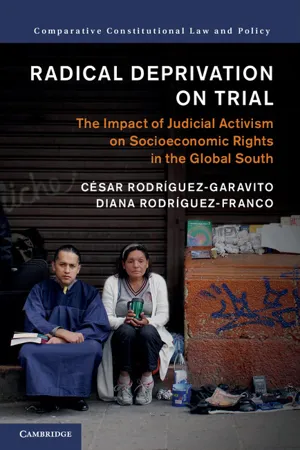 eBook - PDF
Radical Deprivation on Trial
The Impact of Judicial Activism on Socioeconomic Rights in the Global South
- César Rodríguez-Garavito, Diana Rodríguez-Franco(Authors)
- 2015(Publication Date)
- Cambridge University Press(Publisher)
These and other contributions have made a case for dialogic activism on the grounds that it deepens democratic legitimacy in constitutional regimes committed to decent standards of economic well-being. In Chapter 8, we want to make a different yet complementary case for dialogic activism. By drawing lessons from the study of T25 and comparing it with similar rulings in Colombia and elsewhere, we want to make an empirical case for this approach (Rodrı´guez-Garavito 2011a). We thus address the two classical objections to Judicial Activism – that judges are not elected and thus lack democratic legitimacy, and that courts lack the requisite institutional capacity to deal with complex socioeconomic issues and enforce their rulings 26 Studying Impact: Activist Courts Addressing Radical Deprivation (Rosenberg 1991) – by locating the debate in “actually existing democracies,” as illustrated by the institutional contexts in which structural cases on SERs occur. In response to the criticism of the undemocratic origins of judges, we use the evidence from the case study and similar rulings to question the idea- lized and limited conception of democracy that underlies the views of proponents of judicial passivism. Indeed, those advocating for judges’ passivity assume that, unlike the judiciary, other branches of government are democratically legitimated and are invariably subject to democratic accountability mechanisms. Policy and institutional practice, however, call into question this assump- tion. This idealized vision of elected bodies can be countered just by looking at the evidence of influence-peddling scandals (legal and illegal) in national parliaments around the world, or attempts by presidentialist governments to manipulate constitutional rules for personal gain. The legitimacy of actu- ally existing democracies is far more complex and problematic than critics suggest. Practical difficulties are compounded by problems of institutional design. eBook - ePub
Courts and Judicial Activism under Crisis Conditions
Policy Making in a Time of Illiberalism and Emergency Constitutionalism
- Martin Belov(Author)
- 2021(Publication Date)
- Routledge(Publisher)
As pointed out by Michel Foucault, language in modern society is power, and this feature persists even in the most ‘politicised’ legal terminology: simply by classifying a political problem and a political solution into legal language, the justices are (consciously or unconsciously) choosing to impose on the issue the domain and limits set by the legal discourse. 61 Therefore, the work of the Constitutional Courts should be evaluated accordingly, i.e., by using legal criteria and, at the same time, by excluding from the evaluation process all features and limits set by other types of discourses – and, among them, the political one. 60 See Gonçalo de Almeida Ribeiro, Judicial Activism and Fidelity to Law, in L. Coutinho, M. La Torre and S. Smith (eds) Judicial Activism – An Interdisciplinary Approach to the American and European Experiences, 2015, Cham: Springer, 36–40; and Dieter Grimm, Constitutionalism: Past, Present, and Future, 2016, Oxford: Oxford University Press, 208. But see Alec Stone Sweet, The Politics of Constitutional Review in France and Europe, 5 International Journal of Constitutional Law 72 (2007). See, e.g., Lawrence B. Solum, The Supreme Court in Bondage: Constitutional Stare Decisis, Legal Formalism, and the Future of Unenumerated Rights, 9 University of Pennsylvania Journal of Constitutional Law 160–176 (2006); and Ronald Dworkin, Justice in Robes, 2006, Cambridge: Belknap Press, 147–150. 61 See Michel Foucault, The Archaeology of Knowledge and the Discourse on Language, 1972, New York: Pantheon books, ch. 2. See also Alan Hunt and Gary Wickham, Foucault and Law: Towards a Sociology of Law as Governance, 1994, Chicago: Pluto Press, 7–12 and 41–43. 6 Conclusion In light of the debate on Judicial Activism at the constitutional level, i.e., the involvement of Constitutional Courts in political law-making, this chapter has investigated the issue of whether such courts should be considered primarily legal or political actors
Index pages curate the most relevant extracts from our library of academic textbooks. They’ve been created using an in-house natural language model (NLM), each adding context and meaning to key research topics.

