Politics & International Relations

Dissenting Opinion
A dissenting opinion refers to a disagreement expressed by one or more judges in a legal case who do not fully support the majority decision. This dissenting view provides an alternative perspective and rationale for the decision, often highlighting differing interpretations of the law or the case's facts. In the realm of politics and international relations, dissenting opinions can influence future legal interpretations and public discourse.
Written by Perlego with AI-assistance
Related key terms
1 of 5


3 Key excerpts on "Dissenting Opinion"
 eBook - ePub
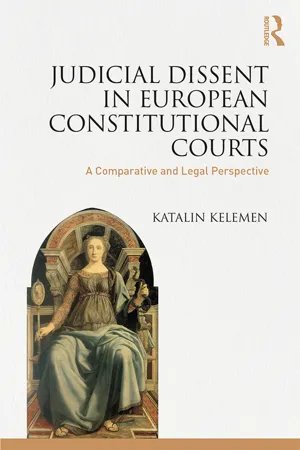
Judicial Dissent in European Constitutional Courts
A Comparative and Legal Perspective
- Katalin Kelemen(Author)
- 2017(Publication Date)
- Routledge(Publisher)
Judicial dissent What is it and why does it matter?1. Judicial dissent and Dissenting Opinions: a definition
By ‘Dissenting Opinion’ we mean a separate opinion that diverges from the opinion of the majority of a group. Naturally, dissent can only exist if the decision is taken by multiple actors. It means that in a court it can exist only if there is a collegial body that decides the case. In other words, dissent can occur in a judicial panel. It cannot occur if the judgment is delivered by a single judge. In this book, the expressions ‘judicial dissent’ and ‘Dissenting Opinion’ will be used as synonyms. The former refers to the phenomenon of judges writing separately, while the latter points to its product. It is also important to clarify that the expression ‘Dissenting Opinion’ can be used in a broad or a strict sense. In the broad sense a Dissenting Opinion is any separate opinion of a member of a judicial panel. A dissenter, however, may disagree with the majority only in part. He may ‘concur’ in the outcome of the case but indicate different reasons for reaching such conclusion. In this case her/his separate opinion is called, more technically, ‘concurring opinion’. A Dissenting Opinion in the strict sense, on the other hand, disagrees with the majority also as regards the ruling. A dissenting judge would have decided the case differently. Conversely, a concurring judge would have simply written the judgment differently, without changing the outcome of the case. Thus, a concurring opinion generally offers an alternative reasoning to the decision, but it may also simply add further arguments (supplementary reasoning) or aim to explain better the opinion of the court (explanatory opinion).1 eBook - PDF
- Neil Duxbury(Author)
- 2021(Publication Date)
- Cambridge University Press(Publisher)
2 The Nature of Judicial Dissent Judicial dissents share many of the features of other forms of dissent. But it would be wrong to think that they have no unique characteristics. And it would certainly be a mistake to presume that the same characteristics are ascribed to judicial dissents from one legal system to the next. Throughout European systems alone, a range of expressions is used to refer to Dissenting Opinions – expressions which put various slants on what it means for judges to dissent. 15 In German legal doctrine, a dissent may be referred to either as a special opinion (Sondervotum) or as a minority opinion (Minderheitsvotum), though in the judgments of the Federal Constitutional Court they are called divergent opinions (abweichende Meinungen). 16 In Italy’s Constitutional Court, a Dissenting Opinion is an opinione dissenziente. 17 But in various Italian regional civil courts before unification, a dissent was a voto di scissura – a vote indicating that the judges involved in a decision had an irreconcil- able difference of opinion. 18 In Spanish, a Dissenting Opinion is a voto particular disidente or discrepante, the word ‘particular’ indicating that disclosure of the opinion is exceptional and subject to the agreement of 15 See Kelemen, Judicial Dissent in European Constitutional Courts, 6. 16 See Frank Halle, ‘Sondervotum und Separate Opinion im Rechtsvergleich’, in Verfassungsrichter. Rechtsfindung am US Supreme Court und am Bundesverfassungsgericht, ed. B. Großfeld and H. Roth (Münster: Lit, 1995), 141–50 at 141–4; Wolfgang Heyde, Das Minderheitsvotum des überstimmten Richters (Bielefeld: Gieseking, 1966), 50–1; Kelemen, Judicial Dissent in European Constitutional Courts, 85–6. In decisions of the European Court of Human Rights, a dissent is an opinion individuelle, though art. 48 § 2 of the Convention refers to ‘[a]ny judge’ of the Court being ‘entitled to deliver a separate opinion’, and Rule 74 § 2 of the Rules of Court states that ‘[a]ny judge . eBook - PDF
- Robert Kolb(Author)
- 2013(Publication Date)
- Hart Publishing(Publisher)
256 In light of the international practice, these con-cerns can be seen to have been exaggerated. On the contrary, separate opinions provide a welcome element of pluralism and nuance. All the more so, given the very great complexity of international disputes and the fluidity of the applicable law. It can be of considerable value to have light shed on any one of a numerous series of aspects that a case may throw up, sometimes arising from the very fact of addressing a question that is overshadowed, or at least little addressed, in the arguments of the Court and of the individual judge’s colleagues. The function of a separate opinion. 257 Individual and Dissenting Opinions, as well as serving certain particular ends, are useful in a wide variety of ways. First , the right to formulate them increases the independence of the individual judge. The judges know they can always give free expression to the reasons that incline them in certain directions. This can make them more inclined to accept the majority view without continuing to resist, in the knowledge that they can discharge their responsibilities not only by voting against the proposed judgment, but also by providing a full statement of the legal basis for their dissent. And, in formulating that Dissenting Opinion, they can ensure that their reasoning is cogent and coherent, and in the process, resist any surreptitious tendency of political considerations to intrude upon it. Second , by taking advantage of the opportunity to present a measured and exact state-ment of their view, such judges can avoid any misunderstandings as to their opinions. It can be important to them to be sure that they have been properly understood. Third , such opinions increase the Court’s transparency. External observers know not only who voted for what, but also the reasoning of those judges who felt it necessary to explain their views. This is not without importance for the Court’s credibility in a ‘demo-cratic’ age.
Index pages curate the most relevant extracts from our library of academic textbooks. They’ve been created using an in-house natural language model (NLM), each adding context and meaning to key research topics.

