Literature

Bell Hooks
Bell Hooks is a prominent feminist author, cultural critic, and social activist known for her insightful and influential writings on race, gender, and class. Her work often challenges traditional power structures and advocates for intersectional feminism. Hooks' accessible writing style and emphasis on personal experience have made her a widely respected figure in feminist literature.
Written by Perlego with AI-assistance
Related key terms
1 of 5

3 Key excerpts on "Bell Hooks"
 eBook - PDF
Educating about Social Issues in the 20th and 21st Centuries
Critical Pedagogues and Their Pedagogical Theories
- Samuel Totten, Jon Pedersen, Samuel Totten, Jon E. Pedersen(Authors)
- 2014(Publication Date)
- Information Age Publishing(Publisher)
Educating About Social Issues in the 20th and 21st Centuries, pages 257–278 Copyright © 2014 by Information Age Publishing All rights of reproduction in any form reserved. 257 CHAPTER 13 Bell Hooks Feminist Critique Through Love Nancy Taber INTRODUCTION This chapter constitutes an exploration of the life and work of feminist Bell Hooks. She has written well over 30 books in the areas of cultural stud- ies, education, writing, and children’s literature. Her work has been enor- mously influential in the field of education as most of her work, regardless of its official discipline, relates to formal education, learning, and everyday pedagogy. She has been heavily influenced by authors as diverse as Paulo Freire, Toni Morrison, and Stuart Hall. Most of her books are written as a collection of essays, focusing on the ways in which gender, race, and class in- tersect in a white supremacist capitalist patriarchy. Her first academic book, Ain’t I a Woman: Black Women and Feminism, was published in 1981, and, as of today, her latest is Writing Beyond Race: Living Theory and Practice (2013). Over the span of more than three decades, hooks has established and main- tained her ongoing position as a key critical theorist and pedagogue whose work is integral to the way in which the field of education is conceptualized and investigated. 258 N. TABER As a white woman from a middle-class background, I am aware of the incongruity of my having this platform to construct a story of hooks’ life and work. I do so with the utmost respect, and clarify that I am not an ex- pert on hooks, nor should my telling of her work be any more important than another’s. In fact, it is my hope that, in reading this chapter, readers will go to her work itself. I have purposely chosen to quote extensively from hooks, herself, in an attempt to give her voice some primacy over my own.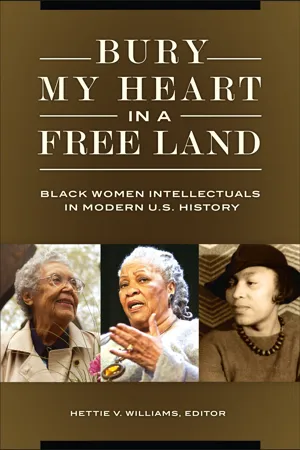 eBook - ePub
Bury My Heart in a Free Land
Black Women Intellectuals in Modern U.S. History
- Hettie V. Williams(Author)
- 2017(Publication Date)
- Praeger(Publisher)
Since the beginning of her writing career, hooks has always been intent on debunking the false and offensive representations of blacks while providing readers with new and accurate insights into black life. Her autobiographies, critical essays, and children’s books derive from the author’s dissatisfaction with the status quo and the recognized need to create alternative images. hooks’s rhetoric of resistance to white supremacist thinking, combined with her idealized vision of black life within multiracial and multicultural America, has produced an important contribution to contemporary African American studies. It is not rhetoric of racial categories, because blackness and whiteness are no longer binary essentialist concepts, and because blackness is no longer defined in relation to other races but rather as a symbol of beauty and integrity. It is a new form of resistance, covert within the simple text, and a discourse that goes beyond the academy and into the community of all people.The words of Michael Apple, who claims that Bell Hooks has taken on the role of Paulo Freire in the United States, best summarize hooks’s contributions: “Her work is wide-ranging, powerful in its indictment of relations of exploitation and domination, appropriately personal and political at one and the same time, and written in a way that provides space for real people to find their own lives spoken to in her voice.”41 hooks’s writings are also compared to Frida Kahlo’s paintings. As Nathalia E. Jaramillo and Peter McLaren observe, “Every text, essay, or critical expose is an expression of hooks’s inner and outer self and of existential realities that give shape to her thinking in and about the wider social setting.”42Although not explicitly stated, all of hooks’s works are based on her personal childhood experiences of racist and sexist discrimination, which she translates into larger political issues. For hooks, no literary work is politically neutral; and even when she writes about her own life, there are always philosophical or political implications that encourage further reflection. With their political function, her books empower African American readers, instilling in them a sense of value and pride. They also lead nonblack readers out of their false perceptions of blackness. hooks’s writings about the rhetoric of resistance and empowerment help to situate her has one of the foremost public intellectuals in the history of the African American experience.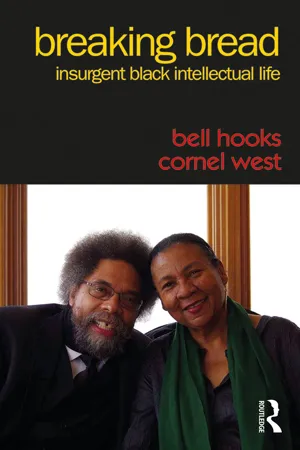 eBook - ePub
Breaking Bread
Insurgent Black Intellectual Life
- bell hooks, Cornel West(Authors)
- 2016(Publication Date)
- Routledge(Publisher)
There was a point after the publication of my first book, where I felt I couldn't go on anymore because I had been so brutally and harshly critiqued by established feminists. It was really those down-home people who were affirming me. This, more than anything else, brought home for me how important larger reward can be.When Shahrazad Ali began to appear in Newsweek and Time, I was very resentful. I thought, here is a woman who's written a book which is completely disenabling to Black people and Black community, and yet she's getting all this play in the press while many Black folks don't even know there is a Bell Hooks, a Cornel West, a Michele Wallace, a Patricia Hill Collins, a Stuart Hall, a Toni Cade Bambara, an Audre Lorde, and all the Black scholars and thinkers who are working in the interest of renewed Black liberation struggle. It can be disheartening.CW Precisely. Our influence could be so much greater if, in fact, Black intellectuals had broader visibility in the establishment journals, magazines, etc. Yet I feel it is significant that we do still have many ardent readers without the establishment heralding us in this regard.And now a quick question about fiction. Very few people know that you write fiction extensively. Who is Bell Hooks the fiction writer?bh My fiction is much more experimental and abstract than my social criticism and feminist writing and that has made me much more shy about it.One of the ideas I speak extensively about wherever I go is the joy of our voices. The fact that we can speak in many different ways. Yet this very asset quickly becomes a liability within a market economy such as this one. Once a corporation or even an independent publishing house can market an author as a specific kind of voice, it becomes a label which is put on you- In fact, it's not very different from Hollywood, where actors constantly struggle to avoid being typecast. Let's face it, it is very hard in this culture for even greatly rewarded writers to write in different kinds of voices. Take someone as distinguished as Toni Morrison: people have come to expect a certain kind of lyrical prose and would be quite shocked and disheartened if Morrison were to alter dramatically the style of her fiction or write nonfiction. Or Alice Walker. The tremendous success of a novel like The Color Purple that is very sparse in its language was followed by a very verbose and wordy book like Temple of My Familiar,
Index pages curate the most relevant extracts from our library of academic textbooks. They’ve been created using an in-house natural language model (NLM), each adding context and meaning to key research topics.

