Literature

Edwardian
The Edwardian era refers to the period of British history during the reign of King Edward VII, from 1901 to 1910. In literature, the term "Edwardian" is used to describe the literary works and cultural trends of this time, characterized by a focus on social issues, the decline of the aristocracy, and the emergence of modernism. This period saw the rise of prominent writers such as E.M. Forster and Virginia Woolf.
Written by Perlego with AI-assistance
Related key terms
1 of 5

6 Key excerpts on "Edwardian"
 eBook - PDF
- Ashley Chantler, David Higgins, Ashley Chantler, David Higgins(Authors)
- 2010(Publication Date)
- Continuum(Publisher)
However, as a description of a period spanning sixty-four years, ‘Victorian’ is necessar-ily a shorthand term. It covers a period when Britain was transformed from a predominately rural society to an urban industrialized nation. Princess Victoria was supposedly reading Charles Dickens’ Oliver Twist (1837) the night before her coronation; however, at this time most of her subjects lived in isolated rural communities and were illiterate. By the time she died in 1901, the motor car was replacing horse power, the telephone and cinema were transforming communication and entertainment, and most people in Britain were able to read and write. As the Victorian period advanced, there was a voracious appetite for literature, whether sensational cheap ‘railway novels’ bought to pass the time on journeys, or the books borrowed from ‘circulating’ (subscription) libraries and the newly created public libraries, or the part-issues of serialized novels which came out in monthly instalments. Never before had so many people been able to read and have access to affordable reading matter (see Sutherland for a useful discussion of Victorian publishing and reading practices). Victorian writers were aware of the potential to reach vast numbers of 134 readers and found a wealth of subject matter for their fiction, plays, and poetry in the dramatic social, political, cultural, and economic changes that were taking place. The 1840s, for example, was a decade of economic hard-ship, which saw the Irish Potato Famine, instability in the financial markets, and political unrest from the Chartists, who sought to improve working-class representation in Parliament. Numerous writers, such as the Brontë sisters, reflected the turmoil of the decade in their work. eBook - PDF
The Child in British Literature
Literary Constructions of Childhood, Medieval to Contemporary
- A. Gavin(Author)
- 2012(Publication Date)
- Palgrave Macmillan(Publisher)
Part III Edwardian, Modern, and Contemporary Literature (1900–2010) 11 Unadulterated Childhood: The Child in Edwardian Fiction Adrienne E. Gavin ‘I love child stories (stories about children)’ Henry de Vere Stacpoole declared in his second volume of autobiography More Men and Mice in 1945 (55). When his own bestselling ‘child story’ The Blue Lagoon was published in 1908, his fascination with childhood was widely shared. The Edwardian years (here defined as 1901–14) saw childhood become the focus of intense interest socially, culturally, and fictionally. Ellen Key’s internationally successful The Century of the Child (1900; English translation 1909) proclaimed the twentieth century the era of child- hood, and for ‘the first time,’ as Jonathan Rose observes, ‘it was widely recognized that children ... have different needs, sensibilities, and habits of thinking; that they cannot be educated, worked, or punished like adults’ (178). Child welfare legislation introduced compulsory registra- tion of midwives, a national education system, free school meals for poor children, and medical inspections for pupils. The 1908 Children and Young Person’s Act criminalized child neglect, established special- ized juvenile courts, and replaced imprisonment of child offenders with borstal or probation. Reducing parental powers and increasing state protection, such laws gave children independent legal rights. Children’s independence from adults was also a keystone of the Edwardian literary fascination with childhood, although as Peter Keating suggests, ‘[t]here is no single or simple explanation why so much independence was being granted at this time to fictional chil- dren’ (226). Like the wider Edwardian cult of childhood, it was in part a reaction against late nineteenth-century decadence and an outmoded Victorian past.
- Britannica Educational Publishing, J.E. Luebering(Authors)
- 2010(Publication Date)
- Britannica Educational Publishing(Publisher)
THE 20TH CENTURY: FROM 1900 TO 1945T he 20th century opened with great hope but also with some apprehension, for the new century marked the final approach to a new millennium. For many, humankind was entering upon an unprecedented era. H.G. Wells’s utopian studies, the aptly titled Anticipations of the Reaction of Mechanical and Scientific Progress upon Human Life and Thought (1901) and A Modern Utopia (1905), both captured and qualified this optimistic mood and gave expression to a common conviction that science and technology would transform the world in the century ahead. To achieve such transformation, outmoded institutions and ideals had to be replaced by ones more suited to the growth and liberation of the human spirit. The death of Queen Victoria in 1901 and the accession of Edward VII seemed to confirm that a franker, less inhibited era had begun.Edwardian NOVELISTS
Many writers of the Edwardian period drew widely upon the realistic and naturalistic conventions of the 19th century, and many novelists in particular were eager to use such conventions to explore the shortcomings of English social life. Wells—in Love and Mr. Lewisham (1900); Kipps (1905); Ann Veronica (1909), his pro-suffragist novel; and The History of Mr. Polly (1910)—captured the frustrations of lower- and middle-class existence, even though he relieved his accounts with many comic touches. In Anna of the Five Towns (1902), Arnold Bennett detailed the constrictions of provincial life among the self-made business classes in the area of England known as the Potteries; in The Man of Property (1906), the first volume of The Forsyte Saga , Galsworthy described the destructive possessiveness of the professional bourgeoisie; and, in Where Angels Fear to Tread (1905) and The Longest Journey eBook - PDF
History of English Literature, Volume 6 - eBook
From the Mid-Victorian Age to the Great War, 1870–1921
- Franco Marucci(Author)
- 2019(Publication Date)
- Peter Lang Group(Publisher)
Part I The Victorian Twilight § 1. Mapping English literature from 1870 to 1901 By way of providing a short and reasoned summary of the topics of this Volume 6, Part I will initially include the discussion, left interrupted before the 1870 break in Volume 4, of writers who survived and continued to be active after that date: in poetry Tennyson and Browning ; in critical prose Arnold and Ruskin; in fiction Trollope, Wilkie Collins, Meredith and, only for her Daniel Deronda, George Eliot. Having completed this section, I shall dwell on the fiction of the realists, of the pessimists and on its counterpart, the adventure novel, entertainment and popular fiction, which are balanced precariously between the demands of the market and aesthetic autonomy. The volume will close with the second-generation Pre-Raphaelites and with the Decadents. The themes at the centre of late Victorianism can be singled out as follows: the awareness of a demarca- tion, which pushes writers towards a historical perspective, and generates the sense of an ending, or a transition to modernity (or a more marked modernity); the ensuing feeling that the world is to be saved, and thence an apocalypticism, optimistic and purposeful on one hand, pessimistic and negative on the other; the debate on faith and science; an interest in myth and mythological literature. British culture of the late nineteenth century is a culture of complexity, and complexity itself becomes for the scholar – especially against the grain of a past critical tradition – an inter- pretative key of the literary history of the period. The theoretical context of the century’s last thirty years is the dialectic between fixed points and perennial change, the ‘chaos into cosmos’ according to Carlyle’s antithesis.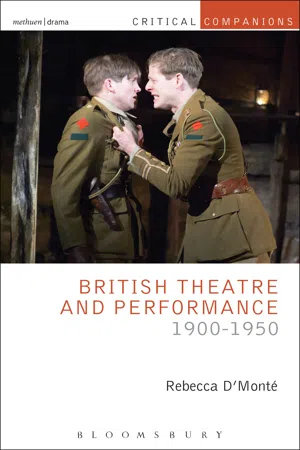 eBook - ePub
- Rebecca D'Monte(Author)
- 2015(Publication Date)
- Methuen Drama(Publisher)
G. Wells, Emmeline Pankhurst and – briefly – Bertrand Russell. The movement was named after the Roman politician Fabius the Delayer and endorsed egalitarianism through the gradual reform of injustice. The Labour Party grew out of socialist groups such as the Fabian Society and trade unions. Started in 1900 and led by Keir Hardie, it was created to support the working classes, and betokened a profound concern with the iniquitous situation where the vast majority of wealth was owned by one per cent of the population. 1 The Tories as well as the Liberal Government which came to power in 1906 saw these groups as a threat to the family and to the class hierarchy, but were unable to stop a series of devastating strikes taking place by coal, rail and port workers, among others. In the run-up to the outbreak of the Great War in 1914 there was serious talk of revolution or civil war. This pull between the old and new has occasioned Samuel Hynes to liken the Edwardian age to ‘a narrow place made turbulent by the thrust and tumble of two powerful opposing tides’. 2 In the Arts rapid changes in areas such as physics, psychology, technology and industry, led to the development of modernism. The work of James Joyce, Virginia Woolf, Pablo Picasso, Georges Braque, Arnold Schoenberg and others, redefined the nature of reality. The Manet and the Post-Impressionists Exhibition at the Grafton Gallery in London prompted Virginia Woolf to write ‘On or about December 1910 human character changed’. 3 Sigmund Freud’s psychoanalytic theories about the influence of childhood also began to filter through to Britain, provoking a considered debate about male and female sexuality. The Edwardian theatre During the Victorian era the rapid expansion of the population, economic migration, the growth of London as the largest city in the world, and the change from a basically agricultural and rural life to one that was industrial- and city-based had a concomitant effect on the theatre industry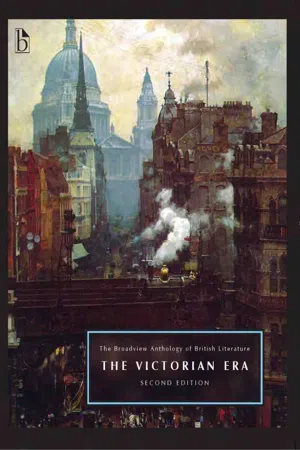 No longer available |Learn more
- Joseph Black, Leonard Conolly, Kate Flint, Isobel Grundy, Don LePan, Roy Liuzza, Jerome McGann, Anne Lake Prescott, Barry Qualls, Claire Waters(Authors)
- 2012(Publication Date)
- Broadview Press(Publisher)
The novel was a dynamic form, shifting according to popular taste and critical assessments of its potential value to readers, who were offered an ever-expanding list of authors and subgenres from which to choose. The early and mid-Victorian novels of Dickens, Thackeray, and Trollope were wildly successful, both with the critical establish-ment and the reading public. Female novelists, inclu-ding the Brontës, Eliot, Braddon, Gaskell, Charlotte Yonge, and Ellen Price Wood were some of the most respected and prolific of the century, and paved the way for legions of other women to enter the field of fiction writing. Although the profession of “novelist” achieved new respectability in the period for both men and women alike, the novel continued in some circles to be maligned as lightweight and “pernicious,” associated with frivolous lady scribblers and their female readers. As George Henry Lewes, George Eliot’s partner, observed in “The Lady Novelists” (1852), “Of all departments of literature, Fiction is the one to which, by 1 The French writer Théophile Gautier (1811–72) is generally credited with coining the phrase “l’art pour l’art” in the preface to his novel, Mademoiselle de Maupin (1836). A number of critics have contended that the idea—if not the precise phrase—dates back to ancient Rome. 2 Wilde’s The Picture of Dorian Gray , which first appeared in Lippincott’s Monthly Magazine in 1890, was immediately accused of having homoerotic overtones and deemed “unclean,” “effeminate,” and “contaminating.” Wilde made a number of changes to the novel before its publication as one volume in 1891, but these were not enough to keep the book from counting against him during Wilde’s trial for acts of “gross indecency.” The Victorian Era lxxv Cover, Famous Crimes , Police Budget Edition, c. 1890. Sensationalized stories of crime and horror, priced at one penny each and known as “penny dreadfuls,” became hugely popular in the late nineteenth century.
Index pages curate the most relevant extracts from our library of academic textbooks. They’ve been created using an in-house natural language model (NLM), each adding context and meaning to key research topics.

