Literature

Mood
Mood in literature refers to the emotional atmosphere or tone created by the author's writing. It encompasses the feelings and vibes evoked in the reader, often through the use of descriptive language, setting, and character emotions. The mood of a literary work can greatly influence the reader's experience and interpretation of the story.
Written by Perlego with AI-assistance
Related key terms
1 of 5

5 Key excerpts on "Mood"
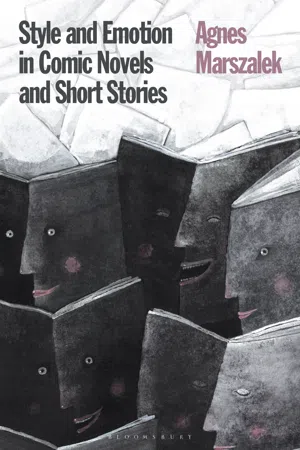
- Agnes Marszalek(Author)
- 2020(Publication Date)
- Bloomsbury Academic(Publisher)
affective tone , which, once established, will have a long-term effect on subsequent reading. Affect in literary reading, according to Miall, is ‘anticipatory’, meaning that it pre-structures our understanding of the text early in the reading process (1989: 56). The anticipatory quality of affect shapes our interpretation of literary texts. Once a certain tone has been set up, the reader will be predisposed to comprehending the text in concordance with that particular feeling.3.1.2. Mood in literary and film studiesIn literary criticism, the term ‘Mood’ is rarely used on its own merit, but rather as an auxiliary to describe two other concepts – atmosphere and tone of literary texts. Even a basic review of a number of dictionaries of literary terms reveals that not only are both atmosphere and tone defined as Moods evoked by literature, but that the three concepts can in fact be used interchangeably (e.g. Baldick 2008: 336; Abrams and Harpman 2012: 18–9). Atmosphere and tone are described as qualities of texts rather than those of readers, yet they seem to generally refer to the way a literary work makes us feel: the Mood it evokes in us.Stylistics and narratology focus on the notion of tone to suggest, for example, that a certain overall tone (e.g. ironic, intimate) can be adopted by the narrator or the implied author as part of the modality (or point of view , Genette 1980) of the work (Wales 2011: 425). A comprehensive stylistic account of tone has been developed by Leech and Short (2007: 225–9), who, like Wales, link it to discoursal point of view , which they see as the relationship between the implied author (or other addresser) and the fiction, expressed through the structure of the discourse. Part of this relationship is the authorial tone , that is, the position taken by the (implied) author towards the readers, and towards the message (2007: 225). An important consideration here is that of symmetry between the attitude expressed by the author and that evoked in the reader (which may be close, but not complete), and the related notion of distance eBook - ePub
Literary Reading, Cognition and Emotion
An Exploration of the Oceanic Mind
- Michael Burke(Author)
- 2010(Publication Date)
- Routledge(Publisher)
Literature, one could say, is all about words and sentences. From my position as a university lecturer in rhetoric and English, I believe, however, that literary reading is about far more than just lexis and syntax. This is not an easy admission for a stylistician to make—equivalent perhaps to a barrister saying that justice is about more than just laws and statutes. Nonetheless, I believe it to be true. Readers create meaning not solely by perceiving and processing words on the page; they are also affected by a whole scale of interactive, largely non-textual, phenomena that constitute important inputs that go into the meaning-making confluence of literary discourse processing. This is what this chapter will show, beginning with the phenomenon of “Mood”.When I use the term “Mood” in this work I do not mean it entirely in the strict psychological sense of the word as it was described in a previous chapter, namely, affective states of relatively long duration often elicited by an internal event (Frijda 1986: 252–53). Rather, by Mood I mean a primarily subconscious and somatic pre-reading state that plays a distinctive role in the reading process. In effect, Mood is a positive kind of feeling that a reader can get once a mainly subconscious “decision” has been made to engage with a literary work. This is not a simple process. Manguel confirms this when he suggests that meaning in literary reading comes about “through a vastly entangled method of learned significances, social conventions, previous readings, personal experiences and private tastes” (1996: 37). The diversity of pre-reading Mood is described by the twentieth-century novelist and academic Harold Brodkey in his 1985 essay Reading, the Most Dangerous Game eBook - PDF
Writing Emotions
Theoretical Concepts and Selected Case Studies in Literature
- Ingeborg Jandl, Susanne Knaller, Sabine Schönfellner, Gudrun Tockner, Ingeborg Jandl, Susanne Knaller, Sabine Schönfellner, Gudrun Tockner(Authors)
- 2018(Publication Date)
- transcript Verlag(Publisher)
However, the 27 Ibid.: 129. 28 Cf. Carroll 1990: 41-42. 260 | P IRJO L YYTIKÄINEN beginning is essential in awakening the interest in the text and in setting the tone. 29 In psychology the term ‘Mood’ has been used to refer to (fleeting or medium -term) states of mind in individuals, and we may ask how this concept relates to the Mood of a literary text. It has been claimed – with good reason, I think – that the way in which the text Moods function follows the logic of Moods in individ-uals. 30 Poe is helpful himself: he describes this logic and, thus, seems to hint at his own poetics in “The Fall“. Poe’s narrator’s description of the constant Mood of Roderick Usher assumes that the Mood determines the attitudes and emotions towards everything: “[A] mind from which darkness, as if an inherent positive quality, poured forth upon all objects of the moral and physical universe in one unceasing radiation of gloom.” 31 The gloom that has invaded the mind of Usher colours his whole world. This observation, when interpreted on the meta-level, is pertinent to the way in which the whole text is constructed. Everything described in this story contributes to creating and strengthening the atmosphere of gloomy horror. Every phenomenon that the narrator pays attention to is seen through the filter of this dark melancholy. This contagious atmosphere seizes the narrator immediately on arrival, before he has met his friend. Not only the state of his friend but what he himself affirms to be a “superstition” about the house and its surroundings being haunted imposes itself on him: I had so worked upon my imagination as really to believe that about the whole mansion and domain there hung an atmosphere peculiar to themselves and their immediate vicinity – an atmosphere which had no affinity with the air of heaven, but which had reeked up from the decayed trees, and the gray wall, and the silent tarn – a pestilent and mystic vapor, dull, sluggish, faintly discernible, and leaden-hued. eBook - ePub
How to Do Things with Narrative
Cognitive and Diachronic Perspectives
- Jan Alber, Greta Olson, Jan Alber, Greta Olson(Authors)
- 2017(Publication Date)
- De Gruyter(Publisher)
I begin by considering the distinction between emotions and Moods. Emotions are intentional mental states in the philosophical sense of the word ‘intentional’: they are directed towards specific objects or situations; as such, they tend to be circumscribed and episodic (Solomon 1993, 112). Being nervous about missing a flight or frustrated after making a careless mistake in chess are examples of emotions, since they are intentionally directed at two states of affair (the missed flight, the chess blunder). Moods, by contrast, are diffuse and tend to lack a distinct intentional object. When I wake up ‘in a good Mood,’ for instance, everything looks somewhat different and I approach my daily tasks with energy and optimism. These feelings are not directed at anything in particular, but they pervade all my thoughts and interactions. One should not draw too sharp a line between emotions and Moods, though. We can be dejected or elated about something that happened to us, but when those emotions tinge one’s attitude towards life as a whole, they become Moods.The same can happen during audiences’ encounters with narrative. In an essay on “Art and Mood” (2003, 539–545), Noël Carroll argues that artworks can evoke Moods via emotional responses: an accumulation of emotions can tip our affective balance one way or another, leading to Moods. In the following section I will focus on this link between emotional responses and the Mood that emerges from a narrative. I will then complicate this account by turning to two additional factors. First, Mood is not just a function of narrative contents – the situations and characters represented by a text, and the circumscribed emotions they elicit – but of style and narrative structure as well. Second, I will argue that Mood should be theorized in terms of bodily feelings, as a shift in the audience’s embodied orientation towards the world. In the last part of this chapter, I will illustrate these claims through a case study. I will discuss a corpus of online reviews of Christopher Nolan’s film Memento (2000), focusing on how Mood and related notions become a vehicle for audiences’ interpretive negotiations of the plot. This corpus is a subset of the over 2,000 online reviews published in the “Internet Movie Database” (IMDb) from the film’s release in 2000 to March 2015.11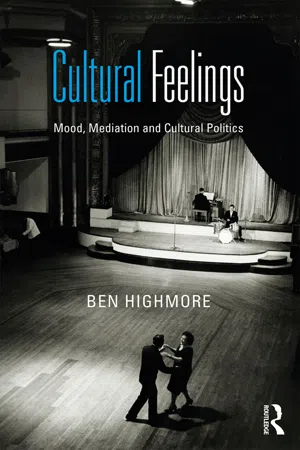 eBook - ePub
Cultural Feelings
Mood, Mediation and Cultural Politics
- Ben Highmore(Author)
- 2017(Publication Date)
- Routledge(Publisher)
1Feeling Our Way and Getting in the Mood(An introduction)This book is about feelings and Moods. But it isn’t about Moods and feelings as internal states, experienced by individualised sovereign subjects. Or it isn’t primarily about that. We live across Mood-worlds. We live through a plethora of feelings. Some Moods and feelings are dramatic and intense; their presence is emphatic, insistent. Other feelings are relatively inconspicuous because they occur too often to be noticeable, or because they saturate a particular situation. Some are just a low hum. We don’t notice the Mood of the place where we work until it is somehow ‘off’. But the day-to-day Mood of our workplace isn’t the absence of Mood. We know this because it is significantly different from the atmosphere in our homes, even though we might not notice that Mood either. All of the feelings we experience are relational – my boredom, for instance, is directed towards something even though it feels so internal and empty to me – and to a greater or lesser extent those relations are deeply entwined with the social worlds that we inhabit.This book is concerned with Moods and feelings as social and historical qualities. As a modest claim, I want to suggest that Moods and feelings are an important aspect of the world, and that we need to take account of them. More immodestly, I want to claim that unless we attend to Moods and feelings we are not engaging in the sociality of social and cultural enquiry. How the world feels to us, and how it has felt to us, is the phenomenal form of the social: this quality is the sense of promise and defeat, of opportunities found and lost, of ease and disquiet, of vibrancy and dourness.In the chapters that follow, I work both theoretically and historically to chart some of the ways that Mood, feeling and atmosphere help us to describe various periods and moments of British post-war social and cultural history. In the next chapter I will explain more precisely why I’m using a word like ‘feeling’ rather than the more theoretically elaborated term ‘affect’, and why I’m conjoining feeling with the equally vague term ‘Mood’. For now, I just want to say that I don’t subscribe to the definition of ‘feeling’ in a statement such as: ‘feelings are personal and biographical, emotions are social, and affects are prepersonal
Index pages curate the most relevant extracts from our library of academic textbooks. They’ve been created using an in-house natural language model (NLM), each adding context and meaning to key research topics.

