Literature

Literary Fiction
Literary fiction refers to a genre of writing that focuses on the quality and depth of the writing, often exploring complex themes and character development. It is known for its emphasis on artistic expression and literary merit, often delving into the human experience and offering thought-provoking insights. This genre is characterized by its nuanced and sophisticated storytelling.
Written by Perlego with AI-assistance
Related key terms
1 of 5
7 Key excerpts on "Literary Fiction"
 eBook - ePub
Literature and Understanding
The Value of a Close Reading of Literary Texts
- Jon Phelan(Author)
- 2020(Publication Date)
- Routledge(Publisher)
Literary Fiction as a subgenre of both literature and fictionThere is a tendency in the philosophy of literature, less conspicuous in the philosophy of fiction, to use the terms ‘literature’ and ‘fiction’ interchangeably. Yet the terms appear to track an important distinction; one recognised by publishers, librarians, booksellers and any reader who expects a different kind of read from the shelf marked ‘literature’ than from the shelf marked ‘fiction’.1 The problem is that in running the concepts ‘literature’ and ‘fiction’ together, no distinction is drawn between arguments that are sound only if the concept ‘literature’ is employed and arguments that are sound only if the concept ‘fiction’ is employed. As a result, the conclusions of such arguments are taken to apply indiscriminately to both literature and fiction, to the potential detriment of both. Some work needs to be done in order to determine what the conceptual relations are between literature, fiction and Literary Fiction. Once this is in place I can investigate the claim that the cognitive gain from reading Literary Fiction is generated from a reader’s engagement with Literary Fiction qua literature and not, as is too often assumed, qua fiction.There is a tradition that takes all literature to be fictional by definition. This view is summarised by Tzvetan Todorov when he says that literature is ‘imitation through language’ and as all imitation is not real but fictional then ‘literature is fiction’ (Todorov 1973: 7 italics in original). It is not clear, however, why we should join this tradition given that many works read and admired as literature are not fictional. Works admired for their literary qualities but which are not fictions include: Descartes’ Meditations, Gibbon’s Decline and Fall of the Roman Empire, some of George Orwell’s essays, and The Song of Solomon. Some works considered ‘literary’ include works based on fact which are fictionalised in their presentation such as Arthur Miller’s The Crucible
- David Morley(Author)
- 2007(Publication Date)
- Cambridge University Press(Publisher)
Later – even in a later drafting – you may turn the House of Fiction upside down and smash all its windows. The truth is many writers secretly desire the cultural cachet of Literary Fiction while not so secretly yearning for the popularity (and royalties) of a great storymaker. There lies your challenge. For new writers, the best way to make story is by knowing what forms are open to you; by taking a thread of narrative and letting it lead you; by dreaming your scenes into verisimilitude; by building credible char- acters and placing them in situational conflict; and by asking your story the question: What if this happened? 155 156 Creative writing Writing Literary Fiction As John Updike says, ‘Fiction is nothing less than the subtlest instrument for self-examination and self-display that mankind has invented yet.’ Literary Fiction is the customary objective for an apprentice to creative writing – the making of novels, novellas and short stories, as well as the modes of flash fiction and anti-narrative. Some question the legitimacy of this. Why not teach them to compose pulp fiction? The answer is that some writing schools do teach commercial genres, and there is every chance that many more will follow: the teaching of children’s fiction, after the success of Philip Pullman, Jacqueline Wilson and J. K. Rowling, waxes exponentially. The argument to teach Literary Fiction comes down to an analogy with a rainforest. Like poetry, we value some species of writing for reasons other than their price within the free market. We value them because they are luminous, protean and give pleasure. More than any other function, they allow language to live. Our languages get flattened, ossified, drained of life by people who do not care about variety or luminosity. Such ‘villains’ – among them politicians, bureaucrats, and the media – are like loggers working language’s forests to the roots, replacing their depth and strangeness with monocrops. eBook - PDF
- Garry L. Hagberg, Walter Jost, Garry L. Hagberg, Walter Jost(Authors)
- 2009(Publication Date)
- Wiley-Blackwell(Publisher)
I will use the term “Literary Fiction” to refer to those works of literature that are also fictional. In Literary Fiction, the bulk of propositions expressed are not put forth as true, or at least as true beyond the world of the work of fiction. If someone challenges my claim about the impending storm with the question, “How do you know?” I might reply by throwing open the curtains or at least switching on the Weather Band radio. By contrast, if someone were to challenge George Eliot’s claim that Rosie Vincy craned her neck on a certain occasion, Ms Eliot would, I take it, be nonplussed. Her reply might go like this: “I know what Rosie did because I simply decide what she did. She’s my creation after all. Perhaps I shouldn’t have had her do all the things she did in Middlemarch , but that’s another question.” That Rosie craned her neck on the how and what we can learn from fiction 351 occasion in question is true in the world of Middlemarch , but outside the world of the work, the question does not even seem to arise. No doubt, many works of literature are, or contain sentences that are, largely true in a way not likely to raise any hard questions. For instance, many works are histor-ical or journalistic while having been “fictionalized” in order to protect identities of the characters discussed. A reporter might for instance go undercover posing as an addict in an American city for an article about the methadone trade. She might then change the names of her informants to protect their identity. In that case, we take what she writes as a memoir rather than a novel or short story with the understanding that minor parts have, in effect, been redacted. More germane for our purposes are cases in which an author will intersperse her novel with observations on city life, marriage, jealousy, political intrigue, and the like that she puts forth as straightforward assertions. In some cases what then occurs in the novel is meant to support one or more of those claims. eBook - PDF
- Terry Eagleton(Author)
- 2012(Publication Date)
- Yale University Press(Publisher)
T H E E V E N T O F L I T E R AT U R E 140 reworks them, in the process of doing which it produces itself. Fiction is about the world by virtue of adhering to its own internal logic. Or – to change the terms round – it is about itself in a way that projects a world. Its inside and outside are reversible. There is another sense in which literary works are self-consti-tuting. One of their features is that they are clearly snatches of ‘discourse’ rather than specimens of ‘language’, which is to say that they are language bound up with specific situations. In everyday life, such situations play a major role in how we make sense of signs. I can generally tell from the state of the traffic and the disposition of our two vehicles that when you flash your headlights you mean ‘Go ahead!’ rather than ‘Watch it!’, even though the action itself can conventionally mean either. The strangeness of literary works is not only that they lack such practical contexts, but that this absence helps to make them what they are. It is this that John Ellis seeks to capture with his notion of literature as contextually free-floating. Without a context, however, a work would risk being unintelligible, so its solution to this dilemma is to produce one for itself as it goes along. Each of a text’s utterances is at once a verbal act in its own right and a contribution to the frame within which it is to be read. Rather as the work generates its own ideological subtext, as we shall see later, so it spins out of its own substance a good many of the terms of reference within which it can make sense. This is part of what we mean by a work’s ‘world’. Comparisons between works of art and human beings are usually bogus. The literary work, pace Georges Poulet, is not a fellow subject with whom we can commune, but a set of marks on a page. 95 Even so, there is a parallel between the way in which fictional texts are self-determining and the way in which individ-uals are. eBook - PDF
- David Davies(Author)
- 2007(Publication Date)
- Continuum(Publisher)
One suggestion is that literary works differ in their content , being pieces of fictional writing. (We shall look at what makes something fictional in Chapter 3.) But this clearly isn’t sufficient. Jokes (‘A panda goes into a restaurant and orders a meal . . .’), philosophical thought experiments (‘Suppose that a demented scientist removed your brain while you slept and placed it in a vat . . .’), scientific thought experiments (see Chapter 8) and comic strips are usually viewed as fictions, but not as literary artworks. Also, some literary works, such as works of lyric poetry, seem to be non-fictional in their subject-matter. So being fictional doesn’t seem to be necessary either. This suggests an alternative criterion of literary art, namely, the style of a piece of writing. This answer was favoured by the Russian Formalists, one of whom, Roman Jakobson, defined literature as ‘organised violence committed on ordinary speech’. 5 Literary writing in the artistic sense, they claimed, deliberately departs from ordinary speech, and relies for its effects on this disruption, which forces us to read it differently and to reflect on our ordinary comprehension of language and of the world. While this seems to be an implausible characterization of most literary prose, it is not difficult to find examples of poetic art that lend themselves to such a description. The first stanza of Gerard Manley Hopkins’ ‘The Sea and the Skylark’, for example, runs as follows: On ear and ear two noises too old to end Trench—right, the tide that ramps against the shore; With a flood or a fall, low lull-off or all roar, Frequenting there while moon shall wear and wend.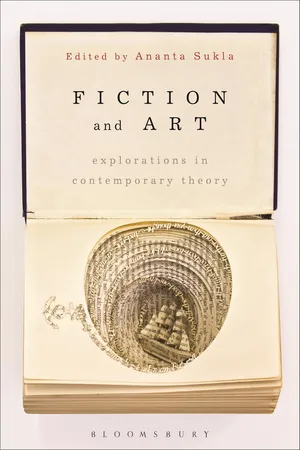 eBook - PDF
Fiction and Art
Explorations in Contemporary Theory
- Ananta Ch. Sukla(Author)
- 2015(Publication Date)
- Bloomsbury Academic(Publisher)
If fiction and nonfiction are taken merely as genre distinctions or aisles in the bookstore, things might remain relatively simple. 1 But fiction and nonfiction are not merely genre descriptions; they are used to describe the ways we should approach and 171 Fiction and Art 172 respond to a text. Fiction and nonfiction are normative terms. All of these pairs are much more loaded than they initially seem, and none of the pairs are as mutually exclusive as we would like to think. The pair I am interested in examining is Literary Fiction and literary nonfiction. Although my focus will be on the ways in which we distinguish between them and whether there can be a mutually exclusive category distinction applied, the other pairs of opposites will continue to inform my investigation into the ways in which we use, understand, confuse and misuse the tenuous distinction that we make between fiction and nonfiction. I will argue that our understanding of both genre descriptions is in fact largely dependent upon another distinction; narrative and non-narrative, and that in significant ways the negation of fiction (nonfiction) cannot fall into a mutually excluded category at all. Further, I will argue that the association of truth with nonfiction and falsity with fiction does us doubly wrong since the ways in which we talk about something being true or false refers to a more propositional kind of statement of fact than narrative could ever possibly offer us. Describing fiction That which we describe as fictional can be taken in a number of ways; it can be something that is made up (fabricated) or simply that which does not correspond with reality. Fictionality can be dictated by the author’s intentions, or it can be something made fictional by use. Presumably, fiction could be dictated merely by the Library of Congress designation printed on the back of a book jacket. However, what is fictional is not merely what is not true.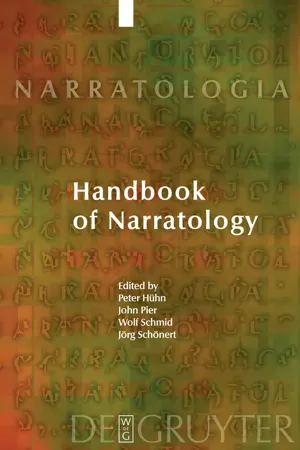 eBook - PDF
- Peter Hühn, John Pier, Wolf Schmid, Jörg Schönert, Peter Hühn, John Pier, Wolf Schmid, Jörg Schönert(Authors)
- 2009(Publication Date)
- De Gruyter(Publisher)
Indeed, fiction, and its species narrative fiction, are best understood as a specific way of producing and using mental representations and semiotic devices, be they verbal or not. This means that narrative and fiction are intersecting categories and must be studied as such (see Martínez & Scheffel 2003). 2.3 Types of Fiction The difficulty of getting a clear picture of the distinction between fac-tual and fictional narrative results in part from a long history of shifting uses of the term “fiction.” The sense which is most current today—that of a representation portraying an imaginary/invented universe or world —is not its original nor its historically most prominent domain of refer-ence. In Latin, fictio had at least two different meanings: on the one hand, it referred to the act of modeling something, of giving it a form (as in the art of the sculptor); on the other hand, it designated acts of pretending, supposing, or hypothesizing. Interestingly, the second sense of the Latin term fictio did not put emphasis on the playful dimension of the act of pretending. On the contrary, during most of its long his-tory, “fiction,” stemming from the second sense of the Latin meaning, was used in reference to serious ways of pretending, postulating, or hy-100 Fictional vs. Factual Narration pothesizing. Hence the term has usually been linked to questions of ex-istence and non-existence, true and false belief, error and lie. In classical philosophy, “fiction” was often used to designate what we today would call a cognitive illusion (→ illusion). Hume used the term in this sense when he spoke about causality or about a unified self, calling them “fictions” (Hume [1739] 1992: Bk I, Pt IV, Sec VI). Now, this type of fiction, as Hume himself explicitly stated, is quite different from fiction in the artistic field. It is part of the definition of a cognitive fiction that it is not experienced as a fiction. A narrative fic-tion, by contrast, is experienced as a fiction.
Index pages curate the most relevant extracts from our library of academic textbooks. They’ve been created using an in-house natural language model (NLM), each adding context and meaning to key research topics.

