Literature

Women's fiction
Women's fiction is a genre that typically focuses on the experiences, relationships, and challenges of women. It often delves into themes such as family dynamics, personal growth, and emotional journeys. While the term "women's fiction" can encompass a wide range of stories and styles, it generally centers on the perspectives and lives of female characters.
Written by Perlego with AI-assistance
Related key terms
1 of 5
5 Key excerpts on "Women's fiction"
 eBook - PDF
Changing Ireland
Strategies in Contemporary Women's Fiction
- Kenneth A. Loparo, Christine St. Peter(Authors)
- 2000(Publication Date)
- Palgrave Macmillan(Publisher)
7 Nor is feminist fiction synonymous with the category ‘women’s fiction’ although it is contained within it. Yet many critics and reviewers use the term women’s fiction as though it were self- evident and all inclusive in its meaning. The term ‘women’s fiction’ then is used to suggest any book by a woman that (some) women might like to read. This has the positive effect of helping women find ‘their’ books, but has the negative effect of marking women’s fiction as ‘other’, allowing men’s fiction to stand as the unmarked standard. Yet for many people, even some feminist critics, the term women’s fiction simply designates the so-called popular women’s fiction genres like Harlequin or Mills and Boone ‘soft’ romances, shopping and sex blockbusters, or family and village sagas of the sort discussed in Chapter 5. There now exist enough of these sorts of women’s novels to constitute a category in the Irish context; that is, in the last few years a fairly significant number of shopping-and-sex block- busters, ‘soft’ romances, and family saga novels have appeared by Irish women for Irish (and other) audiences. But if we designate the novels of such writers as Patricia Scanlan, Mary Ryan, Deirdre Purcell, Kathleen O’Connor, Maeve Binchy or Marian Keyes as ‘women’s novels’, what will feminist publishers eager to reach a more ‘intellec- tual’ audience call the difficult, elegantly crafted novels of such Irish Feminist Fiction 149 writers as Kate O’Brien, Elizabeth Bowen or Janet McNeill? The director of Virago, the British publisher who reissued the novels of all three of these women, deflects the definitional problem by describing Virago publications as comprising ‘things in books which are central to women’s experience’. 8 The British critic Rosalind Coward has attempted to sort out these definitional ambiguities in two important articles in which she distin- guishes ‘feminist fiction’ from her portmanteau category, usefully named ‘women-centred fiction’. eBook - PDF
- M. Makinen(Author)
- 2001(Publication Date)
- Palgrave Macmillan(Publisher)
So this opening chapter is in part a methodological discussion of the issues of the popular, pleasure and the audience, the issue of feminism(s), and of the transformability of formula fiction. 7 M. Makinen, Feminist Popular Fiction © Merja Makinen 2001 Feminism and the popular Feminist literature in Britain and America during the rise of the Women’s Liberation Movement, initially took the form of the realist ‘coming to consciousness’ novel, a form of bildungsroman of the feminist con- sciouness in the female protagonist. Erica Jong’s Fear of Flying and Marilyn French’s The Woman’s Room are two best-selling landmarks in this type of feminist fiction which Nicci Gerrard has defined as ‘the lit- erature of personal angst and domestic oppression ... in which pain is worn like a badge of moral superiority’. 1 But during the later part of the 1970s and progressively in the 1980s, feminist fiction began to branch out into exploring the popular genre format, giving rise to a whole wave of self-consciously styled feminist detective fiction, feminist science fic- tion and feminist fairy tales. Feminist publishing houses, such as Pandora and the Women’s Press, set up their own genre series of detec- tive fiction and science fiction, while the more mainstream and genre presses welcomed self-styled feminist writers. This choice to move into popular genre forms was not an arbitrary one. It could almost be argued, as Judith Williamson did in 1986 in the left-wing journal New Socialist, that during the 1980s, the left as a whole discovered popular culture: It used to be an act of daring on the left to claim enjoyment of Dallas, disco-dancing, or any other piece of popular culture. Now it seems to require equal daring to suggest that such activities, while certainly enjoyable, are not radical. eBook - ePub
In Other Words (RLE Feminist Theory)
Writing as a Feminist
- Gail Chester, Sigrid Nielsen(Authors)
- 2012(Publication Date)
- Routledge(Publisher)
Excellence is not the issue, but who defines it. Now we can turn to feminist writing, both fiction and non-fiction, for a model of literature without aesthetic divisions. For feminism has demonstrated that the division of writing into creative and polemic is artificial and meaningless. Feminists are both, and consider both to be creative writing.Gradually, and as a result of the persistence over many years of many people, there has been a shift in regard for women's writing and feminist fiction – from contempt to acclaim.8 Previously invisible bodies of work from the past and new creations have begun to acquire their (rightful) status – as art. New forms are receiving cultural accreditation: including increasingly the writing of Black women.Feminism also offers evidence of a need for the ‘elevation’ of non-fiction to the level of art and creativity. The Women's Movement has spread and taken root as the largest and most successful world-wide liberation movement this century, arguably surpassing even the great socialist revolutionary movements in insight and achievement. This Movement has taken hold largely as the result of ideas communicated primarily in the form of non-fiction – in the writings of such women as Simone de Beauvoir, Kate Millett, Germaine Greer, Suzie Orbach, Mary Daly, Adrienne Rich, Dale Spender, and the other legions of ‘women of letters’. Women have also discovered that truth is not only stranger, but often stronger, than fiction – and have transformed the forms of life history, biography and autobiography, into revelations and sources of shared power: breaking the silence, revealing the realities of women's lives.9This ‘art’ – of clear thinking communication of the meaning of women's oppression – has taken the creative non-fiction form of:1 ideas that have transformed consciousness, awareness, and understanding, and motivated, i.e. moved, often in a process of catharsis, millions of women to transform their own lives and change the system which oppresses them;
- A. Dooling(Author)
- 2005(Publication Date)
- Palgrave Macmillan(Publisher)
(In this sense, they fit the definition of what Maria Lauret refers to in her analysis of American feminist literature as “self- conscious fictions of subjectivity.”) 55 Second, New Women writers adopted such narrative strategies in response to the prevailing May Fourth discourse on realism, including its claims to mimetic reference but also, on an impor- tant level, can be said to have been empowered by them. At a moment when historical challenges to dominant sexual codes had opened up the possibility of alternative cultural scripts for women, realism’s claims authorized them to represent women. The use of subjective narrative forms and female I-narra- tors in their fiction gave added credibility to their account of modern female experience, and in turn appealed to the reading public’s interest in revela- tions of personal experience. Third and perhaps most crucially, at least in the hands of the most accomplished New Women writers at the time, the female self that is textually “revealed” in fact functions more to raise questions about the possible social identities of the modern woman rather than to assert absolute definitions. As we shall see, the narrative context that precip- itates the (fictional) act of confession typically involves a crisis of some sort that challenges the I-narrator’s self-identity; the conflicts, contradictions, and possibilities she comes to feel about what it means to be a woman are what fuel the production of her text. The project of self-writing (both as it is enacted by and represented in these stories) does not present itself as the solution to the underlying causes of her predicament; insofar as it contributes to the self-awareness of the I-narrator and the reader (again, both actual and the fictional readers figured in the text), including significantly, an awareness of the gaps between feminist ideals and lived experience, however, it is fig- ured as a significant social/political practice.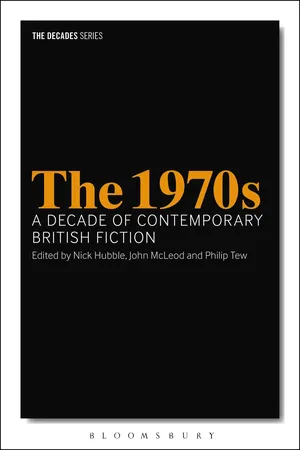
- Nick Hubble, John McLeod, Philip Tew(Authors)
- 2014(Publication Date)
- Bloomsbury Academic(Publisher)
In fact, rather than categorizing feminist fiction in terms of whether it is either ‘social-political’ or ‘psychological-personal’ in nature and making value judgements on this basis, Felski argues that feminist fiction works to collapse binaries and dualisms that characterize Leftist as well as bourgeois thinking: The importance of subjectivity, identity, and narrative in feminist fiction in turn raises a number of more general questions about the politics of literature and the insufficiency of sterile dichotomies – of realism versus experimentalism, identity versus negativity, tradition versus modernity – which have long structured oppositional thinking about cultural practices and in which the second term is unconditionally privileged over the first. The example of feminist literature suggests that the cultural needs of subordinate groups cannot be adequately grasped by continuing to think in terms of such antithetical dualisms. (152) Felski’s view of literature as serving or meeting the needs of women as a subordinate group might be regarded as overly functionalist here. The complex relationship between form, content, authorship and audience reception cannot be adequately or fully grasped by the notion of needs. But as she suggests, in the simultaneously social and experimental practice of consciousness-raising, all aspects of women’s lives, cutting across the personal and political, were subject to discussion, exploration and analysis in texts of the period. A decade of women’s writing: Some key texts There was already an established group of women writers by 1970, published by mainstream presses, which included Muriel Spark, Doris Lessing, Margaret Drabble and Iris Murdoch – to whose work Waugh gives the name ‘Cautious Feminism’ (192). Muriel Spark’s novels from the early 1970s – The Driver’s Seat
Index pages curate the most relevant extracts from our library of academic textbooks. They’ve been created using an in-house natural language model (NLM), each adding context and meaning to key research topics.

