Literature

Feminist Literature
Feminist literature refers to literary works that explore and advocate for the rights, experiences, and perspectives of women. It often challenges traditional gender roles, stereotypes, and power dynamics, and addresses issues such as sexism, discrimination, and inequality. Through storytelling, poetry, and essays, feminist literature aims to raise awareness, promote gender equality, and empower women.
Written by Perlego with AI-assistance
Related key terms
1 of 5
9 Key excerpts on "Feminist Literature"
 eBook - ePub
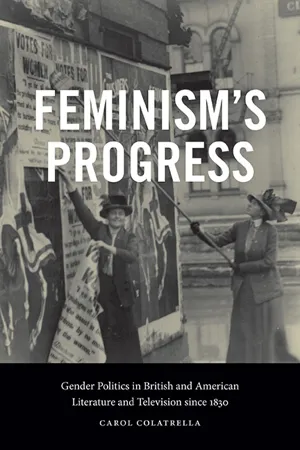
Feminism's Progress
Gender Politics in British and American Literature and Television since 1830
- Carol Colatrella(Author)
- 2023(Publication Date)
- SUNY Press(Publisher)
Feminism’s Progress looks at fictional information—plots, characters, settings, and voice—in selected narratives that incorporate discussions and illustrations of women’s empowerment, social collectivity, equality, resistance, and other issues important to supporters of women’s rights and feminists of different waves. Fictional texts from the nineteenth century to the present—novels, stories, television shows, and films—identify social problems such as bias, discrimination, and violence, and explore feminist arguments promoting gender equity in marriage, education, careers, and politics. My subject includes representations of suffrage movements and women politicians in discussing fictions that recommend reconfiguring the sex/gender system and encouraging individuals to act collectively and cooperatively with others to ensure an equitable future for all.Many theoretical accounts of gender, literature, and culture and fictional texts have helped shape my understanding of feminism—how to define it, ways to evaluate its appearance in literature and media, and its application as a reading strategy. Moira Ferguson explains in the preface to her anthology of British women writers: “By feminist I mean those ideas and actions that advocate women’s just demands and rights, or that counter or offset, at any level, the socio-cultural, sexual and psychological oppression and exploitation of women.”4 Rachel Blau Duplessis offered a dynamic account of feminism in a 2015 interview: “For me feminism is sex-gender justice intertwined with social and economic justice, and it involves female co-equality with males amid female differences, the positions working in endless dialectical movement. Women’s gains in agency, co-equality, and legal redress should not come at the expense of others who endure social wrongs, although there is undoubtedly some cost to people’s claims of power-over-others and to their claims of interpretive hierarchies of importance where women rank as lesser.”5 Sharing a core belief in feminism’s focus on advocacy, equality, and opposition to inequity, these definitions align with the succinct one provided by bell hooks: “feminism is a movement to end sexism, sexist exploitation, and oppression.”6 eBook - PDF
- Robin Truth Goodman(Author)
- 2022(Publication Date)
- Bloomsbury Academic(Publisher)
Introduction Is a Feminist World Literature Possible? Robin Truth Goodman The field of World Literature seems to skirt away from feminism. Much of the genealogical trajectory that is cited in the field’s self-definitions passes from Goethe, Marx and Engels, and Auerbach—with an orientation toward cosmopolitanism and the world market—to Said’s Orientalism; Moretti’s “distance reading,” formalism, and world systems; Pascale Casanova’s world systems in literary circulations with Paris at the center dominating its peripheries; and Damrosch’s imperative to “push against the market” (2009: 463) by expanding the market into the undergraduate classroom for the purpose of expanding enrollments. In this, the centuries-long contributions of feminism to literary studies seem barely a tickle in relation to the great literatures of the world. The category of World Literature, as Debra A. Castillo has noted, often just gestures to the “dark lady,” that is, “the token woman in an otherwise all- male academic circle” (2011: 395). Feminism as World Literature redefines the thematic and theoretical contents of World Literature in feminist terms as well as rethinking feminist terms, analyses, frameworks, and concepts in a World Literature context. The authors recognize genres, strategies, and themes of World Literature that demonstrate feminism as integral to the world-making gestures of literary form and production. In this introduction, I argue that a feminist World Literature’s practices, questions, theories, frameworks, materials, and modes of analyses are particularly urgent now at a time when democracy is possibly at risk of not surviving. World Literature criticism may, indeed, identify World Literature in contrast not just to feminism but also to femininity, as femininity conventionally is associated with interiority, the body, particularity, contingency, stability, nature, the local, the traditional, and the sentimental rather than the global, eBook - ePub
- Robin Truth Goodman(Author)
- 2022(Publication Date)
- Bloomsbury Academic(Publisher)
Feminism as World Literature redefines the thematic and theoretical contents of World Literature in feminist terms as well as rethinking feminist terms, analyses, frameworks, and concepts in a World Literature context. The authors recognize genres, strategies, and themes of World Literature that demonstrate feminism as integral to the world-making gestures of literary form and production. In this introduction, I argue that a feminist World Literature’s practices, questions, theories, frameworks, materials, and modes of analyses are particularly urgent now at a time when democracy is possibly at risk of not surviving.World Literature criticism may, indeed, identify World Literature in contrast not just to feminism but also to femininity, as femininity conventionally is associated with interiority, the body, particularity, contingency, stability, nature, the local, the traditional, and the sentimental rather than the global, the conceptual, the expansive, or the transcendent. Simone de Beauvoir, for example, wrote of femininity as “imminent” in its hominess and grounded in the naturalized physicality of a woman’s body, especially in her reproductive, care, love, and familial capacities. Beauvoir thought that women’s relation to the home as a defense against the world reduced her to dependency and obstructed her liberty: “The home becomes the center of the world and even its only reality: . . . refuge, retreat, grotto, womb, it gives shelter from outside dangers; it is this confused outer world that becomes unreal . . .” (1980 : 450). In a postcolonial context, Partha Chatterjee has agreed, claiming that “nationalism’s success [is] in situating the ‘women’s question’ in an ‘inner’ domain of sovereignty far removed from the arena of political contest” (1997 : 241), where women invoke “tradition” and cultural feeling against the onslaught of political temporalities, abstract generalities, and imperializing modernity. Yet, in what sense can we say that the tradition of representing these “‘inner’ domains of sovereignty” may be focusing on the “women’s question” in order to address broader political relations or even world political relations? Fredric Jameson might identify this “women’s question”—albeit problematically—as part of a “national allegory,” a “third-world” allegory, or even a world allegory in that the domestic context, private life, or locality projects a “political dimension”: an “embattled situation of the public third-world culture and society” (1986 eBook - PDF
Feminism and Christian Tradition
An Annotated Bibliography and Critical Introduction to the Literature
- Mary-Paula Walsh(Author)
- 1999(Publication Date)
- Greenwood(Publisher)
At the level of definition, the literature ranges from feminist critiques of "agape," (e.g., Andolsen [467]) to the relationship between feminist anthropology and feminist ethics (e.g., Farley [472]), and as a consequence, the relationship of feminist ethics to feminist spirituality and feminist political action. (For examples here, see the entries in Andolsen et al. [468] and Daly [470]; and in other portions of the bibliography, see Harrison [207], Heyward [555], and Ruether [545].) Apropos methodological issues, the literature ranges widely, but overall, three main concerns are clear: first, an early articulation of feminist hermeneutical principles by which to ground feminist ethical discussion (e.g., Farley [471], Haney [473], and Hunt [479]); second, a lingering debate over gender differences in moral reasoning (as generated by Gilligan's work [476]); and third, the need for clear political theory for combining praxis and reflection (e.g., Robb [482], Schtissler Fiorenza [483], and Legge [487]). Last, by way of topics and specific ethical issues, the literature yet identifies the dominant culture's continued devaluation of women, women's work, women's sexuality, and women's rights to reproductive freedom as biases still to be overcome. Further, it identifies the varying and combined effects of several social statuses (race/ethnicity, sex, gender or gender role, age, social class and sexual orientation) as interactions negative for women, in that women experience "dual," "triple" or "multiple" oppressions, and in ways that the majority of American males characteristically do not. These multiple oppressions are typically described in the literature as the experience of "interstructured oppression," and they entail the combined effects of "race, gender and class," or more recently, "race, gender, class and sexual orientation." These effects, it is important to note, are interactive, not additive.
- Maaike Meijer, Jetty Schaap, Culture and Female Future Symposium Language, Maaike Meijer, Jetty Schaap, Culture and Female Future Symposium Language(Authors)
- 2020(Publication Date)
- De Gruyter Mouton(Publisher)
I pointed out t h i s d i s c u s s i o n in Amazonen der Llteratur. Generally speaking, every text may be read from a f e m i n i s t point of view. T h i s i s how l i t e r a t u r e and feminism are being separated from each o t h e r , wich causes the l i t e r a r y t r a d i t i o n i t s e l f to remain undiscussed. Feminism seems not to have entered l i t e r a t u r e as a s e r i o u s challenge to t a c i t l i t e r a r y assumptions. In my opinion it is a f e m i n i s t challenge to bring l i t e r a t u r e and feminism together. Going into the l i t e r a r y production mentioned above, I was not at a l l content with t h i s development, because I could prove in my analyses that 130 the negative judgement was due to the incompetence of the critics rather than to the texts themselves. Analysing them without a preconceived theory, I came across many Interesting remarks on the literary tradition relating to the matter of genres and the way women had been put down In Ii terature unt iI now. As I cannot outline my previous research in this paper entirely, I wish to concentrate on the general Ideas I developed concerning the place of women in literature. Thus, I wiI I focus on the place Innovation has in literary historiography, on 'Iitt6rature mIneur', on the different expressions the productivity of fantasy may take, on 'female' experience, and last but not least, on the aesthetic consequences of these aspects for the literary texts I have studied. I shall try, briefly, to give as many examples as possible to Illustrate my remarks. 2.HIstorlography and Women In the traditional literary history we find an obvious lack of women writers. The famous call for a female Shakespeare is answered nowadays by various attempts to re-wrlte history. In doing so, more so-called 'major' writers have seen the light than traditional historiography has wanted to acknowledge. To me this seems to be the model of the splendid exception to the common rule. eBook - ePub
Women and Judaism
New Insights and Scholarship
- Frederick E. Greenspahn(Author)
- 2009(Publication Date)
- NYU Press(Publisher)
Was this simply because men had written far, far better literary works than women? Or, as Kolodny and others suggested, was it because, in their roles as editors, publishers, and patrons, men exercised economic and cultural clout, functioning as tastemakers, as arbiters of excellence? Men, it was suggested, responded to literature that emerged from and spoke to men’s experiences and sensibilities. Looking at “how we read” involved noticing the ways that gender was portrayed in works by both men and women and linking these portrayals to more broadly based world views assumed and conveyed in literary works. It entailed placing literary figures of gender in the wider context of the social, economic, and political systems that shape the way men and women experience their lives and in which writers ply their craft. Addressing either of those concerns—what and how we read—from a feminist viewpoint could draw fire from more established (and mostly male) scholars. When feminist critics focused on “what we read,” they often noticed an imbalance, for example, between the number of men and women writers whose works were included in high school or university courses or mandated by school curricula. To address this, women critics read with a fresh eye, bringing to light women writers whose works had been ignored or undervalued, “rediscovering a lost body of writing.” 4 They introduced a new set of authors into literature classes—new in the sense of not having been studied seriously before. From Elizabethan English literature to contemporary American writing, literature courses began to take on a new shape as feminist critics chipped away at conventional ideas about whose writing “counts” and whose does not. However, such challenges to established literary judgment came at a price. Not infrequently, colleagues would accuse professors of women’s studies of lowering their aesthetic standards by concentrating on inferior works eBook - PDF
- M. Makinen(Author)
- 2001(Publication Date)
- Palgrave Macmillan(Publisher)
58 In the 1990s, the debates raged less internecinely, and began to acknowledge the strengths and the limitations of all the 20 Feminist Popular Fiction different reading positions. Although some are invariably valued more than others, all have some value for feminist practice. These contending debates and the issue of a range of feminist prac- tices obviously raise the question of what is a feminist literary practice, in relation to the texts I examine, and moreover what critical assump- tions am I making about effective feminist criticism in my examination of the case studies? The first is the easiest to answer, for there are some basic political requirements as Cranny-Francis notes in her introduction to Feminist Fictions: In feminist fiction, including feminist genre fiction, feminist discourse operates to make visible within the text the practices by which conservative discourses such as sexism are seemlessly and invisibly stitched into the textual fabric, both into its structure and into its story, the weave and the print. 59 It is this ‘disarticulation’ of the conventions which is the key to femi- nist practice, not simply a role reversal, where women do the male tasks (though that can be an important element) but how the narrative ‘actively interrogates and destabilises the institutions in which those conventions have become embedded’, 60 as Lynne Pearce and Gina Wisker demand of rescripted romance. The answer to the second question must be a more heterogeneous one, if it is going to do justice to the various and contending voices. Barbara Johnson opens her 1998 Feminist Difference: Literature, Psychoanalysis, Race and Gender 61 with a discussion of the 1995 MLA forum on ‘Feminist Criticism Revisited’ attended by a range of feminist theory practitioners including herself, Elaine Showalter, Jane Gallop, Nancy Miller and Bonnie Zimmerman. Rather than confrontation, the mood was one of ambivalence. eBook - ePub
Using Critical Theory
How to Read and Write About Literature
- Lois Tyson(Author)
- 2020(Publication Date)
- Routledge(Publisher)
Chapter 6 Using concepts from feminist theory to understand literature Why should we learn about feminist theory? As we saw in Chapter 4, psychoanalytic theory asks us to examine the ways in which our personal identity is formed by our early emotional experience within the family. In Chapter 5 we saw that Marxist theory asks us to examine the ways in which our personal identity is formed by the socioeconomic system in which we live. Feminist theory asks us to examine, instead, the ways in which our personal identity is formed by our culture’s definitions of what it means to be a man or a woman. For from a feminist perspective, our experience of ourselves, our family, and the socioeconomic system in which we live depends to a large extent on our sex: on the ways in which men and women are treated differently and on the ways in which men are socialized to be masculine and women are socialized to be feminine. Specifically, in most cultures, men occupy most or all positions of power, which is why those cultures are called patriarchies or patriarchal cultures. For the word patriarchy, broadly defined, refers to any society in which men hold most or all of the power. In a patriarchy, women suffer varying degrees of oppression depending on such circumstances as their race, ethnicity, socioeconomic class, religion, gender identification (our internal sense of our own gender, which may or may not match our apparent biological sex at birth), sexual orientation, disability, age, and the country or region in which they live. Feminism, therefore, seeks to understand the variety of ways in which women are oppressed—socially, economically, politically, and psychologically—in order to reduce, if not eliminate, their oppression eBook - ePub
Ambiguous Discourse
Feminist Narratology and British Women Writers
- Kathy Mezei(Author)
- 2000(Publication Date)
- The University of North Carolina Press(Publisher)
Introduction : Contextualizing Feminist Narratology Kathy MezeiYes, yes, if you please, no reference to examples in books. Men have had every advantage of us in telling their own story. Education has been theirs in so much higher a degree; the pen has been in their hands. I will not allow books to prove any thing.—Austen , PersuasionAnne Elliot’s retort to Captain Harville as they debated the differences between men’s and women’s “nature” pinpoints the essence of feminist narratology—the context of how stories are told, by whom, and for whom.This collection is the first to gather together essays that combine feminist and narratological readings of women’s texts. In their selection of British women writers from Jane Austen to Jeanette Winterson, the contributors focus on writers who are conspicuously self-conscious and iconoclastic in their deployment of narrative techniques. While seeking to decode subversive, evasive, or perplexing narrative strategies in Austen or Woolf or Mina Loy, the contributors recognized the value of a feminist narratology in interpreting these strategies, in proving, as Anne Elliot might say, some thing . In 1986 Susan Lanser described the contingent relation between feminism and narratology, which she named “feminist narratology”: “My … task [is] to ask whether feminist criticism, and particularly the study of narratives by women, might benefit from the methods … of narratology and whether narratology, in turn, might be altered by the understandings of feminist criticism and the experience of women’s texts” (342). Taking up the “task” in turn, these essays explore and expose “gender’s effect on the level of discourse” (Warhol, Gendered Interventions
Index pages curate the most relevant extracts from our library of academic textbooks. They’ve been created using an in-house natural language model (NLM), each adding context and meaning to key research topics.

