Literature

Short Fiction
Short fiction refers to brief, concentrated works of prose fiction that typically focus on a single character, event, or idea. It often emphasizes conciseness and efficiency in storytelling, making it a popular form for exploring complex themes in a compact format. Short fiction can encompass a wide range of genres and styles, from traditional short stories to flash fiction and microfiction.
Written by Perlego with AI-assistance
Related key terms
1 of 5
12 Key excerpts on "Short Fiction"
 eBook - PDF
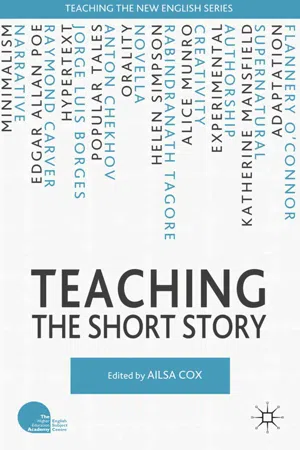
- A. Cox(Author)
- 2011(Publication Date)
- Palgrave Macmillan(Publisher)
Thomas proposes that sudden fiction is around 1750 words, while flash fiction is approximately 750 words or less (1992: 12). Microfiction is described in one instance as ‘a few hundred words’ (Gessell, 2004) and in another as 500 words (by the literary magazine Prairie Fire). While length is the overriding criterion for labelling a story as a short short, this seems inadequate. As noted by Pratt (1994: 95) when writing about all short stories, ‘The problem with shortness, of course, arises from a sense that literary genres ought to be characterised by aesthetic properties, and shortness seems altogether too quantitative, too material a feature to be given top billing.’ In the case of short shorts, narratives and other stylistic features, such as intertextual referencing, emerge in ways somewhat 14 Teaching the Short Story distinctive to the form. Literary theorists noted this problem of defini- tion before short shorts grew in popularity. One of the stories used in this chapter, Hemingway’s ‘The Revolutionist’, has been referred to as a prose vignette or ‘sketch’ (Scholes, 1985: 41); yet Scholes also recog- nised ‘a little narrative to be constructed from this text’, suggesting that ‘sketch’ is an insufficient term. With consideration to narrative structure and stylistic features sug- gesting one genre or another, these Short Fictions raise discussion points for classroom activities and essay assignments. For instance, ‘Water’ by Leebron, also in this chapter, has been taught as part of an exercise in questioning generic categories, debating whether the piece is prose, poetry or a prose poem. What can be stated in broad terms about short shorts, however, is that at the surface level, the stories provided to readers are often incomplete or suggestive of a much larger, less anecdotal, story. eBook - PDF
- Emma Liggins, Andrew Maunder, Ruth Robbins(Authors)
- 2017(Publication Date)
- Red Globe Press(Publisher)
1 Introduction: What Is a Short Story? 1 This question has always exercised critics and commentators on the short story, and often involves them in extraordinary contortions to avoid the simplest and most circular answer: a short story is a story – a narrative sequence of events, episodes or connected emotions – which is short. Even if the term ‘story’ is reasonably uncontentious (and frankly it is not entirely agreed upon), shortness introduces an element of relativity which causes major problems for the short-story critic. A short story is short generally in contrast to the longer prose narrative the novel. Ian Reid goes so far as to say that ‘in its current usage “short story” is generally applied to almost any kind of prose narrative briefer than a novel’, and shortness can lead to accusations of ‘slightness and slickness’, 1 of lesser status and lesser seriousness than the larger work of prose fiction. Size, apparently, matters. Critics therefore often operate by analogy with other forms to describe the short story’s special status. As Dominic Head has suggested, visual metaphors in particular are fre-quently used, 2 although these have the disadvantage of presuming a specific patterning in Short Fiction, forgetting that all narrative is essen-tially temporal, understood through time, rather than primarily spatial as visual art is. Thus, Valerie Shaw suggests that the volume of short stories can be usefully likened to an art exhibition, 3 and William Boyd, in a 2004 Guardian article, writes that the short story is comparable to an exquisite miniature painting, ‘art in highly concentrated form’, whose effects are akin to those of the multivitamin pill: ‘a compressed blast of discerning, intellectual pleasure’. 4 Or the critic turns to meta-phors derived from poetry: the short story is to the novel what the lyric is to the epic – the first is personal, compressed, fragmented and emo-tional, and the second is universal, expansive, totalising and objective. eBook - PDF
- Jeremy Hawthorn(Author)
- 2022(Publication Date)
- Bloomsbury Academic(Publisher)
3 Shorter fiction PREVIEW This chapter deals with ● the short story and the novella as fuzzy categories; ● the taint of commercialism and ‘definition by length’; ● the ‘anecdotal’ and the ‘epiphanic’ short story; ● compression, suggestiveness and the short story; and ● the distinctiveness of the novella. I have already suggested that our familiar tripartite division of prose fiction into the novel, the short story and the novella is one that simplifies a more complex and varied reality, and it is as well to start this chapter with a warning against allowing the use of these categories (more popular perhaps with academics than with writers or the common reader) to obscure the variety of forms open to the writer of prose fiction – both today and in the past. Graham Good provides a useful summary of some of the problems associated with these and other terms: Short Fiction terminology is extremely varied and often inconsistent. The word ‘novella’ is gradually gaining acceptance in English among publishers, writers, and latterly critics, to denote a fictional prose narrative of ‘medium’ length. This usage is supplementing rather than supplanting ‘short story,’ which has been firmly established since the turn of the century. The older terms ‘tale’ and simply ‘story’ were still employed by writers like [Henry] James and [Joseph] Conrad to refer to any narrative shorter than a novel, from about five to a hundred or more pages. (Good 1994, 148) In fact, Conrad used the term ‘tale’ rather more promiscuously than this suggests: his longest novel, Nostromo, is subtitled ‘A Tale of the Seaboard’. One of the reasons why the terms ‘short story’ and ‘novella’ were pressed into use by writers and critics from (especially) the early days of the twentieth century is probably that alternative terms such as ‘tale’ were just too elastic. eBook - PDF
- Jeremy Hawthorn(Author)
- 2016(Publication Date)
- Bloomsbury Academic(Publisher)
3 Shorter Fiction Preview This chapter deals with: • The short story and the novella as fuzzy categories • The taint of commercialism and “definition by length” • The “anecdotal” and the “epiphanic” short story • Compression, suggestiveness, and the short story • The distinctiveness of the novella I have already suggested that our familiar tripartite division of prose fiction into the novel, the short story, and the novella is one that simplifies a more complex and varied reality, and it is as well to start this chapter with a warning against allowing a use of these categories (more popular perhaps with academics than with writers or the common reader) to obscure the variety of forms open to the writer of prose fiction—both today and in the past. Moreover the terms “short story” and “novella” are by no means as widely used or as unambiguous as is the term “novel.” Although the term “novella,” from which the English “novel” descends, can be traced back to the Italian, use of this term today to designate a prose fiction that is shorter than a novel but longer than a short story descends from nineteenth-century German usage. The term is little used outside schools and universities. The term “short story” is more widely understood, but it too is problematic in ways that—for all of the issues of definition that I have discussed in the previous chapter—the term “novel” is not. Graham Good provides a useful summary of these terminological problems: Short Fiction terminology is extremely varied and often inconsistent. The word “novella” is gradually gaining acceptance in English among publishers, Studying the Novel 36 writers, and latterly critics, to denote a fictional prose narrative of “medium” length. This usage is supplementing rather than supplanting “short story,” which has been firmly established since the turn of the century.
- David Morley(Author)
- 2007(Publication Date)
- Cambridge University Press(Publisher)
Indeed, the entire action may take place within the space of a page. Think of them as The practice of fiction 157 prose-haiku. The shortest versions are called nanofiction and are popular on internet publishing sites. Despite their experimental brevity, write your story using a protagonist, conflict, obstacles and resolution; even use a beginning, middle and end. Some aspects should be alluded to or implied, like sticky threads thrown wide around your piece in order to capture and reel in external connotations and resonances. This saves words. More than any other type of writing, a short-short should be written and redrafted in one sitting; part of their energy arises from that concentration of nerve. As Don Paterson writes, ‘The shorter the form, the greater our expectation of its significance – and the greater its capacity for disappointing us’ (2004: 189). Flash fiction is popular with new writers: it makes for immediacy, but can become a displacement activity to avoid longer-haul tasks. Ron Carlson comments, ‘I’m all for short good writing with no sagging in it at all, but I’m also for good long writing with no sagging in it at all . . . the boom in short-shorts has more to do with precious page space than with attention spans . . .’ (Shapard and Thomas, 1989: 312). Carlson has a point. Is brevity a virtue? The various Sudden Fiction anthologies edited by Shapard and Thomas provide models and challenges. Writing Game T H E N O I S E O F S T O R Y Four games in one! Write a short-short using words of one syllable only. Then write a short-short of 400 words, in which every sentence has exactly 8 words. Then write a short-short of 300 words which is entirely one sentence. Write a short story of 2,000 words using no adjectives or adverbs and which can only be understood clearly when it is read aloud by two disembodied voices. A I M : Professional oral storytellers vary the speed and rhythm of their voices to capture and maintain our attention. eBook - PDF
- Robert Graham(Author)
- 2006(Publication Date)
- Bloomsbury Academic(Publisher)
II How To Write Short Stories 43 5 A Brief Tour Around The Short Story The term ‘short story’ did not appear in an English dictionary until 1933. The form is difficult to define. The short story comes in many shapes and sizes. Short stories are usually restricted in time, place and number of characters. Some stories move towards a single ascending dramatic scene or revelation which is generated by conflict. Joyce Carol Oates’s definition of the short story is a useful one: It represents a concentration of imagination and not an expansion; it is no more than 10,000 words; and no matter its mysteries or experimental properties, it achieves closure – meaning that when it ends, the attentive reader understands why. 1 It’s safe to say that the short story is not a brief novel. According to Valerie Shaw, ‘the novel and the short story are separate entities which share the same prose medium but not the same artistic methods.’ 2 The short story is a distinct literary form, as different from a novel, perhaps, as a novel is different from a play. Neither is the short story a brief novel. (Mark Twain once apologised for writing a long letter; if he had had more time, he said, he would have written a shorter one.) A short story may have more in common with a poem: Valerie Shaw describes the form as ‘short but reso-nant; written in prose, but gaining the intensity of poetry.’ She also draws the comparison with photography: a short story has certain things in common with a snapshot. It may well be a moment revealed, and may deal with only a single incident, or even a single perception. Edgar Allan Poe, one of the earliest theorists of the form argued that composition begins with the conception of ‘a certain unique or single effect to be wrought out.’ 44 HOW TO WRITE FICTION (AND THINK ABOUT IT) All of this suggests that the story is a distillation. Anton Chekhov observed that ‘in short stories it is better to say not enough than to say too much,’ and D.H. eBook - PDF
The Modernist Short Story
A Study in Theory and Practice
- Dominic Head(Author)
- 2009(Publication Date)
- Cambridge University Press(Publisher)
Indeed, she begins her article by asserting that 'when the history of the modern short story is written it will have to take account' of these 'two related developments'. 52 As if in response to this assertion Clare Hanson has structured her history of the short form, Short Stories and Short Fictions: i88o-ig8o, to set the two The short story: theories and definitions i7 trends in opposition. She has even posited a new terminology to distinguish between short stories — the conventional, epical, plot- based type - and Short Fictions in which plot is subordinate to internal psychological drama, a category that roughly equates with Baldeshwiler's lyrical story, and Ferguson's complex episode. Hanson's chapter on the modernist era locates Joyce, Woolf, and Mansfield within the latter camp, as writers of Short Fictions rather than stories. 53 The tidiness of this taxonomy is appealing, but when one examines its implications, problems present themselves. To begin with, the term 'Short Fiction' carries a burden of signification which is not easily cast off: Short Fiction is frequently used as an imprecise, all-purpose term which subsumes 'sketch', 'story' and 'novella'- any fiction which is not a novel, effectively. The problem with trying to recoup such a generalized term as a specific critical tool is self- evident, and this terminological quibble suggests a larger problem of descriptive accuracy, especially in relation to Hanson's treatment of the modernists. It is true that plot is de- emphasized in the stories of Joyce, Mansfield and Woolf, and this distinguishes their work from the more carefully plotted Short Fictions of, for example, Henry James and Joseph Conrad.
- Robert Graham(Author)
- 2017(Publication Date)
- Bloomsbury Academic(Publisher)
Part II How to Write a Short Story 71 8 What Is a Short Story? Tom Vowler It’s perhaps easier to declare what a short story isn’t: it’s not an abridged version of the novel; nor is it a prose poem, though it can share aspects of these forms – a distant cousin to both, if you like, a younger, often brash and indecorous one. Let’s start then by terming the story a compressed narrative, irreducible and intense, a piece of fiction designed to move, delight, provoke, amuse or shock – all in a single sitting. Barbara Kingsolver remarked that stories are the successful execution of large truths delivered in tight spaces. Flannery O’Connor, too, evoked this aspect, claiming certain truths exist that can only be told through the short story. Although assimilating elements of early forms of storytelling (fables, myths, sagas, parables, folk tales, ballads), the short story as we know it today is little more than two centuries old. The author Philip Ó Ceallaigh suggests that after food and shelter, stories are the thing we need most to sustain us. Certainly storytellers have been revered throughout history; in the gulags, for example, those who told stories were often bestowed higher status. The form, then, has its roots within the tradition of oral storytelling, where travellers would earn their supper or a bed in exchange for the narrating of an entertaining and compelling tale. From Hawthorne and Poe to Chekhov and Joyce, right up to Carver and Munro, the short story’s emergence has been universal in appeal, adapting itself to disparate cultures and genres. Yet what we regard as the modern short story is the youngest of the literary forms, hardly out of 72 How to Write a Short Story (And Think About It) short trousers. It is the precocious child, refusing to conform, to be pre-dictable or well behaved. Yes, it has learned from what’s passed before, but it wants to push into new territory, mould the literary landscape to its own will, break free of traditional shackles.
- Joshua Miller(Author)
- 2021(Publication Date)
- Cambridge University Press(Publisher)
In Short Fiction, flash fiction, and microfiction, there can be the flash of recognition that also transforms what and how we recognize life, violence, and collectivity through story. This chapter has tracked the productive tension in twenty-first-century fiction between short forms and big troubles. This tension generates new relationships of fiction to a political and historical imagination, to citational modes that enlarge the fictional worlds of short stories, and to the repertoire for narrating labor, migration, and war – not only as experiences, but also as forces actively disavowed, willfully misunderstood, able to jump temporal and spatial scales. NOTES 1 On Hemingway’s apocryphal story in genre criticism, see Zack Wortman, “Daily Shouts Ernest Hemingway’s Six-Word Sequels,” New Yorker, September 11, 2016. See also Luisa Valenzuela, “Introduction: A Smuggler’s Sack,” in Sudden Fiction Latino: Short-Short Stories from the United States and Latin America, edited by Robert Shapard, James Thomas, and Ray Gonzalez (New York: Norton, 2010), 19. See also Diana Fuss, “Flash,” New Literary History 50, no. 3 (Summer 2019): 405–410. 2 Augusto Monterroso, “El Dinosaurio,” in Obras completas (y otros cuentos). (Mexico City: UNAM, 1959; Mexico City: Ediciones Era, 1990), 71. See also Frederick Luis Aldama, “A Scientific Approach to the Teaching of a Flash Fiction,” Interdisciplinary Literary Studies 16, no. 1 (2014): 127–144. 3 James Joyce, Ulysses: The Gabler Edition (New York: Vintage Books, 1986 [1922]), 63. 4 Rob Nixon, Slow Violence and the Environmentalism of the Poor (Cambridge, MA: Harvard University Press, 2011). 5 See, for example, theories of reading world literature by Wai-Chee Dimock, David Damrosch, Franco Moretti, Pheng Cheah, Bruce Robbins, Gayatri Spivak, and work by David Palumbo-Liu and Nirvana Tanoukhi, as part of the influence of Immanuel Wallerstein’s world-systems theory on literary studies.
- Ann-Marie Einhaus(Author)
- 2016(Publication Date)
- Cambridge University Press(Publisher)
9 As Power argues, the rhetoric of revivalism results in generalized discus- sions of the short story form – as opposed to analysis of actual short stories and collections – often in a self-defeating comparison with the novel. The latter, too, is generalized in these accounts so that the alleged panacea of technology is associated with furthering the short story rather than what new technological formats and platforms are doing to the form, content and composition of the novel. Regarding both novel and short story as subject to a volatile and transforming literary marketplace would be one way of circumventing the implicit hierarchical distinctions within these discussions. In that sense, critical analysis of contemporary fiction would be catching up with the shape and construction of such episodic novels as David Mitchell’s Cloud Atlas (2005) and Ali Smith’s Hotel World (2001). The porous gen- eric boundaries between novel and short story collection, as registered in these texts, may also be an acknowledgement of the changing demography for literary consumption. It has often been claimed that the emergence of the short story, as part of the developing magazine culture of the nineteenth century, provided literature for the time-poor: office workers and shop-girls on their way to and from work, mothers and housewives caring for large or extended families, quick literary fixes at lunchtime, or a short read before bedtime. By contrast, with the growth of the twenty-first-century precar- iat, where time-poverty is a common complaint across the traditional class divides, novel-reading tends in practice towards shorter bursts rather than more sustained attention. In this situation, the writers of episodic novels may now be drawing more on the short story form in order to accumulate longer narratives for time-pressurized readers.
- Dominic Head(Author)
- 2016(Publication Date)
- Cambridge University Press(Publisher)
The beginnings of the modern British short story can be located at the opening of the eighteenth century when innovations in publishing launched fiction on a course of development that steered it towards the modern short story. This is not to say that Short Fiction did not exist previously, but it is to assert that a variety of circumstances hindered fiction’s development. Almost all the Short Fiction available to English readers was imported. These stories were primarily translations of Roman and Greek authors familiar to the 32 classically educated and classical European authors of interest to those who were, or wanted to be, familiar with Continental literature; French writers of romance who told stories of the sexual escapades of Europe’s elite; and, towards the end of the century, fables and exotic tales from the East. Since this literature served its purpose as entertainment, and the only lucrative venue for fiction was the stage, there was no motive to write original Short Fiction. These narratives were offered in book-length collections, which limited the audience to the nobility and the wealthiest among the middle class, thereby eliminating any incentive to write stories different from those already being published. Even if English authors wanted to publish original fiction, there was, generally speaking, no publication venue for them to insert original short narratives into this relatively stagnant tradition. Only the wealthiest writers had ready access to the press, and they didn’t write Short Fiction narratives, although Peter Motteaux and Aphra Behn, harbingers of an emerging literary impulse, could perhaps be considered exceptions to this generalization. Then there was the general attitude towards fiction, which, regardless of quality, was considered both trivial and a recognized threat to the morality of readers because it could inflame the emotions and encourage immoral behaviour. eBook - PDF
- C. Reynier(Author)
- 2009(Publication Date)
- Palgrave Macmillan(Publisher)
18 1 Virginia Woolf’s Definition of the Short Story Woolf’s essays about the short story Virginia Woolf’s essays are written, like most essays of her time, in a style both polemical and metaphorical, extremely different from the cut-and-dried scientific style most literary critics and theoreticians adopt today. 1 Yet such a style should not blind us to Woolf’s aim and competence. In some of these essays, such as “Is Fiction an Art?”, she laments the lack of all theory of fiction: For possibly, if fiction is, as we suggest, in difficulties, it may be because nobody grasps her firmly and defines her severely. She has had no rules drawn up for her. And though rules may be wrong, and must be broken, they have this advantage—they con- fer dignity and order upon their subject; they admit her to a place in civilised society. (Essays IV: 460) And in “On Re-Reading Novels”, she opposes fiction to drama which has found its own theory: The drama, however, is hundreds of years in advance of the novel. ... But so far we have swallowed our fiction with our eyes shut. We have not named and therefore presumably recognized the simplest of devices by which every novel has come into being. 2 I would like to show that in her essays, Woolf goes on elaborating her own “theory” of fiction and particularly, a “theory” of the short story. Virginia Woolf’s Definition of the Short Story 19 No definition of the genre is stated explicitly in any particular essay and if we browse through the index of McNeillie’s edition of Woolf’s essays, we find that none of them is devoted to this topic even if sev- eral mention specific short stories. What I mean to show, in the wake of Nena Skrbic stimulating insights into Woolf’s comments on the genre in her essays, reviews and correspondence, 3 is that Woolf’s def- inition of the short story is present but disseminated in her essays and is there for the reader to reconstruct.
Index pages curate the most relevant extracts from our library of academic textbooks. They’ve been created using an in-house natural language model (NLM), each adding context and meaning to key research topics.

