Literature

Mystery Play
Mystery plays were a form of medieval drama that depicted stories from the Bible, often focusing on the mysteries of the Christian faith. These plays were performed by guilds and were an important part of religious festivals and community events. They typically featured biblical characters and events, aiming to educate and entertain audiences while reinforcing religious teachings.
Written by Perlego with AI-assistance
Related key terms
1 of 5
7 Key excerpts on "Mystery Play"
 eBook - ePub
- Peter Happe(Author)
- 2018(Publication Date)
- Routledge(Publisher)
Nevertheless each of the characteristic aspects of the religious drama – its didacticism, its worship and its narrative – were expressed in a wide range of dramatic techniques. Although there was some resistance to drama in clerical circles, it was perceived by many that drama could be very successful as a means of promoting these elements. Hence its techniques were developed to a high level of sophistication. We therefore find that in the plays there is much effort expended upon plot, characterisation, satire and emotion, and that techniques were evolved for the extensive use of these whatever the religious objectives. Beyond this there is also the question of how such things as language and gesture, space and time are enlisted to make effective the encounter between text and audience which we designate as performance.It is convenient to consider plot in two broad categories: those which take on a narrative based upon the Bible or upon a legend which can be taken to be broadly ‘true’, and those which have a plot which is especially constructed or adapted to bring out a special point of doctrine, usually a moral or political theme. This broad distinction enables us to consider Mystery Plays and saints plays on the one hand and the allegorical drama of the morality plays on the other. It is true, though, that in these two broad types there is also a need to include characters of particular type to fit in with the kinds of plot here envisaged.The English mystery cycles present the Christian story from the Creation to Judgement Day, and there is no doubt that the overall design which this narrative implies was highly popular, especially inasmuch as it centred on the Passion of Christ. There is a strong analogue here with the presentation of narrative in visual terms, as can be seen in various picture cycles and in paintings and stained glass which depict on the same canvas the events in the narrative in separate scenes. But the Bible was not the only or the most direct source for the actual narrative; very often it has been discovered that the dramatists used well-known summaries or versions of the traditional narratives, such as the Stanzaic Life of Christ, which was influential in the formation of the Chester cycle. At the same time there were individual sections of narrative which could only be found in specific versions which were not scriptural, especially where they involved plots which were not in the Bible but were elaborations built up apocryphally by later writers. Such a work is The Gospel of Nicodemus, which contains many details and episodes used in the cycles, such as the restoration of the sight of Longinus, the blind soldier in Crucifixion plays. The significance of this is that the narratives tended to come to the authors with a particular interpretation embedded in them. This can be seen most markedly in such sequences as the plays about the life of Mary in the N Town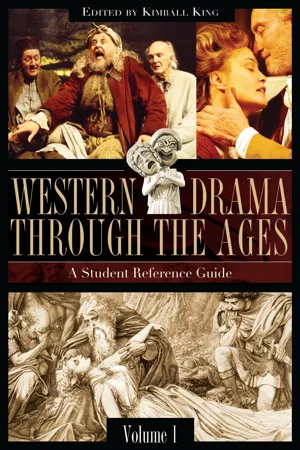 eBook - PDF
Western Drama through the Ages
A Student Reference Guide [2 volumes]
- Kimball King(Author)
- 2007(Publication Date)
- Greenwood(Publisher)
EARLY BIBLICAL DRAMA IN EUROPE The official relationship between Christianity and drama has, however, often been strained. With the rise of Roman Christendom came the decline of theater, a decline St. Augustine noted with approval in 400 A. D. Misgivings about the deceptiveness of acting and disapproval of actors’ lifestyles contributed to the virtual eradication of formal theater in Christian Europe by the sixth century. Ironically, however, the Church itself celebrated Christianity’s dramatic elements in increasingly complex ways, enhancing celebrations of the Eucharist by adding antiphonal exchanges and having priests adopt the roles of characters in accounts of Jesus’s resurrection from the dead. Over time, as more scenes were added, liturgical Latin gave way to local languages and the dramatic services’ popularity grew, the action moved from the cathedral choirs to the naves. By the early thirteenth century, many productions had moved outdoors to accommodate crowds. In 1210, Pope Innocent III ordered them out of the church entirely, and soon trade guilds began taking over the plays’ produc- tion and moving them to community gathering places, sometimes on large wagons serving as stages. Although they added secular, comical features; local, anachronistic elements; and regional expressions, guild members retained the approval of local Roman Catholic clergy and continued to use the plays to illustrate events from the Bible and instruct audiences in Church doctrine and practice. In their own day, these biblical scenes were often called ‘‘miracles,’’ although most drama historians today reserve that term for discussing plays about saints’ lives and use the term ‘‘mysteries’’ for dramas based directly on the Bible. The term’s significance lies not so much in its relation to the plays’ subject matter as it does their roots in the trade guilds. ‘‘Mystery’’ is derived from the French ‘‘mystere’’ or ‘‘metier,’’ words associated with trade guilds. eBook - ePub
Mysticism in the Theater
What’s Needed Right Now
- Tom Block(Author)
- 2022(Publication Date)
- Routledge(Publisher)
You might think that this, then, was another answer to the original dramatic impetus: how to bring theater, society, and the spirit together. After all, for nearly 500 years beginning at the dawn of the second Christian millennia, virtually all European theatrical works based themselves in the Christian scriptures and religious ideals. However, let’s remember what early Greek theater highlighted: the Mysteries. The question mark at the heart of being. Religious theater, by definition, focuses on an imagined exclamation point, sequestered within that religious path only, as the endpoint of meaning.The more dogmatically religious theater is, the less spiritually oriented it becomes. Far from opening a doorway into the ineffable and inexplicable spirit, these works pounded a religio-statist message of certainty, temporal laws, royal power, and divine retribution into the vulnerable craniums of the audience.Not mystical.Regardless, this European theatrical movement from about 1000–1500, predominantly within churches, or in church yards and using scriptural stories as the text, paved the way for a return to secular, professional theater. The two centuries between 1350 and 1550 presented the height of these Christian productions, with drama expanding from liturgical presentations of scripture to works written in the lingua franca of the audience (no longer in Latin), and dealing with a wider selection of stories from the Bible, the Apocrypha, and the lives of the saints.Concomitant of this, a secular theater industry began to emerge. By the end of the 14th century, theatrical productions moved beyond the church walls into town squares, presented by professional guilds (with masons building stages, carpenters building sets, weavers creating costumes, painters making backgrounds, leatherworkers fashioning props, etc.) on “mansions,” or movable stages. The Church elders still controlled the content, but the looming presence of the physical church receded into the background. Productions began concentrating more on the art and artifice of the craft.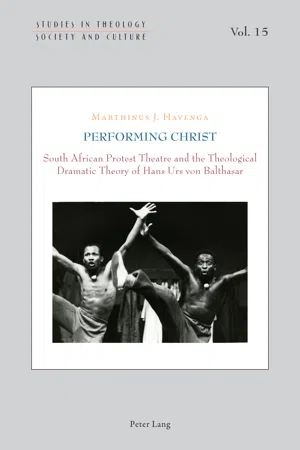 eBook - PDF
Performing Christ
South African Protest Theatre and the Theological Dramatic Theory of Hans Urs von Balthasar
- Marthinus Havenga, Norbert Hintersteiner, Declan Marmion, Gesa Thiessen, Norbert Hintersteiner, Declan Marmion, Gesa Thiessen(Authors)
- 2021(Publication Date)
- Peter Lang Group(Publisher)
Later on, the legends of the martyrs and the saints were staged prior to and after ser- vices. 141 When these ‘performances’ became too big and elaborate for the church buildings, they were moved to the town square where lay persons took part in the plays in different vernacular languages (under the super- vision of the church authorities). 142 While the Church, as a whole, thus remained hostile to the theatre, and various councils and theologians con- tinued to speak out against the dangers of the stage, the Christian Mystery Play was born. Out of these Mystery Plays, other forms of religious plays also came into existence. Examples include the morality plays in England and the autos sacramentales that were staged in Spain (‘Europe’s classical country of the theatre’). 143 These plays did not only focus on biblical narra- tives or the stories of the saints and martyrs, as was the case with the mys- tery plays, but also attempted to make sense of the life of the ‘everyman’ in light of the Christian worldview. This was done by employing the literary device of allegory and by personifying Christian vices and verses in creative 140 Balthasar, TD I, 122. 141 Balthasar, TD I, 105–6. 142 Balthasar, TD I, 106. 143 Balthasar, TD I, 108. 62 chapter 2 ways. Balthasar writes that, even though authors such as the ‘stupendous theatrical genius’, Lope de Vega, who ‘combined the life of the wildest ad- venturer with that of a priest and, at times, penitent’, and Calderón, who also travelled the world as a soldier before becoming a priest, often wrote about seemingly worldly themes, their works were very much within the ambit of salvation history and the Church. 144 With time, some of these dramatic expressions gradually began to fade away, not least because of the Church’s enduring words of condemnation against the theatre. eBook - ePub
The One-Act Play Companion
A Guide to plays, playwrights and performance
- Colin Dolley, Rex Walford(Authors)
- 2015(Publication Date)
- Methuen Drama(Publisher)
From the very beginning, the tradition of ‘re-enacting’ the Last Supper of Jesus and his disciples was enshrined in the ritual of the Eucharist; the usually elevated area of the sanctuary of a church was the ‘stage’ on which this occurred. The chancels of churches were also used at this time as simple dramatic episodes were developed in the liturgy of services: for example, on Good Friday a crucifix was processed through church, to the accompaniment of Misereres sung by the choir; on Easter Sunday, a tomb was represented, and a stone rolled away to the accompaniment of the choir singing Alleluias. Other incidents in the Old and New Testaments (the Garden of Eden, the troubled relationship of Cain and Abel, the building of Noah’s Ark, the Birth of Christ, the adventures of St Paul) began to be dramatised and inserted into church services at certain times of the year, sometimes replacing the sermon.By the 11th and 12th centuries, priests had been replaced by lay-people as actors, and members of craft guilds often took on roles and stories which were akin to their own working occupations. Thus masons might act out a play concerned with the creation of the world, fishmongers the story of Jonah and the whale, and shipwrights the story of Noah and his ark. In time the plays moved from presentation in church (in the chancel or nave) to the porch and eventually to outdoors and they became events in themselves. Then came the desire to play them on movable carts, so that they might be seen by the whole population of a town as they went through the streets.Thus in Britain, sequences of one-act plays, the elements of the Mystery and Morality plays of York, Lincoln, Coventry, Wakefield and other cities, came into being. These sequences (between 10 and 20 minutes long) dramatised the spiritual history of the human race as seen from a Christian perspective. They included comedy (such as the episode of Mak, the sheep-stealer in the Wakefield plays), as well as drama and melodrama. From the porches of churches these plays progressed to small mobile theatres – carts which processed around the town. On these, makeshift stages were developed, with the performers often changing beneath them or at the side. eBook - ePub
- Andrew Pettegree, Paul Nelles(Authors)
- 2017(Publication Date)
- Routledge(Publisher)
They are, in a sense, historical plays, in that they are dramatizations of events that the medieval public perceived as having really occurred. They are thus different from the farces, moralities and sotties, which were seen as fictional and imaginative. About 230 religious plays have come down to us, mostly from the fifteenth and sixteenth centuries, although two go back to the twelfth, two or three to the thirteenth and about 50 to the fourteenth century. 1 Most religious plays in the fourteenth century were called miracles; Mystery Plays or mystères are not found before the fifteenth. About 180 mystères have survived; most were composed and performed between the mid-fifteenth and the mid-sixteenth centuries. Although some of these were relatively short plays, that is about 2000 or 3000 lines long and taking only three or four hours to perform, many were much longer. The performance of these longer plays had to be stretched out over several days or several journées (a journée was the amount of text that could be acted in one session): sometimes both morning and afternoon and lasting up to six or seven hours; sometimes just a three-hour performance during an afternoon. There are several examples of surviving plays which lasted 20 or 25 journées; the longest took up to 40 days, usually a series of Sundays and feast-days. There were no permanent theatres in medieval France, for a play performance, a special theatre had to be built. A small-scale play could be put on indoors, for example in an adapted guild-hall; but most were performed out of doors, in large specially constructed theatres. The performance of such plays was an immensely expensive and complicated activity, and the building of the theatre, the lengthy rehearsals and the performance itself could disrupt the life of a town for almost a year. Mystery Plays flourished especially between the mid-fifteenth and mid-sixteenth centuries eBook - PDF
- Elizabeth Schafer(Author)
- 2019(Publication Date)
- Methuen Drama(Publisher)
52 & theatre & christianity over, with four or five different voices, male and female, tempting Jesus in material and spiritual terms. 31 But casting God, like casting Jesus, will potentially raise pressing ques-tions about theatre and respect, inclusiveness, blasphemy, the real, the realistic, and offence. Theatre & Christianity & Offence A casting call for the role of God has gone out many times in the last 70 years partly as a result of increasing interest in reviving the mediaeval Mystery Plays. These revivals, which mostly use scripts translating middle English into modern English, are often, in England, performed in the cathedral cities which have extant Mystery Plays associated with them, such as York, Chester or Coventry. Although performances are often faith-based initiatives, working in collaboration with local tourism, some of the Mystery Plays are, at least potentially, deeply offensive and until 1968 would have been liable to legal restraints. Because of their provocative com-bination of heritage and possible offensiveness, the Mystery Plays offer a useful introduction to considering theatre and Christianity and offence. The Mystery Plays originate in a Catholic society where literacy levels were low, and they functioned, in part, to narrate Bible stories in an entertaining and consequently memorable way. The plays were suppressed under the Protestant rule of Elizabeth I, but Catholic Europe contin-ued performing Mystery Plays, as well as related forms of theatre such as dramatic processions and tableaux. While some of the York Mysteries were revived in 1951, for the 53 Festival of Britain, it was only in 1968, with the abolition of the power of the Lord Chamberlain to censor mainstream theatrical performance, that modern theatre-makers could again work with something of the creative freedom enjoyed by the mediaeval guilds in representing God onstage.
Index pages curate the most relevant extracts from our library of academic textbooks. They’ve been created using an in-house natural language model (NLM), each adding context and meaning to key research topics.

