Literature

Closet drama
Closet drama refers to a play that is written to be read rather than performed on stage. It is typically intended for private reading or performance in a small, intimate setting. Closet dramas were popular in the 18th and 19th centuries, and often dealt with political or social issues.
Written by Perlego with AI-assistance
Related key terms
1 of 5
7 Key excerpts on "Closet drama"
 eBook - ePub
Closet Drama
History, Theory, Form
- Catherine Burroughs(Author)
- 2018(Publication Date)
- Routledge(Publisher)
Part ICloset drama and stagings of history
 Passage contains an image
1 Introduction
“Closet drama Studies” Catherine BurroughsBut there is a vast difference betwixt a publick entertainment on the Theatre, and a private reading in the Closet: In the first we are confin’d to time, and though we talk not by the hour-glass, yet the Watch often drawn out of the pocket, warms the Actors, that the Audience is weary; in the last, every Reader is judge of his own convenience; he can take up the book, and lay it down at his pleasure; and find out those beauties of propriety, in thought and writing, which escap’d him in the tumult and hurry of representing.From John Dryden’s “Preface” to his Don Sebastian, King of Portugal, a tragedy, acted at the Theatre Royal , 1690; cited in Jonas Barish, “Notes”1Closet drama, definition of: a play that is not intended to be performed onstage, but read by a solitary reader, or, sometimes, out loud in a small group. A related form is the closet screenplay, developed during the twentieth century. The dichotomy between private “closet” drama (designed for reading) and public “stage” drama (designed for performance in a commercial setting) dates from the late eighteenth century.https://en.wikipedia.org/wiki/Closet_dramaAs the first book to discuss in detail the history, theory, and form of the closet play—a dramatic text never intended to be acted or a play impeded from stage performance by circumstances—this volume inaugurates a new field, Closet drama Studies. Featuring twelve original chapters and an Appendix by distinguished scholars that historicize and theorize about the closet play as a genre eBook - PDF
Romantic Dialectics: Culture, Gender, Theater
Essays in Honor of Lilla Maria Crisafulli
- Serena Baiesi, Stuart Curran(Authors)
- 2019(Publication Date)
- Peter Lang Group(Publisher)
After that, he might sit down and write a play.” —Thomas Wolfe, Of Time and the River Despite the disdain for Closet dramas voiced above, critics around the world have begun to explore with seriousness their complicated form and history. They have also provided exciting theoretical approaches about plays intended for reading rather than acting. A traditional Closet drama resembles a play script—in that it is composed of dialogue, mon- ologues, soliloquies, asides, and stage directions—but is dominated by a literary, poetic, and / or choric element conducive to the act of con- templation and intellectual study. Such variations of the Closet drama 168 Catherine Burroughs form foreground the performance of rhetorical moves over a description of bodily movements to the point where speech making is the central action; monologues and soliloquies proliferate; and, when dialogue appears, it often resembles stichomythia—swift, one-line exchanges as in a ping-pong match. Moreover, interiority is privileged. Rarely does a closet play contain scenes among more than three characters, as its focus is often an argument or a debate, the action arising from the work- ing out of a physical problem or the advocacy of a moral position, and, even in the debate format that is so characteristic of the genre, the dia- logic nature of such an exchange is predominately monologic. In addition, the intellectual appeal of the closet play results in the dramaturgy’s comfort with—indeed a relishing of—sententiae, or pre- scriptions for social behavior that moralize and / or advocate. These didactic moments function like the choral passages in Greek drama— when the action is summarized, reflected upon, and offered as a “prod- uct” for intellectual and moral development. eBook - PDF
The Performing Century
Nineteenth-Century Theatre's History
- T. Davis, P. Holland, T. Davis, P. Holland(Authors)
- 2015(Publication Date)
- Palgrave Macmillan(Publisher)
When they serve elocutionary development, such 'academic dramas'73 - whether labelled 'dramatic scenes', 'dramatic poems', 'dramatic verses', 'poetic dramas' or 'dramatic entertainment' - are performance pieces. Barish, in his notes, reminds us that this genre has historically been used to 'teach deportment, elocution, poise, etc. Closet drama [was] a way of circumventing the vulgarity of the playhouse while keeping the dramatic poetic essence.' Likewise, Straznicky emphasizes the differences between sixteenth- and seventeenth-century Closet dramas and those that came later: the Closet dramas of that period were 'not understood as antithet- ical to the stage, regardless of performance history or authorial intention, nor was it [Closet drama of the period] in any fixed sense a private mode. Rather, Closet drama or "dramatic poetry," the nearest equivalent Renaissance term, was a label that could be applied to any play - whether performed or not - that was or sought to be inscribed in literary culture, a culture that, informed as it was by ideas of reading as social practice and print as engagement with the public sphere, was not in stable opposition to "public" forms of theatricality.' 74 And, as Anne Mellor has shown, the 'leading women playwrights of the Romantic era - Joanna Baillie, Hannah More, Hannah Cowley, and Elizabeth Inchbald - consciously used the theater to re-stage and thereby revise both the social construction of gender and the nature of good government', functioning 'as a public school for females, one that could be used to correct the inappropriate or inadequate education many good girls received at home'.7s And yet, while some Romantic closet plays resemble private theatricals and household drama in their semi-public and intimate contexts, the rehearsing of rhetorical mastery nevertheless takes precedence over action.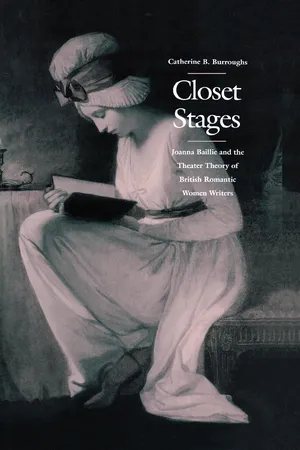 eBook - PDF
Closet Stages
Joanna Baillie and the Theater Theory of British Romantic Women Writers
- Catherine B. Burroughs(Author)
- 2015(Publication Date)
- University of Pennsylvania Press(Publisher)
To study the closet play, then, is to focus on what Thomas Whitaker calls the problematic relations between 'text' and 'per-formance' (Some Reflections 148) and to locate a source of dramatic action in the genre's ability to force on its audience a dialectical movement between acting and reading. 16 Chapter i Before its associations with gay dramaturgy, 28 the term Closet drama was used to refer to plays that were never intended to be performed on stage or to plays that, for whatever reason, were never acted. 29 Om Prakash Mathur, for instance, defines a closet play as dominated by the 'literary' element 55 and which cc 'reads 5 much better than it acts 55 (i). Yet as some scholars recognize, not only does this dichotomy between reading and per-formance fail to describe a number of closet plays written and produced during the Romantic period, but it is precisely this opposition between literariness 55 and theatricality 55 that the genre itself deconstructs: writ-ten to resemble a play script and therefore implying a potential theatrical performance, the closet play makes dramaturgically explicit the bifurcated character of all dramatic literature, tensed between script and live perfor-mance. Whereas Mathur labels the closet play as the strangest case ever known to the science of dramaturgy 55 and uses analogy to describe his puzzlement over the form—it is like a bird which flies with difficulty, if at all, but walks immeasurably better 55 (i)— this strangeness is precisely what has attracted readers in the 19808 and 19905 who are interested in the problematics of terms such as theatricality,55 the dramatic,55 and the per-formable. 55 A study of Baillie's early plays suggests the extent to which closet dra-mas show characters struggling with what are today considered subjects central to gay dramaturgy—that is, the ways in which particular characters comply with or rebel against prescribed gendered and sexual identities in both private and public settings. eBook - PDF
- Arthur F. Kinney(Author)
- 2008(Publication Date)
- Wiley-Blackwell(Publisher)
29 Closet drama Marta Straznicky Defined by most critics as a play that was either never intended for performance or never performed, Closet drama has predictably been marginalized by generations of critics who, however varied their theoretical positions or scholarly interests, have taken Renaissance drama to mean drama written for performance. To be sure, there have been pockets of scholarship on certain clusters of closet plays, such as the neo-Senecan drama of the Sidney circle, the dramatic pamphlets of the civil wars, or, most recently, the variety of plays written by early modern women for whom there was no legiti-mate access to commercial theater. 1 But much of this work is also informed by what we might call a theatrical bias: an imputed preference for theater and performance that construes Closet drama in terms of resistance or deficiency. While this scholar-ship has revealed much about the available forms of theatricality in the period, it has also obscured the place of Closet drama within literary culture more generally and thus made it difficult to assess the form as a discrete tradition of dramatic writing. The inclination in Closet drama criticism toward theater and stageability is largely attributable to the genre’s negative and stage-oriented definition: in one influential formulation, plays “that were never acted, and were never meant to be” (Greg, 1939–59, 4, xii). The opposition between closet and stage implied by this definition, however, was not a feature of Renaissance dramatic discourse, at least not with the kind of regularity that might allow us to take the term itself as current in the period. In fact, it was not until the late eighteenth century that the closet/stage dichotomy became embedded in critical language as a way of distinguishing certain types of plays as appropriate for performance and others for reading.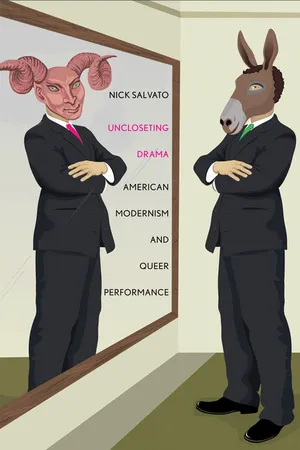 eBook - PDF
Uncloseting Drama
Modernism's Queer Theatres
- Nick Salvato(Author)
- 2010(Publication Date)
- Yale University Press(Publisher)
In the study of modernist Closet drama, I have elaborated these very insights and their conjunction: that closet provisions are not necessarily hostile to but queerly constitutive of possible performance provisions, and that per-formance provisions, especially theatrical ones, can themselves be under-stood as closet provisions. To point, with these ideas in mind, to the dra-mas that take place in other closets, other rooms—from men’s rooms, real and imagined, of the 1930s and the 1960s, to so many other modern inte-riors whose enclosures produce effects that are at once disarming and com-forting, dispiriting and exhilarating—is to go as far as this book’s own en-closures will allow. OTHER CLOSETS, OTHER ROOMS 187 This page intentionally left blank NOTES INTRODUCTION “Half In and Half Out” 1 Waters, Introduction to Trash Trio, vii. 2 One of the screenplays included in the volume, Flamingos Forever (a sequel to Pink Flamingos ), conforms most neatly to this definition of Closet drama. Stymied first by lack of funding and then by Divine’s death, Waters never realized the script for the screen—and how we might realize it in our own living rooms also remains question-able, given that the text ends with “ Divine and family flying on turd over Baltimore, wind in their hair, happy . . . as turd flies away like magic carpet over skyline ” (258). 3 Raber, Dramatic Difference, 13. 4 Straznicky, Privacy, Playreading, and Women’s Closet drama, 1, 16. 5 Gould, Virtual Theater, 1, 7, 37. 6 Archer, Play-making, 21. 7 Hardy, preface to The Dynasts, x. 8 Williams, Playing the Race Card, 17, second emphasis added. See also Brooks, The Melo-dramatic Imagination, and Gledhill, “The Melodramatic Field.” 9 Stein, Four Saints in Three Acts, 445. 10 Zukofsky, Rudens, in “A,” 487. 11 Cox, In the Shadows of Romance, 43. 12 Szondi, Theory of the Modern Drama. 13 Ackerman and Puchner, “Introduction,” 8, 12. 14 Worthen, Print and the Poetics of Modern Drama, 9, 73. eBook - ePub
Words for the Theatre
Four Essays on the Dramatic Text
- David Cole(Author)
- 2019(Publication Date)
- Routledge(Publisher)
77Since it was the early nineteenth-century London stage from which Hazlitt, Coleridge and Lamb thus ran screaming, one is tempted to attribute their flight to the vulgarity of contemporary productions; but in truth production is the vulgarity. On any stage, “[t]hat which was [in the text] merely an airy shape, a dream, a passing thought, immediately becomes an unmanageable reality.”78 Shakespeare, and arguably every true dramatist, must “find his proper place in the heart and in the closet.”79 All theatre aspires to the condition of Closet drama (in which, not coincidentally, the nineteenth century abounded), that is, to the condition of a text read silently to oneself in a room.This looks like a straightforward cherishing of the literary over the theatrical. But we must not miss the paradox. Clearly, the proper place for drama is the theatre. If drama’s proper place is henceforth to be the closet of solitary reading, this can only mean that the solitary reader’s closet must henceforth be recognized as the true theatre, i.e., that theatre has “gone in” to be the reading of a text.Something like this trajectory seems forecast in that granddaddy of all Closet dramas, the “closet scene” (III.iv) from Hamlet .80 It may appear perverse to seek a prototype of the unstaged in this most staged of plays. But this is the very anomaly that the closet scene itself sets out to explore.Hamlet famously likens acting to “a mirror [held] up to nature,”81 a figure that lays stress on theatre’s out-and-about, world-surveying character. Yet when Hamlet himself now comes to hold up a (metaphorical) mirror – “You go not till I set you up a glass/Where you may see the inmost part of you”82 – it is to one person, his mother, alone in her closet.83 This may seem a strangely inward turn for the image of theatre as nature’s mirror to have taken, until we set beside it the advice a contemporary of Shakespeare’s offered his female readers: “Make then your Chamber your private Theatre.”84 True, unlike Hazlitt and Lamb, Gertrude before the “glass” in her private closet/theatre does no actual reading. But, as the titles of numberless medieval and Renaissance works suggest – Speculum humanae salvationis , A Mirror for Magistrates , etc. – there is a long tradition of equating mirrors and books.85 And in fact the “black and grainèd spots” that Gertrude tells Hamlet she sees when “[t]hou turn’st mine eyes into my very soul” sound like nothing so much as print forced upon the attention of a (reluctant) reader.86
Index pages curate the most relevant extracts from our library of academic textbooks. They’ve been created using an in-house natural language model (NLM), each adding context and meaning to key research topics.

