Literature

Narrative Discourse
Narrative discourse refers to the way a story is told, including the structure, style, and techniques used by the author to convey the narrative. It encompasses the organization of events, the point of view, and the overall presentation of the story. Narrative discourse plays a crucial role in shaping the reader's experience and understanding of the literary work.
Written by Perlego with AI-assistance
Related key terms
1 of 5

10 Key excerpts on "Narrative Discourse"
 eBook - PDF
- Angela Goddard, Neil Carey(Authors)
- 2017(Publication Date)
- Routledge(Publisher)
DISCOURSE AND NARRATIVE AIMS OF THIS CHAPTER This chapter will: • begin by outlining some language approaches to narrative, includ- ing speech but concentrating on writing as the major focus; and • continue by broadening its perspective to consider how narratives connect with each other and contribute to discourses of different kinds. THE CENTRALITY OF NARRATIVE The concept of narrative has a chapter in its own right because it fea- tures in so many different academic disciplines as well as in so many walks of life. Narrative is an everyday social activity in conversations as well as being the bread-and-butter of novelists and playwrights. Narratives play a central role in creating discourses because they are one way of constructing a sense of ‘how things are’: if we tell cer- tain kinds of stories repeatedly, then they assume a tangible reality and contribute to a recognisable discourse. Thinking about the rela- tionship between narrative and discourse from the wider, discourse 8 127 DISCOURSE AND NARRATIVE perspective can also be helpful: discourse is a larger concept which contains narratives of different kinds, plus other types of text too. For example, discourses about education are likely to contain many stories told by individuals about their schooling, but other types of text such as school league tables and national statistics, inspection reports, and school uniform and equipment will also feature as dis- course ‘ingredients’. TELLING A STORY If you are working in a group situation, use this as an opportunity to tell the others in your group a brief story about your schooldays. It could be something to do with you getting into trouble, or some- thing exciting that happened – anything that you think is worth telling. It doesn’t matter how rough and unpolished your story is; this is not an exercise to develop professional storytelling skills. The point is to convey something of the nature of the experience or the event you have selected.
- (Author)
- 2011(Publication Date)
- Cuvillier Verlag(Publisher)
1 Discourse Analysis and the Narrative Genre 1.0 Introduction The study of the things people do with talk in order to make sense of the world has been one of the major themes in humanistic and social scientific thought since the mid-twentieth century. This chapter discusses the defining elements of the study of these themes (Discourse Analysis), throws more light on the Narrative Discourse genres, and depicts the current trends in discourse studies and narratology. 1.1 Defining elements of Discourse Analysis Discourse Analysis is a qualitative method of language analysis that has been adopted and developed by social constructionists as a means of characterising language use above the sentence. Trappes Lomax (2004:134) defines it broadly as: the study of language viewed communicatively and/or of communication viewed linguistically… reference to concepts of language in use, language above or beyond the sentence, language as meaning in interaction, and language in situational and cultural context. According to him, depending on the particular convictions and affiliations of functionalists, s tructuralists and social interactionists, each emphasizes the domains that are relevant to him. Generally, there are varied views about the origins and implications of the language in use versus language above the sentence distinction (Schiffrin, 1994, Pennycook, 1994a Widdowson, 1995, Cameron, 2001). To some discourse analysts, discourse refers both to the interactive process and the end result of thought and communication. It is the social process of making and reproducing sense(s). This implies that discourses are the product of social, historical and institutional formations; and meanings are produced by these institutionalized discourses. Individuals do not simply learn languages as abstract skills; they interact with already established discourses in which different subjectivities are already represented. eBook - PDF
- H. Porter Abbott(Author)
- 2020(Publication Date)
- Cambridge University Press(Publisher)
This is because people on stage or in films talk, and as they talk, we learn about events in which they are involved and that can extend in space and time way beyond the boundaries of what we see on stage. In Oedipus Tyrannus, for example, a play that adheres strictly to Aristotle’s rule, Oedipus, in a single day, must reconstruct his entire life. And the audience joins him in this effort, slowly piecing together a long, terrible story in which Oedipus, without knowing it, has been the central player. Two Problems for Speakers of English Most speakers of English grow up using story to mean what we are referring to here as narrative. When, in casual conversation, English speakers say they’ve heard a “good story,” they usually aren’t thinking of the story as separate from the telling of it. When a child wants you to read her favorite story, she often means by that every word on every page. Leave a word out, and you are not reading the whole story. But, as I hope will become clear as we go on, the distinction between story and Narrative Discourse is vital for an understanding of how narrative works. There is a similar problem with the term Narrative Discourse, especially if we take narrative to mean all modes of conveying stories. It is awkward in English to apply the term “discourse” to elements like montage or camera work in films or design in painting. And yet it is true that these things are a kind of language or discourse that we understand and can read and out of which we construct a story. A Pause to Sort out Some Terms: Fabula, Sjuzet, Plot, Progression The distinction between a story and the way it is rendered as narrative was first deployed in the analysis of narrative by Russian Formalists early in the twentieth century. Their terms were fabula and sjuzet, and there are scholars today who still deploy them. As it is commonly understood, fabula is used the way I have eBook - PDF
Narratology beyond Literary Criticism
Mediality, Disciplinarity
- Jan Christoph Meister(Author)
- 2008(Publication Date)
- De Gruyter(Publisher)
Fludernik (1996, 2003) more explicitly claims to privilege ‘spontaneous conversational storytelling’ (1996:13); that is, oral versions of non-fictional storytelling, however, only to revert and give privileged status in her analysis to fictional stories. 3 An additional question, raised 3 Fludernik (2003) argues that the model she has developed in (1996) ‘takes its inspiration from natural narrative, arguing that natural narrative is the prototype of all narrative’ (248), but it should be clear that her goal is very different from my own. While my inter-est in narratives is concerned with how people use them, hers is to work up a definition of narrative that can be applied to ‘all types of narrative texts’, including ‘the two least researched areas of narrative texts—pre-eighteenth-century narrative (medieval and early modern) and postmodernist narrative’ (ibid.). 218 Michael Bamberg recently by Freeman (2004), is whether written transcripts of oral nar-ratives have implications in the sense that predilections stemming from traditional narrativity leak into the analysis. Along these lines it should not come as a surprise that discourse (oral talk) itself is modeled as a text, and its referentiality is declared to be its central ingredient. Discourse is the exchange of referentially denoted information, the way it is represented in the individual mind, encoded by culturally available semiotic means (usually in terms of a linguistic code), and subsequently encoded by the reader/ interlocutor. Discourse is ‘cogni-tive discourse’, exchange between ‘talking heads’. In the worst scenario it is the mere exchange of information; in a somewhat better world, it is the negotiation (between interlocutors) of cognitive models. And in an even better world, it is a negotiation that includes a constant updating of such models (see Herman 2002). eBook - PDF
- Jason Mittell(Author)
- 2017(Publication Date)
- Bloomsbury Academic(Publisher)
Clearly full faithfulness in Narrative Discourse is not the goal, as even adaptations NARRATIVE THEORY AND ADAPTATION. 28 that are faithful to a source’s story may be critiqued for being insufficiently cinematic, overly literary in tone, or too “stagey”— all instances where fidelity to an original’s Narrative Discourse is seen as a failure of adaptation. Thus we need to look carefully at what it means to transform a Narrative Discourse into film, and how it shapes how stories are told. Adaptation, medium, and Narrative Discourse While there are whole genres of books that use images, like graphic novels, picture books, and textbooks, most literature that spawns film adaptations uses a single channel of verbal communication nearly exclusively, save for the few novels that use occasional illustrations, page design, or fonts to convey meaning. Films have quite a bit of verbal communication as well, including on-screen text via captions, or shots featuring a letter or sign to be read by viewers, and most commonly, the spoken word. For a literary adaptation, one of the core questions is how best to capture the original’s use of language within the film; dialogue is the most straightforward way to retain the original language, as with Shakespearean adaptations putting the poetic language into the mouths of characters, even when the film changes the time frame and setting from the original. However, dialogue that reads well on the page might fall flat when spoken in a film, and much of what might be conveyed via dialogue in the theater might be better served by wordless visualization on the screen. eBook - PDF
Narrative Dimensions of Philosophy
A Semiotic Exploration of the Work of Merleau-Ponty, Kierkegaard and Austin
- S. Marsen(Author)
- 2006(Publication Date)
- Palgrave Macmillan(Publisher)
23 The thing perceived is conceived as having life and movement and such is the primary expression of it. Conceptions are thus born as acts of the imagination. —Johan Huizinga Overview This chapter delineates a narrative-semiotic method of textual analysis, and shows how it may lead to an understanding of the discursive processes involved in the construction and communication of knowl- edge. The first part provides a critical discussion of contemporary narrative and semiotic theories, highlighting pertinent methodological issues that emerge from the different approaches; the second part outlines the eclectic model of analysis that will be used in this study, and shows some examples of its application. The story of narrative theory Contemporary narrative theory is diverse and multifaceted. Of the many features and concepts that have been used to develop narrative theories, the following stand out: • Definitions of what narrative is. • Divisions of narrative into different textual levels. • Descriptions of the nature of agents, actors, actants and characters – the performers of action. 2 The Narrative Framework • Discussions on the status of narrative action in relation to physical performance and life. • Perspectives on the relations between narrative and fiction, and on the nature of reality. Defining narrative and describing its textual levels While it is generally agreed that not all texts are narrative, not much agreement exists on the elements that actually do distinguish a text as narrative.
- Sandra Heinen, Roy Sommer, Sandra Heinen, Roy Sommer(Authors)
- 2009(Publication Date)
- De Gruyter(Publisher)
The survey will also demonstrate, however, that psy-1 ‘Narrative comprehension’ and ‘story generation’ are the terms used in linguistics and artificial intelligence respectively to designate what is commonly known as ‘storytelling’. Despite their slightly different connotations, these three terms are treated as synonyms in this paper, whereas the term ‘narrative design’ (which is sometimes used as another synonym of storytelling in crea-tive writing) refers to a specific stage of the storytelling process (cf. section 5). 90 Roy Sommer chological research lacks the domain-specific knowledge required for an analysis of storytelling. Section 4 will therefore propose a concept of narra-tive design which integrates psychological and narratological research. 2. Narratology and Extratextual Literary Communication: Communication Models, Speech Act Theory and Cognition In their discussion of levels of communication in narrative fiction, Neumann and Nünning (2008: 25) proceed from an understanding of literature as a specific form of communication: “From a communicative perspective, narra-tive fiction is regarded as an interaction between an author and the readers through the medium of a text.” Simple communication models assume that an addresser (author) sends a message which makes use of a material me-dium of transmission and is based on a code shared by all participants in the communicative process to an addressee (reader). Narratological models of literary communication realize that there are significant differences between face-to-face oral communication and written communication, such as the time lag between production and reception and the lack of direct interaction between addresser and addressee (ibid.: 26). A third, equally important dif-ference between verbally transmitted messages in everyday communication and literary communication via literary texts results from the specific charac-teristics of fictional narratives which themselves stage communicative pro-cesses. eBook - PDF
- Andreas H. Jucker, Irma Taavitsainen, Andreas H. Jucker, Irma Taavitsainen(Authors)
- 2010(Publication Date)
- De Gruyter Mouton(Publisher)
22. Literary discourse Susan Fitzmaurice 1. Introduction It is possibly appropriate that this interrogation of the historical pragmatic treat-ment of “literary discourse” should close a handbook of historical pragmatics as it is necessarily concerned with examining a source of data that is markedly distinct from other discourse domains in seeking the designation of “literary”. Like relig-ious discourse (chapter 19) and scientific discourse (chapter 20), literary discourse is historicised because its genres and styles change in form and character over time. However, unlike these discourse domains, literary discourse is arguably more di-verse, not only collecting genres that are internally diverse but also collecting a di-verse range of genres. Thus literary discourse encompasses verse genres, narrative fiction and dramatic literature in all their forms and historical exempla. It is ob-vious that this statement delimits, in a wholly pragmatic and convenient fashion, the domain of discourse that is the object of study for this chapter. The specifi-cation of what counts as “literary discourse” is made more fraught by the rules and conventions prevalent in different historical milieus, cultures, educational systems, and ideologies. Indeed, Toolan (1992: ix) observes that “literature” as a term “can-not be defined in isolation from an expression of ideology”. 1 For the sake of making the present treatment manageable, I adopt a conven-tional notion of literary discourse, but I will draw upon non-canonical forms as ap-propriate. 1.1. Literary discourse in historical pragmatics Given the key roles of literary form and poetic convention in shaping the produc-tion, transmission and reception of literary discourse over time, it is reasonable that linguists might regard literary discourse as one of the least reliable sources of ma-terial for the investigation of ordinary communicative practices.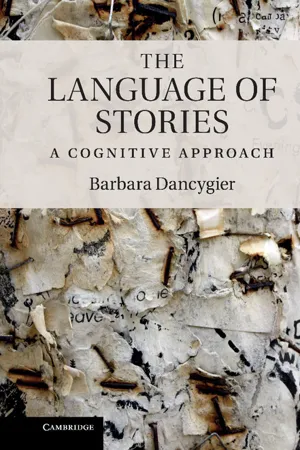 eBook - PDF
The Language of Stories
A Cognitive Approach
- Barbara Dancygier(Author)
- 2011(Publication Date)
- Cambridge University Press(Publisher)
Second, the stories such as the ones discussed by Scalise Sugiyama (also in her earlier work) are clearly intended to achieve a certain effect in the listeners – compassion with victims, fear of predators, increased sense of dependence on social and family structures. But these effects are achieved as a kind of ‘narrative uptake,’ not because they are directly communicated. The mechanism whereby an elaborate linguistic construct can prompt ‘narrative transport’ (cf. Gerrig 1993) must have been present in the minds of the foraging peoples and it is present, in an enhanced form, in our minds. Still, regardless of the form and context of the story, the ‘point’ of the story is only available through constructing its meaning – not 18 Language and literary narratives only by tracking the sequence of events, but, more important, by exploring all the ‘what-if ’ scenarios which could have prevented overly confident children from being abducted or might help us understand ourselves and our world better. There is no limit to what a narrative can do, but it requires a mind which uses the story as it is told or written to construct its meaning. Apart from this broad context in which stories achieve their status of mean- ingful artifacts there is also the question of how a literary text is similar to or different from any other text, spoken or written. I will assume that language and its basic communicative context are the basis on which literariness is built. I treat the basic communicative context similarly to what cognitive linguists call the Ground (Langacker 1991, 2001; Coulson and Oakley 2005; Verhagen 2005) – the immediate surroundings, the presence of the speaker and the hearer, shared knowledge, shared visual and aural field, shared understanding of bodily experience, and, last but not least, the surrounding discourse context. eBook - PDF
- David Pellauer(Author)
- 2007(Publication Date)
- Continuum(Publisher)
With this comes an increasing emphasis on social and psychological complexity, combined with new ways of conveying inwardness, cul-minating in the twentieth century with the stream of consciousness novel. ‘Yet nothing in these successive expansions of character at the expense of the plot escapes the formal principle of configuration and therefore the concept of emplotment’ (T&N 2:10). What is even more significant about the novel, however, is that it leads to new developments in narrative technique in that this is a genre of narra-tive that constantly struggles against being reduced to a fixed set of conventions at the same time it confronts readers with the question: are we faced with illusion or resemblance to reality in fiction? Ricoeur’s reply to this question leads him to shift from his earlier use of the idea of ‘redescription’ to characterize what happens with live metaphor to the idea of ‘reconfiguration’ in order to make sense of what happens through narrative when it is heard or read and under-stood. This is because like all narrative, fiction presents us with a world of the text in which the story is understood to unfold, and this is a world we can imagine ourselves as inhabiting. Hence, on this basis, narrative fiction is a way of seeing the world di ff erently, but also in ways that may be true of the world as it actually is or might 77 THE FULLNESS OF LANGUAGE AND FIGURATIVE DISCOURSE be. For this reason, any theory of narrative, like the theory of metaphor, has at some point to confront the question of truth. Ricoeur suggests, provocatively, the possibility that just as there is a truth of history as narrated, so too there can be a truth of fiction where this is a truth that operates at the level of extended discourse, not at that of the sentence. This is a truth that is not reducible to the logical conjunction of the truth values of its individual sentences, which is why a hermeneutics of the text is required to make sense of it.
Index pages curate the most relevant extracts from our library of academic textbooks. They’ve been created using an in-house natural language model (NLM), each adding context and meaning to key research topics.

