Mathematics

Congruent Triangles
Congruent triangles are two or more triangles that have the same size and shape. This means that their corresponding sides and angles are equal. When two triangles are congruent, it means that they can be superimposed on each other, and all their corresponding parts will coincide perfectly. Congruent triangles are important in geometry and are used to prove various geometric theorems.
Written by Perlego with AI-assistance
Related key terms
1 of 5
10 Key excerpts on "Congruent Triangles"
 eBook - PDF
Mathematical Practices, Mathematics for Teachers
Activities, Models, and Real-Life Examples
- Ron Larson, Robyn Silbey(Authors)
- 2014(Publication Date)
- Cengage Learning EMEA(Publisher)
All Rights Reserved. May not be copied, scanned, or duplicated, in whole or in part. Due to electronic rights, some third party content may be suppressed from the eBook and/or eChapter(s). Editorial review has deemed that any suppressed content does not materially affect the overall learning experience. Cengage Learning reserves the right to remove additional content at any time if subsequent rights restrictions require it. Section 13.1 Congruence of Triangles 495 13.1 Congruence of Triangles Understand the definition of Congruent Triangles. Use the SSS, SAS, and ASA Congruence Postulates. Use Congruent Triangles to explore properties of parallelograms. Congruent Triangles Recall from Chapter 10 that line segments are congruent when they have the same length, and angles are congruent when they have the same measure. Congruent figures have the same size and shape. Standards Grades 3–5 Geometry Students should classify shapes by properties of their lines and angles. Grades 6–8 Geometry Students should describe the relationships between geometrical figures. Definition of Congruent Triangles Two triangles are Congruent Triangles when their corresponding sides are congruent and their corresponding angles are congruent. In the figures below, triangle ABC is congruent to triangle DEF. C B A F E D Matching sides are called corresponding sides. Matching angles are called corresponding angles. △ABC ≅ △DEF The symbol ≅ means “is congruent to.” When writing statements such as △ABC ≅ △DEF, you can start at any vertex. Just be sure to list the vertices of the triangles in corresponding order. EXAMPLE 1 Using the Definition of Congruent Triangles △JKL is congruent to △XYZ. J K L Y 10 cm X Z 75° 65° a. Find the length of — JK. b. Find the measures of angles J and L. SOLUTION a. Because △JKL ≅ △XYZ, the corresponding sides — JK and — XY are congruent. So, the length of — JK is the same as the length of — XY . No longer available |Learn more
- (Author)
- 2014(Publication Date)
- Library Press(Publisher)
If triangle ABC is congruent to triangle DEF, the relationship can be written mathematically as: In many cases it is sufficient to establish the equality of three corresponding parts and use one of the following results to deduce the congruence of the two triangles. The shape of a triangle is determined up to congruence by specifying two sides and the angle between them (SAS), two angles and the side between them (ASA) or two angles and a corresponding adjacent side (AAS). Specifying two sides and an adjacent angle (SSA), however, can yield two distinct possible triangles. ________________________ WORLD TECHNOLOGIES ________________________ Determining congruence Sufficient evidence for congruence between two triangles in Euclidean space can be shown through the following comparisons: • SAS (Side-Angle-Side): If two pairs of sides of two triangles are equal in length, and the included angles are equal in measurement, then the triangles are congruent. • SSS (Side-Side-Side): If three pairs of sides of two triangles are equal in length, then the triangles are congruent. • ASA (Angle-Side-Angle): If two pairs of angles of two triangles are equal in measurement, and the included sides are equal in length, then the triangles are congruent. The ASA Postulate was contributed by Thales of Miletus (Greek). In most systems of axioms, the three criteria— SAS , SSS and ASA —are established as theorems. In the School Mathematics Study Group system SAS is taken as one (#15) of 22 postulates. • AAS (Angle-Angle-Side): If two pairs of angles of two triangles are equal in measurement, and a pair of corresponding non-included sides are equal in length, then the triangles are congruent. • RHS (Right-angle-Hypotenuse-Side): If two right-angled triangles have their hypotenuses equal in length, and a pair of shorter sides are equal in length, then the triangles are congruent.
- Alan Tussy, Diane Koenig(Authors)
- 2018(Publication Date)
- Cengage Learning EMEA(Publisher)
Editorial review has deemed that any suppressed content does not materially affect the overall learning experience. Cengage Learning reserves the right to remove additional content at any time if subsequent rights restrictions require it. CHAPTER 9 • An Introduction to Geometry 750 OBJECTIVE 1 Identify corresponding parts of Congruent Triangles. Simply put, two geometric figures are congruent if they have the same shape and size. For example, if ^ABC and ^DEF shown below are congruent, we can write ^ABC H11061 ^DEF Read as “Triangle ABC is congruent to triangle DEF.” A C B D F E One way to determine whether two triangles are congruent is to see if one triangle can be moved onto the other triangle in such a way that it fits exactly. When we write ^ABC H11061 ^DEF , we are showing how the vertices of one triangle are matched to the vertices of the other triangle to obtain a “perfect fit.” We call this matching of points a correspondence. ^ABC H11061 ^DEF A 4 D Read as “Point A corresponds to point D.” B 4 E Read as “Point B corresponds to point E.” C 4 F Read as “Point C corresponds to point F.” When we establish a correspondence between the vertices of two Congruent Triangles, we also establish a correspondence between the angles and the sides of the triangles. Corresponding angles and corresponding sides of Congruent Triangles are called corresponding parts. Corresponding parts of Congruent Triangles are always congruent. That is, corresponding parts of Congruent Triangles always have the same measure. For the Congruent Triangles shown above, we have m(H11028A) H11005 m(H11028D) m(H11028B ) H11005 m(H11028E ) m(H11028C ) H11005 m(H11028F ) m(BC ) H11005 m(EF ) m(AC ) H11005 m(DF ) m(AB ) H11005 m(DE ) Congruent Triangles Two triangles are congruent if and only if their vertices can be matched so that the corresponding sides and the corresponding angles are congruent.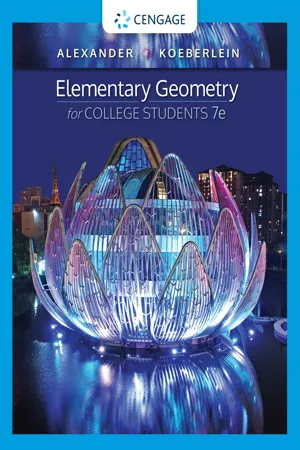 eBook - PDF
- Daniel C. Alexander, Geralyn M. Koeberlein(Authors)
- 2019(Publication Date)
- Cengage Learning EMEA(Publisher)
135 Stripped Pixel/Shutterstock.com 3 Triangles CHAPTER OUTLINE 3.1 Congruent Triangles 3.2 Corresponding Parts of Congruent Triangles 3.3 Isosceles Triangles 3.4 Basic Constructions Justified 3.5 Inequalities in a Triangle ■ PERSPECTIVE ON HISTORY: Sketch of Archimedes ■ PERSPECTIVE ON APPLICATIONS: The Geodesic Dome ■ SUMMARY Majestic! In Statue Square of Hong Kong, the Bank of China (the structure shown centered in the photograph) displays numerous triangles and rises 1209 feet above the square. Designed by I. M. Pei (who studied at the Massachusetts Institute of Technology and also graduated from the Harvard Graduate School of Design), the Bank of China displays triangles of the same shape and size. Such triangles, known as Congruent Triangles, are also displayed in the Ferris wheel found in Exercise 45 of Section 3.3. While Chapter 3 is devoted to the study of types of triangles and their characteristics, the properties of triangles developed herein also provide a much-needed framework for the study of quadrilaterals found in Chapter 4. 136 CHAPTER 3 ■ TRIANGLES 3.1 Congruent Triangles Two triangles are congruent if one fits perfectly over the other. The statement that trian- gles are congruent names their vertices in order as pairs of corresponding vertices. For instance, the statement nABC _ nDEF provides this information: first-named vertices correspond, as do second-named vertices and third-named vertices. In symbols, A 4 D, B 4 E, and C 4 F. The corresponding vertices name corresponding pairs of angles, which are pairs of congruent angles. In Figure 3.1, if nABC _ nDEF, then uni2220A _ uni2220D, uni2220B _ uni2220E, and uni2220C _ uni2220F. D E F (b) A B C (a) Figure 3.1 In the figure, note the equal numbers of red arcs indicating the corresponding and congru- ent angles. In the triangles, pairs of corresponding vertices (in order) determine pairs of corresponding sides, and these are also congruent.
- Andrei D. Polyanin, Alexander V. Manzhirov(Authors)
- 2006(Publication Date)
- Chapman and Hall/CRC(Publisher)
43 44 E LEMENTARY G EOMETRY 3. If three sides of a triangle are congruent to the corresponding sides of another triangle, then the triangles are congruent. 3 ◦ . Triangles are said to be similar if their corresponding angles are equal and their corre-sponding sides are proportional. Similarity tests for triangles: 1. If all three pairs of corresponding sides in a pair of triangles are in proportion, then the triangles are similar. 2. If two pairs of corresponding angles in a pair of triangles are congruent, then the triangles are similar. 3. If two pairs of corresponding sides in a pair of triangles are in proportion and the included angles are congruent, then the triangles are similar. The areas of similar triangles are proportional to the squares of the corresponding linear parts (such as sides, altitudes, diagonals, etc.). 4 ◦ . The line connecting the midpoints of two sides of a triangle is called a midline of the triangle. The midline is parallel to and half as long as the third side (Fig. 3.1 b ). Let a , b , and c be the lengths of the sides of a triangle; let α , β , and γ be the respective opposite angles (Fig. 3.1 a ); let R and r be the circumradius and the inradius, respectively; and let p = 1 2 ( a + b + c ) be the semiperimeter. Table 3.1 represents the basic properties and relations characterizing triangles. TABLE 3.1 Basic properties and relations characterizing plane triangles No. eBook - PDF
- Alan Tussy, Diane Koenig(Authors)
- 2018(Publication Date)
- Cengage Learning EMEA(Publisher)
a. 6 b. 11.25 7. 500 ft SECTION STUDY SET 9.5 VOCABULARY Fill in the blanks. 1. triangles are the same size and the same shape. 2. When we match the vertices of ^ABC with the vertices of ^DEF , as shown below, we call this matching of points a . A 4 D B 4 E C 4 F 3. Two angles or two line segments with the same measure are said to be . 4. Corresponding of Congruent Triangles are congruent. 5. If two triangles are , they have the same shape but not necessarily the same size. 6. A mathematical statement that two ratios (fractions) are equal, such as x 18 5 4 9 , is called a . CONCEPTS 7. Refer to the triangles below. a. Do these triangles appear to be congruent? Explain why or why not. b. Do these triangles appear to be similar? Explain why or why not. Copyright 2019 Cengage Learning. All Rights Reserved. May not be copied, scanned, or duplicated, in whole or in part. Due to electronic rights, some third party content may be suppressed from the eBook and/or eChapter(s). Editorial review has deemed that any suppressed content does not materially affect the overall learning experience. Cengage Learning reserves the right to remove additional content at any time if subsequent rights restrictions require it. CHAPTER 9 • An Introduction to Geometry 854 14. Name the six corresponding parts of the Congruent Triangles shown below. S T E 3 in. 4 in. 4 in. 3 in. 5 in. 5 in. R F G Fill in the blanks. 15. Two triangles are if and only if their vertices can be matched so that the corresponding sides and the corresponding angles are congruent. 16. SSS property: If three of one triangle are congruent to three of a second triangle, the triangles are congruent. 17. SAS property: If two sides and the between them in one triangle are congruent, respectively, to two sides and the between them in a second triangle, the triangles are congruent. No longer available |Learn more
- Daniel C. Alexander, Geralyn M. Koeberlein, , , Daniel C. Alexander, Geralyn M. Koeberlein(Authors)
- 2014(Publication Date)
- Cengage Learning EMEA(Publisher)
CHAPTER OUTLINE 3.1 Congruent Triangles 3.2 Corresponding Parts of Congruent Triangles 3.3 Isosceles Triangles 3.4 Basic Constructions Justified 3.5 Inequalities in a Triangle ■ PERSPECTIVE ON HISTORY: Sketch of Archimedes ■ PERSPECTIVE ON APPLICATIONS: Pascal’s Triangle ■ SUMMARY Chapter 3 Photodisc/Allan Baxter/Getty Images 121 Triangles Majestic! In Statue Square of Hong Kong, the Bank of China (the structure shown at the left in the photograph above) rises 1209 feet above the square. Designed by I. M. Pei (who studied at the Massachusetts Institute of Technology and also graduated from the Harvard Graduate School of Design), the Bank of China displays many triangles of the same shape and size. Such triangles, known as Congruent Triangles, are also displayed in the Ferris wheel found in Exercise 43 of Section 3.3. While Chapter 3 is devoted to the study of triangle types and their characteristics, the properties of triangles developed herein also provide a much-needed framework for the study of quadrilaterals found in Chapter 4. Additional video explanations of concepts, sample problems, and applications are available on DVD. Copyright 2013 Cengage Learning. All Rights Reserved. May not be copied, scanned, or duplicated, in whole or in part. Due to electronic rights, some third party content may be suppressed from the eBook and/or eChapter(s). Editorial review has deemed that any suppressed content does not materially affect the overall learning experience. Cengage Learning reserves the right to remove additional content at any time if subsequent rights restrictions require it. 122 CHAPTER 3 ■ TRIANGLES Unless otherwise noted, all content on this page is © Cengage Learning. Two triangles are congruent if one coincides with (fits perfectly over) the other. In Figure 3.1, we say that if these congruences hold: , , , , , and Figure 3.1 From the indicated congruences, we also say that vertex A corresponds to vertex D , as does B to E and C to F . eBook - PDF
Dr. Math Presents More Geometry
Learning Geometry is Easy! Just Ask Dr. Math
- (Author)
- 2005(Publication Date)
- Jossey-Bass(Publisher)
Here is an experiment for you to try. Get three sticks: one that is 3 inches long and two that are each 5 inches long. Use them to make an isosceles triangle. It will look something like the picture on the left. 74 Dr. Math Presents More Geometry Dear Dr. Math, I was given these three methods of proving two triangles congruent: SSS, SAS, ASA. If I use SAS, is it correct that the angle must be an included angle? Then, two triangles, one that has two sides of equal length to corresponding sides of the second triangle and both hav- ing an angle (not included) equal, cannot be proved congruent. It seems to me that they are congruent, though. Any thoughts on this? Yours truly, Quentin Congruence Theorems for Triangles 3 5 5 Draw a diagram of the triangle you made and label the sides as on the previous page. Now I want you to keep the angle fixed between the two 5-inch sticks and move the 3-inch stick in until it forms a triangle again. If you have followed these instructions, you have constructed two triangles that have congruencies SSA but are clearly not Congruent Triangles. —Dr. Math, The Math Forum Triangles: Properties, Congruence, and Similarity 75 5 5 5 3 3 5 5 Similarity in Triangles Two objects are similar if they are scale images of each other. For example, any two squares are similar—they have the same shape but not necessarily the same size. Any two triangles are similar if all three angles are equal and all three sides are in proportion. (Although if one is true, both must be true, as they imply each other: if the sides are in proportion, then the angles must be equal, and vice versa.) Instead of being congruent as in Congruent Triangles, the cor- responding parts of similar triangles are in proportion. As with con- gruence, there are several shortcuts you can use to determine if two triangles are similar. Hi, Qian, You can tell if two triangles are similar in a lot of different ways, but all of them involve comparing sides and angles. eBook - PDF
Mathematics for Elementary Teachers
A Contemporary Approach
- Gary L. Musser, Blake E. Peterson, William F. Burger(Authors)
- 2013(Publication Date)
- Wiley(Publisher)
Is Roberto correct? Discuss. GEOMETRIC PROBLEM SOLVING USING TRIANGLE CONGRUENCE AND SIMILARITY The two parallelograms below have congruent corresponding sides, but the parallelograms themselves are not congruent. The two tri- angles below have congruent corresponding sides and, by the SSS triangle congruence, the triangles are congruent. These two ideas are related to some principles of fence building. When building a gate for a fence, a crosspiece (A), like the one shown, is added to ensure a stron- ger more stable gate that won’t sag. Why does the diagonal (A) add so much strength that the two parallel pieces (B and C ) couldn’t provide? How is this strengthening crosspiece related to the SSS triangle congruence? 766 Chapter 14 Geometry Using Triangle Congruence and Similarity Applications of Triangle Congruence In this section we apply triangle congruence and similarity properties to prove properties of geometric shapes. Many of these results were observed informally in Chapter 12. Our first result is an application of the SAS congruence property that establishes a property of the diagonals of a rectangle. Problem-Solving Strategy Draw a Picture Show that the diagonals of a rectangle are congruent. SOLUTION Suppose that ABCD is a rectangle [Figure 14.50(a)]. Figure 14.50 A B D C AC = BD (a) A B D C (b) Then ABCD is a parallelogram (from Chapter 12). By a theorem in Section 14.1, the opposite sides of ABCD are congruent [Figure 14.50(b)]. In particular, AB DC ≅ . Consider nABC and n n DCB; ABC C ≅ ∠D B, since they are both right angles. Also, CB BC ≅ . Hence, n n ABC DCB ≅ by the SAS congruence property. Consequently, AC BD ≅ , as desired. ■ The next result is a form of a converse of the theorem in Example 14.11. In parallelogram ABCD, if the diagonals are congruent, it is a rectangle. SOLUTION Suppose that ABCD is a parallelogram with AC BD ≅ [Figure 14.51(a)]. Figure 14.51 Since ABCD is a parallelogram, AD BC ≅ . eBook - PDF
College Geometry
A Unified Development
- David C. Kay(Author)
- 2011(Publication Date)
- CRC Press(Publisher)
You are to name the triangles by number that are congruent in Figure P.12. What congruence criteria apply? (See Gardner, M., Sixth Book of Mathematical Games from Scientific American .) B C D A 1 2 3 4 5 6 7 8 9 10 11 12 13 14 15 16 Figure P .12 13. Figure P.13 for this problem shows the diagram for Euclid’s pons asinorum . Construct a proof based on this diagram to show that if AB AC ≅ , then ∠ ABC ≅ ∠ ACB , using only the SAS postulate. Unified Geometry: Triangles and Congruence 125 B C E F A Figure P .13 14. Are the two triangles as shown in Figure P.14 congruent? Why or why not? J K L I 60° 61° 59° 60° 61° 59° Figure P .14 15. Critiquing a Student’s Proof A student gave this proof involving Figure P.15 for this problem: D B C A Figure P .15 Given : Ray DB combarrowextender arrowrightnosp combarrowextendercombarrowextender bisects ∠ ADC and ∠ BAD ≅ ∠ DBC . Proof ∠ ADB ≅ ∠ CDB by definition of angle bisec-tor, BD BD ≅ (reflexive law), ∠ ADB ≅ ∠ BDC (given). Therefore, Δ ABD ≅ Δ CBD by ASA and BD = CD . What is wrong with this proof? 126 College Geometry: A Unified Development 16. The universal peace symbol consists of a circle and 3 lines drawn from the center to points equally spaced on the circle, as shown in Figure P.16. (That is, the angles at the center are congruent.) Prove that Δ ABC is equilateral, thus providing an axiomatic proof that equilateral triangles exist in unified geometry. B C A Figure P .16 17. Prove Corollary B. [ Hint: Construct point S on ray PQ such that ( PQS ) and QS = QP . Then, every line through P passes through S .] 18. Prove Corollary C. [ Hint: If Δ ABC is isosceles with base BC and such that AB = AC = α /2, consider A *, the extremal opposite of point A . Then ( ABA *) and ( ACA *); continue. For the converse, assume the base angles are right angles and use Theorem 2.] 19. Prove Corollary D. 20. Suppose that ( AEC ) and ( DEB ) in Figure P.20 and that AE = EB and ∠ DAB ≅ ∠ CBA .
Index pages curate the most relevant extracts from our library of academic textbooks. They’ve been created using an in-house natural language model (NLM), each adding context and meaning to key research topics.

