Mathematics

Newton's Third Law
Newton's Third Law states that for every action, there is an equal and opposite reaction. In mathematical terms, this law can be expressed as the principle of conservation of momentum, where the total momentum of a system remains constant if no external forces act on it. This law is fundamental in understanding the behavior of objects in motion and is widely used in mathematical modeling and analysis.
Written by Perlego with AI-assistance
Related key terms
1 of 5

11 Key excerpts on "Newton's Third Law"
 No longer available |Learn more
- (Author)
- 2014(Publication Date)
- Learning Press(Publisher)
Newton's laws of motion Newton's First and Second laws, in Latin, from the original 1687 edition of the Principia Mathematica. Newton's laws of motion are three physical laws that form the basis for classical mechanics. They describe the relationship between the forces acting on a body and its motion due to those forces. They have been expressed in several different ways over nearly three centuries, and can be summarized as follows: ________________________ WORLD TECHNOLOGIES ________________________ 1. First law : Every body remains in a state of rest or uniform motion (constant velocity) unless it is acted upon by an external unbalanced force. This means that in the absence of a non-zero net force, the center of mass of a body either remains at rest, or moves at a constant speed in a straight line. 2. Second law : A body of mass m subject to a force F undergoes an acceleration a that has the same direction as the force and a magnitude that is directly proportional to the force and inversely proportional to the mass, i.e., F = m a . Alternatively, the total force applied on a body is equal to the time derivative of linear momentum of the body. 3. Third law : The mutual forces of action and reaction between two bodies are equal, opposite and collinear. This means that whenever a first body exerts a force F on a se cond body, the second body exerts a force − F on the first body. F and − F are equal in magnitude and opposite in direction. This law is sometimes referred to as the action-reaction law , with F called the action and − F the reaction. The action and the reaction are simultaneous. The three laws of motion were first compiled by Sir Isaac Newton in his work Philosophiæ Naturalis Principia Mathematica , first published on July 5, 1687. Newton used them to explain and investigate the motion of many physical objects and systems. eBook - PDF
- John D. Cutnell, Kenneth W. Johnson, David Young, Shane Stadler(Authors)
- 2015(Publication Date)
- Wiley(Publisher)
In other words, there isn’t just one force on the line of scrimmage; there is a pair of forces. Newton was the first to realize that all forces occur in pairs and there is no such thing as an isolated force, existing all by itself. His third law of motion deals with this fundamental characteristic of forces. Newton’s Third Law of Motion Whenever one object exerts a force on a second object, the second object exerts an oppositely directed force of equal magnitude on the first object. The third law is often called the “action–reaction” law, because it is sometimes quoted as follows: “For every action (force) there is an equal, but opposite, reaction.” Figure 4.7 illustrates how the third law applies to an astronaut who is drifting just outside a spacecraft and who pushes on the spacecraft with a force P B . According to the third law, the spacecraft pushes back on the astronaut with a force 2 P B that is equal in magnitude but oppo- site in direction. In Example 4, we examine the accelerations produced by each of these forces. EXAMPLE 3 | The Displacement of a Raft At the moment that the forces P B and A B begin acting on the raft in Example 2, the velocity of the raft is 0.15 m/s, in a direction due east (the 1x direction). Assuming that the forces are main- tained for 65 s, find the x and y components of the raft’s displacement during this time interval. Reasoning Once the net force acting on an object and the object’s mass have been used in Newton’s second law to determine the acceleration, it becomes possible to use the equations of kinematics to describe the resulting motion. We know from Example 2 that the acceleration components are a x 5 10.018 m/s 2 and a y 5 10.011 m/s 2 , and it is given here that the initial velocity components are v 0x 5 10.15 m/s and v 0y 5 0 m/s. Thus, Equation 3.5a ( x 5 v 0x t 1 1 2 a x t 2 ) and Equation 3.5b ( y 5 v 0y t 1 1 2 a y t 2 ) can be used with t 5 65 s to determine the x and y com- ponents of the raft’s displacement. eBook - PDF
- John Matolyak, Ajawad Haija(Authors)
- 2013(Publication Date)
- CRC Press(Publisher)
4.2.2 N EWTON ’ S S ECOND L AW The proper mathematical statement of Newton’s second law takes the following form: F p net t = ∆ ∆ , (4.1) where p is the momentum of the object defined as p = m v , (4.2) m is its mass. From the above two equations one may have F v net m t = ∆ ∆ ( ) . Assuming that the mass stays constant, this equation reduces to F v net = m t ∆ ∆ , or F = m a . (4.3) This is a vector equation equivalent in two dimensions to two-component equations: (F x ) net = ma x , (4.4a) (F y ) net = ma y . (4.4b) EXAMPLE 4.1 Calculate the horizontal force with which a 6-year-old child is pulling her 1.40-kg toy box on a smooth surface so that it moves in a straight line with an acceleration of 1.20 m/s 2 . S OLUT ION Since the motion is one dimensional, say x, the acceleration is then along the x direction. Thus, Newton’s second law, (F x ) net = ma x , which after substitution becomes (F x ) net = (1.40 kg)(1.20 m/s 2 ) = 1.68 N. 67 Newton’s Laws: Implications and Applications © 2010 Taylor & Francis Group, LLC A NALYSIS Such a force is moderately small with which, as could be envisioned, a 6-year-old child can move such mass. EXAMPLE 4.2 How much force is needed to give a truck of 7.00 × 10 3 kg an acceleration of 5.00 m/s 2 ? S OLUT ION Using Newton’s second law, (F x ) net = ma x , the force would then be (F x ) net = (7.00 × 10 3 kg)(5.00 m/s 2 ) = 3.50 × 10⁴ N. A NALYSIS This is a large force that is needed to move a 7.00-ton truck. 4.2.3 N EWTON ’ S T HIRD L AW Newton’s third law is a fundamental law that describes an essential feature of nature. It describes mutual physical forces between any pair of entities when one of them acts with a force on the other. The object that is being acted on by a force responds, that is, reacts, instantaneously with a force of reaction equal and opposite in direction to the force acting on it. eBook - PDF
- William Moebs, Samuel J. Ling, Jeff Sanny(Authors)
- 2016(Publication Date)
- Openstax(Publisher)
The object experiences acceleration due to gravity. • Some upward resistance force from the air acts on all falling objects on Earth, so they can never truly be in free fall. Chapter 5 | Newton's Laws of Motion 253 • Careful distinctions must be made between free fall and weightlessness using the definition of weight as force due to gravity acting on an object of a certain mass. 5.5 Newton’s Third Law • Newton’s third law of motion represents a basic symmetry in nature, with an experienced force equal in magnitude and opposite in direction to an exerted force. • Two equal and opposite forces do not cancel because they act on different systems. • Action-reaction pairs include a swimmer pushing off a wall, helicopters creating lift by pushing air down, and an octopus propelling itself forward by ejecting water from its body. Rockets, airplanes, and cars are pushed forward by a thrust reaction force. • Choosing a system is an important analytical step in understanding the physics of a problem and solving it. 5.6 Common Forces • When an object rests on a surface, the surface applies a force to the object that supports the weight of the object. This supporting force acts perpendicular to and away from the surface. It is called a normal force. • When an object rests on a nonaccelerating horizontal surface, the magnitude of the normal force is equal to the weight of the object. • When an object rests on an inclined plane that makes an angle θ with the horizontal surface, the weight of the object can be resolved into components that act perpendicular and parallel to the surface of the plane. • The pulling force that acts along a stretched flexible connector, such as a rope or cable, is called tension. When a rope supports the weight of an object at rest, the tension in the rope is equal to the weight of the object. If the object is accelerating, tension is greater than weight, and if it is decelerating, tension is less than weight. eBook - PDF
Superstrings and Other Things
A Guide to Physics, Second Edition
- Carlos Calle(Author)
- 2009(Publication Date)
- CRC Press(Publisher)
Newton’s first law is also called the law of inertia. We have spoken of forces pushing and pulling on objects to change their states of motion. These forces caused the objects to move. However, we all know that we can push on a heavy piece of furniture, like a dresser for example, and fail to move it. In this case the force applied is balanced by the frictional force between the dresser and the floor. We would say that the net force acting on the dresser is zero. Forces are vector quantities and this knowledge helps us understand why we can have several forces applied to an object and still have a net or resultant force equal to zero. When the two teams participating in a tug-of-war contest are unable to drag each other across the center line (Figure 3.7), the net force on the rope is zero, even though the individual team members, each of different strengths, pull with different forces. The sum of all the individual forces pulling on the rope is zero and the rope does not move. In Figure 3.7, we have the three different forces F 1 , F 2 , and F 3 exerted by each one of the three women acting on the left side of the rope, and the three additional forces, F ′ 1 , F ′ 2 , and F ′ 3 , exerted by the men, all different, and differing from the first ones, acting on the right side of the rope. In this vector diagram, the lengths of the vector forces are proportional to their mag-nitudes. Since the total length of the vectors on the left is equal to the total length of the three vectors acting on the right, the vector sum of these six forces is equal to zero. Thus the net force acting on the rope is zero and we say that the rope is in equilibrium. Newton’s first law says that, if the net force acting on an object is zero, the object will not change its state of motion. Thus, if the object is in equilibrium, its velocity remains constant. A constant velocity means that the velocity can take up any value that does not change, including zero, the case of an object at rest. eBook - PDF
- John D. Cutnell, Kenneth W. Johnson, David Young, Shane Stadler(Authors)
- 2018(Publication Date)
- Wiley(Publisher)
Friction The force that an object encounters when it moves or attempts to move along a surface. It is always directed parallel to the surface in question. Tension The tendency of a rope (or similar object) to be pulled apart due to the forces that are applied at either end. Equilibrium The state an object is in if it has zero acceleration. Mathematically, equilibrium means = 0. Apparent Weight The force that an object exerts on the platform of a scale. It may be larger or smaller than the true weight, depending on the acceleration of the object and the scale. Chapter 4 39 Newton's laws of Motion First Law An object continues in a state of rest or in a state of motion at a constant speed along a straight line, unless compelled to change that state by a net force. By "net" force we mean the vector sum of all of the forces acting on an object. For example, consider a spaceship in deep space, isolated from any other object or force. If the ship is stationary, it will remain so. But if the ship is moving (its rocket engines are shut down) it will continue to move in a straight line with a constant speed. So if the ship were traveling into deep space at say, 100 000 milh, it would continue to move at this speed in a straight line, even without the rocket engines firing, until an outside force acted to stop or change its motion. Second Law When a net force 2:F acts on an object of mass m, the acceleration a that results is directly proportional to the net force and has a magnitude that is inversely proportional to the mass. The direction of the acceleration is the same as the direction of the net force. This statement is usually written as LF=ma or a=LF/m (4.1) The symbol 2:F represents the net force, that is, the vector sum of all the forces acting on an object. This means that the components of the forces must be examined. For example, in two dimensions, equation (4.1) becomes Equations (4.1) and (4.2) can be used to determine the units of force. eBook - PDF
- John D. Cutnell, Kenneth W. Johnson, David Young, Shane Stadler(Authors)
- 2015(Publication Date)
- Wiley(Publisher)
This is a vector equation and, for motion in two dimensions, is equivalent to Equations 4.2a and 4.2b. In these equations the x and y subscripts refer to the scalar components of the force and acceleration vectors. The SI unit of force is the newton (N). When determining the net force, a free-body diagram is helpful. A free-body diagram is a diagram that represents the object and the forces acting on it. 4.5 Newton’s Third Law of Motion Newton’s third law of motion, often called the action–reaction law, states that whenever one object exerts a force on a second object, the second object exerts an oppositely directed force of equal magnitude on the first object. Check Your Understanding (The answers are given at the end of the book.) 23. A circus performer hangs stationary from a rope. She then begins to climb upward by pulling herself up, hand over hand. When she starts climbing, is the tension in the rope (a) less than, (b) equal to, or (c) greater than it is when she hangs stationary? 24. A freight train is accelerating on a level track. Other things being equal, would the tension in the coupling between the engine and the first car change if some of the cargo in the last car were transferred to any one of the other cars? 25. Two boxes have masses m 1 and m 2 , and m 2 is greater than m 1 . The boxes are being pushed across a frictionless horizontal surface. As the drawing shows, there are two possible arrangements, and the pushing force is the same in each. In which arrangement, (a) or (b), does the force that the left box applies to the right box have a greater magnitude, or (c) is the magnitude the same in both cases? m 1 m 1 m 2 (a) (b) m 2 Pushing force Pushing force undiminished along the rope. Then, a 540-N tension force T B acts upward on the left side of the scaffold pulley (see part a of the drawing). A tension force is also applied to the point P, where the rope attaches to the roof. eBook - PDF
- Robert Resnick, David Halliday, Kenneth S. Krane(Authors)
- 2016(Publication Date)
- Wiley(Publisher)
Our program for mechanics. The three boxes on the left suggest that force is an interaction between a body and its environment. The three boxes on the right suggest that a force act- ing on a body will accelerate it. 3-2 Newton’s First Law 43 force is needed to set the body in motion, but no external force is needed to keep a body moving with constant velocity. It is difficult to find a situation in which no external force acts on a body. The force of gravity acts on an object on or near the Earth, and resistive forces such as friction or air resistance oppose motion on the ground or in the air. Fortunately, we need not go to the vacuum of distant space to study motion free of external force, because, as far as the overall translational motion of a body is concerned, there is no distinction between a body on which no external force acts and a body on which the sum or resultant of all the ex- ternal forces is zero. We usually refer to the resultant of all the forces acting on a body as the “net” force. For example, the push of our hand on the sliding block can exert a force that counteracts the force of friction on the block, and an upward force of the horizontal plane counteracts the force of gravity. The net force on the block can then be zero, and the block can move with constant velocity. Note that, even though four forces act on the block, the net force can still be zero. The net force is determined by the vector sum of all the forces that act on the object. Forces of equal magnitude and opposite direction have a vector sum of zero. Thus we can achieve a condition of no net force on an object by arranging to apply forces that counteract other forces that act on the body, such as a push by a hand or an engine to overcome friction. This principle was adopted by Newton as the first of his three laws of motion: Consider a body on which no net force acts.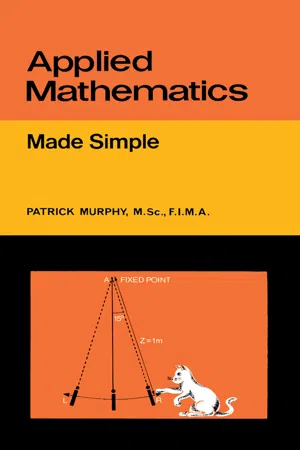 eBook - PDF
Applied Mathematics
Made Simple
- Patrick Murphy(Author)
- 2014(Publication Date)
- Butterworth-Heinemann(Publisher)
If no slipping takes place, we simply 78 Applied Mathematics Made Simple tip forward and thus momentarily overbalance; we correct this by placing the other foot forward so that walking commences. Newton's Third Law is particularly useful in its application to the study of changes in momentum which occur when bodies collide. When two bodies collide, the period of contact may be considered in two parts : (a) a period during which a compression of the bodies takes place, and (b) a period during which the bodies regain their former shape and, in so doing, rebound apart. The latter period is usually called the period of restitu-tion, and we say that the 'force of restitution' makes them rebound apart. Bodies vary in their ability to regain their former shape. For example, balls of putty retain a permanent distortion and may not rebound at all, whereas steel ball-bearings will regain their original shape very rapidly. This ability to regain shape and rebound after a collision is called the elasti-city of the body. Bodies which rebound and separate after impact are said to be 'elastic', while bodies unable to recover their shape are said to be 'inelastic'. But knowing whether or not the bodies will separate after impact is not enough : we would like to know something about their velocities after the impact. To simplify our work we shall consider the collision of spheres which are smooth : this means that the forces between them during the impact must act along the common normal, i.e. the line joining their centres. We have seen that the change of momentum caused by a constant force F acting for a time t on a body of mass m is Ft = m(v — «). If we consider the same force acting for the same time z o n a different mass m u we obtain Ft = m x (vi — ιΐγ) so that m(v — u) = Wi(t>i — Wi). This result means that equal forces which act on different masses for the same time produce equal changes in momentum.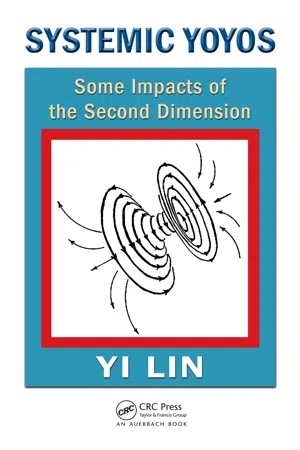 eBook - PDF
Systemic Yoyos
Some Impacts of the Second Dimension
- Yi Lin(Author)
- 2008(Publication Date)
- Auerbach Publications(Publisher)
More specifically, after introducing the new figurative analysis method, we will have a chance to generalize all three laws of motion so that external forces are no longer required for these laws to work. As what is known, these laws are one of the reasons why physics is an exact science. It can be expected that these generalized forms of the laws will be equally applicable to social sciences and humanity areas as their classic forms in natural science. To this end, please consult the remaining chapters in this book. The presentations in this chapter and the following two chapters are based on Lin (2007). 4.1 The Second Stir and Newton’s First Law of Motion Newton’s first law says that an object will continue in its state of motion unless compelled to change by a force impressed upon it. This property of objects, their natural resistance to changes in their state of motion, is called inertia. Based on the theory of blown-ups, one has to address two questions not settled by Newton in his first law: Question 4.1. If a force truly impresses on the object, the force must be from outside of the object. Then, where can such a force be from? Question 4.2. This problem is about the so-called natural resistance of objects to changes in their state of motion. Specifically, how can such a resistance be considered natural? Newton’s Laws of Motion n 53 It is because uneven densities of materials create twisting forces that fields of spinning currents are naturally formed. This end provides an answer and explana-tion to Question 4.1. Based on the yoyo model (Figure 1.1), the said external force comes from the spin field of the yoyo structure of another object, which is a level higher than the object of our concern. The forces from this new spin field push the object of concern away from its original spin field into a new spin field. If there were not such a forced traveling, the said object would continue its original movement in its original spin field. eBook - PDF
- John D. Cutnell, Kenneth W. Johnson, David Young, Shane Stadler(Authors)
- 2018(Publication Date)
- Wiley(Publisher)
Newton’s laws of motion apply whether or not an object is in equilibrium. For an object in equilibrium the acceleration is zero ( a → = 0 m /s 2 ) in Newton’s second law, and the present section presents several examples of this type. In the nonequilibrium case the acceleration of the object is not zero ( a → ≠ 0 m /s 2 ) in the second law, and Section 4.12 deals with these kinds of situations. Since the acceleration is zero for an object in equilibrium, all of the acceleration components are also zero. In two dimensions, this means that a x = 0 m/s 2 and a y = 0 m/s 2 . Substituting these values into the second law (∑F x = ma x and ∑F y = ma y ) shows that the x component and the y component of the net force must each be zero. In other words, the forces acting on an object in equilibrium must balance. Thus, in two dimensions, the equilibrium condition is expressed by two equations: Σ F x = 0 (4.9a) Σ F y = 0 (4.9b) *If a rope is not accelerating, a → is zero in the second law, and ΣF → = ma → = 0, regardless of the mass of the rope. Then, the rope can be ignored, no matter what mass it has. †In this discussion of equilibrium we ignore rotational motion, which is discussed in Chapters 8 and 9. In Section 9.2 a more complete treatment of the equilibrium of a rigid object is presented and takes into account the concept of torque and the fact that objects can rotate. T –T FIGURE 4.26 The force T → applied at one end of a massless rope is transmitted undiminished to the other end, even when the rope bends around a pulley, provided the pulley is also massless and friction is absent. 4.11 Equilibrium Applications of Newton’s Laws of Motion 103 In using Equations 4.9a and 4.9b to solve equilibrium problems, we will use the following five-step reasoning strategy: REASONING STRATEGY Analyzing Equilibrium Situations 1. Select the object (often called the “system”) to which Equations 4.9a and 4.9b are to be applied.
Index pages curate the most relevant extracts from our library of academic textbooks. They’ve been created using an in-house natural language model (NLM), each adding context and meaning to key research topics.

