Mathematics

Prime Numbers
Prime numbers are natural numbers greater than 1 that have no positive divisors other than 1 and themselves. They play a fundamental role in number theory and are the building blocks for all other numbers. Prime numbers have applications in cryptography, computer science, and various fields of mathematics.
Written by Perlego with AI-assistance
Related key terms
1 of 5
11 Key excerpts on "Prime Numbers"
 No longer available |Learn more
- (Author)
- 2014(Publication Date)
- Research World(Publisher)
________________________ WORLD TECHNOLOGIES ________________________ Chapter-1 Introduction to Prime Numbers A prime number (or a prime ) is a natural number that has exactly two distinct natural number divisors: 1 and itself. The smallest twenty-five Prime Numbers (all the Prime Numbers under 100) are: 2, 3, 5, 7, 11, 13, 17, 19, 23, 29, 31, 37, 41, 43, 47, 53, 59, 61, 67, 71, 73, 79, 83, 89, 97 (sequence A000040 in OEIS). An infinitude of Prime Numbers exists, as demonstrated by Euclid around 300 BC, although the density of Prime Numbers within natural numbers is 0. The number 1 is by definition not prime. The fundamental theorem of arithmetic establishes the central role of primes in number theory: any positive integer n can be factored into primes, written as a product of primes or powers of different primes (including the empty product of factors for 1). Moreover, this factorization is unique except for a possible reordering of the factors. The property of being prime is called primality . Verifying the primality of a given number n can be done by trial division. The simplest trial division method tests whether n is a multiple of an integer m between 2 and √ n . If n is a multiple of any of these integers then it is a composite number, and so not prime; if it is not a multiple of any of these integers then it is prime. As this method requires up to √ n trial divisions, it is only suitable for relatively small values of n . More sophisticated algorithms, which are much more efficient than trial division, have been devised to test the primality of large numbers. There is no known useful formula that yields all of the Prime Numbers and no composites. However, the distribution of primes, that is to say, the statistical behaviour of primes in the large can be modeled.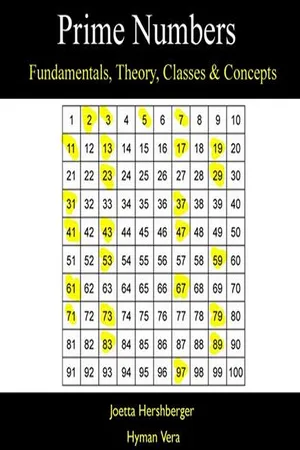 No longer available |Learn more
Prime Numbers
Fundamentals, Theory, Classes & Concepts
- (Author)
- 2014(Publication Date)
- Library Press(Publisher)
________________________ WORLD TECHNOLOGIES ________________________ Chapter 1 Introduction to Prime Numbers A prime number (or a prime ) is a natural number that has exactly two distinct natural number divisors: 1 and itself. The smallest twenty-five Prime Numbers (all the Prime Numbers under 100) are: 2, 3, 5, 7, 11, 13, 17, 19, 23, 29, 31, 37, 41, 43, 47, 53, 59, 61, 67, 71, 73, 79, 83, 89, 97 (sequence A000040 in OEIS). An infinitude of Prime Numbers exists, as demonstrated by Euclid around 300 BC, although the density of Prime Numbers within natural numbers is 0. The number 1 is by definition not prime. The fundamental theorem of arithmetic establishes the central role of primes in number theory: any positive integer n can be factored into primes, written as a product of primes or powers of different primes (including the empty product of factors for 1). Moreover, this factorization is unique except for a possible reordering of the factors. The property of being prime is called primality . Verifying the primality of a given number n can be done by trial division. The simplest trial division method tests whether n is a multiple of an integer m between 2 and √ n . If n is a multiple of any of these integers then it is a composite number, and so not prime; if it is not a multiple of any of these integers then it is prime. As this method requires up to √ n trial divisions, it is only suitable for relatively small values of n . More sophisticated algorithms, which are much more efficient than trial division, have been devised to test the primality of large numbers. There is no known useful formula that yields all of the Prime Numbers and no composites. However, the distribution of primes, that is to say, the statistical behaviour of primes in the large can be modeled. eBook - PDF
Number, Shape, & Symmetry
An Introduction to Number Theory, Geometry, and Group Theory
- Diane L. Herrmann, Paul J. Sally Jr.(Authors)
- 2012(Publication Date)
- A K Peters/CRC Press(Publisher)
. . . . . 3 Divisibility and Primes One of the earliest concepts that comes up when people discuss numbers is the idea of a prime number. Usually, if students are asked to describe what a prime number is, the definition comes out as: “A prime is a number that can only be divided by itself and 1.” Since this will be an important definition, let’s take some time to be sure the formal definition is completely precise. In fact, before we can define a prime number, we have to decide what we mean by “divided by.” 3.1 Divisibility When we first talk about division in the integers, we usually mean “divides evenly.” That means we can divide a number into several equal parts with nothing left over. For example, we can agree that 7 divides 21, but does not divide 23. Definition. Start with two integers a and b . We say that a divides b if there is an integer k so that ak = b . We will write this as a | b . Example. We claimed 7 divides 21. How does this fit the definition? Here, a = 7 and b = 21 . What is the integer k for the definition? Simple arithmetic shows that if k = 3, then 7 · 3 = 21. Also, since we cannot find an integer k so that 7 k = 23, we can say that 7 does not divide 23. Example. What about 0? In order for 0 | n to be true, we would need an integer k so that 0 · k = n . Since 0 · k is 0 for every possible k , the only integer that 0 divides is 0 itself. Practice Problem 3.1. Which integers divide 0 ? 67 68 3 . Divisibility and Primes If a divides b , we call a a factor , or a divisor , of b . What are the other factors of 21? From elementary arithmetic, we would come up with a short list of the numbers 1, 3, 7, and 21. These are all the positive divisors of 21. Are there any negative divisors? Yes, in fact, -1, -3, -7, and -21 are also divisors of 21. Let’s check one of them. Example. Let’s show that -3 divides 21. Here, a = -3 and b = 21. What integer k makes the equation -3 k = 21 true? If k = -7, we know that ( -3)( -7) = 21 . eBook - PDF
- Daniel E. Flath(Author)
- 2018(Publication Date)
- American Mathematical Society(Publisher)
CHAPTER 1 Prime Numbers and Unique Factorization 1. Introduction All introductions to number theory since Gauss’s greatest Disquisitiones Arith - meticae (1801) have begun the same way, with the aptly named Fundamental Theorem of Arithmetic. What better place to start? Theorem 1.1. Fundamental Theorem of Arithmetic. Every integer greater than 1 can be expressed as a product of Prime Numbers in one and only one way. Thus he who would know the integers well must study the primes. The first question to ask is just how many primes are there? We shall soon see that there are infinitely many primes, so we had better refine the question. We will prove Theorem 1.2. Chebyshev. For x > 2, the number of primes that are less than x is between (l/10)(jc/log x) and 10(x/log x). That is, to within an order of magnitude there are x/log x primes less than x. We prove Theorem 1.1 in Section 3. The proof will depend upon properties of greatest common divisors that we will use again and again. A first applica-tion to linear Diophantine equations is the subject of Section 4. There is a preliminary discussion of the distribution of primes in Section 2. A proof of Theorem 1.2 is presented in Section 5. 1 2 Prime Numbers AND UNIQUE FACTORIZATION 2. Prime Numbers Divisibility is without a doubt the most important concept in number theory. Definition. A nonzero integer b is said to divide a e Z (written ba) iff there exists c g Z such that a = be. We say then that b is a divisor of a. Definition. A positive integer n is prime iff n > 1 and there is no factorization n = ab with positive integers a, b < n. A positive integer n is composite iff n > 1 and n is not prime. Note that a positive integer greater than 1 is prime if and only if its only positive divisors are itself and 1. Every positive integer can be constructed from Prime Numbers by multipli-cation. This fact, the first theorem in the subject of number theory, is the source of our interest in primes. eBook - PDF
Number Theory and Geometry
An Introduction to Arithmetic Geometry
- Alvaro Lozano-Robledo(Author)
- 2019(Publication Date)
- American Mathematical Society(Publisher)
Recall that we have defined a prime number as a natural number with exactly two positive divisors. The first few Prime Numbers are 2 , 3 , 5 , 7 , 11 , 13 , 17 , 19 , 23 , 29 , 31 , 37 , . . . . From the definition of prime, we immediately deduce an algorithm to check whether a number n is prime: A number n > 1 is prime if and only if n is not divisible by any number between 1 and n − 1 . This algorithm can be improved by noticing that every number n is divisible by at least one prime number (this was shown in Example 2.3.13). Thus, if n is not prime, then n has a positive divisor d = 1 , n , and d itself has a prime divisor p . It follows that n has a prime divisor p = 1 , n . Hence: A number n > 1 is prime if and only if n is not divisible by any prime number between 1 and n − 1 . Furthermore, if n is composite, then it has a prime divisor p ≤ √ n (this is Exercise 3.5.2). Hence, we have shown the following criterion for primality. Theorem 3.0.1. A number n > 1 is prime if and only if n is not divisible by any prime number between 1 and √ n . 61 62 3. The Prime Numbers Figure 3.1. Eratosthenes of Cyrene (c. 276 BC – c. 194 BC). Image source: Wikimedia Commons. Example 3.0.2. Let us show that 97 is a prime number. Suppose for a contra-diction that 97 is composite. Then, it has a prime divisor p ≤ √ 97 ≤ √ 100 = 10 . Hence, 97 is divisible by 2 , 3 , 5 , or 7 . However, 97 = 2 · 48 + 1 = 3 · 32 + 1 = 5 · 19 + 2 = 7 · 13 + 6 . It follows that the remainder when dividing 97 by 2 , 3 , 5 , or 7 , respectively, is 1 , 1 , 2 , or 6 . Hence, 97 is not divisible by 2 , 3 , 5 , or 7 , and it must be prime. In the next section we discuss a method (due to Eratosthenes of Cyrene; see Figure 3.1) to list all the Prime Numbers below a bound N . 3.1. The Sieve of Eratosthenes The following algorithm is named after Eratosthenes, an ancient Greek mathemati-cian (and also a geographer, poet, astronomer, and music theorist). eBook - PDF
The Higher Arithmetic
An Introduction to the Theory of Numbers
- H. Davenport(Author)
- 2008(Publication Date)
- Cambridge University Press(Publisher)
These considerations extend easily to more than two numbers. But then it is important to note the two kinds of relative primality that are possible. Several numbers are said to be relatively prime if there is no number greater than 1 which divides all of them; they are said to be relatively prime in pairs if no two of them have a common factor greater than 1. The condition for the former is that there shall be no one prime occurring in all the numbers, and for the latter it is that there shall be no prime that occurs in any two of the numbers. There are several simple theorems on divisibility which one is inclined to think of as obvious, but which are in fact only obvious in the light of the uniqueness of factorization into primes. For example, if a number divides the product of two numbers and is relatively prime to one of them it must divide the other. If a divides bc and is relatively prime to b, the prime 16 The Higher Arithmetic factorization of a is contained in that of bc but has nothing in common with that of b, and is therefore contained in that of c. 6. Euclid’s algorithm In Prop. 2 of Book VII, Euclid gave a systematic process, or algorithm, for finding the highest common factor of two given numbers. This algorithm provides a different approach to questions of divisibility from that adopted in the last two sections, and we therefore begin again without assuming anything except the mere definition of divisibility. Let a and b be two given natural numbers, and suppose that a > b. We propose to investigate the common divisors of a and b. If a is divisible by b, then the common divisors of a and b consist simply of all divisors of b, and there is no more to be said. If a is not divisible by b, we can express a as a multiple of b together with a remainder less than b, that is a = qb + c, where c < b. eBook - PDF
- Karl Smith(Author)
- 2016(Publication Date)
- Cengage Learning EMEA(Publisher)
14444444244444443 This is the sum of the digits. Copyright 2017 Cengage Learning. All Rights Reserved. May not be copied, scanned, or duplicated, in whole or in part. Due to electronic rights, some third party content may be suppressed from the eBook and/or eChapter(s). Editorial review has deemed that any suppressed content does not materially affect the overall learning experience. Cengage Learning reserves the right to remove additional content at any time if subsequent rights restrictions require it. Section 5.2 Prime Numbers 185 Finding Primes Since every natural number greater than 1 has at least two divisors, can any number have more than two? Checking: 2 has exactly two divisors: 1, 2 3 has exactly two divisors: 1, 3 4 has more than two divisors: 1, 2, and 4 Thus, some numbers (such as 2 and 3) have exactly two divisors, and some (such as 4 and 6) have more than two divisors. Do any natural numbers have fewer than two divisors? We now state a definition that classifies each natural number according to the number of divisors it has. We see that 2 is prime, 3 is prime, 4 is composite (since it is divisible by three natural numbers), 5 is prime, and 6 is composite (since it is divisible by 1, 2, 3, and 6). Note that every natural number greater than 1 is either prime or composite. The number 1 is neither prime nor composite. One method for finding primes smaller than some given number was first used by a Greek mathematician, Eratosthenes, more than 2,000 years ago. The technique is known as the sieve of Eratosthenes. Suppose we wish to find the primes less than 100. We prepare a table of natural numbers 1–100 using the following procedure. No longer available |Learn more
- Sergei Abramovich(Author)
- 2006(Publication Date)
- Information Age Publishing(Publisher)
Topics in Mathematics for Elementary Teachers, pages 91–112 Copyright © 2010 by Information Age Publishing All rights of reproduction in any form reserved. 91 CHAPTER 6 DIVISIBILITY AND Prime Numbers The elementary theory of numbers should be one of the very best subjects for early mathematical instruction. It demands very little previous knowledge, its subject matter is tangible and familiar; the processes of reasoning which it employs are simple, general and few, and it is unique among the mathematical sciences in its appeal to natural human curiosity. —G. H. Hardy (1929, p. 818) 1. INTRODUCTION Several topics listed in the Algebra standard of the Principles and Standards for School Mathematics belong to number theory. A reference to one such topic is an expectation that “upper elementary students [can] conjecture that the sum of the first n odd numbers is n 2 ” (National Council of Teach- ers of Mathematics, 2000, p. 39). Once the students have a conjecture, they might be wondering whether it is true or not. This implies that in order to be able to “appreciate and nurture the creative suggestions of talented stu- dents” (Conference Board of the Mathematical Sciences, 2001, p. 13), the teachers should have experience with mathematics that goes beyond one’s informal conjecturing. 92 Topics in Mathematics for Elementary Teachers Number theory is a natural extension of arithmetic in which properties of numbers discovered through operations on them are put in a theoretical perspective. That is why number theory provides many opportunities for fostering teachers’ mathematical experience. Many properties of numbers were already discussed in Chapter 4 in connection with the multiplication table. eBook - PDF
- Owen Bishop(Author)
- 2013(Publication Date)
- Newnes(Publisher)
The gaps are actually narrower than shown, and there are many more of them. Real numbers comprise the rational numbers and the irrational numbers. Irrational numbers are numbers that are written as non-recurring, non-terminating decimals. The sequence of digits after the decimal point continues indefinitely without ever repeating. Examples of irrational numbers include ABOUT NUMBERS 5 V2, π, e, 5.343 343 334 . . . , and many others. These numbers fill up the remaining gaps in the number line. Two important constants π pi, the ratio of the circumference of a circle to its diameter, value = 3.1416 (to four decimal places). e the exponential constant, value = 2.7183 (to four decimal places). Useful for expressing rates of increase or decrease (page 59), and as the base of natural logarithms (page 26). Imaginary numbers are explained on page 240. They do not appear on the number line of Figure 1.1. We use imaginary numbers in several branches of electronic theory, for example, when studying alternating signals. Factors An integer which divides exactly into another integer is called a factor of that integer. For example, 6 is a factor of 18, because it divides into 18 exactly 3 times, with no remainder. The complete list of factors of 18 is: 1, 2, 3, 6, 9, and 18 The list of factors of an integer always includes 1 and the integer itself. Some integers have only 1 and themselves as factors. Such integers are called Prime Numbers. Prime Numbers The first twenty Prime Numbers are: 2, 3, 5, 7, 11, 13, 17, 19, 23, 29, 31, 37, 41, 43, 47, 53, 59, 61, 67 and 71. We find the prime factors of an integer (or factorize it) by following the routine set out in the box. Example Factorize 84, listing (a) the prime factors and (b) all factors, (a) Finding the prime factors. eBook - PDF
A Mathematical Bridge
An Intuitive Journey in Higher Mathematics
- Stephen Hewson(Author)
- 2009(Publication Date)
- WSPC(Publisher)
If we write v 1 ...v n = V then we see that aU + ( b 1 ··· b n ) V = 1 This proves that a must also be coprime to b 1 ··· b n . square Proof of 2: Suppose that ab/p is a natural number for a pair a,b of natural numbers and a prime number p . Suppose also that p does not divide exactly into a . Since p is a prime number this means that a and p are coprime: we can therefore use Bezout’s lemma to find integers u and v such that au + pv = 1. This enables us to write b = b × 1 = b ( au + pv ) = ( ab ) u + bpv Dividing through by p gives us b/p = ( ab/p ) u + bv 28 In more advanced number theory this is used as the definition of primality. Numbers 113 Now, since p divides into ab , the right-hand side of this equation is a whole number. Therefore the left-hand side is also a whole number, which means that p must divide exactly into b . square We can make use of these results to conclude this section with a proof of the fundamental theorem of arithmetic with which we opened the dis-cussion of Prime Numbers: each natural number has an essentially unique factorisation into prime factors. This is the main result in the theory of Prime Numbers. Proof: To prove this result we must first show that each natural number greater than 1 has at least one prime factorisation. We can then move on to address the question of uniqueness. Suppose that there is a natural number which does not possess a prime number factorisation. Then there must certainly be a smallest natural num-ber n which could not be written as a product of Prime Numbers. Clearly n must be the product of at least two smaller factors greater than 1, otherwise it would itself be prime. But each of these smaller factors must be express-ible as a product of Prime Numbers because we assumed that n was the smallest number which did not have a prime factorisation. Consequently the product of the factors of n is also a product of Prime Numbers. eBook - PDF
- J. F. Humphreys, M. Y. Prest(Authors)
- 2004(Publication Date)
- Cambridge University Press(Publisher)
1 Number theory This chapter is concerned with the properties of the set of integers { . . . , − 2 , − 1 , 0 , 1 , 2 , . . . } under the arithmetic operations of addition and mul-tiplication. We shall usually denote the set of integers by Z . We shall assume that you are acquainted with the elementary arithmetical properties of the in-tegers. By the end of this chapter you should be able to solve the following problems. 1. What are the last two digits of 3 1000 ? 2. Can every integer be written as an integral linear combination of 197 and 63? 3. Show that there are no integers x such that x 5 − 3 x 2 + 2 x − 1 = 0. 4. Find the smallest number which when divided by 3 leaves 2, by 5 leaves 3 and by 7 leaves 2. (This problem appears in S ¯ un tz ˘ i su` an j ¯ ing ( Master Sun’s Arithmetical Manual ) which was written around the fourth century.) 5. How may a code be constructed which allows anyone to encode messages and send them over public channels, yet only the intended recipient is able to decode the messages? 1.1 The division algorithm and greatest common divisors We will assume that the reader is acquainted with the elementary properties of the order relation ‘ ≤ ’ on the set Z . This is the relation ‘less than or equal to’ which allows us to compare any two integers. Recall that, for example, − 100 ≤ 2 and 3 ≤ 3. The following property of the set P = { 1 , 2 , . . . } of positive integers is important enough to warrant a special name. 1 2 Number theory Well-ordering principle Any non-empty set, X , of positive integers has a smallest element (meaning an element which is less than or equal to every member of the set X ). You are no doubt already aware of this principle. Indeed you may wonder why we feel it necessary to state the principle at all, since it is so ‘obvious’. It is, however, as you will see, a key ingredient in many proofs in this chapter. An equivalent statement is that one cannot have an unending, strictly decreasing, sequence of positive integers.
Index pages curate the most relevant extracts from our library of academic textbooks. They’ve been created using an in-house natural language model (NLM), each adding context and meaning to key research topics.

