Mathematics

Trigonometric Functions
Trigonometric functions are mathematical functions that relate the angles of a right-angled triangle to the lengths of its sides. The main trigonometric functions include sine, cosine, and tangent, which are used to calculate the relationships between angles and sides in trigonometry. These functions are fundamental in various fields such as physics, engineering, and navigation.
Written by Perlego with AI-assistance
Related key terms
1 of 5

11 Key excerpts on "Trigonometric Functions"
 eBook - PDF
- Mary Jane Sterling(Author)
- 2023(Publication Date)
- For Dummies(Publisher)
2 Trigonometric Functions IN THIS PART . . . Define the basic trig functions using the lengths of the sides of a right triangle. Determine the relationships between the trig cofunctions and their shared sides. Extend your scope to angles greater than 90 degrees using the unit circle. Investigate the ins and outs of the domains and ranges of the six trig functions. Use reference angles to compute trig functions. Apply trig functions to real-world problems. CHAPTER 6 Describing Trig Functions 91 Chapter 6 Describing Trig Functions B y taking the lengths of the sides of right triangles or the chords of circles and creating ratios with those numbers and variables, our ancestors initi- ated the birth of Trigonometric Functions. These functions are of infinite value, because they allow you to use the stars to navigate and to build bridges that won’t fall. If you’re not into navigating a boat or engineering, then you can use the trig functions at home to plan that new addition. And they’re a staple for students going into calculus. You may be asking, “What is a function? What does it have to do with trigonom- etry?” In mathematics, a function is a mechanism that takes a value you input into it and churns out an answer, called the output. A function is connected to rules involving mathematical operations or processes. The six trig functions require one thing of you — inputting an angle measure — and then they output a number. These outputs are always real numbers, from infinitely small to infinitely large and everything in between. The results you get depend on which function you use. Although in earlier times, some of the function computations were rather tedious, today’s hand-held calculators, and even phones, make everything much easier. IN THIS CHAPTER » Understanding the three basic trig functions » Building on the basics: The reciprocal functions » Recognizing the angles that give the cleanest trig results » Determining the exact values of functions eBook - PDF
- Cynthia Y. Young(Author)
- 2021(Publication Date)
- Wiley(Publisher)
Chapter 6 Review 657 Section Concept Key Ideas/Formulas 6.2 Definition 1 of Trigonometric Functions: Right triangle ratios Definition 1 defines Trigonometric Functions of acute angles as ratios of sides in a right triangle. Trigonometric Functions: Right triangle ratios SOH sin θ = opposite _ hypotenuse CAH cos θ = adjacent _ hypotenuse TOA tan θ = opposite _ adjacent b a θ c Adjacent Opposite Hypotenuse Reciprocal identities cot θ = 1 _____ tan θ csc θ = 1 _____ sin θ sec θ = 1 _____ cos θ Cofunctions If α + β = 90°, then: sin α = cos β sec α = csc β tan α = cot β Evaluating Trigonometric Functions exactly for special angle measures: 30°, 45°, and 60° The other Trigonometric Functions can be found for these values using tan θ = sin θ _ cos θ and reciprocal identities. Using calculators to evaluate (approximate) Trigonometric Functions Make sure the calculator is in degree mode. The sin, cos, and tan buttons can be combined with the reciprocal button, 1/x to get csc, sec, and cot. 6.3 Solving Right Triangles Solving a right triangle given the measure of an acute angle and a side length • The third angle measure can be found exactly using α + β + γ = 180°. • Right triangle trigonometry is used to find the lengths of the remaining side. Solving a right triangle given the lengths of two sides • The length of the third side can be found using the Pythagorean theorem. • The measures of the acute angles can be found using right triangle trigonometry. sin cos 30° 1 _ 2 √ _ 3 _ 2 45° √ _ 2 _ 2 √ _ 2 _ 2 60° √ _ 3 _ 2 1 _ 2 658 CHAPTER 6 Trigonometric Functions Section Concept Key Ideas/Formulas 6.4 Definition 2 of Trigonometric Functions: Cartesian plane Angles in standard position An angle is said to be in standard position if its initial side is along the positive x-axis and its vertex is at the origin. eBook - PDF
- Cynthia Y. Young(Author)
- 2023(Publication Date)
- Wiley(Publisher)
4.3.1 Conceptual Understand that right triangle definitions of Trigonometric Functions for acute angles are consistent with definitions of Trigonometric Functions for all angles in the Cartesian plane. To define the Trigonometric Functions in the Cartesian plane, let us start with an acute angle θ in standard position. Choose any point (x, y) on the terminal side of the angle as long as it is 388 CHAPTER 4 Trigonometric Functions of Angles not the vertex (the origin). A right triangle can be drawn so that the right angle is made when a perpendicular segment connects the point (x, y) to the x-axis. Notice that the side opposite θ has length y and the other leg of the right triangle has length x. Words Math The distance r from the origin (0, 0) to the point (x, y) can be found using r = √ _______________ (x − 0) 2 + ( y − 0) 2 r = √ _ x 2 + y 2 the distance formula. Since r is a distance, it is always positive. r > 0 Using our first definition of Trigonometric Functions in terms of right triangle ratios (Section 4.2), we say that sin θ = opposite _________ hypotenuse . From this picture we see that the sine function can also be defined by the relation sin θ = y _ r . Similar reasoning holds for all six Trigonometric Functions and leads us to the second definition of the Trigonometric Functions, in terms of ratios of coordinates and distances in the Cartesian plane. (x, y) θ x y (x, y) θ x y r x y (x, y) θ x y r x y Let (x, y) be any point, other than the origin, on the terminal side of an angle θ in standard position. Let r be the distance from the point (x, y) to the origin; then the six Trigonometric Functions are defined as sin θ = y _ r cos θ = x _ r tan θ = y _ x (x ≠ 0) csc θ = r _ y ( y ≠ 0) sec θ = r _ x (x ≠ 0) cot θ = x _ y ( y ≠ 0) where r = √ _ x 2 + y 2 , or x 2 + y 2 = r 2 . eBook - PDF
- Sheldon Axler(Author)
- 2011(Publication Date)
- Wiley(Publisher)
542 chapter 9 Trigonometric Functions 9.4 More Trigonometric Functions learning objectives By the end of this section you should be able to evaluate the tangent of any multiple of 30 ◦ or 45 ◦ ( π 6 radians or π 4 radians); find the equation of the line making a given angle with the positive horizontal axis and containing a given point; sketch a radius of the unit circle corresponding to a given value of the tangent function; compute cos θ, sin θ, and tan θ if given just one of these quantities and the location of the corresponding radius; evaluate sec θ, csc θ, and cot θ as 1 divided by the value of one of the other Trigonometric Functions. Section 9.3 introduced the cosine and the sine, the two most important Trigonometric Functions. This section introduces the tangent, another key trigonometric function, along with three more Trigonometric Functions. Definition of Tangent Recall that cos θ and sin θ are defined to be the first and second coordinates of the endpoint of the radius of the unit circle corresponding to θ. The ratio of these two numbers, with the cosine in the denominator, turns out to be sufficiently useful to deserve its own name. Tangent The tangent of an angle θ, denoted tan θ, is defined by tan θ = sin θ cos θ provided that cos θ = 0. The radius of the unit circle corresponding to θ has its initial point at (0, 0) and its endpoint at (cos θ, sin θ). Thus the slope of this line segment Recall that the slope of the line segment connecting (x 1 , y 1 ) and (x 2 , y 2 ) is y 2 -y 1 x 2 -x 1 . equals sin θ-0 cos θ-0 , which equals sin θ cos θ , which equals tan θ. In other words, we have the following interpretation of the tangent of an angle: Tangent as slope tan θ is the slope of the radius of the unit circle corresponding to θ. The following figure illustrates how the cosine, sine, and tangent of an angle are defined: section 9.4 More Trigonometric Functions 543 Θ cos Θ, sin Θ slope tan Θ 1 The radius corresponding to θ has slope tan θ.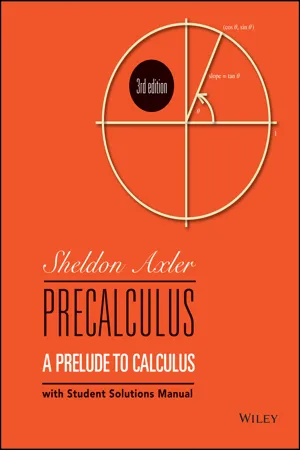 eBook - PDF
Precalculus
A Prelude to Calculus
- Sheldon Axler(Author)
- 2016(Publication Date)
- Wiley(Publisher)
Three more Trigonometric Functions are sometimes used. These functions are simply the mul- tiplicative inverses of the functions we have already defined. Here are the formal definitions. The secant, cosecant, and cotangent functions do not exist in France, in the sense that students there do not learn about these functions. Secant The secant of an angle θ, denoted sec θ, is defined by sec θ = 1 cos θ . Cosecant The cosecant of an angle θ, denoted csc θ, is defined by csc θ = 1 sin θ . Cotangent The cotangent of an angle θ, denoted cot θ, is defined by cot θ = cos θ sin θ . In all three of these definitions, the function is not defined for values of θ that would result in a division by 0. For example, the cosecant function is not defined at integer multiples of π. Because the cotangent is defined to be the cosine divided by the sine and the tangent is defined to be the sine divided by the cosine, we have the following consequence of the definitions. Tangent and cotangent are multiplicative inverses. If θ is an angle such that both tan θ and cot θ are defined, then cot θ = 1 tan θ . Many books place too much emphasis on the secant, cosecant, and cotangent. You The scientific calculator on an iPhone (obtained by rotating the standard calculator sideways) has buttons for cos, sin, and tan but omits buttons for sec, csc, and cot. will rarely need to know anything about these functions beyond their definitions. Whenever you do encounter one of these functions, simply replace it by its definition in terms of cosine, sine, and tangent and then use your knowledge of those more familiar functions. By concentrating on cosine, sine, and tangent rather than all six Trigonometric Functions, you will attain a better understanding with less clutter in your mind. 322 Chapter 4 Trigonometric Functions Example 5 (a) Evaluate sec 60 ◦ . eBook - PDF
- Ron Larson(Author)
- 2021(Publication Date)
- Cengage Learning EMEA(Publisher)
Hypotenuse θ Side adjacent to θ Side opposite θ Using the lengths of these three sides, you can form six ratios that define the six Trigonometric Functions of the acute angle θ . sine cosecant cosine secant tangent cotangent In the definitions below, 0° < θ < 90° (θ lies in the first quadrant). For such angles, the value of each trigonometric function is positive. Right triangle trigonometry has many real-life applications. For example, in Exercise 70 on page 287, you will use right triangle trigonometry to analyze the height of a helium-filled balloon. Right Triangle Definitions of Trigonometric Functions Let θ be an acute angle of a right triangle. The six Trigonometric Functions of the angle θ are defined below. (Note that the functions in the second row are the reciprocals of the corresponding functions in the first row.) sin θ = opp hyp cos θ = adj hyp tan θ = opp adj csc θ = hyp opp sec θ = hyp adj cot θ = adj opp The abbreviations opp, adj, and hyp represent the lengths of the three sides of a right triangle. opp = the length of the side opposite θ adj = the length of the side adjacent to θ hyp = the length of the hypotenuse Georg Joachim Rheticus (1514–1576) was the leading Teutonic mathematical astronomer of the sixteenth century. He was the first to define the Trigonometric Functions as ratios of the sides of a right triangle. HISTORICAL NOTE © Scott Cornell/Shutterstock.com Copyright 2022 Cengage Learning. All Rights Reserved. May not be copied, scanned, or duplicated, in whole or in part. Due to electronic rights, some third party content may be suppressed from the eBook and/or eChapter(s). Editorial review has deemed that any suppressed content does not materially affect the overall learning experience. Cengage Learning reserves the right to remove additional content at any time if subsequent rights restrictions require it. eBook - PDF
- Geoffrey Berresford, Andrew Rockett(Authors)
- 2015(Publication Date)
- Cengage Learning EMEA(Publisher)
Trigonometric Functions 8 © SFC/Shutterstock.com What You’ll Explore Many quantities, from sound waves to seasonal temperatures, behave in a cyclic fashion, repeating their values over time. In this chapter you will use trigonomet-ric functions to model cyclic behaviour, predicting daily temperatures and sea-sonal profits. You will use derivatives to find rates of income growth, and integrals to give cumulative sales. Along the way, you will find the best angle for hitting a home run, shooting a basket, or kicking a fieldgoal. 8.1 Triangles, Angles, and Radian Measure 8.2 Sine and Cosine Functions 8.3 Derivatives of Sine and Cosine Functions 8.4 Integrals of Sine and Cosine Functions 8.5 Other Trigonometric Functions Copyright 2016 Cengage Learning. All Rights Reserved. May not be copied, scanned, or duplicated, in whole or in part. Due to electronic rights, some third party content may be suppressed from the eBook and/or eChapter(s). Editorial review has deemed that any suppressed content does not materially affect the overall learning experience. Cengage Learning reserves the right to remove additional content at any time if subsequent rights restrictions require it. APPLICATION PREVIEW Tones, Temperature, and Trigonometry This chapter introduces the sine and cosine functions, “wavy” curves that repeat themselves at regular intervals. Such functions have many applications. For example, musical sounds are caused by vibrations in the air, which can be picked up by a microphone and displayed on an oscilloscope. The following graph shows the sound wave from a saxophone playing a G#. This curve can be expressed as the sum of modified sine and cosine curves.* Saxophone G# The next graph shows the daily temperature range in New York City for the years 2012 and 2013 (the very jagged line), and the normal daily high and low temperatures (the smoother curves), which may be closely approximated by sine and cosine curves. eBook - PDF
Precalculus
Functions and Graphs
- Earl Swokowski, Jeffery Cole(Authors)
- 2018(Publication Date)
- Cengage Learning EMEA(Publisher)
Cengage Learning reserves the right to remove additional content at any time if subsequent rights restrictions require it. SECTION 5.3 Trigonometric Functions of Real Numbers 351 The formulas in this definition express function values in terms of coor-dinates of a point P on a unit circle. For this reason, the trigonometric func-tions are sometimes referred to as the circular functions. EXAMPLE 1 Finding values of the Trigonometric Functions A point P s x , y d on the unit circle U corresponding to a real number t is shown in Figure 4, for p , t , 3 p y 2 . Find the values of the Trigonometric Functions at t. Solution Referring to Figure 4, we see that the coordinates of the point P s x , y d are x 5 2 3 5 , y 5 2 4 5 . Using the definition of the Trigonometric Functions in terms of a unit circle gives us FIGURE 4 y x A (1, 0) P ( H11002 E , H11002 R ) u H11005 t t U Definition of the Trigonometric Functions in Terms of a Unit Circle If t is a real number and P s x , y d is the point on the unit circle U that corresponds to t , then sin t 5 y cos t 5 x tan t 5 y x s if x ± 0 d csc t 5 1 y s if y ± 0 d sec t 5 1 x s if x ± 0 d cot t 5 x y s if y ± 0 d . (continued) sin t 5 y 5 2 4 5 cos t 5 x 5 2 3 5 tan t 5 y x 5 2 4 5 2 3 5 5 4 3 csc t 5 1 y 5 1 2 4 5 5 2 5 4 sec t 5 1 x 5 1 2 3 5 5 2 5 3 cot t 5 x y 5 2 3 5 2 4 5 5 3 4 . ■ EXAMPLE 2 Finding a point on U relative to a given point Let P s t d denote the point on the unit circle U that corresponds to t for 0 # t , 2 p . If P s t d 5 s 4 5 , 3 5 d , find (a) P s t 1 p d (b) P s t 2 p d (c) P s 2 t d Solution (a) The point P s t d on U is plotted in Figure 5(a), where we have also shown the arc AP of length t . To find P s t 1 p d , we travel a distance p in the coun-terclockwise direction along U from P s t d , as indicated by the blue arc in the figure. Since p is one-half the circumference of U , this gives us the point P s t 1 p d 5 s 2 4 5 , 2 3 5 d diametrically opposite P s t d . eBook - PDF
Precalculus
Functions and Graphs, Enhanced Edition
- Earl Swokowski, Jeffery Cole(Authors)
- 2016(Publication Date)
- Cengage Learning EMEA(Publisher)
Such functions are the building blocks for calculus. In addition, the unit circle approach is useful for discussing graphs and deriving trigonometric identities. You should work to become proficient in the use of both formulations of the Trigonometric Functions, since each will reinforce the other and thus facilitate your mastery of more advanced aspects of trigonometry. sin 0.01 0.009 999 8 0.01 sin (0.02 0.019 998 7 0.02 sin (0.03 0.029 995 5 0.03 if x 0, then sin x x 1, and so sin x x . x l 0 f x l 1 0, 1 as x l 0 , f x l 1 and as x l 0 , f x l 1. 2 3 2.1 2.1, 2.1 , Y 1 sin x x 0 0 x 0 x l 0 x l 0 f x , f x sin x x f x sin x x E X A M P L E 7 2 , 2 cos x 1 2 FIGURE 22 by 2.1, 2.1 , Copyright 2017 Cengage Learning. All Rights Reserved. May not be copied, scanned, or duplicated, in whole or in part. Due to electronic rights, some third party content may be suppressed from the eBook and/or eChapter(s). Editorial review has deemed that any suppressed content does not materially affect the overall learning experience. Cengage Learning reserves the right to remove additional content at any time if subsequent rights restrictions require it. 5.3 Trigonometric Functions of Real Numbers 363 Exer. 1–4: A point P ( x , y ) is shown on the unit circle U corresponding to a real number t . Find the values of the Trigonometric Functions at t . 1 2 3 4 Exer. 5–8: Let P ( t ) be the point on the unit circle U that corresponds to t . If P ( t ) has the given rectangular coor-dinates, find (a) P ( t ) (b) P ( t ) (c) P ( t ) (d) P ( t ) 5 6 7 8 Exer. 9–16: Let P be the point on the unit circle U that corresponds to t . Find the coordinates of P and the exact values of the Trigonometric Functions of t, whenever possible. eBook - PDF
- David Cohen, Theodore Lee, David Sklar, , David Cohen, Theodore Lee, David Sklar(Authors)
- 2016(Publication Date)
- Cengage Learning EMEA(Publisher)
(Philadelphia: Saunders College Publishing, 1990), pp. 236–237; D. E. Smith, History of Mathematics, Vol. II (New York: Dover Publications, Inc., 1953), pp. 614–622. y x y x y x radians _ radians _π radians π radians 3 2π 3 2π Figure 3 Examples of angles in standard position. Name of Function Abbreviation cosine cos sine sin tangent tan secant sec cosecant csc cotangent cot Copyright 201 Cengage Learning. All Rights Reserved. May not be copied, scanned, or duplicated, in whole or in part. Due to electronic rights, some third party content may be suppressed from the eBook and/or eChapter(s). Editorial review has deemed that any suppressed content does not materially affect the overall learning experience. Cengage Learning reserves the right to remove additional content at any time if subsequent rights restrictions require it. To define the Trigonometric Functions, we begin by placing the angle u in standard position and drawing in the unit circle x 2 y 2 1, as shown in Figure 4. (Recall from Chapter 1 that the equation x 2 y 2 1 represents the circle of radius 1, with center at the origin.) Notice the notation P ( x , y ) in Figure 4; this stands for the point P , with coordinates ( x , y ), where the terminal side of angle u intersects the unit circle. With this notation, we define the six Trigonometric Functions of u as follows. 7.2 Trigonometric Functions of Angles 483 x 2 +y 2 =1 y x P(x, y) ¨ Figure 4 P ( x , y ) denotes the point where the terminal side of angle u intersects the unit circle. Definition Trigonometric Functions of Angles Much of our subsequent work in trigonometry will be devoted to exploring the consequences of these definitions. Two initial observations that will help you in memorizing the definitions are these: 1. cos u is the first coordinate of the point where the terminal side of angle u inter-sects the unit circle; sin u is the second coordinate. (You can remember this by noting that, alphabetically, cosine comes before sine.) 2. eBook - PDF
- Cynthia Y. Young(Author)
- 2017(Publication Date)
- Wiley(Publisher)
We now turn our attention to graphing the other circular functions: tangent, cotangent, secant, and cosecant. We know the graphs of the sine and cosine functions, and we can get the graphs of the other circular functions from the sinusoidal functions. Recall the reciprocal and quotient identities: tan x 5 sin x cos x cot x 5 cos x sin x sec x 5 1 cos x csc x 5 1 sin x Recall that in graphing rational functions, a vertical asymptote corresponds to a denominator equal to zero (as long as the numerator and denominator have no common factors). As you will see in this section, tangent and secant functions have graphs with vertical asymptotes at the x-values where the cosine function is equal to zero, and cotangent and cosecant functions have graphs with vertical asymptotes at the x-values where the sine function is equal to zero. One important difference between the sinusoidal functions, y 5 sin x and y 5 cos x, and the other four Trigonometric Functions 1 y 5 tan x, y 5 sec x, y 5 csc x, and y 5 cot x 2 is that the sinusoidal functions have defined amplitudes, whereas the other four Trigonometric Functions do not (since they are unbounded vertically). The Tangent Function Since the tangent function is a quotient that relies on sine and cosine, let us start with a table of values for the quadrantal angles. SKILLS OBJECTIVES ■ ■ Graph basic tangent, cotangent, secant, and cosecant functions. ■ ■ Graph translated tangent, cotangent, secant, and cosecant functions. CONCEPTUAL OBJECTIVES ■ ■ Understand the relationships between the graphs of cosine and secant functions and the sine and cosecant functions. ■ ■ Understand that graph-shifting techniques for tangent and cotangent are consistent with translations used for sinusoidal functions; but for secant and cosecant functions, we first graph the horizontally translated sinusoidal functions and then we shift up or down depending on the vertical translations.
Index pages curate the most relevant extracts from our library of academic textbooks. They’ve been created using an in-house natural language model (NLM), each adding context and meaning to key research topics.

