Physics

Fermions and Bosons
Fermions and bosons are two categories of elementary particles in quantum physics. Fermions, such as electrons and quarks, obey the Pauli exclusion principle, meaning no two identical fermions can occupy the same quantum state simultaneously. Bosons, like photons and gluons, do not follow this principle and can occupy the same quantum state. This fundamental distinction has important implications for the behavior of matter at the quantum level.
Written by Perlego with AI-assistance
Related key terms
1 of 5
10 Key excerpts on "Fermions and Bosons"
 eBook - PDF
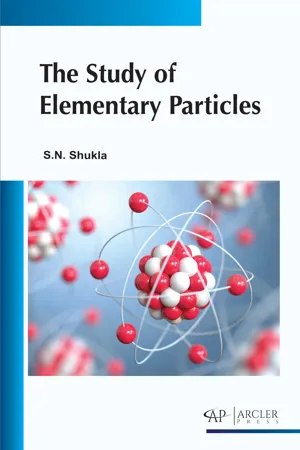
- SachchidaNand Shukla(Author)
- 2023(Publication Date)
- Arcler Press(Publisher)
Some fermions are primary particles, such as electrons, whereas others, such as protons, are composite particles. Particles with integer spin are bosons, while particles with half-integer spin are fermions, per the spin- statistics theorem in relativistic quantum field theory (Figure 2.5). Classification of Elementary Particles 39 Figure 2.5. The spin–statistics theorem in quantum mechanics ties a particle’s intrinsic spin (angular momentum not attributable to orbital motion) to the par- ticle statistics it obeys. All particles that travel in three dimensions have either integer spin or half-integer spin in units of the decreased Planck constant. Source: https://alchetron.com/Spin%E2%80%93statistics-theorem. Fermions have another unique trait in conjunction to their spin: they have preserved baryon or lepton quantum numbers. As a result, what is commonly known as the spin-statistics relationship is actually a spin statistics-quantum number relationship. As a consequence of the Pauli Exclusion Principle, only one fermion can occupy a particular quantum state at a given time. If multiple fermions have the same spatial probability distribution, then at least one property of each fermion, such as its spin, must be different. Fermions are usually associated with matter, whereas bosons are generally force carrier particles, although in the current state of particle physics the distinction between the two concepts is unclear. Weakly interacting fermions can also display bosonic behavior under extreme conditions. At low temperature fermions show superfluidity for uncharged particles and superconductivity for charged particles (Calvo et al., 2016). Composite fermions, such as protons and neutrons, are the key building blocks of everyday matter. The name fermion was coined by English theoretical physicist Paul Dirac from the surname of Italian physicist Enrico Fermi. Quarks and leptons are the two types of elementary fermions recognized by the SM. No longer available |Learn more
- (Author)
- 2014(Publication Date)
- Learning Press(Publisher)
________________________ WORLD TECHNOLOGIES ________________________ Chapter- 4 Fundamental Bosons Boson In particle physics, bosons are subatomic particles that obey Bose–Einstein statistics. Several bosons can occupy the same quantum state. The word boson derives from the name of Satyendra Nath Bose. Bosons contrast with fermions, which obey Fermi–Dirac statistics. Two or more fermions cannot occupy the same quantum state. Since bosons with the same energy can occupy the same place in space, bosons are often force carrier particles. In contrast, fermions are usually associated with matter (although in quantum physics the distinction between the two concepts is not clear cut). Bosons may be either elementary, like photons, or composite, like mesons. Some composite bosons do not satisfy the criteria for Bose-Einstein statistics and are not truly bosons (e.g. helium-4 atoms); a more accurate term for such composite particles would be bosonic-composites. All observed bosons have integer spin, as opposed to fermions, which have half-integer spin. This is in accordance with the spin-statistics theorem which states that in any reasonable relativistic quantum field theory, particles with integer spin are bosons, while particles with half-integer spin are fermions. While most bosons are composite particles, in the Standard Model, there are five bosons which are elementary: • the four gauge bosons (γ · g · W ± · Z); • the Higgs boson (H 0 ). Unlike the gauge bosons, the Higgs boson has not yet been observed experimentally. Composite bosons are important in superfluidity and other applications of Bose–Einstein condensates. ________________________ WORLD TECHNOLOGIES ________________________ Definition and basic properties By definition, bosons are particles which obey Bose–Einstein statistics: when one swaps two bosons, the wavefunction of the system is unchanged. eBook - PDF
Lectures on Quantum Mechanics
A Primer for Mathematicians
- Philip L. Bowers(Author)
- 2020(Publication Date)
- Cambridge University Press(Publisher)
24 Bosons and Fermions This rule of the 180 ◦ phase shift for alternatives involving exchange in identity of electrons is very odd, and its ultimate reason in nature is still only imperfectly understood . . . Such particles are called fermions . . . Particles for which interchange does not alter phase are called bosons . . . All particles are either one or the other, bosons or fermions. These interference properties can have profound and mysterious effects. R.P. Feynman and A.R. Hibbs Quantum Mechanics and Path Integrals, 1965 In Lecture 21 we discovered that the state space of a quantum system composed of two subsystems with respective state spaces H 1 and H 2 is the analytic tensor product H 1 ⊗ H 2 . In this lecture we will refine this picture and try to eliminate redundancies that arise when the two subsystems are indistinguishable. For concreteness, consider a quantum system composed of two particles, the first with state space H 1 and the second with state space H 2 . The most general state vector for the system is a sum of the form ∑ i c i (ϕ i ⊗ χ i ), where each ϕ i ∈ H 1 and χ i ∈ H 2 . This description needs no refinement if the two particles in principle are distinguishable. For example, when one particle is a proton and the other an electron, as in atomic hydrogen, the particles are distinguishable at all times and the proton state space differs in kind from the electron state space. There is no chance for confusion, as the state vector ϕ ∈ H 1 can refer only to the state of, say, the proton, while χ ∈ H 2 can refer only to that of the electron. Consider, though, the case where the two particles are indistinguishable, not only in practice but even in principle. For example, both particles may be electrons in the central potential of a helium atom. As far as anyone can establish, there is no way to label 379 380 Bosons and Fermions the two electrons and keep track of one as “electron no. No longer available |Learn more
- (Author)
- 2014(Publication Date)
- Academic Studio(Publisher)
________________________ WORLD TECHNOLOGIES ________________________ Chapter 4 Fundamental Bosons Boson In particle physics, bosons are subatomic particles that obey Bose–Einstein statistics. Several bosons can occupy the same quantum state. The word boson derives from the name of Satyendra Nath Bose. Bosons contrast with fermions, which obey Fermi–Dirac statistics. Two or more fermions cannot occupy the same quantum state. Since bosons with the same energy can occupy the same place in space, bosons are often force carrier particles. In contrast, fermions are usually associated with matter (although in quantum physics the distinction between the two concepts is not clear cut). Bosons may be either elementary, like photons, or composite, like mesons. Some composite bosons do not satisfy the criteria for Bose-Einstein statistics and are not truly bosons (e.g. helium-4 atoms); a more accurate term for such composite particles would be bosonic-composites. All observed bosons have integer spin, as opposed to fermions, which have half-integer spin. This is in accordance with the spin-statistics theorem which states that in any reasonable relativistic quantum field theory, particles with integer spin are bosons, while particles with half-integer spin are fermions. While most bosons are composite particles, in the Standard Model, there are five bosons which are elementary: • the four gauge bosons (γ · g · W ± · Z); • the Higgs boson (H 0 ). Unlike the gauge bosons, the Higgs boson has not yet been observed experimentally. Composite bosons are important in superfluidity and other applications of Bose–Einstein condensates. ________________________ WORLD TECHNOLOGIES ________________________ Definition and basic properties By definition, bosons are particles which obey Bose–Einstein statistics: when one swaps two bosons, the wavefunction of the system is unchanged. eBook - PDF
- Moshe Gitterman(Author)
- 2012(Publication Date)
- WSPC(Publisher)
Chapter 3 Many-body Problem 3.1 Fermions and Bosons In classical mechanics, at any moment one can identify the particles in the system, and then follow the trajectories of each particle. However, in quantum mechanics, there are no trajectories, and after its identification, one cannot follow each particle to the next moment. The proper concept in quantum mechanics is “how many particles” and not “which particles”. Assume that two identical particles are described by the wave function Ψ k ( ξ 1 ,ξ 2 ) , i.e., they are located in state k and described by the coordinates ξ 1 and ξ 2 . Let us interchange the particles. Since only | Ψ | 2 has the physical meaning, the new wave function Ψ k ( ξ 2 ,ξ 1 ) may differ from the original function only by a phase factor, i.e., Ψ k ( ξ 1 ,ξ 2 ) = exp ( iα ) Ψ k ( ξ 2 ,ξ 1 ) = exp (2 iα ) Ψ k ( ξ 1 ,ξ 2 ) (3.1) In the last equality in (3.1), we return to the original function, which implies that exp (2 iα ) = 1 or exp ( iα ) = ± 1. Therefore, all particles may be divided into two groups, bosons and fermions, according to Ψ k ( ξ 1 ,ξ 2 ) = +Ψ k ( ξ 2 ,ξ 1 ) – bosons (3.2) Ψ k ( ξ 1 ,ξ 2 ) = − Ψ k ( ξ 2 ,ξ 1 ) – fermions Two fermions cannot be at the same state since Ψ = 0 for ξ 1 = ξ 2 . This is the famous Pauli exclusion principle. If a system contains many fermions, the interchange of each pair of particles produces a minus sign. If the particles do not interact and thus can be described by single-particle wave functions Ψ k ( ξ j ) , a convenient formulation of the many-body wave function Ψ ( ξ 1 ,ξ 2 ...ξ n ) is a Slater determinant, 29 30 A Brief Tour of Modern Quantum Mechanics Ψ ( ξ 1 ,ξ 2 ...ξ n ) = vextendsingle vextendsingle vextendsingle vextendsingle vextendsingle vextendsingle vextendsingle vextendsingle Ψ k 1 ( ξ 1 ) Ψ k 2 ( ξ 1 ) ... Ψ k n ( ξ 1 ) Ψ k 1 ( ξ 2 ) Ψ k 2 ( ξ 2 ) ... Ψ k n ( ξ 2 ) ... eBook - PDF
Classical and Quantum Statistical Physics
Fundamentals and Advanced Topics
- Carlo Heissenberg, Augusto Sagnotti(Authors)
- 2022(Publication Date)
- Cambridge University Press(Publisher)
The thermal behavior of bosons is described by Bose–Einstein statistics, and when their number is conserved a novel phenomenon, Bose–Einstein condensation, emerges. The modern treatment of spin rests on multi-component Schrödinger wavefunc- tions, which originate from relativistic fields. The relativistic treatment afforded by quantum field theory makes the correspondence between half odd integer spins and Fermi–Dirac statistics on the one hand, and between integer spins and Bose–Einstein statistics on the other, inevitable for systems of particles that transform under one- dimensional representations of the permutation group S N . These are apparently the only options that are realized in nature, in the general case. This chapter is devoted to exploring systems of Fermi and Bose particles in the simplest settings, and to elucidate their strikingly different thermal behaviors. 8.1 Identical Particles in Quantum Mechanics Let us begin by considering the Schrödinger equation for a pair of identical particles, H(1, 2) | ψ(1, 2) = E| ψ(1, 2) , (8.1) while also taking into account that, for two identical Fermi particles, | ψ(1, 2) = − | ψ(2, 1) , (8.2) 141 142 Quantum Statistics while for two identical Bose particles | ψ(1, 2) = | ψ(2, 1) . (8.3) This is the correct prescription in general, but when mutual interactions are negligible, so that H(1, 2) H(1) + H(2) , (8.4) the solutions of the single-particle problem, H(1) | ψ α (1) = E α | ψ α (1) , (8.5) where α = 0, 1, 2, . . . labels the one-particle states, also determine the corresponding solutions for two-particle systems. Thus, for a pair of Fermi particles the allowed eigenvectors corresponding to the energy eigenvalues E α + E β read | ψ α,β (1, 2) = 1 √ 2 | ψ α (1) | ψ β (2) − | ψ β (1) | ψ α (2) , (8.6) and the independent states are all captured if α > β. eBook - PDF
Many-Body Theory Exposed!
Propagator Description of Quantum Mechanics in Many-Body Systems
- Willem H Dickhoff, Dimitri Van Neck;;;(Authors)
- 2008(Publication Date)
- WSPC(Publisher)
Chapter 5 Noninteracting bosons and fermions In Ch. 3, we discussed the consequences of the Pauli principle for an as-sembly of noninteracting fermions localized in space. For atoms and nuclei, the resulting shell model, or independent-particle model, provides a useful starting point for further study. When dealing with a large homogeneous system, it is practical to take advantage of translational invariance in choos-ing a sp basis. The special role of the momentum or wave vector basis is therefore clear. The corresponding “shell model” of such an infinite system is referred to as the Fermi gas. Details are presented in Sec. 5.1. An im-portant idealization of a system of electrons in a metal, the electron gas, is introduced in Sec. 5.2. Fermi-gas considerations apply to several other infinite systems that are briefly reviewed in Sec. 5.3 for nuclear and neutron matter, and in Sec. 5.4 for the 3 He liquid. After reviewing some statistical mechanics in Sec. 5.5, the occupation number representation is employed to derive some standard results for non-interacting bosons and fermions at finite temperature. The phenomenon of Bose–Einstein condensation is discussed in Sec. 5.6. Bosons in an infinite homogeneous system are considered in Sec. 5.6.1. A preliminary presen-tation of Bose–Einstein condensation in traps is given in Sec. 5.6.2 with attention to the thermodynamic limit in Sec. 5.6.3. Fermions at finite tem-perature are briefly dealt with in Sec. 5.7. 5.1 The Fermi gas at zero temperature The bulk properties of homogeneous systems of interacting fermions at a certain density ρ is of great interest. For such a system, the Fermi gas, where the interparticle interactions are neglected, provides a good starting point. It is instructive to study it first at zero temperature. Applications 73 74 Many-body theory exposed! involving fermions at finite T will be presented in Sec. 5.7. In the Fermi gas each particle only contributes its kinetic energy H 0 = T = p 2 2 m . eBook - PDF
- Henrik Smith(Author)
- 1991(Publication Date)
- WSPC(Publisher)
Electrons and phonons are not independent particles. An electron may emit or absorb a phonon, because the motion of the lattice gives rise to deviations Fermions and Bosons 213 from the strictly periodic potential. It is also possible for two electrons to interact by the exchange of a phonon, one electron emitting a phonon, which is absorbed by the other electron. This interaction is attractive under certain conditions and is responsible for the superconductivity of many metals. In the following subsection we shall disregard the motion of the lattice atoms and exploit the particular symmetry which characterizes the periodic potential; invariance with respect to translations through a lattice vector. In addition to this symmetry it is crucial to take into account that electrons are identical fermions. It is therefore necessary to describe electrons in terms of wave functions which are antisymmetric with respect to the interchange of any two electrons. This is often formulated as a Pauli exclusion principle: In a given quantum state it is possible to put at most one electron. Note however, that this formulation implicitly assumes that it is possible to neglect the interaction between the electrons themselves (cf. Section 8.2). 9.1 Free electron gas The conduction electrons in a metal constitute a gas of freely-moving particles. In the simplest possible free-electron model one neglects entirely the presence of the ions in the lattice as well as the interaction between the electrons them-selves, except in so far as the existence of the positively charged ionic lattice makes the metal electrically neutral as a whole. In the free-electron model one therefore represents this lattice by a uniform background of positive charge, re-sulting in a constant potential energy for a conduction electron. The potential energy is thus a constant in the free-electron model.
- Michael A. Parker(Author)
- 2009(Publication Date)
- CRC Press(Publisher)
Suppose a ket j i represents an electron state. The creation operator places a single electron in the state according to j 1 i ¼ f þ j 0 i , where j 0 i represents the empty state. Likewise, the annihilation operator removes a single particle according to j 0 i ¼ f j 1 i and where f j 0 i ¼ 0. The Fermion creation and annihilation operators obey anticommutation relations ^ f , ^ f þ þ ¼ 1 ^ f þ , ^ f þ þ ¼ 0 ^ f , ^ f þ ¼ 0 ( 8 : 42 ) where the anticommutator is de fi ned by ^ A , ^ B þ ¼ ^ A ^ B þ ^ B ^ A ( 8 : 43 ) One can illustrate the relation between the commutation relations and the Pauli exclusion principle. Let the anticommutator ^ f þ , ^ f þ þ ¼ 0 operate on the vacuum state j 0 i . Then ^ f þ , ^ f þ þ j 0 i ¼ 0 j 0 i ¼ 0 or 2 ^ f þ ^ f þ j 0 i ¼ 0 Therefore, we see that trying to place two Fermions in the same state results in zero ^ f þ ^ f þ j 0 i ¼ 0 In contrast to the Fermion, any number of Boson particles with their integer spins (0, 1, 2, . . . ) can occupy a single state at one time. For example, any number of photons (spin 1) can occupy the fundamental Fabry-Perot resonator mode. This means the fundamental sine wave can have any amplitude as determined by the number of photons in the mode. The fact that an unlimited number of bosons can occupy a single mode can be linked to the commutation relations for the Boson creation ^ b þ ks and the annihilation ^ b ks operators ^ b , ^ b þ ¼ 1 ^ b , ^ b ¼ 0 ^ b þ , ^ b þ ¼ 0 ( 8 : 44 ) Indistinguishable quantum particles obey different statistics than their indistinguishable classical counterparts. Quantum mechanically, we cannot distinguish between two Fermions in different states with the same energy nor between two Fermions occupying two states with different energy as shown in Figure 8.24. Switching the particles in either position or energy does not result in a new thermodynamic microstate. We can see this behavior from the electron wave function.
- Albert T. Jr. Fromhold(Author)
- 2012(Publication Date)
- Academic Press(Publisher)
It corresponds to an energy S a + S h for the system. If both particles are in the same state, the minus sign characteristic of Fermi particles causes (1,2) to be zero. [This is not the case for Bose particles; however, the normalization factor must be changed (from 2 1 / 2 to 2~*).] Therefore we again see that two noninteracting Fermi particles cannot be in the same energy eigenstate. Equivalently, we may say that two noninteract-ing Fermi particles cannot both be in states described by the same set of quantum numbers, in accordance with the Pauli exclusion principle. Note from Eq. (2.36) that even if φ α is different from φ^ (1,2) is zero for Fermi particles whenever = r 2' corresponding to both particles being simultaneously at a given position in space. This is not the case for Bose particles. 1.4.2 Electron Spin. It is worthwhile to examine in an elementary manner how spin enters into the formalism, and how it can affect the symmetry of the wave function. Recall that in Chap. 1, §6 we mentioned that spin for a particle is analogous to polarization for an electromagnetic wave. In both cases we must have some coordinates and a technique for including the physical property in the formulation. The spin function x(a t ) in terms of spin coordinates a t provides a convenient way of doing this for particles; there are analogous ways for adding a description of polarization to a scalar function describing an electromagnetic wave, although the more widely known method is simply to formulate electric and magnetic fields as vector quantities. We restrict our consideration of quantum spin to cases for which the total wave function for the system can be written as the product of a function of the space coordinates (e.g., a Slater determinant) and a function of the spin coordinates, Φ = (XrMvd* (2.37) §1] WAVE FUNCTIONS FOR A MANY-PARTICLE SYSTEM 161 where a t represents the spin coordinates of the system.
Index pages curate the most relevant extracts from our library of academic textbooks. They’ve been created using an in-house natural language model (NLM), each adding context and meaning to key research topics.

