Physics

Pauli Repulsion
Pauli repulsion, also known as the Pauli exclusion principle, is a fundamental concept in quantum mechanics. It states that no two identical fermions, such as electrons, can occupy the same quantum state simultaneously. This principle is responsible for the stability of matter and the structure of the periodic table, as it prevents electrons from occupying the same energy level within an atom.
Written by Perlego with AI-assistance
Related key terms
1 of 5
12 Key excerpts on "Pauli Repulsion"
 eBook - PDF
- Supriyo Bandyopadhyay, Marc Cahay(Authors)
- 2015(Publication Date)
- CRC Press(Publisher)
The description of all such systems is impre-cise in the sense that the problem cannot be solved exactly. There are, how-ever, important principles and theorems that govern many electron systems. Probably, the most fundamental of them is the Pauli Exclusion Principle that applies to any two fermions. As early as 1924, while analyzing spectroscopic data of atoms with more than one electron, Pauli conjectured that no two electrons can occupy the same quantum state if their wavefunctions overlap. This led him to formulate 277 278 Introduction to Spintronics the famous Exclusion Principle that bears his name. This Principle states that no two fermions, whose wavefunctions have non-zero overlap, can have exactly the same set of quantum numbers . One of the early successes of the Pauli Exclusion Principle was to provide an explanation for the periodic table of the elements. The concept of exchange energy follows from the Pauli Exclusion Principle. Any determination of the energy eigenvalues and corresponding eigenstates of a system composed of more than one electron must take into account the Coulomb interaction between electrons since electrons are charged particles. Furthermore, for such a system of identical and indistinguishable Fermi par-ticles, the Symmetry Principle dictates that the overall wavefunction of the system must be antisymmetric under the operation of swapping the indices of any two electrons. This principle, along with the Pauli Exclusion Principle, gives rise to the exchange interaction. 10.1.1 The helium atom The Pauli Exclusion Principle was first applied to study the simplest many-electron system, namely, the helium atom, which has two electrons orbiting a nucleus. Using first-order perturbation theory, one can estimate the energy levels of the helium atom. eBook - PDF
Chemical Modelling
Volume 14
- Michael Springborg, Jan-Ole Joswig(Authors)
- 2018(Publication Date)
- Royal Society of Chemistry(Publisher)
Recent progress on fermionic exchange symmetry Carlos L. Benavides-Riveros DOI: 10.1039/9781788010719-00071 1 Introduction In January 1925 Wolfgang Pauli announced the famous principle which takes his name. 1 As is well known, the content of this principle is a rule that excludes the possibility of any two electrons in a quantum system occupying the same quantum state. It is difficult to underestimate its importance. Among other things, it explains the classification of the periodic table, the electronic structure of atoms and molecules and in the end the stability of ‘‘normal’’ matter. 2 The entire principle, as well as its counterpart for bosons, can be understood as a constitutively a priori element of quantum mechanics. 3 Originally Pauli introduced the exclusion principle as a phenomeno-logical rule to explain some known, but as yet unexplained, spectroscopic anomalies. However, when Dirac transplanted the Pauli principle from its phenomenological domain onto the framework of the then new quantum mechanics, the exclusion rule became the manifestation of a mathematical fact: the antisymmetric character of the wave function of an assembly of indistinguishable fermions. As Dirac pointed out in 1926, an antisym-metric wave function vanishes when two particles occupy the same spin orbit, which implies therefore the Pauli principle. 4 So far, physicists have been unable to give a logical reason for this principle or to deduce it from more general premises. ‘‘I had always the feeling and I still have it today, that this is a deficiency,’’ stressed Pauli in 1945 in his Nobel lecture. 5 Although, to some extent, Dirac’s insight made Pauli principle oper-ational, employing wave functions to calculate the quantum properties of atoms and molecules is altogether a formidable computational task. Part of the reason for this complexity is the rapid growth of the computational cost with the number of electrons and the size of the 1-particle Hilbert space. eBook - PDF
- Gary N. Felder, Kenny M. Felder(Authors)
- 2022(Publication Date)
- Cambridge University Press(Publisher)
The “Pauli exclusion principle” says that no two electrons can be in the same quantum state as each other. For example, if you put 17 electrons in an infinite square well they can’t all occupy the ground state together. They have to spread out into different states. This principle is important because systems tend to settle into their lowest-energy states. If you look at 80 different hydrogen atoms at room temperature you will find virtually all of them in their ground states (meaning n = 1). Without the Pauli exclusion principle, if you looked at a single mercury atom you would find 80 electrons all in the n = 1 state. That is quantum mechanically forbidden, however, so in many-electron atoms the electrons fill in lots of different 370 8.1 The Pauli Exclusion Principle 371 energy levels (starting at the bottom). The result is a wide range of properties for different types of atoms. Before we talk about how this affects atoms, we have to clarify three things about this principle. 1. What exactly do we mean by a quantum state? In this case, a “quantum state” means a set of quantum numbers. Remember, however, that in addition to the three quantum numbers we discussed in Section 7.1 (n, l, and m l ), there is also the fourth quantum number m s for spin. So a multielectron atom can have two electrons in the ground state (n = 1, l = 0, m l = 0), one with spin up and one with spin down. The third electron, however, needs a different value of n, l, and/or m l . 2. Is this just about electrons, or do all particles obey this? It’s about more than just electrons, but not all particles obey it. Every particle can be classified as either a “fermion,” meaning it obeys the Pauli exclusion principle, or a “boson,” meaning it does not. Fermions include electrons, protons, and neutrons, while bosons include photons and some more obscure particles like “gluons” and “Higgs.” Whether a particle is a fermion or a boson depends on its spin. eBook - PDF
Physics 1942 – 1962
Including Presentation Speeches and Laureates' Biographies
- Sam Stuart(Author)
- 2013(Publication Date)
- Elsevier(Publisher)
At this stage of the development of atomic theory, Wolfgang Pauli made a decisive contribution through his discovery in 1925 of a new law of Nature, the exclusion principle or Pauli principle. The 1945 Nobel Prize in Physics has been awarded to Pauli for this discovery. Pauli based his investigation on a profound analysis of the experimental and theoretical knowledge in atomic physics at the time. He found that four quantum numbers are in general needed in order to define the energy state of an electron. He then pronounced his principle, which can be expressed by saying that there cannot be more than one electron in each energy state when this state is completely defined. Three quantum numbers only can be related to the revolution of the electron round the nucleus. The necessity of a fourth quantum number proved the existence of interesting properties ofthe electron. 20 PHYSICS 1 9 4 5 Other physicists found that these properties may be interpreted by stating that the electron has a « spin», i.e. that it behaves to some extent as if it were rapidly rotating round an axis through its centre of gravity. Pauli showed himself that the electronic configuration is made fully in-telligible by the exclusion principle, which is therefore essential for the elu-cidation of the characteristic physical and chemical properties of different el-ements. Among those important phenomena for the explanation of which the Pauli principle is indispensable, we mention the electric conductivity of metals and the magnetic properties of matter. In 1925 and 1926 essential progress of another kind was made in the quan-tum theory, which is the foundation of atomic physics. New and revolu-tionary methods were developed for the description of the motion of par-ticles. The fundamental importance of Pauli's discovery could now be seen more clearly. His principle proved to be an independent and necessary com-plement to the new quantum theory. eBook - PDF
- Ashok Das(Author)
- 2008(Publication Date)
- World Scientific(Publisher)
Chapter 8 Dirac field theory 8.1 Pauli exclusion principle So far we have discussed field theories which describe spin zero bosonic particles. In trying to go beyond and study the theory of spin 1 2 fields, we note that spin 1 2 particles such as electrons are fermions. Unlike Bose particles, fermions obey the Pauli exclusion principle which simply says that there can at the most be one fermion in a given state. (There can be more fermions only if they are non-identical.) Thus, in dealing with such systems, we have to find a mechanism for incorporating the Pauli principle into our theory. Let us consider an oscillator described by the annihilation and the creation operators a F and a † F respectively. The number operator for the system is given as usual by N F = a † F a F . (8.1) It is easy to show that we can assign Fermi-Dirac statistics to such an oscillator (and, therefore, incorporate the Pauli principle) by re-quiring that the creation and the annihilation operators satisfy anti-commutation relations as opposed to the conventional commutation relations for the bosonic oscillator. For example, if we require [ a F ,a F ] + = a 2 F + a 2 F = 0 , bracketleftbig a † F ,a † F bracketrightbig + = ( a † F ) 2 + ( a † F ) 2 = 0 , bracketleftbig a F ,a † F bracketrightbig + = a F a † F + a † F a F = 1 , (8.2) 285 286 8 Dirac field theory then, we obtain N 2 F = a † F a F a † F a F = a † F parenleftBig bracketleftbig a F ,a † F bracketrightbig + − a † F a F parenrightBig a F = a † F ( 1 − a † F a F ) a F = a † F a F = N F . (8.3) In other words, the anti-commutation relations in (8.2) automatically lead to N F ( N F − 1) = 0 , (8.4) which shows that the eigenvalues of the number operator, in such a theory, can only be n F = 0 , 1 . (8.5) This is, of course, what the Pauli exclusion principle would say. Namely, there can be at the most one quantum in a given state. eBook - PDF
- John Daintith(Author)
- 2008(Publication Date)
- CRC Press(Publisher)
Pauli’s ex-clusion principle stated that no two electrons in an atom could have the same four quantum numbers ( n , l , m , and s ). The concept of electron spin was put forward in 1926 by Samuel G OUDSMIT and George U HLENBECK to explain Pauli’s fourth quantum number. The exclusion principle explained many aspects of atomic be-havior, including a proper understanding of the periodic table. It has also been applied to other particles. It was for his introduction of the ex-clusion principle that Pauli was awarded the 1945 Nobel Prize for physics. Pauli’s second great insight was in resolving a problem in beta decay – a type of radioactiv-ity in which electrons are emitted by the atomic nucleus. It was found that the energies of the electrons covered a continuous range up to a maximum value. The difficulty was in recon-ciling this with the law of conservation of en-ergy; specifically, what happened to the “missing” energy when the electrons had lower energies than the maximum? In 1930, in a let-ter to Lise M EITNER , Pauli suggested that an emitted electron was accompanied by a neu-tral particle that carried the excess energy. En-rico F ERMI suggested the name “neutrino” for this particle, which was first observed in 1953 by Frederick R EINES . Pauli made a number of other important con-tributions to quantum mechanics and quan-tum field theory, including the spin–statistics theorem (1940) and the CPT theorem (1955). He also worked out the formulation of non-Abelian gauge theories in 1953, but did not publish this work because he did not see how the observed short-range nuclear forces could emerge from such theories. Pauli wrote several other influential books and reviews in addition to his early work on relativity theory, notably on quantum mechanics and quantum field theory. Pauling, Linus Carl (1901–1994) Ameri-can chemist Science is the search for truth, that is, the effort to understand the world: it involves the Pauling, Linus Carl 587
- David A. B. Miller(Author)
- 2008(Publication Date)
- Cambridge University Press(Publisher)
Show that the resulting state after the scattering is still of the right form required for identical particles. 13.2 Pauli exclusion principle Fermions have one particularly unusual property compared to classical particles, the Pauli exclusion principle, which follows from the simple antisymmetric definition given previously. For two fermions, we know the wavefunction is of the form Eq. (13.15). Suppose now that we postulate that the two fermions are in the same single-particle state – say, state a . Then, the wavefunction becomes ( ) ( ) ( ) ( ) ( ) 1 2 1 2 2 1 , 0 tp a a a a c ψ ψ ψ ψ ψ = − = ⎡ ⎤ ⎣ ⎦ r r r r r r (13.22) Note that this wavefunction is zero everywhere. Hence, it is not possible for two fermions of the same type (e.g., electrons) in the same spin state to be in the same single-particle state. This is the famous Pauli exclusion principle, originally proposed to explain the occupation of atomic orbitals by electrons. Only fermions show this exclusion principle, not bosons. There is no corresponding restriction on the number of bosons that may occupy a given mode. 5 4 Why bosons are associated with integer spin and fermions with half-integer spin is not a simple story. The simplest statement we can make is that it is a consequence of relativistic quantum field theory. The arguments are reviewed by I. Duck and E. C. G. Sudarsham, “Toward an understanding of the spin-statistic theorem,” Am. J. Phys. 66 , 284–303 (1998). 5 See Appendix D, Section D.9, for a brief general discussion of the concept of modes. 316 Chapter 13 Identical particles 13.3 States, single-particle states, and modes The use of the word state can be confusing in discussions of Pauli exclusion and identical particles in general. A quantum mechanical system at any given time is only in one state. In one given state of the system, individual particles can be in different single-particle states or modes . eBook - ePub
- Sophie Gibb, Robin Findlay Hendry, Tom Lancaster, Sophie Gibb, Robin Findlay Hendry, Tom Lancaster(Authors)
- 2019(Publication Date)
- Routledge(Publisher)
The only function that this holds for is zero, hence the probability of finding two fermions (for example, electrons) at the same place is zero. This is the Pauli exclusion principle, an emergent property, arising out of the wavefunction of a system that has no classical analogue. Returning to atoms, it is the exclusion property that determines the emergent orbital-like picture (essentially only one electron can exist in each “orbit”). Colour: Why does a material have a particular colour? This is a straightforward question but with an answer deeply rooted in quantum mechanics. In isolated atoms, electrons occupy different energy levels. Due to the Pauli exclusion principle, it is only possible for electrons with different (up and down) spins to occupy the same energy level. In periodic, crystalline solids, these energy levels are replaced with bands of closely packed energy levels whose relative location and form are determined by the solution of the Schrödinger equation for that material. If an electron is excited from a filled level to an empty one by absorbing energy (usually a packet of light called a photon), then we have an electron in an excited state. However, not all photons are absorbed by the material, because electrons cannot absorb energies of arbitrary energies – electrons can only be in specific energy states. So to move an electron from one allowed state to another allowed state requires a photon whose energy is the difference in energy of those two states. White light contains photons of all energies 3 in the visible spectrum. When this light shines on an object, it interacts with the electrons in the material. Photons with energies that correspond to the difference in electron energy levels get absorbed, and electrons are promoted from the lowest energy states to higher energy states. The remaining light is reflected from the object, and that is what reaches our eyes. The colour we see corresponds to the light that is not absorbed eBook - PDF
- Rudolf Peierls(Author)
- 2020(Publication Date)
- Princeton University Press(Publisher)
3. STATISTICAL MECHANICS 3.1. PAULI PRINCIPLE IN METALS The modern electron theory of metals started with the remark by Pauli that the exclusion principle, and hence Fermi-Dirac statistics, must be applied to all the electrons, in particular all the conduction electrons, in a piece of metal. This removed at once the difficulty about the paramagnetism of metals. According to classical statistics, the electron spins should be free to follow an applied magnetic field, and this would lead to a paramagnetic susceptibility following Curie's law, i.e., proportional to the inverse temperature, whereas in fact metals showed a paramagnetic susceptibility which was inde-pendent of temperature and much weaker than would correspond to Curie's law. By Fermi-Dirac statistics, most electrons are in orbital states already containing two electrons of opposite spin. They cannot therefore align themselves with the external field without violating the exclusion principle. This is possible only for electrons in states of motion which are not completely filled, i.e., those with energies within a distance kT from the Fermi energy, E F . Their number is less than the total number of electrons by a factor of the order of kT/E F , and this factor explains both the temperature independence and the small value of the susceptibility. This step opened the way to the solution of many other paradoxes of a similar kind. However, although the application of the Pauli principle to all the electrons in the system was clearly required by the basic rules of quantum mechanics, and confirmed by empirical knowledge, it left people with a rather uncomfortable feeling: If two electrons are at opposite ends of a metal wire of macroscopic dimensions, say a meter in length, is it not surprising that they can manage to avoid being in the same state of motion? How can each of them know what the other is doing? The answer to this question is that it would indeed be difficult for eBook - PDF
- Ian Duck, E C George Sudarshan(Authors)
- 1998(Publication Date)
- World Scientific(Publisher)
Chapter 1 Discovery of the Exclusion Principle Summary: We describe Pauli's deduction of the Exclusion Principle, based on Stoner's explanation based on four quantum numbers of the Peri-odic Table of the Elements and the magic numbers 2,8,18,32,-• •. §1. Introduction. There is no one fact in the physical world which has a greater impact on the way things are, than the Pauli Exclusion Principle. To this great Princi-ple we credit the very existence of the hierarchy of matter, both nuclear and atomic, as ordered in Mendelejev's Periodic Table of the chemical elements, which makes possible all of nuclear and atomic physics, chemistry, biology, and the macroscopic world that we see. The critical fact originated by Bohr that atomic electrons must occupy only a discrete set of quantum states is necessary but not sufficient to un-derstand the Periodic Table. Bohr himself struggled with the problem of constructing an atomic model which would have the required detailed prop-erties, especially the observed family structure of the elements, but he was forced to invoke ad hoc excitations of the inner atomic cores which were not only unappealing but which still failed to produce key features of the Periodic Table [1.1]. Furthermore, they were soon shown by Pauli to be inconsistent with the properties of inert gases. As we discuss at length in this chapter, E.C. Stoner, then a research student at Cambridge, had the remarkable insight to use a new quantum number, introduced by Lande in a different context, with which he was able to modify Bohr's atomic model and to reproduce exactly the observed 2,8,18, • • • family structure of the Periodic Table of the Elements [1.2]. 21 Stoner was on the verge of even more remarkable insights which he in fact stated and even emphasized, but never quite explicitly recognized. He was on the verge of discovering the electron spin-^. He twice stated the Exclusion Principle, in effect if not in generality.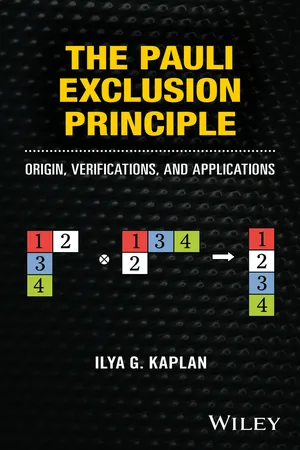 eBook - ePub
The Pauli Exclusion Principle
Origin, Verifications, and Applications
- Ilya G. Kaplan(Author)
- 2016(Publication Date)
- Wiley(Publisher)
In what follows we will not discuss more this very important but unsolved problem. Let us turn to another aspect of the Pauli exclusion principle. According to it, only two types of permutation symmetry are allowed: symmetric and antisymmetric. Both belong to the one‐dimensional representations of the permutation group, while all other types of permutation symmetry are forbidden. On the other hand, the Schrödinger equation is invariant under any permutation of identical particles and its solutions may belong to any representation of the permutation group, including the multidimensional representations that are forbidden by the Pauli exclusion principle. Here we can repeat the question asked in the end of Section 1.2 : whether the Pauli principle limitation on the solutions of the Schrödinger equation follows from the fundamental principles of quantum mechanics or it is an independent principle. Depending on the answer to this question, physicists can be divided into two groups. Some physicists, including the founders of quantum mechanics Pauli [6] and Dirac [7] (see also books by Schiff [8] and Messiah [9]), had assumed that there are no laws in Nature that forbid the existence of particles described by wave functions with more complicated permutation symmetry than those of bosons and fermions, and that the existing limitations are only due to the specific properties of the known elementary particles. Messiah [9, 10] has even introduced the term symmetrization postulate to emphasize the primary nature of the constraint on the allowed types of the wave function permutation symmetry No longer available |Learn more
- (Author)
- 2014(Publication Date)
- Learning Press(Publisher)
According to the Pauli exclusion principle, fermions cannot share quantum states, so their occupation numbers N i can only take on the value 0 or 1. The fermionic annihilation operators c and creation operators are defined by their actions on a Fock state thus ________________________ WORLD TECHNOLOGIES ________________________ These obey an anticommutation relation: One may notice from this that applying a fermionic creation operator twice gives zero, so it is impossible for the particles to share single-particle states, in accordance with the exclusion principle. Field operators We have previously mentioned that there can be more than one way of indexing the degrees of freedom in a quantum field. Second quantization indexes the field by enumerating the single-particle quantum states. However, as we have discussed, it is more natural to think about a field, such as the electromagnetic field, as a set of degrees of freedom indexed by position. To this end, we can define field operators that create or destroy a particle at a particular point in space. In particle physics, these operators turn out to be more convenient to work with, because they make it easier to formulate theories that satisfy the demands of relativity. Single-particle states are usually enumerated in terms of their momenta (as in the particle in a box problem.) We can construct field operators by applying the Fourier transform to the creation and annihilation operators for these states. For example, the bosonic field annihilation operator is The bosonic field operators obey the commutation relation where δ( x ) stands for the Dirac delta function. As before, the fermionic relations are the same, with the commutators replaced by anticommutators. It should be emphasized that the field operator is not the same thing as a single-particle wavefunction. The former is an operator acting on the Fock space, and the latter is a quantum-mechanical amplitude for finding a particle in some position.
Index pages curate the most relevant extracts from our library of academic textbooks. They’ve been created using an in-house natural language model (NLM), each adding context and meaning to key research topics.

