Physics

Mass and Energy
Mass and energy are fundamental concepts in physics. Mass refers to the amount of matter in an object, while energy is the ability to do work. According to Einstein's theory of relativity, mass and energy are interchangeable, as expressed by the famous equation E=mc^2, where E is energy, m is mass, and c is the speed of light.
Written by Perlego with AI-assistance
Related key terms
1 of 5

11 Key excerpts on "Mass and Energy"
 No longer available |Learn more
- (Author)
- 2014(Publication Date)
- White Word Publications(Publisher)
Mass–energy equivalence does not imply that mass may be converted to energy, and indeed implies the opposite. Modern theory holds that neither mass nor energy may be destroyed, but only moved from one location to another. Mass and Energy are both conserved separately in special relativity, and neither may be created or destroyed. In physics, mass must be differentiated from matter, a more poorly defined idea in the physical sciences. Matter, when seen as certain types of particles, can be created and destroyed (as in particle annihilation or creation), but the precursors and products of such reactions retain both the original Mass and Energy, each of which remains unchanged (conserved) throughout the process. Letting the m in E = mc 2 stand for a quantity of matter (rather than mass) may lead to incorrect results, depending on which of several varying definitions of matter are chosen. E = mc 2 has sometimes been used as an explanation for the origin of energy in nuclear processes, but mass–energy equivalence does not explain the origin of such energies. Instead, this relationship merely indicates that the large amounts of energy released in such reactions may exhibit enough mass that the mass-loss may be measured, when the released energy (and its mass) have been removed from the system. Einstein was not the first to propose a mass–energy relationship. However, Einstein was the first scientist to propose the E = mc 2 formula and the first to interpret mass–energy equivalence as a fundamental principle that follows from the relativistic symmetries of space and time. Conservation of Mass and Energy The concept of mass–energy equivalence connects the concepts of conservation of mass and conservation of energy, which continue to hold separately. The theory of relativity allows particles which have rest mass to be converted to other forms of mass which require motion, such as kinetic energy, heat, or light. No longer available |Learn more
- (Author)
- 2014(Publication Date)
- Academic Studio(Publisher)
Mass– energy equivalence does not imply that mass may be ″converted″ to energy, and indeed implies the opposite. Modern theory holds that neither mass nor energy may be destroyed, but only moved from one location to another. In physics, mass must be differentiated from matter, a more poorly defined idea in the physical sciences. Matter, when seen as certain types of particles, can be created and destroyed, but the precursors and products of such reactions retain both the original Mass and Energy, both of which remain unchanged (conserved) throughout the process. Letting the m in E = mc 2 stand for a quantity of matter may lead to incorrect results, depending on which of several varying definitions of matter are chosen. E = mc 2 has sometimes been used as an explanation for the origin of energy in nuclear processes, but mass–energy equivalence does not explain the origin of such energies. Instead, this relationship merely indicates that the large amounts of energy released in such reactions may exhibit enough mass that the mass-loss may be measured, when the released energy (and its mass) have been removed from the system. Einstein was not the first to propose a mass–energy relationship. However, Einstein was the first scientist to propose the E = mc 2 formula and the first to interpret mass–energy equivalence as a fundamental principle that follows from the relativistic symmetries of space and time. Conservation of Mass and Energy The concept of mass–energy equivalence connects the concepts of conservation of mass and conservation of energy, which continue to hold separately. The theory of relativity allows particles which have rest mass to be converted to other forms of mass which require motion, such as kinetic energy, heat, or light. However, the mass remains. Kinetic energy or light can also be converted to new kinds of particles which have rest mass, but again the energy remains. No longer available |Learn more
- (Author)
- 2014(Publication Date)
- Learning Press(Publisher)
Mass–energy equivalence does not imply that mass may be converted to energy, and indeed implies the opposite. Modern theory holds that neither mass nor energy may be destroyed, but only moved from one location to another. Mass and Energy are both conserved separately in special relativity, and neither may be created or destroyed. In physics, mass must be differentiated from matter, a more poorly defined idea in the physical sciences. Matter, when seen as certain types of particles, can be created and destroyed (as in particle annihilation or creation), but the precursors and products of such reactions retain both the original Mass and Energy, each of which remains unchanged (conserve d) throughout the process. Letting the m in E = mc 2 stand for a quantity of matter (rather than mass) may lead to incorrect results, depending on which of several varying definitions of matter are chosen. E = mc 2 has sometimes been used as an explanation for the origin of energy in nuclear processes, but mass–energy equivalence does not explain the origin of such energies. Instead, this relationship merely indicates that the large amounts of energy released in such reactions may exhibit enough mass that the mass-loss may be measured, when the released energy (and its mass) have been removed from the system. Einstein was not the first to propose a mass–energy relationship. However, Einstein was the first scientist to propose the E = mc 2 formula and the first to interpret mass–energy equivalence as a fundamental principle that follows from the relativistic symmetries of space and time. Conservation of Mass and Energy The concept of mass–energy equivalence connects the concepts of conservation of mass and conservation of energy, which continue to hold separately. The theory of relativity allows particles which have rest mass to be converted to other forms of mass which require motion, such as kinetic energy, heat, or light. No longer available |Learn more
- (Author)
- 2014(Publication Date)
- Library Press(Publisher)
Mass–energy equivalence does not imply that mass may be ″converted″ to energy, and indeed implies the opposite. Modern theory holds that neither mass nor energy may be destroyed, but only moved from one location to another. In physics, mass must be differentiated from matter, a more poorly defined idea in the physical sciences. Matter, when seen as certain types of particles, can be created and destroyed, but the precursors and products of such reactions retain both the original Mass and Energy, both of which remain unchanged (conserved) throughout the process. Letting the m in E = mc 2 stand for a quantity of matter may lead to incorrect results, depending on which of several varying definitions of matter are chosen. E = mc 2 has sometimes been used as an explanation for the origin of energy in nuclear processes, but mass–energy equivalence does not explain the origin of such energies. Instead, this relationship merely indicates that the large amounts of energy released in such reactions may exhibit enough mass that the mass-loss may be measured, when the released energy (and its mass) have been removed from the system. Einstein was not the first to propose a mass–energy relationship. However, Einstein was the first scientist to propose the E = mc 2 formula and the first to interpret mass–energy equivalence as a fundamental principle that follows from the relativistic symmetries of space and time. Conservation of Mass and Energy The concept of mass–energy equivalence connects the concepts of conservation of mass and conservation of energy, which continue to hold separately. The theory of relativity allows particles which have rest mass to be converted to other forms of mass which require motion, such as kinetic energy, heat, or light. However, the mass remains. Kinetic energy or light can also be converted to new kinds of particles which have rest mass, but again the energy remains. No longer available |Learn more
- (Author)
- 2014(Publication Date)
- White Word Publications(Publisher)
Outside the SI system, a variety of different mass units are used, depending on context, such as the slug (sl), the pound (lb), the Planck mass ( m P ), and the solar mass ( M ⊙ ). In normal situations, the weight of an object is proportional to its mass, which usually makes it unproblematic to use the same unit for both concepts. However, the distinction between mass and weight becomes important for measurements with a precision better than a few percent (because of slight differences in the strength of the Earth's gravitational field at different places), and for places far from the surface of the Earth, such as in space or on other planets. A mass can sometimes be expressed in terms of length. The mass of a very small particle may be identified with its inverse Compton wavelength (1 cm −1 ≈ 3.52×10 −41 kg). The mass of a very large star or black hole may be identified with its Schwarzschild radius (1 cm ≈ 6.73×10 24 kg). The mass is the electric dipole moment. Summary of mass concepts and formalisms In classical mechanics, mass has a central role in determining the behavior of bodies. Newton's second law relates the force F exerted in a body of mass m to the body's acceleration a : Additionally, mass relates a body's momentum p to its velocity v : and the body's kinetic energy E k to its velocity: In special relativity, relativistic mass is a formalism which accounts for relativistic effects by having the mass increase with velocity. Since energy is dependent on reference frame (upon the observer) it is convenient to formulate the equations of physics in a way such that mass values are invariant (do not change) between observers, and so the equations are independent of the observer. For a ________________________ WORLD TECHNOLOGIES ________________________ single particle, this quantity is the rest mass; for a system of bound or unbound particles, this quantity is the invariant mass.
- Martinus J G Veltman(Author)
- 2003(Publication Date)
- World Scientific(Publisher)
Energy, Momentum and Mass-Shell 4.1 Introduction The aim of this Chapter is to explain the mechanical properties of elementary particles that will form the basis of much that we shall be discussing. In particular, it is necessary to have a good understanding of momentum and energy, and, for a single particle, the relation between the two, called the mass-shell relation. Energy and momentum are important concepts because of two facts: first they are, in the context of quantum mechanics, enough to describe completely the state of a single free particle (disregarding internal properties such as spin and charge), and second, they are conserved. For energy this is well known: for any observable process the initial energy equals the final energy. It may be distributed differently, or have a different form, but no energy disappears. If we burn wood in a stove the chemical energy locked in the wood changes into heat that warms the space where the stove is burning; eventually this heat dissipates to the outside, but does not disappear. This is the law of con-servation of energy. Similarly there is a law for conservation of momentum and we shall try to explain that in this section for simple collision processes. The fact that a description of the state of a particle in terms of its energy and momentum is a complete description is very much at the heart of quantum mechanics. Normally we specify the state of a particle by its position and its momentum at a given time: 115 4 116 E L E M E N T A R Y P A R T I C L E P H Y S I C S where, when and how does it move. Momentum a is a vector, meaning that it has a direction: momentum has thus three compo-nents, momentum in the x , y and z directions. That means that for the specification of the state of a particle we have three space coordinates plus the time and the three components of the mo-mentum. In quantum mechanics, when you know precisely the momentum of a particle no information on its location can be given.
- John R. Fanchi, John R. Fanchi, (Authors)
- 2013(Publication Date)
- Academic Press(Publisher)
Equation (9.4.1) presents mass as a derived concept: mass is calculated from energy and momentum. By contrast, Equation (9.4.2) presents energy as the derived concept: energy is calculated from mass and momentum. In practice, particle mass is not measured, but is inferred from measurements of energy in calorimeters and momentum from particle tracks. These inferred masses are not fundamental measurements because they depend on the theory used 266 Energy: Technology and Directions for the Future to establish the relationship between energy and momentum, in this case special relativity is the theory underlying Equation (9.4.1). If we assumed that a particle was nonrelativistic so that m 2 c 4 p 2 c 2 , and we were only interested in positive values of energy, Equation (9.4.2) would become E = m 2 c 4 + p 2 c 2 = mc 2 1 + p 2 c 2 m 2 c 4 ≈ mc 2 + p 2 2 m (9.4.3) Equation (9.4.3) shows that the total energy of a nonrelativistic free particle with positive energy is the sum of the energy due to the mass of the particle and the kinetic energy of the particle. Although scattering experiments study the behavior of very small submi-croscopic systems, the machines needed to perform these experiments are often huge and expensive. The chief function of scattering machines is to guide a collimated beam of particles into either a stationary material target or into another beam of particles. It is usually necessary to accelerate the incident beam of particles until its particles have attained a desired velocity. For this reason machines built to perform particle scattering experiments are called particle accelerators . To justify their high cost relative to other types of experiments, particle accelerators and associated particle detectors have been valuable in studying many fundamental natural processes, and their development has yielded spin-off technology in commercially important areas such as magnet design and superconductivity. eBook - PDF
- Norman Gray(Author)
- 2022(Publication Date)
- Cambridge University Press(Publisher)
We can see from Eq. (7.5) that, even when a particle is stationary and = 0, the energy is non-zero. In other words, a particle of mass has an energy associated with it simply by virtue of its mass. The low-speed limit of Eq. (7.2b) simply expresses the conservation of mass, but we see from Eq. (7.3) that it is actually expressing the conservation of energy. In SR there is no fundamental distinction between Mass and Energy – mass is, like kinetic, thermal and strain energy, merely another form into which energy can be transmuted – albeit a particularly dense store of energy, as can be seen by calculating the energy equivalent, in joules, of a mass of 1 kg. It turns out from GR that it is not mass that gravitates, but energy-momentum (most typically, however, in the particularly dense form of mass), so that thermal and electromagnetic energy, for example, and even the energy in the gravitational field itself, all gravitate (it is the non-linearity implicit in the last remark that is part of the explanation for the mathematical difficulty of GR). In each of these cases, the amount of (thermal, electromagnetic, strain) energy would be a quantity with the units of kilogrammes. Although the quantities = and are frame-dependent, and thus not physically meaningful by themselves, the quantity defined by Eq. (7.1) has a physical significance. Let us now consider the magnitude of the 4-momentum vector. Like any such magnitude, it will be frame-invariant, and so will express some- 7.1 Energy and Momentum 129 thing fundamental about the vector, analogous to its length. Since this is the momentum vector we are talking about, this magnitude will be some important invariant of the motion, indicating something like the ‘quantity of motion’. From the definition of the momentum, Eq. (7.1), and its magnitude, Eq. (6.14), we have ⋅ = 2 ⋅ = 2 , (7.7) and we find that this important invariant is the mass of the moving particle. eBook - PDF
- P R Wallace(Author)
- 1991(Publication Date)
- World Scientific(Publisher)
Symmetry remains, and conservation laws, and causality. Each con-cept has been broadened and refined, and new relations found be-tween them, but the essential features of the concept have remained. It is important, therefore, that we talk about these concepts in the context of Newtonian mechanics, for only then will we be able to understand their subtler significance in modern physics. 2.1. M a s s Let us start with the concept of mass. A less terse definition for the mass of a body (or a particle) is coefficient of inertia. Consider, for example, two objects made of the same material, one having twice the volume of the other (twice as big). Suppose that each is acted upon by an identical force for an identical length of time. It is found that the smaller body is accelerated to twice the speed of the larger one. The larger one has more resistance to acceleration, more inertia than the smaller. We say it has twice the mass. Of course, inertia is only proportional to size for objects made of the same material. A ball of lead of 20 cm diameter has more inertia, and hence more mass than one of aluminum. How do we test their relative masses? In the same way as before, by comparing the relative accelerations which they are given by identical forces. The above statements, which define mass (in relative terms at least) seem almost precisely equivalent to Newton's Law of Motion. Galileo had already formulated the rather strange law that every body, left to itself (i.e. not acted upon by any force) would continue indefinitely in its state of rest or uniform motion in a straight line. What is so difficult about this law is that it is hard to imagine something not acted upon by any force! It certainly has never existed in the real universe. It is an abstraction, a mental construct. We can, however, imagine it better today than in the time of Newton Fundamental* of Newtonian Mechanic » 23 or Galileo, due to our increasing familiarity with space travel. No longer available |Learn more
- Irving Granet, Maurice Bluestein(Authors)
- 2014(Publication Date)
- CRC Press(Publisher)
In addition, it pos-sesses energy due to the internal attractive and repulsive forces between particles. These forces become the mechanism for energy storage whenever particles become separated, such as when a liquid evaporates or the body is subjected to a deformation by an external energy source. Also, energy may be stored in the rotation and vibration of the molecules. Additional amounts of energy are involved with the electron configuration within the atoms and with the nuclear particles. The energy from all such sources is called the inter-nal energy of the body and is designated by the symbol U . Per unit mass ( m ), the specific internal energy is denoted by the symbol u , where mu = U . Thus, mu U = (2.1) or u U m = (2.2) 64 Thermodynamics and Heat Power From a practical standpoint, the measurement of the absolute internal energy of a system in a given state presents an insurmountable problem and is not essential to our study of thermodynamics. We are concerned with changes in internal energy, and the arbitrary datum for the zero of internal energy will not enter into these problems. Just as it is possible to distinguish the various forms of energy, such as work and heat, in a mechanical system, it is equally possible to distinguish the various forms of energy associated with electrical, chemical, and other systems. For the purpose of this book, these forms of energy, work, and heat are not considered. Students are cautioned that if a system includes any forms of energy other than mechanical, these items must be included. For example, the energy that is dissipated in a resistor as heat when a current flows through it must be taken into account when all the energies of an electrical system are being considered. 2.5 Potential Energy Let us consider the following problem, illustrated in Figure 2.3, where a body of mass m is in a locality in which the local gravitational field is constant and equal to g .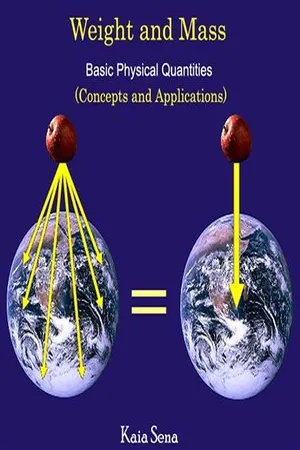 No longer available |Learn more
Weight and Mass
Basic Physical Quantities (Concepts and Applications)
- (Author)
- 2014(Publication Date)
- Learning Press(Publisher)
This is because the total energy of all particles and fields in a system must be summed, and this quantity, as seen in the center of momentum frame, and divided by c 2 , is the system's invariant mass. In special relativity, mass is not converted to energy, for all types of energy still retain their associated mass. Neither energy nor invariant mass can be destroyed in special relativity, and each is separately conserved over time in closed systems. Thus, a system's invariant mass may change only because invariant mass is allowed to escape, perhaps as light or heat. Thus, when reactions (whether chemical or nuclear) release energy in the form of heat and light, if the heat and light is not allowed to escape (the system is closed and isolated), the energy will continue to contribute to the system rest mass, and the system mass will not change. Only if the energy is released to the environment will the mass be lost; this is because the associated mass has been allowed out of the system, where it contributes to the mass of the surroundings. Controversy According to Lev Okun, Einstein himself always meant the invariant mass when he wrote m in his equations, and never used an unqualified m symbol for any other kind of mass. Okun and followers reject the concept of relativistic mass. Arnold B. Arons has argued against teaching the concept of relativistic mass: For many years it was conventional to enter the discussion of dynamics through derivation of the relativistic mass, that is the mass–velocity relation, and this is probably still the dominant mode in textbooks. More recently, however, it has been increasingly recognized that relativistic mass is a troublesome and dubious concept. The sound and ________________________ WORLD TECHNOLOGIES ________________________ rigorous approach to relativistic dynamics is through direct development of that expression for momentum that ensures conservation of momentum in all frames: rather than through relativistic mass ....
Index pages curate the most relevant extracts from our library of academic textbooks. They’ve been created using an in-house natural language model (NLM), each adding context and meaning to key research topics.

