Physics

Mass in Physics
Mass in physics refers to the measure of the amount of matter in an object. It is a fundamental property of an object and is typically measured in kilograms. Mass is distinct from weight, which is the force exerted on an object due to gravity. In physics, mass plays a crucial role in determining an object's inertia and its response to external forces.
Written by Perlego with AI-assistance
Related key terms
1 of 5

11 Key excerpts on "Mass in Physics"
 eBook - ePub
From Atoms to Higgs Bosons
Voyages in Quasi-Spacetime
- Chary Rangacharyulu, Christopher J. A. Polachic, Chary Rangacharyulu, Christopher J. A. Polachic(Authors)
- 2019(Publication Date)
- Jenny Stanford Publishing(Publisher)
In Newtonian physics, mass is an inherent, invariant property of an object, unlike weight. It is independent of a particle’s other properties or behaviors, including its motion. The concept of mass happens to be the first point of discussion in the Principia, wherein Newton defined this property as a measure of “the quantity of matter…arising from its density and bulk conjunctly.” 3 By 1889, the standard kilogram was defined with reference to a physical cylinder of platinum–iridium alloy, 4 and the carat was thus redefined as a 200 mg mass, no longer requiring any reference to carob beans. Although mass is considered a more fundamental property than weight, it is curiously inaccessible to direct measurement. It is interesting to note how our methods of measuring and assigning mass have evolved over the last two centuries. Until very recently (and only then did exceptions arise in the context of specialized experiments performed on the atomic and subatomic scale), measurements of mass have always been performed indirectly through determination of weight or applied force. We will see, however, that on smaller scales, physicists have approached the problem of mass with an evolving set of techniques to quantify it as a property of a system. In the process, the quasirealist worldview of many physicists has overtaken and redefined this property of matter, which, throughout earlier human history, had a fairly concrete, common-sense basis in everyday life. Newton’s understanding of mass was closely linked with the concept of inertia, which can be understood as the resistance of matter to changes in its state of motion. To measure the mass of a body, in the Newtonian system, is to provide a numerical value to the inertia of the body. Thus, while the mass of a body is not dependent on its state of motion, it is understood as being directly related to the body’s response to such changes when external force is applied No longer available |Learn more
- (Author)
- 2014(Publication Date)
- Learning Press(Publisher)
________________________ WORLD TECHNOLOGIES ________________________ Chapter 1 Introduction to Mass in Physics, mass (from Ancient Greek: μ ᾶ ζα) commonly refers to any of three properties of matter, which have been shown experimentally to be equivalent: Inertial mass, active gravitational mass and passive gravitational mass . In everyday usage, Mass is often taken to mean weight , but in scientific use, they refer to different properties. The inertial mass of an object determines its acceleration in the presence of an applied force. According to Newton's second law of motion, if a body of fixed mass m is subjected to a force F , its acceleration a is given by F / m . A body's mass also determines the degree to which it generates or is affected by a gravitational field. If a first body of mass m 1 is placed at a distance r from a second body of mass m 2 , each body experiences an attractive force F whose magnitude is where G is the universal constant of gravitation, equal to 6.67×10 −11 kg −1 m 3 s −2 . This is sometimes referred to as gravitational mass (when a distinction is necessary, M is used to denote the active gravitational mass and m the passive gravitational mass). Repeated experiments since the 17th century have demonstrated that inertial and gravitational mass are equivalent; this is entailed in the equivalence principle of general relativity. Special relativity shows that rest mass and energy are essentially equivalent via the well-known relationship ( E = mc 2 ). Mass is a conserved quantity. From the viewpoint of any single unaccelerated observer, mass can neither be created or destroyed, and special relativity does not change this understanding. However, relativity adds the fact that all types of energy have an associated mass, and this mass is added to systems when energy is added, and the associated mass is subtracted from systems when the energy leaves. No longer available |Learn more
- (Author)
- 2014(Publication Date)
- Academic Studio(Publisher)
________________________ WORLD TECHNOLOGIES ________________________ Chapter 1 Introduction to Mass in Physics, mass (from Ancient Greek: μ ᾶ ζα) commonly refers to any of three properties of matter, which have been shown experimentally to be equivalent: Inertial mass, active gravitational mass and passive gravitational mass . In everyday usage, Mass is often taken to mean weight , but in scientific use, they refer to different properties. The inertial mass of an object determines its acceleration in the presence of an applied force. According to Newton's second law of motion, if a body of fixed mass m is sub-jected to a force F , its acceleration a is given by F / m . A body's mass also determines the degree to which it generates or is affected by a gravitational field. If a first body of mass m 1 is placed at a distance r from a second body of mass m 2 , each body experiences an attractive force F whose magnitude is where G is the universal constant of gravitation, equal to 6.67×10 −11 kg −1 m 3 s −2 . This is sometimes referred to as gravitational mass (when a distinction is necessary, M is used to denote the active gravitational mass and m the passive gravitational mass). Repeated experiments since the 17th century have demonstrated that inertial and gravitational mass are equivalent; this is entailed in the equivalence principle of general relativity. Special relativity shows that rest mass and energy are essentially equivalent via the well-known relationship ( E = mc 2 ). Mass is a conserved quantity. From the viewpoint of any single unaccelerated observer, mass can neither be created or destroyed, and special relativity does not change this understanding. However, relativity adds the fact that all types of energy have an associated mass, and this mass is added to systems when energy is added, and the associated mass is subtracted from systems when the energy leaves. eBook - PDF
- P R Wallace(Author)
- 1991(Publication Date)
- World Scientific(Publisher)
Symmetry remains, and conservation laws, and causality. Each con-cept has been broadened and refined, and new relations found be-tween them, but the essential features of the concept have remained. It is important, therefore, that we talk about these concepts in the context of Newtonian mechanics, for only then will we be able to understand their subtler significance in modern physics. 2.1. M a s s Let us start with the concept of mass. A less terse definition for the mass of a body (or a particle) is coefficient of inertia. Consider, for example, two objects made of the same material, one having twice the volume of the other (twice as big). Suppose that each is acted upon by an identical force for an identical length of time. It is found that the smaller body is accelerated to twice the speed of the larger one. The larger one has more resistance to acceleration, more inertia than the smaller. We say it has twice the mass. Of course, inertia is only proportional to size for objects made of the same material. A ball of lead of 20 cm diameter has more inertia, and hence more mass than one of aluminum. How do we test their relative masses? In the same way as before, by comparing the relative accelerations which they are given by identical forces. The above statements, which define mass (in relative terms at least) seem almost precisely equivalent to Newton's Law of Motion. Galileo had already formulated the rather strange law that every body, left to itself (i.e. not acted upon by any force) would continue indefinitely in its state of rest or uniform motion in a straight line. What is so difficult about this law is that it is hard to imagine something not acted upon by any force! It certainly has never existed in the real universe. It is an abstraction, a mental construct. We can, however, imagine it better today than in the time of Newton Fundamental* of Newtonian Mechanic » 23 or Galileo, due to our increasing familiarity with space travel. eBook - PDF
Hypersymmetry
Physics of the Isotopic Field-Charge Spin Conservation
- György Darvas(Author)
- 2020(Publication Date)
- De Gruyter(Publisher)
2 MASS Mass is a physical quantity familiar to the reader. It plays an odd role in physics. Therefore, we start the discussion with mass. The difference between gravitational and inertial masses was known for over three hundred years. Why did not one distinguish them in the equations of physics? There were different reasons for it. First , according to a simplified formulation of the second law of Newton, the mass can be defined as the ratio between a force that affects it and its acceleration caused by that force. This definition does not take into consideration whether the force in question originates from the gravity of another object or it is an inertial force. The so defined mass could be measured by the same unit in both cases. Second , the proportion between the measures of the two kinds of masses was fixed to “ 1 ” . This made the appearance like the two masses were identical, and at the available test procedures, the results seemed satisfactory for centuries. Third , the so-called equivalence principle was formulated. The quantitative equivalence between the gravitational and inertial masses of the same body (at least at rest) was measured accurately first by R. Eötvös (and his colleagues, 1910, 1922) in 1906 – 1909. The experimental proof of their equal value made available for A. Einstein to formulate the equivalence principle in the early 1910s. When Einstein (1915, 1916) formulated the general theory of gravity, known as the general theory of relativity (GTR), he really considered that the equivalence principle meant iden-tity between the equivalent value masses. Although he changed his mind in a few years and formulated more precisely, the so-called “ weak formulation of the equiv-alence principle ” inspired many textbook writers to identify them, even up to now. This was pragmatically correct, but theoretically not justified.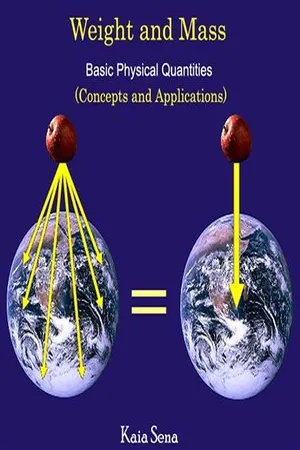 No longer available |Learn more
Weight and Mass
Basic Physical Quantities (Concepts and Applications)
- (Author)
- 2014(Publication Date)
- Learning Press(Publisher)
However, the implications of special relativity will not change the meaning of mass in any essential way. ________________________ WORLD TECHNOLOGIES ________________________ According to Newton's second law, we say that a body has a mass m if, at any instant of time, it obeys the equation of motion where F is the force acting on the body and a is the acceleration of the body. For the moment, we will put aside the question of what force acting on the body actually means. This equation illustrates how mass relates to the inertia of a body. Consider two objects with different masses. If we apply an identical force to each, the object with a bigger mass will experience a smaller acceleration, and the object with a smaller mass will experience a bigger acceleration. We might say that the larger mass exerts a greater resistance to changing its state of motion in response to the force. However, this notion of applying identical forces to different objects brings us back to the fact that we have not really defined what a force is. We can sidestep this difficulty with the help of Newton's third law, which states that if one object exerts a force on a second object, it will experience an equal and opposite force. To be precise, suppose we have two objects A and B, with constant inertial masses m A and m B . We isolate the two objects from all other physical influences, so that the only forces present are the force exerted on A by B, which we denote F AB , and the force exerted on B by A, which we denote F BA . Newton's second law states that where a A and a B are the accelerations of A and B, respectively. Suppose that these accelerations are non-zero, so that the forces between the two objects are non-zero. This occurs, for example, if the two objects are in the process of colliding with one another. Newton's third law then states that and thus Note that our requirement that a A be non-zero ensures that the fraction is well-defined. eBook - PDF
Mechanics
Lectures on Theoretical Physics
- Arnold Sommerfeld(Author)
- 2013(Publication Date)
- Academic Press(Publisher)
6 Mechanics of a Particle 1.1 of a given force by a suitable weight. (By means of a pulley and string we can let the vertical force of gravity act in a direction opposed to the given force.) If, in addition, we procure a number of equally heavy bodies, a set of weights, we obtain a tentative scale with which to measure forces quantitatively. The same is true for the concept of force as for all other physical con-cepts and names : word definitions have very little meaning ; physically signi-ficant definitions are obtained as soon as we prescribe a way of measur-ing the quantity in question. Such a prescription need not contain the details of practical procedure, but merely state a way to measure the quantity in principle. The above prescription, making use of gravity, has given a concrete content to the right member of our law of momentum (3) ; it has thereby become a real physical statement. It is true that the left member still con-tains the mass m, up to now undefined. This does not mean that the defini-tion of mass is the only content of the law. For the law brings out that it is p, not p itself or perhaps p which is determined by the force. We shall see in § 4 how the definition of mass is obtained in case it is variable, the relativistic mass serving as example. Third law: Action always equals reaction, or: the forces two bodies exert on each other are always equal and opposite in direction. This is the principle of action and reaction. It says that for every pressure there is a pressure in the opposite direction. Forces always occur paired in nature. The falling stone attracts the earth just as strongly as the earth attracts the stone. This law makes possible the transition from the mechanics of single mass points to that of compound systems ; it is therefore fundamental to the entire field of structural statics, to name but one example.
- Thais Russomano, Gustavo Dalmarco, Felipe Prehn Falcao(Authors)
- 2022(Publication Date)
- Springer(Publisher)
The mass of an object is independent of where it is located. Weight is very much dependent on location. For example, near the surface of the Earth, the weight of an object is W mg, where g 9.81 m/s 2 directed toward the center of the Earth. However, near the surface of the Moon, the weight will be calculated in the same way, but the value of g is 1.6 m/s 2 directed toward the center of the Moon. Inertial mass is mainly defined by Newton’s law (F ma), which states that when a force F is applied to an object, it will accelerate proportionally, and that constant of proportion is the mass of that object. Therefore, to determine the inertial mass, it is necessary to apply a force of F (N) to GENERAL CONCEPTS IN PHYSICS—DEFINITION OF PHYSICAL TERMS 5 an object, to measure the acceleration a (m/s 2 ), and to divide F/a, which gives the inertial mass m (kg). It is easy to conclude that the bigger the mass of a body, the bigger will be its inertia, which is a unique property of gravity. A classic example is presented here. Imagine an elephant with a mass of 700 kg and a person with a mass of 70 kg. By using the formula F ma, it is possible to calculate the force of attrac- tion between the Earth and the elephant (F 700 9.8 6860 N) and between the Earth and the person (F 70 9.8 686 N), as represented in Figure 1.3. However, the g force produced in both cases will be the same due to the inertial mass of each one, the elephant and the man. If F is 686 N and the mass of the man is 70 kg, a is 9.8 m/s 2 . Equation 1.3 expresses the calculation of a for the elephant. F m a a F m a 6860 700 a 9.8 m/s 2 (1.3) 1.3 APPARENT WEIGHT AND NORMAL FORCE On Earth, man is aware of his weight because there is an external medium (the Earth’s surface) pushing back against his body with an inertial force equal to the gravitational force attracting it toward the center of the Earth. According to Newton, whenever objects A and B interact with each other, they exert forces upon each other. eBook - ePub
Mid-Latitude Atmospheric Dynamics
A First Course
- Jonathan E. Martin(Author)
- 2013(Publication Date)
- Wiley(Publisher)
3Mass, Momentum, and Energy: The Fundamental Quantities of the Physical World
Objectives
Study of the physical world tends to be focused on the quantities known as mass, momentum, and energy. The behavior of the atmosphere is no exception to this rule. In this chapter we will investigate the manner in which these quantities and their various interactions serve to describe the building blocks of a dynamical understanding of the atmosphere at middle latitudes. We must first consider the distribution of mass in the atmosphere and the force balance that underlies this distribution. A number of insights concerning the vertical structure of the atmosphere proceed directly from this understanding.Beginning with Newton’s second law, we will construct expressions for the conservation of momentum in the three Cartesian directions. These expressions are commonly known as the equations of motion and will serve as the fundamental set of physical relationships for all subsequent inquiry in this book. Scale analysis of the horizontal equations of motion will reveal that a simple diagnostic relationship between the mass and momentum fields, geostrophy, characterizes the mid-latitude atmosphere on Earth. Finally, employing these equations of motion we will develop expressions for the conservation of mass and the conservation of energy. We begin by considering the distribution of mass in the atmosphere.3.1 Mass in the Atmosphere
For our purposes, we shall define mass as the measure of the substance of an object and make that measurement in kilograms (kg). Though it was not clear to ancient thinkers like Aristotle,1 the atmosphere has mass. In fact the Earth’s atmosphere has a mass of 5.265 × 10¹⁸ eBook - PDF
Ancient Hindu Science
Its Transmission and Impact on World Cultures
- Alok Kumar(Author)
- 2022(Publication Date)
- Springer(Publisher)
89 C H A P T E R 5 Physics Physics deals with matter and energy and their interactions. Measurements are central to the growth of physics and length (space), time, and mass, are the three most important physical quantities, called the fundamental quantities. Most other physical quantities are generally ex- pressed in their terms of mass, length, and time. For example, speed is measured in miles per hour (or kilometer per hour) and involves a measurement of space (distance) and time. This means that a car moving with 65 miles/hour moves 65 miles (one measurement) in one hour (second measurement). Similarly, force is measured in terms of mass, length, and inverse-square of time. Therefore, for convenience purposes, most civilization defined standards for these fundamental quantities. The ancient Hindus also methodically and carefully defined these standards. 5.1 SPACE (ĀKĀŚA) Space is a three dimensional matrix into which all objects are situated and move without produc- ing any interaction between the object and the space. In the classical sense, space allows a physical ordering of objects without any reference to time. Objects appear to be near or distant due to this physical ordering. In the Newtonian (classical) world, where objects move with speeds much smaller in comparison to the speed of light, space and time are independent of each other, and are considered as separate fundamental quantities. In the relativistic world, where objects move with a velocity that is comparable to the velocity of light (3 10 8 m/s), space and time do not have their independent status; they are integrated and form a new space-time (spatio-temporal) reality. In the present context, only the classical picture of space and time as two independent realities are considered. Ākāśa is one of the terms used to describe “space” in the Sanskrit language. According to the Chāndogya-Upanis . ad, space was the first entity in the creation of the universe. No longer available |Learn more
- (Author)
- 2014(Publication Date)
- Learning Press(Publisher)
By substituting the definition of acceleration, the algebraic version of Newton's second law is derived: It is sometimes called the second most famous formula in physics. Newton never explicitly stated the formula in the reduced form above. Newton's second law asserts the direct proportionality of acceleration to force and the inverse proportionality of acceleration to mass. Accelerations can be defined through kinematic measurements. However, while kinematics are well-described through ref-erence frame analysis in advanced physics, there are still deep questions that remain as to what is the proper definition of mass. General relativity offers an equivalence between space-time and mass, but lacking a coherent theory of quantum gravity, it is unclear as to how or whether this connection is relevant on microscales. With some justification, Newton's second law can be taken as a quantitative definition of mass by writing the law as an equality; the relative units of force and mass then are fixed. The use of Newton's second law as a definition of force has been disparaged in some of the more rigorous textbooks, because it is essentially a mathematical truism. The equality between the abstract idea of a force and the abstract idea of a changing momentum vector ultimately has no observational significance because one cannot be defined without simultaneously defining the other. What a force or changing momentum is must either be referred to an intuitive understanding of our direct perception, or be defined implicitly through a set of self-consistent mathematical formulas. Notable physicists, philosophers and mathematicians who have sought a more explicit definition of the concept of force include Ernst Mach, Clifford Truesdell and Walter Noll. Newton's second law can be used to measure the strength of forces. For instance, knowledge of the masses of planets along with the accelerations of their orbits allows scientists to calculate the gravitational forces on planets.
Index pages curate the most relevant extracts from our library of academic textbooks. They’ve been created using an in-house natural language model (NLM), each adding context and meaning to key research topics.

