Physics

Telephoto Lenses
Telephoto lenses are a type of camera lens with a long focal length, allowing for magnified images of distant subjects. They are commonly used in photography to capture subjects such as wildlife, sports, and landscapes from a distance. Telephoto lenses compress the perspective and create a shallow depth of field, making them popular for portrait photography as well.
Written by Perlego with AI-assistance
Related key terms
1 of 5
12 Key excerpts on "Telephoto Lenses"
 eBook - ePub
- Leslie Stroebel(Author)
- 1999(Publication Date)
- Routledge(Publisher)
Although Telephoto Lenses are generally designed and used for photographing objects at moderate to long distances from the camera, the telephoto design has also been used for some macro lenses. The advantages of the telephoto design for photomacrography are (1) that a longer focal length lens can be used at a longer distance from the subject to obtain the same image size, which allows more room for lighting the subject without casting the shadow of the camera on the subject, and (2) when the bellows is fully extended to obtain the maximum scale of reproduction, the image distance (the distance from the back nodal plane of the lens to the film) is larger with the telephoto lens than with a normal lens of the same focal length, which produces a larger scale of reproduction.One should remember that the covering power of Telephoto Lenses is smaller than that of normal-type lenses of the same focal length. One 360-mm (14-in.) focal length telephoto view camera lens, for example, has a circle of good definition with a diameter of 230 mm, which is considerably smaller than the focal length, but it is still larger than the 220-mm-diameter circle produced by a 150-mm (5.9-in.) focal length normal-type lens made by the same manufacturer and recommended for use on 4 × 5-in. view cameras.Figure 5-8 A conventional lens (top ) and a telephoto lens of the same focal length (bottom ) focused on a distant object. The image nodal point of the telephoto lens is located in front of the lens in the position indicated by the arrow.Wide-Angle Lenses
Wide-angle lenses are characterized by having greater covering power than normal lenses of equal focal length. Since covering power is measured in terms of the diameter of the circle of good definition and the angle of coverage, both factors will be relatively large for wide-angle lenses. The diameter of the circle of good definition will be considerably larger than the focal length, and the angle of coverage will be considerably larger than 53°, the angle produced when the diameter of the circle of good definition is equal to the focal length. The establishment of a limiting value to separate wide-angle lenses from normal lenses would be arbitrary. Some lens manufacturers classify lenses with an angle of coverage of 65°, only 12° higher than the 53° that can be expected with normal lenses, as wide-angle lenses.Angles of 80° to 100° are more representative of this type of lens, and lenses with angles of coverage up to 180° now are mass-produced. eBook - ePub
- Ernst Wildi(Author)
- 2012(Publication Date)
- Routledge(Publisher)
The 180-degree diagonal angle of view of the 30 mm Distagon does not allow placing filters or shades in front of the lens because they would cut into the field of view.The Distagon design and the multicoating have reduced flare to a degree that makes it possible to photograph directly into a light source without a shade and without any noticeable loss of contrast. The filter problem has been solved with a removable front section that allows you to attach small, 26 mm filters inside the lens.The lens comes from the factory with a clear glass in place. This clear glass, or filter, must always be there because it is part of the lens design. Image quality suffers without the glass. Four of the most common filters are supplied with the lens.TELEPHOTO DESIGNS
True Telephoto Lenses
An optically true telephoto lens is an optical design where the principal plane, from which the focal length is measured, is not within the physical dimension of the lens but is somewhere in front of it. This lens design allows the lenses to be made physically more compact — shorter than the focal length of the lens.Telephoto Lenses for Close-Up Work
As the focal length of a lens increases, so usually does the minimum focusing distance, and this may give some photographers the impression that Telephoto Lenses are meant for long distance photography only. This is not so. The focusing distances are limited for mechanical design reasons. All tele lenses can be used at closer distances in combination with close-up accessories. Extension tubes are perfect for this purpose.The close-up charts in Chapter 19 show the area coverage with different extension tubes for focal lengths up to 255 mm (150 mm lens plus 1,7 converter) for the H system and up to 250 mm in the V system.INTERNAL FOCUSING
Focusing a lens to closer distances usually means moving the entire lens farther from the image plane thereby making the lens physically longer. This is still the case with many lenses. On many modern lenses, especially telephotos, focusing is accomplished optically by moving some of the lens elements within the lens design. This method, which does not change the physical length of the lens at all or only to a minor degree and does not result in a rotating lens barrel, is known as internal focusing. Internal focusing can result in smoother, easier focusing than the mechanical type, especially in long telephotos. Since internal focusing does not move the entire lens, the focusing range can be and has been extended all the way where it can produce life-size magnification on the HC 4/120 macro for the H system cameras while maintaining the automatic focusing capability over the entire focusing range. Figure 14-18 shows how the lens elements are moved in the 120 mm HC macro lens when focusing from infinity to the minimum focusing distance where the lens produces life-size magnification on the film format. This was partially made possible as the focusing mechanism does not need to turn or move the entire lens. Many Hasselblad H system lenses have internal focusing indicated as rear or front focusing, depending on whether the front or rear elements are used for this purpose. The image quality of the 120 mm HC Macro lens is shown in the MTF diagrams for different distances in Figure 14-19 (see also Figure 14-20 eBook - ePub
- Sidney Ray(Author)
- 1999(Publication Date)
- Routledge(Publisher)
28 Telephotography28.1 Introduction
Telephotography is taken to mean the use of lenses or optical systems of very long focal length or narrow FOV relative to the recording format, principally to produce images of usable size from distant subjects. Such systems, especially for extreme telephotography, find applications in aerial and astronomical work as well as for terrestrial uses such as surveillance, animal behavioural studies and sports events. Other applications include range instrumentation and long range oblique photography (LOROP).Note that the EFL (f ) determines magnification (m ). Given that m = v /u, as u ≥200f or u approximates infinity then v ≈ f . So m ≈ f /u , i.e. image size is directly proportional to focal length; see Figure 28.1 . A person of height 1.8 m will fill a format height of 24 mm at 48 m distance with a 600 mm lens, or be 6 mm high at nearly 200 m, but only then 3 mm high with a 300 mm lens.Figure 28.1 (a-b) Focal length Change of image size with focal length in telephotography, (a) 300 mm dioptric lens, (b) 600 mm given from a 300 mm lens and x2 teleconverter.The circular image field must circumscribe the format to avoid vignetting or cutoff , causing a darkening of the image in the corners. The format area acts as the field stop and with the EFL determines the horizontal field angle of view (HFOV), an unambiguous method of lens classification.where h is the horizontal dimension of the format. A standard lens has an EFL approximately equivalent to the diagonal of the format and an HFOV of some 40 degrees, corresponding roughly to the sharp extent of static human vision. Lenses of shorter and longer EFL will be wide angle and narrow angle respectively (Figure 28.2 ). Curiously, the latter term is never used, instead, long focus , telephoto or even high power telephoto
- David D. Busch(Author)
- 2016(Publication Date)
- Rocky Nook(Publisher)
The flip side of the coin is that even at f/16, a 300mm and longer lens will not provide much depth-of-field, especially when the subject is large in the frame (magnified). Like fire, the depth-of-field aspects of a telephoto lens can be friend or foe. Getting closer. Telephoto Lenses allow you to fill the frame with wildlife, sports action, and candid subjects. No one wants to get a reputation as a surreptitious or “sneaky” photographer (except for paparazzi), but when applied to candids in an open and honest way, a long lens can help you capture memorable moments while retaining enough distance to stay out of the way of events as they transpire. Reduced foreground/increased compression. Telephoto Lenses have the opposite effect of wide angles: they reduce the importance of things in the foreground by squeezing everything together. This so-called compressed perspective makes objects in the scene appear to be closer than they are to the naked eye. You can use this effect as a creative tool. You’ve seen the effect hundreds of times in movies and on television, where the protagonist is shown running in and out of traffic that appears to be much closer to the hero (or heroine) than it really is. Figure 9.18 A 300mm focal length and a wide aperture (small f/number) helped isolate this owl from its background. Accentuates camera shakiness. Telephoto focal lengths hit you with a double whammy in terms of camera/photographer shake. The lenses themselves are bulkier, more difficult to hold steady, and may even produce a barely perceptible seesaw rocking effect when you support them with one hand halfway down the lens barrel. As they magnify the subject, they amplify the effect of any camera shake eBook - PDF
- Michael A. Covington(Author)
- 2018(Publication Date)
- Cambridge University Press(Publisher)
107 Chapter 7 Camera Lenses The previous chapter was mostly about adapting telescopes to make them deliver images to cameras rather than eyepieces. There is an easier way. If you want to form a sharp, bright image on the sensor of a camera, why not use optics designed for the purpose – namely camera lenses? Even professional astronomical research sometimes uses camera lenses. For example, Yale astronomer Pieter van Dokkum and his Dragonfly Project team regularly discover dwarf galaxies and intergalactic matter using an array of Canon 400-mm f/2.8 Telephoto Lenses (with dedicated astrocameras, not DSLRs). They found that commercially available Telephoto Lenses with the newest coatings scatter less light, and hence see fainter objects against a dark background, than even the best observatory telescopes. 1 Most of my best deep-sky work has been done with medium to long Telephoto Lenses, see Figure 7.1. I joke that astrophotography is subsidized by high-school football – sports photographers in every town are why good 300-mm f/4 lenses are made in such quantities that we can afford them. These lenses compete head- on with small refracting telescopes and often outperform them. 7.1 Why You Need Another Lens The “kit” lens that probably came with your DSLR is not very suitable for photographing star fields. It has at least three disadvantages: • It is slow (about f/4 or f/5.6). • It is a zoom lens, and optical quality has been sacrificed in order to make zooming possible. 1 P. G. van Dokkum et al., “Forty-seven Milky Way-sized, extremely diffuse galaxies in the Coma cluster,” Astrophysical Journal Letters 798:L45 (2015); R. G. Abraham and P. G. van Dokkum, “Ultra-low surface brightness imaging with the Dragonfly Telephoto Array,” Publications of the Astronomical Society of the Pacific 126:55–69 (2014). 108 7.1. Why You Need Another Lens Figure 7.1. Exploring the universe with a telephoto lens.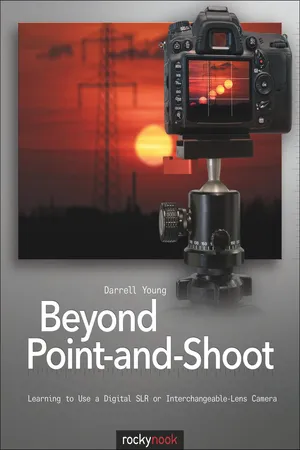 eBook - ePub
Beyond Point-and-Shoot
Learning to Use a Digital SLR or Interchangeable-Lens Camera
- Darrell Young(Author)
- 2012(Publication Date)
- Rocky Nook(Publisher)
long focal length.Angle of view is an important topic that we will investigate more in the next section. We will look at pictures all the way from a 10 mm focal length to a 400 mm focal length, and you will see how the angle of view changes according to the focal length of the lens. First, though, let’s talk a little more about focal length.Figure 2.7: View with a wide-angle lens (short focal length). Horses in Cades Cove of Great Smoky Mountains National Park.Figure 2.8: View with a normal lens (medium focal length). Emily and Gabe, a young married couple.Figure 2.9: View with a telephoto lens (long focal length). Sunset on Foothills Parkway West in Great Smoky Mountains National Park.Focal Length Changes Angle of View
The simplest way to describe focal length is to say, in general terms, it is the length of the lens in millimeters (mm). Physically longer lenses often have longer focal lengths, and shorter lenses often have shorter focal lengths. Figure 2.10 shows a short focal length lens (50 mm) and a long focal length lens (200 mm).Figure 2.10: Short (50 mm) and long (200 mm) focal length lensesHowever, defining focal length in this way is a little misleading because today’s lenses, made with computer-assisted design techniques, can manipulate (bend) light in ways that older lenses simply could not. A telephoto lens from today is often significantly shorter and lighter than a telephoto lens from years ago.Focal length does not really mean the actual physical length of the lens, although that is the way most photographers think about it. Technically speaking, focal length simply means the distance from the nodal point —often in the middle of the lens—to the imaging sensor surface (point of focus). If the distance from the nodal point to the imaging sensor is 50 millimeters, you have a 50 mm lens; if the distance is 200 millimeters, the lens is a 200 mm lens (figure 2.10 ). But don’t worry about it! That is as technical as we need to get. You do not have to worry about nodal points and distances to imaging sensors. All you have to do is learn to recognize how a certain focal length lens (or zoom setting) performs on your camera. If you want to know more about nodal points, there are plenty of articles on the web. Here is an article that is useful, although it is quite technical: http://en.wikipedia.org/wiki/Cardinal_point_(optics) eBook - PDF
- Michael A. Covington(Author)
- 1999(Publication Date)
- Cambridge University Press(Publisher)
See Dragesco (1995, especially p. 36) for more about customized cameras. You can even build your own camera – all it has to do is hold a piece of film in place at the focal plane. Simple homebuilt astrocameras are described in Sky & 9.10 Special astrocameras 161 Telescope (December, 1980, pp. 530–533, and December, 1985, pp. 612–613). They take round images on cut pieces of 35-mm film. And there are of course many ways to modify an old or cheap 35-mm camera for astrophotography. 9.11 Lenses Now for lenses – which are at least as important as cameras if you do piggy-backing or afocal work. The next few sections will define the basic types of camera lenses, explain how they work, and give some practical advice. For the whole story about how lenses work, see Kingslake (1978, 1989) and Ray (1994). A normal lens is one for which the focal length, film size (corner to corner), and lens-to-film distance are all about the same. For 35-mm film, which measures 43 mm corner to corner, normal lenses are in the 40–55-mm range. Whether normal lenses ‘‘match the human eye’’ is a matter of dispute; artists’ sketches usually cover a narrower field, corresponding to an 80- or 100-mm lens, but taking pictures of people indoors with an 80-mm lens is difficult because you often can’t get far enough away from the subject. Camera makers have settled on 50 mm as the best compromise, and this is generally their sharpest lens, as well as fastest. A telephoto lens produces a larger image of a narrower field of view. But ‘‘telephoto’’ means more than ‘‘long-focal-length.’’ As Fig. 9.5 shows, the focal length of a telephoto lens is usually greater than the physical length of the lens barrel. This is accomplished by negative projection – there is a negative element, similar to a Barlow lens, near the film. Some especially compact telephotos are mirror lenses, miniature Maksutov–Cassegrain telescopes, often with extra glass elements and even a refracting layer of glass in front of the mirror. eBook - PDF
- John D. Cutnell, Kenneth W. Johnson, David Young, Shane Stadler(Authors)
- 2018(Publication Date)
- Wiley(Publisher)
Accommodation The process by which the focal length of the eye is automatically adjusted, so that objects at different distances can be made to produce focused images on the retina. Near point The point nearest the eye at which an object can be placed and still produce a sharp image on the retina. Far point The location of the farthest object on which the fully relaxed eye can focus. Nearsightedness (myopia) A condition in which the eye can focus on nearby objects, but not on distant ones. The condition can be corrected through the use of glasses made from diverging lenses. Farsightedness (hyperopia) A condition in which the eye can focus on distant objects, but not on nearby ones. The condition can be correctec;l through the use of glasses made from converging lenses. Refractive power A figure of merit of a lens measured in diopters and given by 1/f, where f is the focal length of the lens in meters. Angular size The angle an object subtends at the eye of the viewer. Angular magnification The ratio of the fmal angular size produced by an optical instrument to the reference angular size of the object. Magnifying glass A single converging lens that fonns an enlarged, upright, and virtual image of an object which is placed at or inside the focal point of the lens. Compound microscope A device consisting of an objective lens and an eyepiece lens which produces an enlarged, inverted, and virtual image of an object. Astronomical telescope A device which magnifies distant objects with the aid of objective and eyepiece lenses. It produces a final image which is inverted and virtual. Spherical aberration An effect in which rays from the outer edge of a spherical lens are not focused at the same point as rays that pass through the center of the lens, thus causing images to be blurred. Chromatic aberration An undesirable lens effect arising when a lens focuses different colors at different points. eBook - PDF
- Graham Saxby(Author)
- 2016(Publication Date)
- CRC Press(Publisher)
The telephoto attachments increase the focal length of an existing lens system, usually by ×1.5 or ×2, and are simple Galilean telescopes. Wide-angle attachments are in the form of a reversed Galilean telescope, and decrease the focal length similarly. Figure 5.13a and b show the way the optics operate in each case when used in front of the camera lens. In many modern systems they are inserted behind the lens, i.e., in the image space, and in such cases the order of the components is reversed. Anamorphic systems squeeze the image in a single direction, and are used to produce images that can be expanded using a similar system, for projection in wide-screen format. One d D (a) D d (b) Figure 5.13 Afocal lens attachments: (a) telephoto; (b) retrofocus. These configurations apply to front fitting. D/d is the magnification. When fitted behind the main lens they are reversed. The Science of Imaging, Second Edition: An Introduction 76 form is similar to the wide-angle attachment except that it has cylindrical instead of spherical components. The other is more sophisticated, and consists of a pair of achromatic prism combinations (Figure 5.14). Altering the angle of these changes the squeeze ratio for different wide-screen formats. Lens Systems for Underwater Photography We have become so accustomed to watching superb examples of underwater photog-raphy in television documentaries that we tend to forget its technical difficulties (not to mention the hostility of the medium and of some of its residents). The photogra-phy itself is hampered by the turbidity of the water and the poor lighting conditions. The main optical problem is that we are no longer working in air, and the refractive index of the water has to be taken into account in the design of the optical system. If you are in the habit of swimming without goggles or a face mask, you will be aware of the impossibility of seeing underwater objects sharply without an airspace in front of your eyes. eBook - PDF
- Rudolf Kingslake(Author)
- 2012(Publication Date)
- Academic Press(Publisher)
III. DEPTH OF FOCUS AND DEPTH OF HELD 265 C. BY USE OF A TELENEGATIVE ATTACHMENT Instead of using an empty extension tube, a much greater change in image size can be obtained by using a 2 X or 3 X telenegative attach-ment, (a so-called tele-extender,) between the lens and the camera. This attachment serves to double or triple the image size without altering in any way the previously determined object distance. By means of such an attachment, combined with a diopter attachment if necessary, it is possible to copy a small object at a magnification close to unity. D. BY USE OF A SMALL BELLOWS If you are using a single-lens reflex camera (SLR), it is most conve-nient to use a macro lens with a small bellows between the lens and the camera. This type of lens has been especially designed for use at a wide range of magnifications with no loss of definition, and by extending the bellows sufficiently it is possible to reach unit magnification of even a little greater. It should be noted that at magnifications greater than unity, the lens should be turned around with the normal rear element facing the near object. E. BY MEANS OF A MACRO ZOOM LENS Some zoom lenses are called macro zooms because, by turning a locking ring, you can change the relation between the moving ele-ments in such a way that it is possible to focus on very close objects without loss of definition and without the need for front or rear attachments. III. DEPTH OF FOCUS AND DEPTH OF HELD The two terms depth of focus and depth of field are liable to be confused, and they are generally defined in the following manner. Assuming that the lens is free from all aberrations, there will be a 266 15. PHOTOGRAPHIC OPTICS certain plane in the object space that is precisely conjugate to the film plane in the image space. eBook - PDF
- Fritz Deumlich, Wolfgang Faig(Authors)
- 2010(Publication Date)
- De Gruyter(Publisher)
1. Optical Equipment and Level Bubbles scope length. The relative opening of the objective lens is the ratio of free diameter d EP of the objective lens and the focal length /: Figure 102 Objective lenses a) common achromat b) two lens objective with small air space ( Fraunhofer-Objective ) c) heavy flint achromats (Heavy flint glass = glass with high refractivity); nearly com-plete correction of the secular spectrum (38) The larger the relative opening, the higher the light strength. The latter in-creases with the square of q. Telelens objectives of surveying instruments have relative openings up to about 1 : 5, e.g. for theodolites 1 : 5.8 for the Wild T3, 1 : 7.9 for the T05, 1 : 5.8 for the T5 (U.S.S.R.); for tachometers 1 : 6.3 for the Dahlta, 1 :4.8 for the Redta (Zeiss, Jena), 1 :5.3 for the Wild RDS and 1 : 5.5 for the Wild EDH. The ratio is smaller for instruments which are used together with illuminated targets, than for instruments for sighting extended objects such as range poles or levelling rods. An increase in q leads to more complicated lens systems. Telescopes with bent path of rays are even shorter than the ones with straight arrangements and apochromats (figure 329, 330). Mirror telescopes also are very short, but have high light strength and are nearly free of the secondary spectrum as well as providing upright images. Figure 103a illustrates a straight telescope in the Cassegrain arrangement. Rays passing through the focal compound lens L (for aplanatic correction) are reflected from the drilled main mirror 8 1 to the convex capturing mirror S 2 , and from there, through the focussing lens Z to the cross hair plate G. The length of the system is 0.4/. Another telescope with bent path of rays (figure 103 b) consists of a collecting lens system with positive lens L^ and negative lens L 2 (which facilitates spherical correction and fulfils the sine condition), and two mirror lenses S 1 and S 2 (concave mirror). eBook - PDF
- Thomas Luhmann, Stuart Robson, Stephen Kyle, Jan Boehm(Authors)
- 2013(Publication Date)
- De Gruyter(Publisher)
As a rule of thumb, the focal length of a normal lens is approximately equal to the diagonal of the image format. Small image formats (found in video cameras, mobile phones and low-cost digital cameras) require short focal lengths in order to produce wide angles of view. 190 3 Imaging technology 3.4.3.3 Super wide-angle and fisheye lenses In close-range photogrammetry, short focal length lenses with wide fields of view are often selected because they allow for shorter object distances, greater object coverage and, consequently, more favourable ray intersection angles. Wide-angle lenses have fields of view typically in the range 60–75°. Lenses with larger fields of view designed to maintain the central perspective projection are known as super wide-angle lenses (approx. 80–120°). Whilst they have increased image aberrations and illumination fall-off towards the extremes of the image format (section 3.1.3.6), their use in photogrammetry is common as it supports working in cluttered environments with short taking distances. Fisheye lenses utilise a different optical design that departs from the central perspective imaging model to produce image circles of up to 180° (section 3.3.6). In general, the effect of radial distortion increases with larger fields of view. Fig. 3.96 shows examples of images taken with lenses of different focal lengths and fields of view. For some lenses the distortion is clearly visible and here the 15 mm quasi-fisheye lens shows the greatest distortion, but the illumination fall-off identifiable in the 14mm super wide angle lens image is noticeably absent. Fisheye lenses must be modelled using the appropriate fish eye projection model (see section 3.3.6) as the polynomials described in section 3.3.3.1 will be unstable due to the very high distortion gradients.
Index pages curate the most relevant extracts from our library of academic textbooks. They’ve been created using an in-house natural language model (NLM), each adding context and meaning to key research topics.

