Physics

Transformer
A transformer is a device that transfers electrical energy between two or more circuits through electromagnetic induction. It consists of two coils of wire, known as the primary and secondary windings, which are magnetically coupled but electrically isolated. When an alternating current passes through the primary coil, it creates a changing magnetic field that induces a voltage in the secondary coil, allowing for voltage transformation.
Written by Perlego with AI-assistance
Related key terms
1 of 5
10 Key excerpts on "Transformer"
 No longer available |Learn more
- (Author)
- 2014(Publication Date)
- The English Press(Publisher)
________________________ WORLD TECHNOLOGIES ________________________ Chapter- 4 Transformer Pole-mounted split-phase Transformer with center-tapped secondary winding (note use of grounded conductor, right, as one leg of the primary feeder) ________________________ WORLD TECHNOLOGIES ________________________ A Transformer is a device that transfers electrical energy from one circuit to another through inductively coupled conductors—the Transformer's coils. A varying current in the first or primary winding creates a varying magnetic flux in the Transformer's core and thus a varying magnetic field through the secondary winding. This varying magnetic field induces a varying electromotive force (EMF) or voltage in the secondary winding. This effect is called mutual induction. If a load is connected to the secondary, an electric current will flow in the secondary winding and electrical energy will be transferred from the primary circuit through the Transformer to the load. In an ideal Transformer, the induced voltage in the secondary winding ( V s ) is in proportion to the primary voltage ( V p ), and is given by the ratio of the number of turns in the secondary ( N s ) to the number of turns in the primary ( N p ) as follows: By appropriate selection of the ratio of turns, a Transformer thus allows an alternating current (AC) voltage to be stepped up by making N s greater than N p , or stepped down by making N s less than N p . In the vast majority of Transformers, the windings are coils wound around a ferromagnetic core, air-core Transformers being a notable exception. Transformers range in size from a thumbnail-sized coupling Transformer hidden inside a stage microphone to huge units weighing hundreds of tons used to interconnect portions of power grids. All operate with the same basic principles, although the range of designs is wide. No longer available |Learn more
- (Author)
- 2014(Publication Date)
- Academic Studio(Publisher)
____________________ WORLD TECHNOLOGIES ____________________ Chapter-2 Transformer Pole-mounted power distribution Transformer with center-tapped secondary winding (note use of grounded conductor, right, as one leg of the primary feeder). It transforms the high voltage of the overhead distribution wires to the lower voltage used in house wiring. A Transformer is a static device that transfers electrical energy from one circuit to another through inductively coupled conductors—the Transformer's coils. A varying current in the first or primary winding creates a varying magnetic flux in the Transformer's core and thus a varying magnetic field through the secondary winding. This ____________________ WORLD TECHNOLOGIES ____________________ varying magnetic field induces a varying electromotive force (EMF) or voltage in the secondary winding. This effect is called mutual induction. If a load is connected to the secondary, an electric current will flow in the secondary winding and electrical energy will be transferred from the primary circuit through the Transformer to the load. In an ideal Transformer, the induced voltage in the secondary winding ( V s ) is in proportion to the primary voltage ( V p ), and is given by the ratio of the number of turns in the secondary ( N s ) to the number of turns in the primary ( N p ) as follows: By appropriate selection of the ratio of turns, a Transformer thus allows an alternating current (AC) voltage to be stepped up by making N s greater than N p , or stepped down by making N s less than N p . In the vast majority of Transformers, the windings are coils wound around a ferromagnetic core, air-core Transformers being a notable exception. Transformers range in size from a thumbnail-sized coupling Transformer hidden inside a stage microphone to huge units weighing hundreds of tons used to interconnect portions of power grids. All operate with the same basic principles, although the range of designs is wide. No longer available |Learn more
- (Author)
- 2014(Publication Date)
- Academic Studio(Publisher)
____________________ WORLD TECHNOLOGIES ____________________ Chapter-1 Transformer Pole-mounted power distribution Transformer with center-tapped secondary winding (note use of grounded conductor, right, as one leg of the primary feeder). It transforms the high voltage of the overhead distribution wires to the lower voltage used in house wiring. A Transformer is a static device that transfers electrical energy from one circuit to another through inductively coupled conductors—the Transformer's coils. A varying current in the first or primary winding creates a varying magnetic flux in the ____________________ WORLD TECHNOLOGIES ____________________ Transformer's core and thus a varying magnetic field through the secondary winding. This varying magnetic field induces a varying electromotive force (EMF) or voltage in the secondary winding. This effect is called mutual induction. If a load is connected to the secondary, an electric current will flow in the secondary winding and electrical energy will be transferred from the primary circuit through the Transformer to the load. In an ideal Transformer, the induced voltage in the secondary winding ( V s ) is in proportion to the primary voltage ( V p ), and is given by the ratio of the number of turns in the secondary ( N s ) to the number of turns in the primary ( N p ) as follows: By appropriate selection of the ratio of turns, a Transformer thus allows an alternating current (AC) voltage to be stepped up by making N s greater than N p , or stepped down by making N s less than N p . In the vast majority of Transformers, the windings are coils wound around a ferromagnetic core, air-core Transformers being a notable exception. Transformers range in size from a thumbnail-sized coupling Transformer hidden inside a stage microphone to huge units weighing hundreds of tons used to interconnect portions of power grids. All operate with the same basic principles, although the range of designs is wide. No longer available |Learn more
- (Author)
- 2014(Publication Date)
- Academic Studio(Publisher)
____________________ WORLD TECHNOLOGIES ____________________ Chapter-11 Transformer Pole-mounted split-phase Transformer with center-tapped secondary winding (note use of grounded conductor, right, as one leg of the primary feeder) ____________________ WORLD TECHNOLOGIES ____________________ A Transformer is a device that transfers electrical energy from one circuit to another through inductively coupled conductors—the Transformer's coils. A varying current in the first or primary winding creates a varying magnetic flux in the Transformer's core and thus a varying magnetic field through the secondary winding. This varying magnetic field induces a varying electromotive force (EMF) or voltage in the secondary winding. This effect is called mutual induction. If a load is connected to the secondary, an electric current will flow in the secondary winding and electrical energy will be transferred from the primary circuit through the Transformer to the load. In an ideal Transformer, the induced voltage in the secondary winding (V s ) is in proportion to the primary voltage (V p ), and is given by the ratio of the number of turns in the secondary (N s ) to the number of turns in the primary (N p ) as follows: By appropriate selection of the ratio of turns, a Transformer thus allows an alternating current (AC) voltage to be stepped up by making N s greater than N p , or stepped down by making N s less than N p . In the vast majority of Transformers, the windings are coils wound around a ferromagnetic core, air-core Transformers being a notable exception. Transformers range in size from a thumbnail-sized coupling Transformer hidden inside a stage microphone to huge units weighing hundreds of tons used to interconnect portions of power grids. All operate with the same basic principles, although the range of designs is wide. No longer available |Learn more
- (Author)
- 2014(Publication Date)
- Orange Apple(Publisher)
________________________ WORLD TECHNOLOGIES ________________________ Chapter 2 Transformer Pole-mounted power distribution Transformer with center-tapped secondary winding (note use of grounded conductor, right, as one leg of the primary feeder). It transforms the high voltage of the overhead distribution wires to the lower voltage used in house wiring. ________________________ WORLD TECHNOLOGIES ________________________ A Transformer is a static device that transfers electrical energy from one circuit to another through inductively coupled conductors—the Transformer's coils. A varying current in the first or primary winding creates a varying magnetic flux in the Transformer's core and thus a varying magnetic field through the secondary winding. This varying magnetic field induces a varying electromotive force (EMF) or voltage in the secondary winding. This effect is called mutual induction. If a load is connected to the secondary, an electric current will flow in the secondary winding and electrical energy will be transferred from the primary circuit through the Transformer to the load. In an ideal Transformer, the induced voltage in the secondary winding ( V s ) is in proportion to the primary voltage ( V p ), and is given by the ratio of the number of turns in the secondary ( N s ) to the number of turns in the primary ( N p ) as follows: By appropriate selection of the ratio of turns, a Transformer thus allows an alternating current (AC) voltage to be stepped up by making N s greater than N p , or stepped down by making N s less than N p . In the vast majority of Transformers, the windings are coils wound around a ferromagnetic core, air-core Transformers being a notable exception. Transformers range in size from a thumbnail-sized coupling Transformer hidden inside a stage microphone to huge units weighing hundreds of tons used to interconnect portions of power grids. All operate with the same basic principles, although the range of designs is wide. eBook - PDF
- Jan De Kock, Cobus Strauss(Authors)
- 2004(Publication Date)
- Newnes(Publisher)
5 Transformer theory 5.1 Transformer theory Transformer is an essential device in electrical AC power distribution system, which is used to transform AC voltage magnitudes of any value obtained from a source to any desired value for the purpose of distribution and/or consumption. The development of power Transformer dates back to 19th century. The main feature of a Transformer is its constant VA rating whether referred to its primary side or the secondary side. With VA being constant ( V refers to the voltage magnitude and A refers to the current magnitude in a Transformer winding), it is possible to get a higher V with lower A or a lower V with a higher A , by choosing suitable ratio for the Transformer. The major benefit of such a device is its ability to take in the high current produced at relatively low voltage from the electrical generators and transform this power at a higher voltage level with lower current. This ensures that the power generated in the order of several megavolt amperes (MVA) is being transmitted at low current magnitudes in a cable of practical dimensions over very long distances. Today’s transmission and distribution systems are heavily dependent upon this technology and Transformers are used extensively throughout the world. The standard Transformer A standard Transformer typically consists of a pair of windings, primary and secondary linked together by a magnetic core. The windings can be connected in any of the following types, which in turn decides to which category a Transformer belongs. There are two basic types of the Transformer viz., (a) shell type and (b) core type. These are illustrated in Figure 5.1. In Figure 5.1, the windings are the concentric portions and the white solid portions refer to the metallic part of a Transformer (laminations), which either surround the windings (shell type) or where the windings surround the core (core type). No longer available |Learn more
- (Author)
- 2014(Publication Date)
- College Publishing House(Publisher)
____________________ WORLD TECHNOLOGIES ____________________ Chapter 7 Transformer Pole-mounted power distribution Transformer with center-tapped secondary winding (note use of grounded conductor, right, as one leg of the primary feeder). It transforms the high voltage of the overhead distribution wires to the lower voltage used in house wiring. A Transformer is a static device that transfers electrical energy from one circuit to another through inductively coupled conductors—the Transformer's coils. A varying current in the first or primary winding creates a varying magnetic flux in the Transformer's core and thus a varying magnetic field through the secondary winding. This varying magnetic field induces a varying electromotive force (EMF) or voltage in the secondary winding. This effect is called mutual induction. ____________________ WORLD TECHNOLOGIES ____________________ If a load is connected to the secondary, an electric current will flow in the secondary winding and electrical energy will be transferred from the primary circuit through the Transformer to the load. In an ideal Transformer, the induced voltage in the secondary winding ( V s ) is in proportion to the primary voltage ( V p ), and is given by the ratio of the number of turns in the secondary ( N s ) to the number of turns in the primary ( N p ) as follows: By appropriate selection of the ratio of turns, a Transformer thus allows an alternating current (AC) voltage to be stepped up by making N s greater than N p , or stepped down by making N s less than N p . In the vast majority of Transformers, the windings are coils wound around a ferromagnetic core, air-core Transformers being a notable exception. Transformers range in size from a thumbnail-sized coupling Transformer hidden inside a stage microphone to huge units weighing hundreds of tons used to interconnect portions of power grids. All operate with the same basic principles, although the range of designs is wide.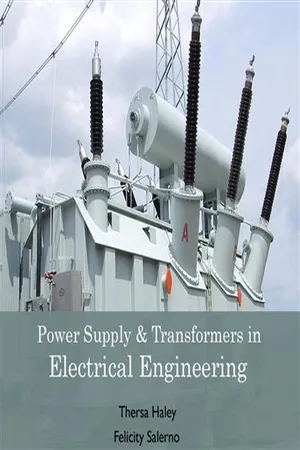 No longer available |Learn more
- (Author)
- 2014(Publication Date)
- Academic Studio(Publisher)
Transformers range in size f rom a thumbnail-sized coupling Transformer hidden inside a stage microphone to huge units weighing hundreds of tons used to interconnect portions of power grids. All operate with the same basic principles, although the range of designs is wide. While new t echnologies have eliminated the need for Transformers in some electronic circuits, Transformers are still found in nearly all electronic devices designed for household (mains) voltage. Transformers are essential for high -voltage electric power transmissi on, which makes long -distance transmission economically practical. ________________________ WORLD TECHNOLOGIES ________________________ History Discovery Faraday's experiment with induction between coils of wire The phenomenon of electromagnetic induction was discovered independently by Michael Faraday and Joseph Henry i n 1831. However, Faraday was the first to publish the results of his experiments and thus receive credit for the discovery. The relationship between electromotive force (EMF) or voltage and magnetic flux was formalized in an equation now referred to as Faraday's law of induction: . where is the magnitude of the EMF in volts and Φ B is the magnetic flux through the circuit (in webers). Faraday performed the first experiments on induction between coils of wire, including winding a pair of coils around an iron ring, thus creating the first toroidal closed -core Transformer. ________________________ WORLD TECHNOLOGIES ________________________ Induction coils Faraday's ring Transformer The first type of Transformer to see wide use was the induction coil, invented by Rev. Nicholas Callan of Maynooth College, Ireland in 1836. He was one of the first researchers to realize that the more turns the secondary winding has in relation to the primary winding, the larger is the increase in EMF. Induction coils evolved from scien -tists' and inventors' efforts to get higher voltages fro m batteries. No longer available |Learn more
- (Author)
- 2014(Publication Date)
- Academic Studio(Publisher)
Transformers range in size from a thumbnail-sized coupling Transformer hidden inside a stage microphone to huge units weighing hundreds of tons used to interconnect portions of power grids. All operate with the same basic principles, although the range of designs is wide. While new technologies have eliminated the need for Transformers in some electronic circuits, Transformers are still found in nearly all electronic devices designed for household (mains) voltage. Transformers are essential for high-voltage electric power transmission, which makes long -distance transmission economically practical. ____________________ WORLD TECHNOLOGIES ____________________ History Discovery Faraday's experiment with induction between coils of wire The phenomenon of electromagnetic induction was discovered independently by Michael Faraday and Joseph Henry in 1831. However, Faraday was the first to publish the results of his experiments and thus receive credit for the discovery. The relationship between electromotive force (EMF) or voltage and magnetic flux was formalized in an equation now referred to as Faraday's law of induction: . where is the magnitude of the EMF in volts and Φ B is the magnetic flux through the circuit (in webers). ____________________ WORLD TECHNOLOGIES ____________________ Faraday performed the first experiments on induction between coils of wire, including winding a pair of coils around an iron ring, thus creating the first toroidal closed -core Transformer. Induction coils Faraday's ring Transformer The first type of Transformer to see wide use was the induction coil, invented by Rev. Nicholas Callan of Maynooth College, Ireland in 1836. He was one of the first researchers to realize that the more turns the secondary winding has in relation to the primary wind ing, the larger is the increase in EMF. Induction coils evolved from scientists' and inventors' efforts to get higher voltages from batteries. eBook - PDF
Electronic and Electrical Engineering
Principles and Practice
- Lionel Warnes(Author)
- 2017(Publication Date)
- Red Globe Press(Publisher)
298 Figure 16.1 The parts of a Transformer (16.1) 16 Transformers P ROPERLY-DESIGNED Transformers are highly efficient (up 99.5% for some multi-MVA Transformers) devices that are chiefly used to step down (or step up) alternating voltages and also for matching loads. They range in size from multi-tonne, multi-MVA Transformers in electricity distribution systems to 1VA, PCB-mounted Transformers for portable instruments. Besides their high efficiencies, they are also notable for their reliability and freedom from the need for maintenance virtues stemming from their lack of moving parts. AC became standard partly because Transformers have these attractive properties, relegating DC to special purposes. 16.1 The ideal Transformer A Transformer comprises two coils wrapped around a magnetic (more correctly ferromagnetic) core which channels nearly all the magnetic flux through them. Figure 16.1 shows a Transformer, one coil of which the primary is connected to the supply, while the other coil the secondary is connected to the load. The coils are wound onto the limbs of the core, which are connected by a yoke . Transformers are reversible because primary can become secondary and vice versa: the primary is the coil connected to the primary supply, that is all. Current passing through the primary coil produces magnetic flux in the core; if all this flux passes through the secondary coil then the e.m.f. induced in it can be found from Faraday’s law of electromagnetic induction: The voltages are proportional to the numbers of turns in the coils: the coil with the most turns Chapter 16 299 (16.3) (16.2) (16.4) (16.5) Figure 16.2 The dot convention has the higher voltage . An ideal Transformer is 100% efficient and the power put into the primary coil is equal to the power put out by the secondary: P 1 = P 2 . That is Substituting for V 1 / V 2 from Equation 16.1 gives where n is the turns ratio of the Transformer.
Index pages curate the most relevant extracts from our library of academic textbooks. They’ve been created using an in-house natural language model (NLM), each adding context and meaning to key research topics.

