Physics

Simple Motor
A simple motor is a basic device that converts electrical energy into mechanical motion. It typically consists of a coil of wire (the armature) that rotates within a magnetic field when an electric current is passed through it. This motion is used to drive a shaft or perform other mechanical work.
Written by Perlego with AI-assistance

9 Key excerpts on "Simple Motor"
 No longer available |Learn more
- (Author)
- 2014(Publication Date)
- Orange Apple(Publisher)
Electric motors may be classified by the source of electric power, by their internal construction, by their application, or by the type of motion they give. The physical principle of production of mechanical force by the interactions of an electric current and a magnetic field was known as early as 1821. Electric motors of increasing efficiency were constructed throughout the 19th century, but commercial exploitation of electric motors on a large scale required efficient electrical generators and electrical distribution networks. Some devices, such as magnetic solenoids and loudspeakers, although they generate some mechanical power, are not generally referred to as electric motors, and are usually termed actuators and transducers, respectively. ________________________ WORLD TECHNOLOGIES ________________________ History and development Faraday's electromagnetic experiment, 1821 Proof of principle The conversion of electrical energy into mechanical energy by an electromagnetic means was demonstrated by the British scientist Michael Faraday in 1821. A free-hanging wire was dipped into a pool of mercury, on which a permanent magnet was placed. When a current was passed through the wire, the wire rotated around the magnet, showing that the current gave rise to a close circular magnetic field around the wire. This motor is often demonstrated in school physics classes, but brine (salt water) is sometimes used in place of the toxic mercury. This is the simplest form of a class of devices called homopolar motors. A later refinement is the Barlow's wheel. These were demonstration devices only, unsuited to practical applications due to their primitive construction. ________________________ WORLD TECHNOLOGIES ________________________ Jedlik's electromagnetic self-rotor, 1827 (Museum of Applied Arts, Budapest. The historic motor still works perfectly today.) In 1827, Hungarian physicist Ányos Jedlik started experimenting with devices he called electromagnetic self-rotors. No longer available |Learn more
- (Author)
- 2014(Publication Date)
- Learning Press(Publisher)
The physical principle of production of mechanical force by the interactions of an electric current and a magnetic field was known as early as 1821. Electric motors of increasing efficiency were constructed throughout the 19th century, but commercial exploitation of electric motors on a large scale required efficient electrical generators and electrical distribution networks. Some devices, such as magnetic solenoids and loudspeakers, although they generate some mechanical power, are not generally referred to as electric motors, and are usually termed actuators and transducers, respectively. ________________________ WORLD TECHNOLOGIES ________________________ History and development Faraday's Electromagnetic experiment, 1821 The principle The conversion of electrical energy into mechanical energy by a electromagnetic means was demonstrated by the British scientist Michael Faraday in 1821. A free-hanging wire was dipped into a pool of mercury, on which a permanent magnet was placed. When a current was passed through the wire, the wire rotated around the magnet, showing that the current gave rise to a close circular magnetic field around the wire. This motor is often demonstrated in school physics classes, but brine (salt water) is sometimes used in place of the toxic mercury. This is the simplest form of a class of devices called homopolar motors. A later refinement is the Barlow's Wheel. These were demonstration devices only, unsuited to practical applications due to their primitive construction. ________________________ WORLD TECHNOLOGIES ________________________ Jedlik's electromagnetic self-rotor, 1827. (Museum of Applied Arts, Budapest. The historic motor still works perfectly today.) In 1827, Hungarian Ányos Jedlik started experimenting with electromagnetic rotating devices he called electromagnetic self-rotors. eBook - ePub
Electric Motors and Drives
Fundamentals, Types and Applications
- Austin Hughes, Bill Drury(Authors)
- 2019(Publication Date)
- Newnes(Publisher)
Electric motors are so much a part of everyday life that we seldom give them a second thought. When we switch on an ancient electric drill, for example, we confidently expect it to run rapidly up to the correct speed, and we don’t question how it knows what speed to run at, nor how it is that once enough energy has been drawn from the supply to bring it up to speed, the power drawn falls to a very low level. When we put the drill to work it draws more power, and when we finish the power drawn from the supply reduces automatically, without intervention on our part.The humble motor, consisting of nothing more than an arrangement of copper coils and steel laminations, is clearly rather a clever energy converter, which warrants serious consideration. By gaining a basic understanding of how the motor works, we will be able to appreciate its potential and its limitations, and (in later chapters) see how its already remarkable performance is dramatically enhanced by the addition of external electronic controls.The great majority of electric motors have a shaft which rotates, but linear electric motors have niche applications, and whilst they appear very different from their rotating sister, their principle of operation is the same.This chapter deals with the basic mechanisms of motor operation, so readers who are already familiar with such matters as magnetic flux, magnetic and electric circuits, torque, and motional e.m.f. (electromotive force) can probably afford to skim over much of it. In the course of the discussion, however, several very important general principles and guidelines emerge. These apply to all types of motor and are summarised in Section 1.9 . Experience shows that anyone who has a good grasp of these basic principles will be well equipped to weigh the pros and cons of the different types of motor, so all readers are urged to absorb them before tackling other parts of the book.1.2 Producing rotation
Nearly all motors exploit the force which is exerted on a current-carrying conductor placed in a magnetic field. The force can be demonstrated by placing a bar magnet near a wire carrying current (Fig. 1.1 ), but anyone trying the experiment will probably be disappointed to discover how feeble the force is, and will doubtless be left wondering how such an unpromising effect can be used to make effective motors.Fig. 1.1 No longer available |Learn more
- (Author)
- 2014(Publication Date)
- Academic Studio(Publisher)
The physical principle of production of mechanical force by the interactions of an electric current and a magnetic field was known as early as 1821. Electric motors of increasing efficiency were constructed throughout the 19th century, but commercial exploitation of electric motors on a large scale required efficient electrical generators and electrical distribution networks. Some devices, such as magnetic solenoids and loudspeakers, although they generate some mechanical power, are not generally referred to as electric motors, and are usually termed actuators and transducers, respectively. ____________________ WORLD TECHNOLOGIES ____________________ History and development Faraday's electromagnetic experiment, 1821 Proof of principle The conversion of electrical energy into mechanical energy by an electromagnetic means was demonstrated by the British scientist Michael Faraday in 1821. A free-hanging wire was dipped into a pool of mercury, on which a permanent magnet was placed. When a current was passed through the wire, the wire rotated around the magnet, showing that the current gave rise to a close circular magnetic field around the wire. This motor is often demonstrated in school physics classes, but brine (salt water) is sometimes used in place of the toxic mercury. This is the simplest form of a class of devices called homopolar motors. A later refinement is the Barlow's wheel. These were demonstration devices only, unsuited to practical applications due to their primitive construction. ____________________ WORLD TECHNOLOGIES ____________________ Jedlik's electromagnetic self-rotor, 1827 (Museum of Applied Arts, Budapest. The historic motor still works perfectly today.) In 1827, Hungarian physicist Ányos Jedlik started experimenting with devices he called electromagnetic self-rotors.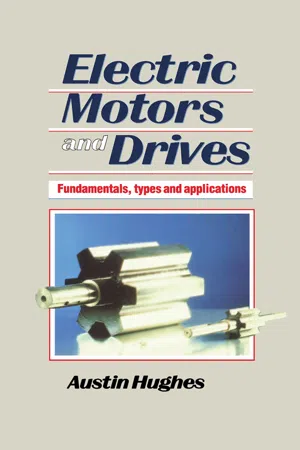 eBook - PDF
Electric Motors and Drives
Fundamentals, types and applications
- Austin Hughes(Author)
- 2013(Publication Date)
- Newnes(Publisher)
7 ELECTRIC MOTORS INTRODUCTION Electric motors are so much a part of everyday life that we seldom give them a second thought. When we switch on an electric drill, for example, we expect it to run rapidly up to the correct speed, and we don't question how it knows what speed to run at, nor how it is that once enough energy has been drawn from the supply to bring it up to speed, the power drawn falls to a very low level. When we put the drill to work it draws more power, and when we finish the power drawn from the mains reduces automatically, without inter-vention on our part. The humble motor, consisting of nothing more than an arrangement of copper coils and steel laminations, is clearly rather a clever energy converter, which warrants serious con-sideration. By gaining a basic understanding of how the motor works, we will be able to appreciate its potential and its limitations, and (in later chapters) see how its already remarkable performance can be even further improved by the addition of external controls. This chapter deals with the basic mechanisms of motor operation, so readers who are already familiar with such matters as magnetic flux, magnetic and electric circuits, torque, and motional e.m.f. can probably afford to skip most 2 Electric Motors and Drives PRODUCING ROTATION Nearly all motors exploit the force which is exerted on a current-carrying conductor placed in a magnetic field. The force can be demonstrated by placing a bar magnet near a wire carrying current, but anyone who tries the experiment will probably be disappointed to discover how feeble the force is, and will doubtless be left wondering how such an unpromising effect can be used to make effective motors. We shall see that in order to make the most of the mechan-ism, we need to arrange for there to be a very strong magnetic field, and for it to interact with many conductors, each carry-ing as much current as possible.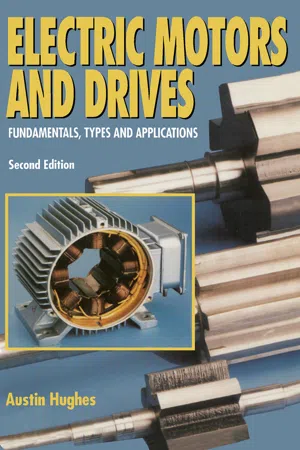 eBook - PDF
Electric Motors and Drives
Fundamentals, Types and Applications
- Austin Hughes(Author)
- 2013(Publication Date)
- Newnes(Publisher)
7 ELECTRIC MOTORS INTRODUCTION Electric motors are so much a part of everyday life that we seldom give them a second thought. When we switch on an electric drill, for example, we expect it to run rapidly up to the correct speed, and we don't question how it knows what speed to run at, nor how it is that once enough energy has been drawn from the supply to bring it up to speed, the power drawn falls to a very low level. When we put the drill to work it draws more power, and when we finish the power drawn from the mains reduces automatically, without intervention on our part. The humble motor, consisting of nothing more than an arrangement of copper coils and steel laminations, is clearly rather a clever energy converter, which warrants serious con-sideration. By gaining a basic understanding of how the motor works, we will be able to appreciate its potential and its limitations, and (in later chapters) see how its already remark-able performance can be even further improved by the addition of external controls. This chapter deals with the basic mechanisms of motor operation, so readers who are already familiar with such matters as magnetic flux, magnetic and electric circuits, torque, and motional e.m.f can probably afford to skip most of it. In the course of the discussion, however, several very important 2 Electric Motors and Drives general principles and guidelines emerge. These apply to all types of motor and are summarised in the concluding section. Experience shows that anyone who has a good grasp of these basic principles will be well equipped to weigh the pros and cons of the different types of motor, so all readers are urged to absorb them before tackling other parts of the book. PRODUCING ROTATION Nearly all motors exploit the force which is exerted on a current-carrying conductor placed in a magnetic field. eBook - PDF
- Irving Gottlieb(Author)
- 1997(Publication Date)
- Newnes(Publisher)
In a Electric motor generalities 7 Fig. 1.6 Motor action exerted on current-carrying conductor in a magnetic field. Endowing magnetic lines of force with the elastic property of rubber- bands, enables one to visualize the motion imparted to a current-carrying conductor. The interaction of the magnetic fields as shown is found in vir- tually all electric motors. Downward motion of the conductor would occur if either (not both) the current direction or the magnetic poles were reversed. Note: Conventional current-flow is used in this book. general, but inviolate way, it tells us that 'any change in magnetic flux linkage is accompanied by effects opposing the change'. The electrlc motor as an energy converter At the very outset, we should concern ourselves with what electric motors do. A popular but erroneous notion is that electric motors create or produce mechanical energy. Mechanical energy is definitely not created; yes, it may be said to be produced at the shaft of the motor, but this is, at best, only a partial answer. We must point out that this mechanical energy comes at the expense of some other form of energy. The simple and true fact of the matter is that the electric motor (and the electric generator, as well) is an energy converter. More specifically, the motor converts electrical energy into mechanical energy. In so doing, it is never 100% efficient-in the overall budget of energy availability, there are always inevitable energy losses. These losses may manifest themselves as still other forms of energy, such as heat, light, sound, friction, radiation, etc. Energy, itself is the capability of doing work. In the practical world, it would be well to say that available energy represents the capability of doing usefulwork. Because of nature's previous activities, most of the useful energy 8 Practical Electric Motor Handbook ,, , . . . . sources stem from various chemical, gravitational, and nuclear arrangements of planetary matter. eBook - PDF
Micromechatronics
Modeling, Analysis, and Design with MATLAB, Second Edition
- Victor Giurgiutiu, Sergey Edward Lyshevski(Authors)
- 2016(Publication Date)
- CRC Press(Publisher)
4 Permanent-Magnet Direct-Current Motion Devices and Actuators 4.1 Permanent-Magnet Motion Devices and Electric Machines: Introduction The principle of energy conversion and electromagnetic electromechanical motion devices were fi rst examined and demonstrated by Michael Faraday in 1821. One of the fi rst commutator direct current (DC) electric motors was designed, tested, utilized, and com-mercialized by Anyos Jedlik in 1828 and William Sturgeon in 1832. Alternating current machines (synchronous and induction) were invented and demonstrated by Nicola Tesla in 1880s. By 1882, Nicola Tesla pioneered and developed the theory of the rotating magnetic fi eld which is a cornerstone principle of electromechanical motion devices. He designed and demonstrated a two-phase induction motor in 1883. The fi rst three-phase squirrel-cage induction motor was invented and demonstrated by Michail Osipovish Dolivo-Dobrovolski in 1890. In this chapter, we study various high-performance translational and rotational DC electromechanical motion device and actuators which operate utilizing the electromagnetic interactions between windings and permanent magnets. As covered in Section 2.5, the torque tends to align the magnetic moment ~ m with ~ B , and ~ T ¼ ~ m ~ B . Various illustrative examples were reported and visualized in Figure 2.14. One also recalls that the torque is ~ T ¼ ~ R ~ F , where for a fi lamentary closed loop the expression for the electromagnetic force is ~ F ¼ i þ l ~ B d ~ l . This equation is simpli fi ed to ~ F ¼ i ~ B þ d ~ l for a uniform magnetic fl ux density distribution. We examined electrostatic and variable-reluctance actuators in Chapter 3 emphasizing that other advanced actuation solutions exist. The device physics can be centered on utilization of the energy stored by permanent magnets which establish a strong stationary magnetic fi eld. The electromagnetic force and torque production is evident from the equations for F and T reported. eBook - ePub
The Principles of Electronic and Electromechanic Power Conversion
A Systems Approach
- Braham Ferreira, Wim van der Merwe(Authors)
- 2013(Publication Date)
- Wiley-IEEE Press(Publisher)
Chapter 7
Simple Electrical Machines
7.1 Introduction
The physical principle of the production of mechanical force by the interaction between an electric current and a magnetic field was known as early as 1821. In electricity generation, an electric generator is a device that converts mechanical energy to electrical energy. The reverse conversion of electrical energy into mechanical energy is done by an electric motor, and motors and generators have many similarities. In fact, many motors can be mechanically driven to generate electricity and can often make acceptable generators.Chapter 7 is the first of two chapters about electrical machines, the principle of operation is discussed and a simple dc electrical machine is introduced. The focus is on the principles of converting electrical power into mechanical power and on taking the initial steps for understanding how an electrical machine contributes to the operation of electrical energy conversion systems.The dc machine made it possible to control the application of mechanical power. Older trains and trams used rheostats, another name for variable resistors, to control the current that flows through the armature and the field winding making it possible to accelerate smoothly and to control the top speed. Next time you go to a technical museum, take a look at the antique trains and trams and see how cleverly the old engineers designed the drivetrains.In this chapter, we do not discuss the various arrangements of field windings and the speed and torque characteristics of self-excited dc machines that many textbooks have as this is old fashioned. Nowadays, the control is done with power electronics.
Index pages curate the most relevant extracts from our library of academic textbooks. They’ve been created using an in-house natural language model (NLM), each adding context and meaning to key research topics.

