Politics & International Relations

Brutus Papers
The Brutus Papers were a series of essays written by Robert Yates, a delegate to the Constitutional Convention, in opposition to the ratification of the United States Constitution. The papers argued that the Constitution would create a powerful central government that would infringe upon the rights of the states and the people.
Written by Perlego with AI-assistance
Related key terms
1 of 5

3 Key excerpts on "Brutus Papers"
 eBook - PDF
The Federalist
With Letters of Brutus
- Alexander Hamilton, James Madison, John Jay, Terence Ball(Authors)
- 2003(Publication Date)
- Cambridge University Press(Publisher)
, , in PJM , vol. , p. . A Citizen of Philadelphia [Peletiah Webster], The Weakness of Brutus Exposed (Philadelphia, ), in FC , p. ; DH , vol. , p. . Brutus highly competent way the major Anti-Federalist themes, such as consolidation, the small republic, a bill of rights, and representa-tion. He provides the best Anti-Federalist rebuttal of the powerful Federalist argument, well known in the form given it by Publius, that the federal government must be given unlimited powers to meet the unlimited contingencies implicit in its vast responsibility. He provides an extended and excellent discussion – the best in the Anti-Federalist literature – of the judiciary to be established under the Constitution and its far-reaching implications. In these latter respects and in general, the Brutus essays are the most direct Anti-Federal confrontation of the arguments of The Federalist . Who was the redoubtable polemicist who called himself Brutus? The best guess is that he was Robert Yates ( – ), a prominent New York jurist and one of that state’s three delegates to the Philadelphia convention (the other two were John Lansing and Alexander Hamilton). Yates and Lansing left Philadelphia in a fury when it became clear that the delegates were bent not on revising but on scrapping the Articles of Confederation and replacing them with a new constitution. But whether Yates was Brutus cannot be known for certain. Despite some scholars’ confidence that Yates was Brutus, others have expressed reservations and withheld judgment. But, whatever his identity, Brutus provides a critical counterpoint to Publius. By reprinting his letters in full, with cross-references and citations to The Federalist and the Constitution, we can better see how deeply intertwined and contrapuntal their arguments actually are. eBook - PDF
The Federalist Papers
A Reader's Guide
- Kyle Scott(Author)
- 2013(Publication Date)
- Bloomsbury Academic(Publisher)
For Publius to denounce them as he does is a way of reinforcing the claim that what the U.S. Constitution creates is nothing short of new and revolutionary. It assimilates the lessons of history and philosophy into a new sort of regime which the world up until this point has never known. So whatever one may think of the greatness of Rome, or the brilliance of Athens and Sparta, Publius tells us to disregard them when it comes to politics and listen instead to those who met in Philadelphia. New York Anti-Federalist Brutus, who adopted the pen name from the Roman Brutus who slew Cesar in the name of liberty and republican government, saw things quite differently from Publius. While Publius made no apologies for taking what was good from previous governments and then devising an entirely new system and theory, Brutus thought such a break was presumptuous, conceited, READING THE FEDERALIST PAPERS 69 and foolhardy. With no proof that what Publius proposes can succeed, Brutus says that it cannot succeed. History furnishes no examples of a free republic, anything like the extent of the United States. The Grecian Republics were of small extent; so also was that of the Romans. Both of these, it is true, in process of time, extended their conquests over large territories of country; and the consequence was, that their governments were changed from that of free governments to those of the most tyrannical that ever existed in the world (Ketcham 1993: 276). This is a clash of worldviews on display. One side, Publius, thinks that breaking from the past is possible and beneficial; that the U.S.A. can re-create what has always occurred by learning from its mistakes. Brutus thinks that if it has not been done it cannot be done, that breaking with the past should be limited in manner and extent.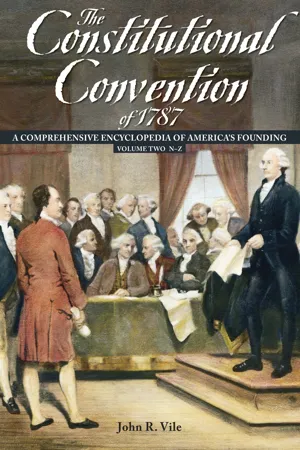 eBook - PDF
The Constitutional Convention of 1787
A Comprehensive Encyclopedia of America's Founding [2 volumes]
- John R. Vile(Author)
- 2005(Publication Date)
- ABC-CLIO(Publisher)
Such names con- veyed authors’ broad intentions without identify- ing them by name and thus drawing attention to their personalities rather than to arguments (see Bernstein with Rice 1987, 218). Writers often chose names from classical history. At the time that Alexander Hamilton was considering publi- cation of The Federalist, essays critical of the Con- stitution, probably written by Robert Yates, were being published in New York under the pen name of Brutus. This name was derived from that of Lucius Brutus, who had overthrown Tarquin, the last Roman king, and was the forebear of Marcus Junius Brutus, the ringleader in the assas- sination of the future dictator Julius Caesar. In entering the fray with The Federalist, Alexan- der Hamilton drew from his knowledge of Plu- tarch to come up with the name Publius. Publius Valerius was the statesman who established a wor- thy republican government after Lucius Brutus overthrew Tarquin. The Romans had called Pub- lius “Publicola,” or “people-lover,” as a way of symbolizing his commitment to republican gov- ernment. Hamilton wanted to convey this same commitment to republicanism in his and his col- laborators’ essays (Bernstein with Rice 231). for further reading Bernstein, Richard B., with Kym S. Rice. 1987. Are We to Be a Nation? The Making of the Constitution. Cam- bridge, MA: Harvard University Press. Hamilton, Alexander, James Madison, and John Jay. 1961. The Federalist Papers. Ed. Clinton Rossiter. New York: New American Library. Publius Madison instead advocated attempting to control its effects. He argued that the new government would do so both by substituting the considered judgment of the people’s representatives for the people themselves and by embracing a larger land area than that of earlier democracies. Madison theorized that, unlike a pure democracy, this re- public would encompass so many factions that no single faction would be likely to dominate.
Index pages curate the most relevant extracts from our library of academic textbooks. They’ve been created using an in-house natural language model (NLM), each adding context and meaning to key research topics.

