Politics & International Relations

Criminal Law
Criminal law refers to the body of laws that deal with conduct considered harmful to society. It encompasses the prosecution and punishment of individuals who have committed crimes, such as theft, assault, or murder. Criminal law also outlines the legal procedures and rights of the accused, as well as the penalties for different offenses.
Written by Perlego with AI-assistance
Related key terms
1 of 5


7 Key excerpts on "Criminal Law"
 eBook - PDF
- Topo Santoso(Author)
- 2023(Publication Date)
- Hart Publishing(Publisher)
See www.collinsdictionary. com/dictionary/english/criminal-code. President for mutual approval, 8 with the President then enacting the agreed-upon bill to become law. 9 This process was reaffirmed by Article 1 point 3 of Law No 12 of 2011, which states that a law is statutory legislation established by the House of Representatives with the mutual approval of the President. In this discussion, the sources of Criminal Law will be limited to the sense defined by Sudikno Mertokusumo above, namely ‘where we can find or explore the law’. 10 In other words, this is the origin or source from which a regulation obtains legal force. 11 Thus this chapter will discuss the sources of law where provisions regarding Criminal Law can be found, including provisions on the prin- ciple of legality; the application of Criminal Law according to place and person; criminal acts and their elements; criminal sanctions; attempted criminal acts; complicity in criminal acts; concurrence of criminal acts; the basis for aggravating the punishment; the basis for mitigating the punishment; the basis for elimination of punishment; and the dismissal of the criminal prosecution authority. Literature on Criminal Law generally presents three sources of Criminal Law: (1) the Criminal Code and the laws that amend it; (2) Special Criminal Laws outside the Criminal Code; and (3) Non-Criminal Laws which contain criminal provisions. Section II will look at Indonesia’s Criminal Code. II. Criminal Code A code of law is a collection or compendium. It is a complete positive legal system, scientifically regulated, and declared by legislative authorities. A body of law is drawn up by a legislative authority, and is intended to establish, in a general and systematic form, the principles of all laws, whether written or unwritten, positive or customary, derived from law (enactment) or from a previous decision (prec- edent).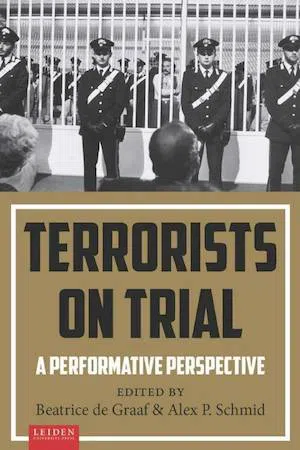
- Alex P. Schmid, Beatrice de Graaf(Authors)
- 2016(Publication Date)
- Leiden University Press(Publisher)
The only existing international terrorist court, the Special Tribunal for Lebanon in The Hague, still has to adhere to Lebanese national law.3 The Lockerbie trial (2000–2001), held in the Netherlands, was conducted under Scottish national law. This illustrates that justice basically remains linked to national political communities, and is subject to national sovereignty. Terrorists, on the other hand, have traditionally breached national sovereignty and crossed international borders. Terrorist trials are often considered ‘political’. There is a widespread implicit assumption that a ‘political trial’ also amounts to ‘political justice’, i.e. that such 24 | pa{ltex p. srcwh|mxisd trials are partisan, like some trials held by victorious powers at the end of a war. In this chapter, I will examine the notions of ‘terrorism’ and ‘crime’, and what we actually mean when we call a crime or a trial ‘political’. I will also explore the notion of ‘justice’ and its dark twin brother ‘revenge’. On closer inspection, all of these terms are ambiguous. 2.2. Political Crime and the Political Offence Exception Perhaps the least controversial of these concepts would seem to be the concept of ‘crime’. Yet even the notion of what is considered a crime varies greatly across time and cultural space, as the laws that define an offence vary, and as what is and what is not considered moral and legitimate varies. Crimes are often interpreted in terms of a conflict between a ‘bad’ individual and a ‘good’ society—with the government standing between the parties as the representative of society, bringing to trial those who violate its norms.4 The state has the prerogative to proscribe an act against persons or property it deems dangerous or merely undesirable, thereby making it a crime. Many prohibited acts are, however, ‘victimless’, like some traffic offences or violations of migration law; these are crimes merely because the state has declared them to be punishable offences. eBook - PDF
- Carlson Anyangwe(Author)
- 2015(Publication Date)
- Langaa RPCIG(Publisher)
57 Part II Application of the Criminal Law The basic principles governing the application of the Criminal Law in this country are these. Firstly, all persons are subject to the Criminal Law. 1 Secondly, municipal Criminal Law is subject to international law and to all treaties duly promulgated and published. 2 Thirdly, the general part of the Criminal Law governs any other criminal provision, whether it is contained in the Penal Code or not, save as otherwise provided by law as an exception that adds to or derogates from the general part. 3 Fourthly, any general principle of the Criminal Law that is not contained in Book I of the Penal Code must yield to a particular provision governing the same matter but which is inconsistent with the said general principle. 4 1 Penal Code, s.1. Parliamentary immunity or head-of-state immunity only means that the beneficiary of any such immunity may not be arrested or prosecuted while covered by the terms of the immunity. 2 Penal Code, s.2(1). International law, whether conventional or customary, trumps municipal law whenever they clash. 3 Penal Code, s.2(2). 4 Penal Code, s.2(3). 58 59 Chapter 5 The Principle of Legality: A Safeguard of Individual Liberty The principle of legality is the root principle that underlies the administration of the Criminal Law in all modern systems of law. It forms part of the rule of law originally adumbrated by European political thinkers of the 17 th and 18 th centuries like Montesquieu and Beccaria who were very dissatisfied with the harshness and arbitrariness of both the political and criminal justice systems of the time. This fundamental principle is often expressed in the following Latin maxim, nullum crimen, nulla poena sine lege. There is no crime, no punishment, except in accordance with law. There can be no crime or penalty without law making it so. eBook - PDF
Globalisation, Criminal Law and Criminal Justice
Theoretical, Comparative and Transnational Perspectives
- Valsamis Mitsilegas, Peter Alldridge, Leonidas Cheliotis, Valsamis Mitsilegas, Peter Alldridge, Leonidas Cheliotis(Authors)
- 2015(Publication Date)
- Hart Publishing(Publisher)
1 The Concept of Crime and Transnational Networks of Community ROGER COTTERRELL* Introduction: Politics, Culture and Crime Is there a need for a concept of crime? Surely debates around this issue have now been played out? Louk Hulsman notes that ‘there is no “ontological reality” of crime’. 1 That is, the term seems to refer to no irreducible, distinctive social phe-nomenon existing independently of legal definition. Crime is what the state (or some international agency authorised by states) declares it to be through law. By designating an offence as ‘criminal’, state law links it to pre-existing assumptions about the kinds of punishment appropriate for criminal behaviour and, it seems, any conduct might be so designated. Crime is what the Criminal Law in a given society at a given time states it to be. For Criminal Lawyers in general what matters is the procedure and substance of this law. Moreover, juristically rationalising it is not the same as conceptualising ‘crime’ as a social entity. Yet the immense variety of kinds of conduct labelled as criminal sometimes attracts comment and even concern 2 because ‘the sheer number of criminal offences has grown exponentially’. 3 In this situation, doubts about the coherence of ‘crime’ as a category have tended in practice to be pushed aside, so William Stuntz suggested, by making Criminal Law not one field but two. The first [field] consists of a few core crimes . . . The second consists of everything else. Criminal Law courses, Criminal Law literature, and popular conversations about crime focus heavily on the first. The second dominates criminal codes. 4 * I am grateful to Bill Gilmore, Leonidas Cheliotis, Philip Stenning, David Nelken and Robert Reiner for their comments. 1 LHC Hulsman, ‘Critical Criminology and the Concept of Crime’ in J Muncie, E McLaughlin and M Langan (eds), Criminological Perspectives: A Reader (London, Sage, 1996) 300. eBook - PDF
International Law, Power, Security and Justice
Essays on International Law and Relations
- Serge Sur(Author)
- 2010(Publication Date)
- Hart Publishing(Publisher)
A. The Dimensions of the Internationalisation of Criminal Law The internationalisation in question has three dimensions, which corre-spond to three successive stages of development. The first, the minimal stage of internationalisation, is limited to a conventional establishment of police and judicial cooperation between states for a better application of their respective domestic Criminal Laws. Extradition conventions are a prime example. In such a scenario, the consent of the public authorities of other states can be required to ensure the application of domestic Criminal Law; but to be precise, we are still dealing with the application of domestic law— the determination of offences and punishments remains solely domestic, and extradition in fact can always be refused by the solicited state. This minimal variation on Criminal Law can result in a more developed inter-nationalisation, as when the Security Council, through a decision, that is to say by means of an international, unilateral and obligatory act, orders a state to produce certain of its citizens before a foreign criminal court. This was the case years ago with regard to Libya (Resolution 731 of 21 January 1992), and in this we can see the preliminary working of what would go on to become the special international tribunals created by the Security Council. A second stage of internationalisation, which is again in the area of clas-sic inter-statism, consists of defining the criminal offences under inter-national rules or, at the least, providing for them, generally by means of multilateral conventions. This international determination often includes, in more or less precise terms, an obligation for state parties to establish their jurisdiction with regard to crimes or offences prosecuted in this manner. This constitutes non-institutional, normative internationalisation in the sense that punishment can only be carried out by national jurisdictions.
- David Armstrong, Theo Farrell, Hélène Lambert(Authors)
- 2012(Publication Date)
- Cambridge University Press(Publisher)
Though, as Antonio Cassese notes, the application of Criminal Law is complicated by ‘a real patchwork of normative standards’ that is the natural product of the ‘heterogeneous and composite origin’ of Criminal Law. 43 Nevertheless, two key principles of Criminal Law have found general applicability at the international level. First is the principle of individual criminal responsibility. This requires, as we have already explained, that an individual incurs liability for the violation of international law only where the relevant international law relates the particular obligation directly to individuals. This is now true for all offences under customary international law and the majority of offences under treaty law. The various contours of this principle are 42 Cassese, International Criminal Law , 26–8. 43 Cassese, International Criminal Law , 18. 212 The law in world politics codified in Article 25 of the ICC Statute, which recognises criminal liability for both direct and indirect perpetrators. Commission includes physical perpetration, ordering and inducing an act that is criminal as well as participation in a common plan to commit a crime within the jurisdiction of the ICC. Complicity includes consenting to aid and abet a crime with the knowledge that the act of the accomplice aids substantially the work of the principal perpetrator. A principle of liability that has crystallised since WWII is that of superior/command responsibility. This holds that a superior, whether of military or political rank, is personally responsible for crimes committed by his subordinates where the superior knows or had reason to know that crimes are taking place and fails to prevent or punish the perpetrators. eBook - PDF
Crime and Law
Theory, Research, and Policy
- Anne Wade(Author)
- 2019(Publication Date)
- Society Publishing(Publisher)
The Crime and Law: Theory, Research, and Policy 116 next question not adequately addressed in Criminal Law is its voice, its tone, and its terms within which such laws should cater for those that it supposes to protect. 5.3.1. The Legal Voice Some studies will claim that the law does not address the citizens. It is a code that works in the courtrooms, outlining actions that the court should follow by defining punishments, and when certain conditions have been met to justify a case (Hart, 1994). The law should also be made with the citizens in mind so that they can also know and be knowledgeable on some of its aspects such as whom it holds liable for misconduct or criminal liabilities. Holding such a view looks like the truth in some legal aspects which include Criminal Law (sentencing, legal exceptions) that seem to be directed to the court system and not the citizens. Scholars say that is not the convincing view of the whole legal spectrum; they say that the law speaks for all citizens. The voice of the law gets louder if you find yourself on the wrong side of the law as a defendant, when called upon to answer charges of criminal conduct, and when the law is prescribed to mete punishment on the wrongdoing for which you are being tried. When defining the conducts that should be criminal and those that are legally permissible, the law is seen to speak to all citizens concerning what we may or may not do. However, there are some aspects of the substantive legal procedures that define offenses within Criminal Law that are not addressing all citizenry but to those that engage in proscribed acts within those laws. Like in the case of traffic laws which only addresses drivers, those who deal with shares in the stock exchange are addressed by the insider trading laws, etc.
Index pages curate the most relevant extracts from our library of academic textbooks. They’ve been created using an in-house natural language model (NLM), each adding context and meaning to key research topics.
