Politics & International Relations

David Cameron
David Cameron is a British politician who served as the Prime Minister of the United Kingdom from 2010 to 2016. He is a member of the Conservative Party and was known for his leadership during a period of significant political and economic challenges, including the Brexit referendum. Cameron's policies and leadership style have had a lasting impact on British politics.
Written by Perlego with AI-assistance
Related key terms
1 of 5

3 Key excerpts on "David Cameron"
 eBook - ePub
The Prime Ministers
Reflections on Leadership from Wilson to Johnson
- Steve Richards(Author)
- 2019(Publication Date)
- Atlantic Books(Publisher)
8
David Cameron
David Cameron will be recalled as the prime minister that took the UK out of the EU, against his own wishes. Cameron possessed a sunnier personality than most leaders and yet his ending was uniquely dark. All the modern prime ministers left office with much to be gloomy about, and in some cases they despaired for the remainder of their lives. But the chaos unleashed on so many fronts by Cameron’s decision to hold a referendum, and then lose it, was a uniquely bleak legacy. The nightmare of Iraq would still have happened if Blair had boldly opposed the war, because the US administration was determined to invade. Thatcher’s poll tax was addressed by abolition. But Brexit became never-ending, sucking up all political energy for years to come. As with all modern prime ministers, the seeds were sown at the beginning. Cameron’s referendum was not an aberration, but part of a pattern. Even as he fought what seemed like a distinctively refreshing leadership campaign in 2005, he was moving towards his fall.David Cameron was only thirty-nine when he became leader of the Conservative Party in December 2005, younger even than the youthful Tony Blair had been when he became Labour leader. Significantly, Cameron had far less experience of formative political battles within his party and beyond. As a result, he became a leader without quite knowing who he was as a public figure, or what he was for. His polished poise, demeanour and apparent sense of political purpose obscured his deep inexperience for a time. He rose too speedily and was neither ready nor ideologically suited to lead the UK after the many traumas of the 2008 financial crash.Early internal and external battles matter for aspirant leaders. They test recently elected politicians in many different ways. Are they resilient? Do they possess guile? What are their convictions and values? Can they express them effectively? Blair was Cameron’s model as a leader, but the Labour leader had been an MP for eleven years by the time he acquired the crown, and had been heavily involved in several intense internal debates over the future of Labour’s policy and strategy. Being a prominent participant in the battles over a party’s future is one way that aspirant leaders acquire some shape and definition. eBook - PDF
Cameron and the Conservatives
The Transition to Coalition Government
- T. Heppell, D. Seawright, T. Heppell, D. Seawright(Authors)
- 2012(Publication Date)
- Palgrave Macmillan(Publisher)
The focus of this chapter is less on the question of whether or not Cameron is a ‘powerful’ PM – a debate about prime ministers where political scientists have, as it were, been chasing their own tails for a long time – and more on what he has to do as prime minister, how he does it and how well he does it. Borrowing from presidential studies, the focus is on Cameron’s political skills and leadership style, using a six-point model derived from Fred Greenstein’s (2001) study of US presidents, adapted to the institutional and political context of the British system. The argument, briefly, is that political and governmental leaders have to: communicate – organise – show political skill – set out policy aims and visions – process advice and take decisions – cope with the stress of the top job and show emotional intelligence. The model helps us understand the tasks and demands leaders face, the skills they have, their strengths and weaknesses, successes and failures, and the difference they make (Theakston, 2007, 2011). Communication skills In the run-up to the 2010 general election the Institute for Leadership and Management conducted a survey of 2,000 UK managers, asking them to rate the leadership skills of the three party leaders and to compare them to selected international leaders and to prominent business figures. On the five dimensions of leadership assessed in the poll, Cameron got his highest personal rating for his communication skills and was rated as the best of the party leaders on this aspect (scoring a mean of 6.22 on a ten-point scale, com- pared to Clegg’s 5.52 and Brown’s 3.91). He was rated a better communicator than Nicolas Sarkozy (5.64) and Angela Merkel (6.06), but compared less well to Richard Branson (8.11) and Barack Obama (8.20) (Institute for Leadership and Management, 2010). There is wide agreement that Cameron excels at the public communication aspects of political leadership.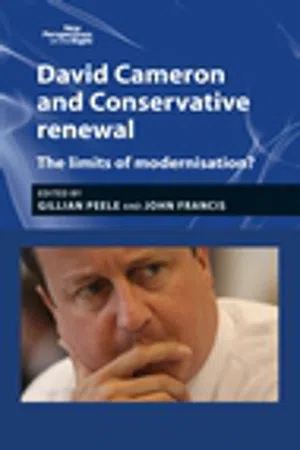 eBook - ePub
David Cameron and Conservative renewal
The limits of modernisation?
- Gillian Peele, John Francis, Gillian Peele, John Francis(Authors)
- 2016(Publication Date)
- Manchester University Press(Publisher)
1David Cameron’s leadership and party renewal
Gillian PeeleWriting on the tenth anniversary of David Cameron’s victory in the Conservative leadership election, Paul Goodman, the editor of the influential online site ConservativeHome, noted that on some measures Cameron’s decade in the leadership made him the second most successful Conservative leader in the last hundred years (ConservativeHome, 6 December 2015). Yet, as Goodman’s article also underlined, there is a sense in which Cameron’s leadership remains puzzling and problematic: for many observers his fundamental beliefs remained unclear. There is thus a sense that he was either echoing the title of the ConservativeHome article, something of a political chameleon or a leader with a series of differing, indeed contradictory, impulses. Nor is there any agreed interpretation of the effect of his leadership. In some ways he has succeeded brilliantly against the odds in renewing the Conservative Party, taking it back to a dominant position in the British political system and delivering, as a powerful prime minister, a style of governance which has restored Conservative governing credibility. For critics, however, there remains the question of how securely based these achievements are and what the historical verdict on Cameron’s leadership will be. As the United Kingdom entered a phase of acute internal controversy over the impact of leaving the European Union, the legacy of his leadership for the longer-term future of the Conservative Party is far from certain.This chapter explores the relationship between David Cameron’s leadership, including those contradictory impulses and tensions, and the revitalisation of the Conservative Party, the renewal that is the subject of this book. Academic interest in leadership, and especially in political leadership, has burgeoned in recent years (Rhodes and t’Hart, 2014 ). Leadership is a multidimensional concept involving the interaction of individuals and the context in which they operate. That interaction in turn raises a host of questions which will continue to challenge scholars in the field (for an excellent overview see Elgie, 2015 ). For the limited purposes of this chapter, three points from the leadership literature should be borne in mind at this stage. The first is the difficulty of providing a comprehensive and objective account of the personality, skills, traits and other factors which are displayed by an individual leader and determining how, if at all, they have shaped his or her actions. This difficulty is acute for the study both of historical figures and contemporary figures. In the case of living politicians, especially if they are still in office, the problem is compounded by the likelihood that perspectives on that leader may be subjective or self-interested, biased or partial and (inevitably) short-term and incomplete. Biographical studies which may provide an important source of understanding are likely to suffer from these limitations. Thus the available studies of David Cameron are useful but necessarily flawed in some respect. An early study of Cameron originally written in 2007 while containing many useful insights takes the analysis only up to 2012 (Elliott and Hanning 2007 ; 2nd ed., 2012). Two excellent recent studies (which had at least some cooperation from officials) focus on Cameron’s role in government concentrating on the period of Coalition. Although largely positive about Cameron’s role, they are cautious in their judgments about how history will judge him and effectively take the story up until 2015. The study by Lord Ashcroft (a former Party treasurer and co-chairman) and journalist Isabel Oakeshott did not enjoy official cooperation and has to be read against the background of a less than happy relationship between Ashcroft and Cameron (Ashcroft and Oakeshott, 2015
Index pages curate the most relevant extracts from our library of academic textbooks. They’ve been created using an in-house natural language model (NLM), each adding context and meaning to key research topics.

