Politics & International Relations

Margaret Thatcher
Margaret Thatcher was the first female Prime Minister of the United Kingdom, serving from 1979 to 1990. She was known for her conservative policies, free-market economic reforms, and strong stance against communism. Thatcher's leadership style and policies, often referred to as Thatcherism, had a significant impact on British politics and international relations during the late 20th century.
Written by Perlego with AI-assistance
Related key terms
1 of 5

10 Key excerpts on "Margaret Thatcher"
 eBook - ePub
America in the British Imagination
1945 to the Present
- J. Lyons(Author)
- 2013(Publication Date)
- Palgrave Macmillan(Publisher)
4The United States and the Politics of Thatcherism, 1979–1990I n May 1979, Margaret Thatcher became the first woman in British history to be elected prime minister. When she resigned in November 1990 she was the longest serving prime minister of the twentieth century having won three consecutive general elections. Many saw Thatcher’s Conservative government as the savior of Britain, freeing the nation from trade union power, regenerating individual responsibility and ushering in a new enterprise culture. Others, however, opposed the Conservative’s free-market philosophy, decrying the inequality and social conflict their policies engendered and arguing that Thatcher was unconcerned with the plight of the disadvantaged. But virtually all her supporters and critics agree that Thatcher’s 11 years at 10 Downing Street left an indelible mark on British society.Ever since the ideology of “Thatcherism” was first introduced by cultural theorist Stuart Hall in an article in Marxism Today in January 1979, the nature and roots of Margaret Thatcher’s ideas, policies and values have divided political scientists and more recently historians. Hall saw Thatcherism as a movement of the “radical right,” which gained substantial popular support and constituted something new in British politics. Subsequently, some argued that Thatcher’s policies were a decisive break with the traditions of the Conservative party and others that her ideas date back to nineteenth-century liberalism.1 Others have suggested that Thatcher’s politics were rooted in the upheavals of the 1970s and developed pragmatically and cautiously in the 1980s.2 Scholars have focused on her early parental influences, her time at Oxford University in the 1940s or the failure of Edward Heath’s Conservative government of the early 1970s as the defining events that shaped Thatcher’s thinking. A recent study has even suggested that Thatcher was a defender of the postwar consensus against the “progressive consensus” of the 1960s, seeking to restore the order and harmony of the immediate postwar years.3 eBook - ePub
God In Number 10
The Personal Faith of the Prime Ministers, Balfour to Blair
- Mark Vickers(Author)
- 2022(Publication Date)
- SPCK Publishing(Publisher)
l – Labour’s defeat on 3 May 1979 was largely the consequence of the ‘winter of discontent’. Winning a majority of 43 seats, Margaret Thatcher was appointed Prime Minister on 4 May 1979.Thatcher identified herself as a ‘conviction politician’, rejecting the post-war consensual style of government. Determined to roll back the frontiers of the state and encourage private enterprise, she cut rates of personal taxation and pursued monetarist policies to curb inflation. The results were dramatic: the country plunged into recession, manufacturing industry declined and unemployment rose, peaking subsequently at 3.3 million. Opposed by ‘wets’ in her own Cabinet, Thatcher held her nerve, but her popularity plummeted.The Argentinian invasion of the Falkland Islands in April 1982 and its defeat by the British task force led to the reversal of her political fortunes. Helped also by a recovering economy, at least in London and the south, and an Opposition split between a left-leaning Labour Party and the Liberal-SDP Alliance, Thatcher led the Conservatives to a landslide victory in the general election on 9 June 1983, winning a majority of 144.Appointing a Cabinet more aligned to her own vision, she pressed ahead with the privatization of nationalized industries and public utilities. Council-house tenants had already been given the right to buy their own homes. Determined to curb trade union power, she defeated Arthur Scargill’s National Union of Miners in a costly and violent strike in 1984–5. Strikes ceased to be a regular feature of national life. She escaped an assassination attempt when the IRA bombed her Brighton hotel during the 1984 Conservative Party conference.Thatcher passionately opposed Communism as inimical to freedom, rejoicing in the title of ‘Iron Lady’ accorded her by the Soviet Union. She shared Ronald Reagan’s determination to win the Cold War. The UK’s nuclear deterrent was renewed despite unilateralist opposition from the Labour Party and the Campaign for Nuclear Disarmament (CND). When Mikhail Gorbachev assumed office in the Soviet Union, she recognized him as someone with whom she could do business. eBook - ePub
Leadership and Uncertainty Management in Politics
Leaders, Followers and Constraints in Western Democracies
- François Vergniolle De Chantal, Agnès Alexandre-Collier(Authors)
- 2015(Publication Date)
- Palgrave Macmillan(Publisher)
This chapter explores political leadership in the light of the theoretical framework provided by works of reference and contributes to this book’s attempt to analyse the dynamic relationship between the leader and his/her followers. It focuses on the premierships of Margaret Thatcher and John Major, trying to assess the influence of their respective leaderships on the particular sphere of European policy. Political leadership and the European issue played a decisive part in both their premierships, albeit in different ways, as will be demonstrated below.The first part analyses and compares the leadership styles of Margaret Thatcher and John Major, considering the influence of these particular approaches on the decision-making processes favoured by both Prime Ministers. European policy being the main focus here, their respective visions of Europe will also be examined, with consideration given to questions concerning the role of personal leadership and the agency of the two political leaders. The second part will study the impact of political leadership on European policy-making – at the European level but also at national and party levels. As leadership appears inextricably linked to the European issue for both Margaret Thatcher and John Major, the relationship between the leader and his/her followers will be analysed and differentiated. How did political leadership and Europe interact under Thatcher and Major? How do both Prime Ministers fit within the typology provided by the authors in the introduction to this book?Divergent leadership styles, converging European visions
First of all, the leadership styles of Margaret Thatcher and John Major were diametrically opposed. Margaret Thatcher was a conviction politician characterised by strong leadership and determination, as epitomised in the appellation ‘the Iron Lady’. She came to power with a radical political agenda; she broke with the consensus which had prevailed since the Second World War in British political life, establishing a new political order – which makes her akin to the ‘Reconstruction’ leader identified by Stephen Skowronek in his typology of American presidents (Skowronek, 1997). Not only was Margaret Thatcher a charismatic leader as defined by Max Weber (Weber, 2004: 133–45), she was also a ‘transforming leader’ according to the theoretical framework provided by James Burns: ‘Such leadership occurs when one or more person engage eBook - PDF
Politicians and Rhetoric
The Persuasive Power of Metaphor
- J. Charteris-Black(Author)
- 2016(Publication Date)
- Palgrave Macmillan(Publisher)
86 4 Margaret Thatcher and the Myth of Boedicia 4.1 Background: the Iron Lady Born in Grantham in Lincolnshire in 1925, Margaret Thatcher was destined to become the most influential female politician in British twentieth-century history. She was elected as leader of the Conservative Party in 1975 and became Prime Minister in 1979, and remained so until her resignation in November 1990. Her guiding beliefs have been summarised by her biographer Hugo Young as follows: She saw a smaller state, a more market-orientated economy, a citizenry required to make more choices of its own. She wanted weaker unions, stronger businessmen, an enfeeblement of collective provision and greater opportunities for individual self-help. All of these she succeeded in filling with a sense of moral purpose, which proved that she was, in some sense, right, and socialists were with equal certainty wrong. (Young 1993: 604) It was a sense of moral conviction combined with effective image management that was at the basis of Margaret Thatcher’s dominance of British politics throughout the 1980s and explains why she became the political icon of her time – both nationally and internationally. She succeeded in winning elections in 1979, 1983 and 1987 and became the symbol of Western resistance to the Soviet Union. It is perhaps worth considering the significance of the nickname originally coined in 1976 by the Soviet magazine the Red Star – ‘The Iron Lady’. Whatever the J. Charteris-Black, Politicians and Rhetoric © Jonathan Charteris-Black 2005 Margaret Thatcher and the Myth of Boedicia 87 original intentions of its author, this metaphorical phrase came to be reinterpreted as a mark of respect rather than of criticism: It established her importance: for nobody unimportant would be worth the Russians’ while to attack. It gave her an identity as an international, and not merely a domestic, politician. eBook - ePub
The Prime Ministers
Reflections on Leadership from Wilson to Johnson
- Steve Richards(Author)
- 2019(Publication Date)
- Atlantic Books(Publisher)
She had a respect for those that did not give in. So you would wait until she drew breath and start again. You would say ‘I’ve heard what you said but this was the point… if I may continue…’ There were two Margaret Thatchers. There was the Margaret Thatcher with lots of shallow instincts and personal experiences… She would talk about a policy or idea based on a farmer she met or what tenants she met did with their council house… and this wasn’t intellectually appealing… There was another Margaret Thatcher where you would seek to change a discussion from her gut instincts to more of an intellectual dialogue… then you could persuade her. 18 Towards the end of her leadership, Europe came to dominate, with Heseltine hovering on the backbenches as a passionate pro-European. Thatcher was the first Conservative prime minister partly to fall over Europe, but she was by no means the last. Her three immediate successors as Conservative prime minister, John Major, David Cameron and Theresa May, also fell as a result of Europe. The third successor, Theresa May, led a government in which the issue of Europe overwhelmed all others. Over Europe and much more, Thatcher had transformed her party into one with a much more radical cutting edge. The dance between leader and party can be tense and jagged. The one between Thatcher and her party was neat and symmetrical. The Conservative Party became much more Thatcherite. She personified the changes in her own party. As part of the change, she moved the Conservatives towards a more Eurosceptic position and became, in the end, the first prime ministerial victim of that move. In tone she was increasingly hostile to Europe, although rarely in practice. She was, after all, a great advocate of the 1986 Single European Act and of the single market that was its consequence. It was she who signed the UK up to every single treaty during her period as prime minister. But she viewed with alarm the moves towards the integrationist Maastricht Treaty
- Robert Eccleshall, Graham Walker(Authors)
- 2002(Publication Date)
- Routledge(Publisher)
Margaret Hilda Thatcher (née Roberts), Baroness Thatcher of Kesteven
Born 13 October 1925, younger daughter of Alfred Roberts and Beatrice Stephenson. Educated at Kesteven and Grantham Girls Grammar School and Somerville College, Oxford. Married 1951 Denis Thatcher. MP for Finchley 1959– 92. Joint Parliamentary Secretary, Ministry of Pensions and National Insurance 1960–4; Secretary of State for Education and Science 1970–4; Leader of the Opposition 1975–9; Prime Minister 1979–90. Left Commons 1992, ennobled (hereditary peerage) the same year.Thatcher’s premiership was remarkable by any standards. She was the first female prime minister in Britain, holding office without interruption for longer than anyone since Liverpool. She was the first serving prime minister to be removed by a ballot of her MPs. She was the only twentieth-century party leader to give her name to what was an ideology—affirming the virtues of limited but firm government—and also a project to rescue Britain from post-war collectivism. According to conventional wisdom Conservative prime ministers travel unencumbered by excessive ideological baggage and without a strong sense of direction: their task is to keep the ship of state bobbing along rather than navigating it—as socialists purportedly wish to do—towards beguiling horizons. But in pursuit of her mission to unravel the corporate state Thatcher displayed an evangelical fervour not seen since Gladstone’s time. With the possible exception of Lloyd George— another formidable outsider who reached the top unaided by a charmed circle of party elders—she was the most combative premier of the twentieth century, despising the ‘fudge and mudge’ of consensus and compromise, believing that a leader’s objectives can best be secured, inside and outside the cabinet, by robust argument and by the ruthless treatment of those enemies, within and without the country, liable to obstruct the march to national recovery. Her natural element appeared to be the politics of warfare, and in the struggle to make Britain great again she was often accused of being humourless, dogmatic and imperious: an impatient workaholic who was sometimes fractious and irritable, and unfailingly fussy, brisk and emphatic. Attlee, the only other twentieth-century prime minister to preside over the installation of a mighty political project—the planned, welfare economy which she was so determined to dismantle—was reserved and conciliatory. She was unflinching in her convictions, apparently relishing skirmishes with those she considered to be either spineless or not clearly ‘one of us’ in the task of restoring to Britain the riches and splendour of a glorious past, and conveying the impression that she wanted to manage everybody and everything.
- John Charmley(Author)
- 2008(Publication Date)
- Bloomsbury Academic(Publisher)
14 The Iron Lady 209 A distinction should be drawn between the philosophical and political roots of what became known as Thatcherism. Mrs Thatcher is the only British politician of the twentieth century to have had her name enshrined in an ideology, and because of this and her combative char-acter it was easy for her critics to call her an ideologue; this is to miss the main point of naming a creed after the woman – which was that it was closely bound up with her personality. Hayek, Friedman and the Institute of Economic Affairs simply gave ‘substance and intellectual respectability to her beliefs and instincts, but most of these derive from her own experience and her idea of what is commonsense.’ 1 When she told the Party Conference in 1975 that ‘the economy had gone wrong because something had gone wrong spiritually and philosophically’, she was expressing her deepest feelings and those of millions who could identify with what she was saying; if Sir Keith told her that monetarism could help deal with this situation, all well and good. The personal nature of Thatcherism helps explain some of its contradictions. She passionately believed in getting the state off peoples’ backs, just as she disdained statist solutions to political problems – she loathed the ‘nanny state’, yet she was one of nature’s ‘nannies’, passionately believing that she knew how to save the country she loved; not surprisingly this created tension between instinct and action. This would have existed in any case – the frontiers of the state cannot be rolled back except by action from the centre – but it was made more acute by Mrs Thatcher’s personality. At the time of her selection as leader and during the ensuing years of oppo-sition, as during the election campaign of 1979, her personality was an issue; it was one her opponents hoped to exploit, and one which many of her colleagues feared might yet hand Labour a victory: but without Margaret Thatcher there would have been no ‘Thatcherism’.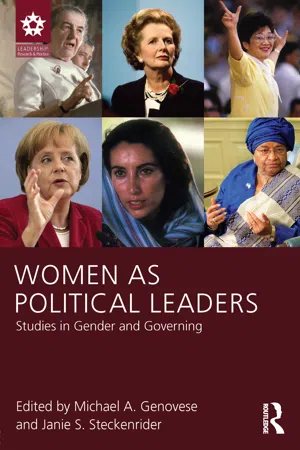 eBook - ePub
Women as Political Leaders
Studies in Gender and Governing
- Michael A. Genovese, Janie S. Steckenrider, Michael A. Genovese, Janie S. Steckenrider(Authors)
- 2013(Publication Date)
- Routledge(Publisher)
Thatcher's policies raise questions about winners and losers. Clearly, labor and the underclass were losers. Under Thatcher, the tax system became less progressive, social services were cut, and unemployment rose. The number of homeless skyrocketed, and government support for housing dropped. The disabled, the weak, the poor, and the elderly all suffered under Thatcher's policies. Under Thatcher, inequality and poverty rose, adding to what Neil Kinnock has called the “archipelago of poverty” in Britain. There was no measurable “trickle down.” The big winners were those in the upper class. In short, under Thatcher, the rich got richer and the poor got poorer, and, according to Ogden (1990), “a meaner and greedier society” was created (p. 335).Thatcher's goal of freeing the economy came at a high cost in human terms. It also required a strong state to implement these goals. That a free economy would go along with a strong, centralized, more intrusive state runs counter to traditional conservative goals. But that is precisely what took place in Britain. Thatcher, more an authoritarian conservative than a libertarian conservative, gave lip service to the rhetoric of the minimalist state, but her activist government expanded the power of the central state and pursued what one of her ministers called “the smack of firm government” (Kavanaugh, 1990, pp. 284, 294). Thatcher attempted to enforce a “moral” code of competitive capitalism. This required government rule making, as well as a good deal of persuasion. The government's education policy serves as an excellent example of the contradictions in a system of heightened government control in a less-controlled economy. The state intruded more often as guide and rule enforcer as Thatcher divested the government of nationalized industries and attempted to create a new model of economic man for Britain.Military and Defense Policy
When Margaret Thatcher took office in 1979, Britain's international standing was quite low. The heady days of empire had ended, and the “sick man of Europe” had limited power and little prestige. On top of that, Thatcher herself had no prior experience in foreign affairs.Thatcher's early foreign policy goals were clear: increase defense spending, maintain a nuclear arms deterrent, support the United States, oppose the Soviet Union and communism, support NATO, but maintain cool relations regarding Britain's membership in the European Economic Community (EEC). But Thatcher's policy goals were very quickly overshadowed by her style in foreign affairs: resolute, unyielding, nationalistic, rigid. It was not long before the sobriquet “the Iron Lady,” given to Thatcher by the Soviet news agency, TASS, became both a fitting appellation and a description of her style of governing. eBook - PDF
British Prime Ministers and Democracy
From Disraeli to Blair
- Roland Quinault(Author)
- 2011(Publication Date)
- Continuum(Publisher)
She was Prime Minister continuously for 11 and a half years – from May 1979 until November 1990 – the longest tenure since Lord Liverpool in the early nineteenth century. Yet her premiership was controversial at the time and has remained so in retrospect. Although she pledged to unite the nation, she often seemed to govern more by confrontation than by consensus. She was loathed by most of the intelligentsia, who regarded her as intolerant, simplistic and humourless – a demagogue with drawing-room manners. 4 Their distaste was reflected in the refusal of Oxford University to award her an honorary degree in 1985, although the dons were also influenced by an increase in student fees and a cut in the science research budget. 5 During the time that Thatcher was Prime Minister she put her own ideologi-cal stamp on government policy and she was the only premier of the twentieth century to become eponymous. Initially, she did not encourage the concept of ‘Thatcherism’ but after her third successive general election victory she declared that ‘Thatcherism is for centuries’. 6 Twelve years later, when it was announced that she was no longer able to speak in public, one newspaper observed that the ‘voice of Thatcherism falls silent’. 7 But Thatcher was as much a product M A R G A R E T T HAT C H E R B R I T I S H P R I M E M I N I S T E R S A N D D E M O C R A C Y 174 175 as she was a parent of Thatcherism. She did not originate the core tenets of Thatcherism: a belief in free market economics and in individual enterprise and responsibility. They had their origins in radical Victorian Liberalism – as Thatcher acknowledged when she advocated a return to ‘Victorian values’. 8 Those values were, in any case, widely accepted in the Conservative Party before she came to power. Indeed her election as the leader of the party in 1975 reflected the strength of support for those values in the party. eBook - PDF
Global Rules
America, Britain and a Disordered World
- James E. Cronin(Author)
- 2014(Publication Date)
- Yale University Press(Publisher)
. . in London” and even suggested that “Thatcher has lost her grip on the political rudder.” 14 The doubts apparently had no effect on the President’s judgment then or later. Three years later, another Ambassador, Charles Price, forwarded to Reagan a piece from the Economist critical of Thatcher’s style of running foreign policy. Reagan again refused to criticize, even in private, and told Price that the article “reminded me of U.S. media criticism of my policies. Margaret’s perseverance and persuasiveness . . .” he added, “have always been among her greatest strengths.” 15 Reagan and Thatcher were also mindful of each other’s domestic political needs, even when dealing with the wider world. The economic summit at Williamsburg in 1983 was held while Thatcher was fighting a general elec-tion campaign and the London Summit of 1984 took place while Reagan sought a second term. A British official noted the impact: Williamsburg had occurred in the middle of the British election campaign, and that fact had to a great extent dominated the proceedings, for nobody had wanted to complicate her job of fighting the election. There was the same feeling this year [1984] all through the preparations and at the summit itself. Everyone understood that President Reagan was in the middle of a campaign and no one wanted to rock the boat for him. 16 Predictably enough, Reagan was “overjoyed” at Thatcher’s 1983 victory and Thatcher could barely contain her excitement at Reagan’s triumph in 1984: “What a victory! I cannot tell you how delighted I am.” 17 Not merely the personal relationship, then, but the broader effort by Thatcher and Reagan to make the world safe for markets and inhospitable for the enemies of capitalism would be sustained throughout the 1980s. Inevitably, the campaign was not always successful, but it had many successes; and the effect was to create a new paradigm informing domestic and foreign policy.
Index pages curate the most relevant extracts from our library of academic textbooks. They’ve been created using an in-house natural language model (NLM), each adding context and meaning to key research topics.

