Politics & International Relations

Electoral Systems
Electoral systems refer to the rules and processes used to translate votes into seats in a representative assembly. They vary widely across countries and can have a significant impact on the representation of different political parties and groups. Common electoral systems include first-past-the-post, proportional representation, and mixed systems, each with its own advantages and drawbacks.
Written by Perlego with AI-assistance
Related key terms
1 of 5
10 Key excerpts on "Electoral Systems"
 eBook - PDF
Political and Civic Leadership
A Reference Handbook
- Richard A. Couto(Author)
- 2010(Publication Date)
- SAGE Publications, Inc(Publisher)
This makes it possible for someone to win electoral votes and to lose the national public vote. This convoluted measure remains from the Constitution’s framers’ intent to prevent someone becom-ing president based on temporary popularity or charis-matic appeal. The long history of court cases in the United States to decide eligibility requirements for those who can and cannot vote testify to the difficulty of any electoral system meeting its democratic intent, and to the desire of some to impede it. The Dimensions of Electoral Systems André Blais (2008) defines an electoral system as “the set of rules which govern the process by which citizens’ opinions about candidates and parties are expressed in votes and by which these votes are thereafter translated into the designa-tion of decision-makers” (p. 100). David M. Farrell distin-guishes between electoral system and electoral law. Electoral law more broadly refers to the entire “family of rules gov-erning the process of elections: from the calling of the elec-tion, through the stages of candidate nomination, party campaigning and voting, and right up to the stage of count-ing votes and determining the actual elections result” (Farrell, 1997, p. 3). From these definitions, three dimen-sions of Electoral Systems can be discerned. First, the way people can indicate their political preference on the ballot paper, which we will henceforth refer to as the voting or bal-lot structure . The second element considers the translation of votes into seats; these rules will be denominated by the for-mula structure . A third element, which in many cases coin-cides with the first two and can be indirectly deduced from them, concerns the type of district that can be discerned. We consider this as an element of the concept district structure .
- Daniel Bochsler(Author)
- 2015(Publication Date)
- Palgrave Macmillan(Publisher)
1.1 Previous research Why study Electoral Systems and party systems? The efficiency of Electoral Systems and party systems has widespread implications for democracy, politics and policies. Parties are one of the basic pillars of representative democracies, and elections and Electoral Systems are the foundation on which democracy is built. It is thus no wonder that the establishment of the electoral system is seen as one of the most crucial aspects of democratisation and democratic consolida- tion (Merkel, 2007, p. 416). The question of whether and how Electoral Systems affect party systems is too crucial to be left to paths of historical coincidence. While in a handful of micro-states modern democracy without politi- cal parties is thinkable and practised (Anckar and Anckar, 2000), in all other cases it is unthinkable. An important dimension of party systems is the contrast between representation and governability, or the con- trast between large and small party systems. Large systems threaten to obstruct coalition-building (Nohlen, 2004, p. 158), cut the life expect- ancy of cabinets (Sanders and Herman, 1977; Taagepera and Sikk, 2010; Taylor and Herman, 1971) and over-emphasise particular group demands over national interests (e.g. Shepsle and Weingast, 1981, p. 109). Small Introduction 3 party systems are said to increase government responsibility (Powell, 1989), but risk producing governments which lack broad popular sup- port (Lijphart, 1999, pp. 167–8). While they might decrease the repre- sentation of extremist parties (Powell, 1989), they might also exclude minorities from politics (e.g. Rokkan, 1970, p. 157), and this might result in political violence (Powell, 1982) or the breakdown of democ- racy (Diskin, Diskin and Hazan, 2005). eBook - PDF
- J. Colomer(Author)
- 2016(Publication Date)
- Palgrave Macmillan(Publisher)
Part 1 Introduction 3 1 The Strategy and History of Electoral System Choice Josep M. Colomer It is on account of the importance of the consequences of the electoral system, especially on the number of political parties and the political composition of assemblies and governments, that the choice of system matters. However, Electoral Systems – as are other prominent political institutions – are also a consequence of already existing political parties in assemblies and governments, each of which tends to prefer those institutional formulas and procedures that can consolidate, reinforce or increase their relative strength. As will be argued and discussed in the following pages, political configurations in which there is a single dominant party or two rather balanced parties tend to produce choices in favour of rather restrictive or exclusionary Electoral Systems, such as those based on the majority principle, while pluralistic settings with multiple parties tend to support choices in favour of more inclusive electoral formulas, such as those using rules of proportional representation. More generally, the choice of electoral system seems to follow what could be called the ‘Micro-mega rule’, by which the large prefer the small and the small prefer the large: a few large parties tend to prefer small assemblies, small district magnitudes and rules based on small quotas of votes for allocating seats, while multiple small parties tend to prefer large assemblies, large district magnitudes, and large quotas. In a nutshell, large parties prefer small institutions in order to exclude others from competition, while small parties prefer large institutions able to include them within.
- S. Birch(Author)
- 2003(Publication Date)
- Palgrave Macmillan(Publisher)
Yet voting is but the first stage in the representational process. In order to have an input into decision-making, citizens also need to ensure that their vote counts. This chapter will evaluate the effect of various aspects of electoral system design on the representational inclusion, understood as the proportion of voters whose choices are reflected in the composi- tion of the assembly. How voters are represented will be the subject of Chapters 5 and 6; the present analysis will be concerned with whether they are represented, from both the collective (national-level) and the dyadic (district-level) perspectives. Electoral inclusion is of inherent normative interest in any polity. Votes that do not contribute to the election of parliamentary representa- tives leave those who cast them outside the collective decision- making process. Yet in the context of established democracies even high levels of exclusion may not pose a threat to the system, as both parties and voters generally have sufficient information about overall patterns of electoral support for self-exclusion to be a conscious choice. Strongly committed adherents of minor political streams may opt to preserve their ideological purity by contesting elections that they know they have no chance of winning; likewise voters may vote 'expressively' for no-hope political options, either out of ideological commitment or as a form of protest. In most democratic systems, activ- ity of this kind is of relatively minor significance and represents little more than a legitimate, if marginal, alternative to the parliamentary party system. The same cannot necessarily be said of democratizing states, in which high levels of electoral exclusion may call the democratic legitimacy 77 78 Electoral Systems and Political Transformation of the political system into question. eBook - PDF
Women and Legislative Representation
Electoral Systems, Political Parties, and Sex Quotas
- M. Tremblay(Author)
- 2016(Publication Date)
- Palgrave Macmillan(Publisher)
While this is not a new view of representation, it has gathered momentum in recent years. If, historically, the discussion of political representation excluded women, today it is impossible to imagine it proceeding without addressing the political representation of women. In fact, the proportion of women in parliament is increasingly per- ceived as an indication of a state’s quality of political representation. Formal representation refers to the institutional rules and procedures through which representatives are chosen. The voting system, as the primary mechanism for this choice, is the process through which the will of the people is converted into seats in parliament (Farrell 2001: 4; Gallagher and Mitchell 2005a: 3). There are three basic types of Electoral Systems: plurality/majority (or majoritarian) systems, PR systems, and mixed systems (Massicotte and Blais 1999; Norris 2004: 41; Reynolds, Reilly and Ellis 2005: 27). Each type of electoral system is based on a particular concept of political representation. McLean (1991) suggests that voting systems be classified according to the distinction between the “microcosm” and “principal-agent” conceptions of representation. Lijphart (1984: 150) stresses the same point. PR systems find their ideological justification in the “microcosm” conception of representation. Such systems are intended to represent both the majority and the minorities proportionally translating party votes into party seats in parliament. Consequently, PR systems are those most likely to give rise to multiparty arrangements. By contrast, majoritarian systems, which are based on the “principal-agent” conception of representation, not only bestow vic- tory on the majority while ignoring minorities, but they also give further power to the victorious party by accentuating its representation in parlia- ment (to the detriment of other political groups). Such systems give rise to a smaller and less diverse range of parties than do PR systems. eBook - PDF
Embodying Democracy
Electoral System Design in Post-Communist Europe
- S. Birch, F. Millard, M. Popescu, K. Williams(Authors)
- 2002(Publication Date)
- Palgrave Macmillan(Publisher)
36 Foreign experts were often called in after local policy-makers had already made up their minds and wanted outside counsel to validate their preferences. Here one should distinguish between advice given by foreigners and intentional replication or adaptation of a foreign elec- toral law, with or without advice from that country’s experts. The degree of actual influence of foreign models can be expected to vary according to a number of factors. One is the availability of domestic experts in electoral system design. If they are few, there may be a greater tempta- tion to take an ‘off-the-rack’ system from another country. Another factor is the level of cultural affinity with other countries, which may encourage institutional emulation. But overall it seems likely that most countries pick, choose and adapt in a process that owes more to bricolage than slavish copying or imposition, and that the adaptation of existing models involves a large measure of creativity. Foreign ‘inspiration’ might thus be a better term than ‘influence’, and we can anticipate that such inspiration will be refracted through a variety of factors specific to the domestic political context of the country in question. Contextual factors It is often held that Electoral Systems ought to be ‘appropriate’ to the social and political context in which they operate. But this does not mean that for each state there is an ideal electoral system. Subjective factors are vital in determining how ‘appropriateness’ is interpreted. Explaining Electoral Systems 13 All social systems have numerous attributes that influence electoral outcomes; those that are most salient in a given state will depend on perceptions of representation and the professed aims to be achieved through the electoral system. Multi-ethnicity is frequently considered to demand proportional representation in order that minorities can feel themselves properly represented through the election of people from their own group.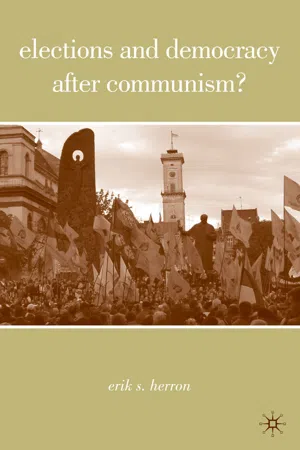 eBook - PDF
- E. Herron(Author)
- 2009(Publication Date)
- Palgrave Macmillan(Publisher)
4 C h a p t e r 4 Consequences of Electoral System Choice The previous chapter demonstrated that political actors take electoral sys- tem design seriously, even in nondemocratic countries, updating and modify- ing the rules to benefit themselves and their allies. This chapter investigates a primary output of the electoral rules: political party systems. 1 Political scientists have intensively investigated the connection between election rules and the party systems that emerge out of the electoral process. This connection is important because the number of parties in a political sys- tem is one indicator of how power is distributed. As Giovanni Sartori (1976, 120) observed, “It does matter how many are the parties. For one thing, the number of parties immediately indicates, albeit roughly, an important feature of the political system: the extent to which political power is fragmented or non-fragmented, dispersed or concentrated.” The concentration of power in too few hands threatens viable democracy, but significant dispersion of power may undermine effective governance. This chapter addresses how political institutions, social cleavages, and the postcommunist legacy affect party system development. As noted in Chapter 1, an intense scholarly debate has raised questions about the equivalence of postcommunist cases with their counterparts in other world regions. Rather than assuming, a priori, that postcommunist states differ from other transi- tion countries, this chapter’s investigation explicitly controls for the post- communist experience. The analysis reveals that expectations about party system development may obtain in postcommunist societies, but that these outcomes may be attenuated by regional idiosyncrasies. The first section of this chapter outlines the debate over the relative impor- tance of institutional and contextual features in determining the contours of party systems. The second section presents interregional and intraregional eBook - PDF
The Chain of Representation
Preferences, Institutions, and Policy across Presidential Systems
- Brian F. Crisp, Santiago Olivella, Guillermo Rosas(Authors)
- 2020(Publication Date)
- Cambridge University Press(Publisher)
However, as preference heterogeneity increases, the importance of electoral rules as incentive structures that favor certain choices increases as well. A voter may identify a preferred candidate – one who reflects the voter’s preferences over policy outcomes nearly perfectly – seemingly making vote choice easy. However, if the voter determines that his or her preferred candidate cannot attract sufficient support from other voters to win office, 12 Studying the Chain of Representation the voter’s utility will be maximized by looking for another – not quite as preferred – candidate who can plausibly win. We will refer to electoral rules as “constraining” when they encourage a diverse citizenry to think long and hard about which candidates are viable. We will refer to electoral rules as “permissive” when the bar for obtaining viability is lower, diminishing voters’ need to assess whether they should strategically defect from their preferred option. 4 The major families of Electoral Systems – majoritarian, mixed, and propor- tional – are defined primarily on this dimension of electoral system strength: from strong or constraining systems to weak or permissive ones (Cox 1987, Leys 1959, Sartori 1968). While an electoral system family is a nice first cut at categorizing electoral incentives, there is a great deal of variation in rules even within these families, as we will show in Chapter 7. To capture the relative strength of Electoral Systems, we will describe how our cases vary in terms of district magnitude, seat allocation formula, and legal electoral threshold. District magnitude, as noted earlier, is the number of seats that need to be filled in a given district. The seat allocation formula is the rule that translates votes into seats. Legal thresholds are lower bounds, in terms of votes received, that must be cleared in order to win a seat. We think that electoral incentives work both on party elites and on voting citizens. eBook - PDF
- Cees Van der Eijk, Mark N. Franklin(Authors)
- 2009(Publication Date)
- Red Globe Press(Publisher)
A m ong establ i shed de m ocrac i es, few countr i es have repeat-edly ad j usted the i r electoral syste m i n recent years (only Greece and, m ore recently, Italy) . Frequent changes i n electoral syste m under mi ne the pred i ctab i l i ty needed i f part i es and voters are to behave purposefully . Yet, occas i onally the rules govern i ng parl i a m entary elect i ons are rewr i tten, for exa m ple after the restorat i on of de m ocracy follow i ng an i nterrupt i on by d i ctatorsh i p, or, very occas i onally, when funct i on i ng de m ocrac i es feel that the i r electoral syste m s do not (any longer) fulf i l a nu m ber of w i dely subscr i bed goals . At such t im es, const i tut i on wr i ters have the opportun i ty to learn fro m accu m ulated exper i ence and i nst i tute rules that ‘im prove ’ the func-t i on i ng of de m ocrat i c syste m s (see Boxes 3 . 3 and 3 . 4 and Further Read i ng) . Tr a de-offs i n des i gn i ng a n elector a l system There i s no perfect electoral syste m , j ust syste m s i n wh i ch the trade-offs that have been m ade are thought to be appropr i ate for part i cular countr i es, the i r culture and the i r people ’ s expectat i ons about what an elect i on should be . A m a j or trade-off i s between party representat i on and i nd i v i dual repre-sentat i on . In a proport i onal syste m voters effect i vely choose between part i es by m ark i ng the na m e of a part i cular party or i ts l i st leader . As a consequence of these votes a whole group of representat i ves are elected to the leg i slature, proport i onal to the nu m ber of votes cast for that party l i st . But, for part i cu-lar voters, who i s the i r representat i ve ? There i s no such person, as all those elected ( i. e . the ent i re Parl i a m ent) are everyone ’ s representat i ves . In other words, there i s no close, let alone un i que, l i nk between a voter and a part i c-ular representat i ve i n a l i st proport i onal syste m.
- Rory O'Connell(Author)
- 2020(Publication Date)
- Cambridge University Press(Publisher)
The acceptance of a wide variety of Electoral Systems suggests that the Court is not open to arguments that certain Electoral Systems support more 147 Parti nationaliste basque v France App no 71251 / 01 ( 2007 ) 47 EHRR 47 . 148 Parti nationaliste basque v France , paras 16 , 29 – 32 . 149 Parti nationaliste basque v France , para 47 . 150 Parti nationaliste basque v France , paras 49 – 51 . 264 Regulation of Elections deliberative models of democracy, or at least this would not be a straightfor-ward argument. 151 Practices like simple plurality majoritarian systems, high thresholds in party list system or bonus seat mechanisms all serve to rationalise the different views that may be expressed in a legislature, but the Court accepts they are all legitimate in principle. On matters of electoral design, there are almost no cases where the Court has found a violation. The Court itself has explained well just why it is reluctant to be exacting in such cases. The design of Electoral Systems can pursue different aims, and these different aims are often not even compatible, most obviously in terms of balancing the need for fair representation with the creation of coherent currents of thought and stable government. There are different ways of securing similar outcomes, e.g. stable government might be facilitated by simple plurality voting, thresholds in party list systems or bonus seats. Context may be everything – Iceland, for instance, has challenges securing representation outside the capital city due to population changes; hypothetically, the European Parliament and its practice of degressive propor-tionality would be a very different context from national elections. Assessments are also subject to contingency; witness the difference between the 2002 Turk-ish general election and the 2007 one, both considered in Yumak and Sadak .
Index pages curate the most relevant extracts from our library of academic textbooks. They’ve been created using an in-house natural language model (NLM), each adding context and meaning to key research topics.

