Politics & International Relations

Elitism Theory
Elitism theory posits that power in society is concentrated in the hands of a small, privileged elite who make decisions that shape the political and social landscape. This theory suggests that the masses have limited influence, and that a select few hold the most power and influence. Elitism is often associated with the idea that certain groups or individuals have disproportionate control over resources and decision-making.
Written by Perlego with AI-assistance
Related key terms
1 of 5


8 Key excerpts on "Elitism Theory"
 eBook - ePub
- Heinrich Best, John Higley, Heinrich Best, John Higley(Authors)
- 2017(Publication Date)
- Palgrave Macmillan(Publisher)
1965 , p. 163).Giovanni Sartori (1987 , p. 155) has construed Robert A. Dahl’s well-known concept of “polyarchy” as denoting “a multiple, diffuse, and, at best, open constellation of power groups.” Other scholars contend that the cohesion of some national elites lies in a tacit consensus about norms and rules of political behavior that keep politics from becoming violent (Higley and Burton 2006 , pp. 11–12). That elites are consciously conspiratorial, as Meisel insisted they must be, is seldom evident and it is but one of several possibilities research on elites must explore.Elitism
Populist politicians routinely employ “elitism” as a term of abuse for critics and rivals. Consider this exchange between TV anchorman Brian Williams and candidates Sarah Palin and John McCain during the 2008 US presidential campaign:Williams to Palin: “Governor, what is an elite? Who is a member of the elite?”Palin: “Anyone who thinks that they are, I guess, better than anyone else—that’s my definition of elitism.”McCain (smiling): “I know where a lot of them live.”Williams: “Where’s that?”McCain:“Well, in our nation’s capital and New York City. I’ve seen it. I’ve lived there.…These elitists think they can dictate what they believe to America rather than let Americans decide for themselves.” (The New Yorker , August 16, 2008, p. 27)Elitism has no agreed meaning inside or outside social science. One of many meanings is a belief in the inevitability of rule by elites, which implies focusing on elites as key political and social actors. A more diffuse and normatively colored meaning is a consciousness of or a pride in belonging to a highly selective or favored group. Still more diffuse meanings are a respect for or deference toward leadership, an esteem for accomplishments, a reverence for heritage, or an insistence that some idea or contribution is better than all others. As an adjective, “elitist” is routinely used by commentators and politicians to denigrate anyone who questions egalitarian values, who agrees with Weber that effective politics rest on talent and professionalism, or who claims, as Pareto did, that people differ innately in their abilities and talents for governing or ruling (Henry 1994 eBook - PDF
The Modern State
Theories and Ideologies
- Erika Cudworth, Timothy Hall, John McGovern(Authors)
- 2020(Publication Date)
- EUP(Publisher)
CHAPTER THREE The State and the Power Elite Erika Cudworth and John McGovern Elite theory represents a decisive break with the understandings of much liberal pluralism in that it takes as axiomatic the elite dom-ination of the state. Whatever the form of polity and organisation of governmental institutions, the state is run by an elite. ‘Classical’ elitism, associated with the work of Robert Michels (1911 [1999]), Vilfredo Pareto (1935 [1976]) and Gaetano Mosca (1896 [1939]), considered that political power was always and irresistibly concen-trated in the hands of a small ruling elite. Popular sovereignty is mythic, for all systems of governments are ‘actually’ oligarchic and any institutions or processes that claim to be ‘democratic’ are a ‘sham’ (Runciman 1963, cited Birch 1993: 169). In order to substantiate this claim, Anthony Birch (1993: 170) considers that elite theorists need to provide evidence to support at least one of the following propositions. First, that access to polit-ical office is restricted to a small cohesive group with common inter-ests that are not shared by the majority of citizens. Secondly, that office-holders are rarely responsive to the opinions and interests of the general public and are able to use coercion, persuasion or manipulation in order to induce public compliance. Finally, and associated with more contemporary left/Marxist elitist approaches, that office holders take decisions in line with the interests of a priv-ileged group (such as a capitalist class). Elite theorists are both real-ists and empiricists, seeking to unmask the facade of liberal democratic practices or of political organisations and practices 63 committed to socialism. However, the efficacy and substance of their empirical work varies in levels of systematisation and rigour. Certainly the classical elite theorists, despite an often passionate commitment to the ‘scientific’ study of society, produced work infused with ideology. eBook - PDF
- Matevž Tomšic(Author)
- 2016(Publication Date)
- Peter Lang Group(Publisher)
In this way, the rule of the modern political community ought to be carried out on the basis of specialised knowledge and skills, meaning that “power needs knowledge which provides it with legitimacy and efficiency” (Bauman 1987, p. 48). The analysis of elites has to consider the structural aspects, i.e. the position of particular elite segments in the structure of society. In this way, an elite could be defined as a group of individuals “who are able, by the virtue of their strategic positions in powerful organisations, to affect national outcomes regularly and substantially” (Field et al. 1990, p. 152). For most researchers, the national elite thus consists of those holding key positions in the biggest and most important political, business, military, professional and cultural organisations. However, one must stress that elitism needs, beside placement in the above- mentioned structural positions, the recognition of the elite status both in terms of self-perception and recognition on the part of different sub-elites and the gen- eral public. 2. Thematisation of elites The analysis of elites is strongly related to the perception of the essence and character of a particular social setting and the relations within it, especially with regard to the power relationships between relevant social actors. One should dis- tinguish between theories that deal with the phenomenon of elites and elite theo- ries that represent specific perspectives on social reality, especially with regard to the question of who rules society. 2.1 Classical elite theory Classical elite theory was founded by the Italian social and political thinkers Pareto, Mosca and Michels and advocates a sharp division of society between a well-organised and cohesive minority (with a strong collective identity) that eBook - PDF
- Subrata K. Mitra, Malte Pehl, Clemes Spiess, Subrata K. Mitra, Malte Pehl, Clemes Spiess(Authors)
- 2009(Publication Date)
- Verlag Barbara Budrich(Publisher)
Fathered by Vilfredo Pareto, Gaetano Mosca and Roberto Michels at the turn of the cen-tury, this theory purported to offer a better understanding of socio-political regimes in general, and of democratic ones in particular, than class theory was able to do. However, although it differed from class theory in many respects, it shared with it a most critical view of democracy. In the wake of the triumvi-rate of fathers of elite theory, many later elite theorists (e.g. Wright Mills 1956) upheld the ideal of democracy, but emphasized that extant democracies fall far short of the ideal. According to the democratic ideal, majorities rule minorities. In fact (organized) minorities – that is, power, ruling, or govern-ing elites 4 – rule over (unorganized) majorities, and they do so in democracies 4 As commonly viewed, elites may be distinguished from the rank and file public by their exertion of substantial power and/or influence over that public and over political outcomes. Some elite persons – whose positions are based on public support – are usually also referred to as leaders. In contemporary society the most prominent elites include political (party) leaders – of both the government and the opposition – the heads of the state bureaucracy, the military and the police, the captains of business and industry, union leaders, those in charge of the media and cultural/intellectual elite church leaders and the leaders of major social movements, also known as counter-elites. Some elites command more power than others. At the top are those who hold power at the national or supra-national level, in between are those who hold power only in certain sectors of society and at the lowest level are heads of small units, although the boundaries between the levels are not sharply defined. Elite theory has been concerned mainly with top-level elites. Eva Etzioni-Halevy 70 no less than in other regimes. eBook - PDF
The Role of Local Political Elites in East Central Europe
A Descriptive Inquiry into Local Leadership in Six Transitional Democracies of the Region
- Roxana Marin(Author)
- 2021(Publication Date)
- Budrich Academic Press(Publisher)
But the term did not become widely used in social and political writing until late in the nineteenth century in Europe, or until the 1930s in Britain and America, when it was diffused through the sociological theories of elites” (Bot-tomore 1964: 3), consecrated by the “neo-Machiavellians” or the classical Ital-ian “elitists”. Eventually, in contemporaneity, the elite studies favored a “func-tionalist theory of stratification” 3 , according to which present-day “knowledge society” and its constant developments and subtleties present some complexi-ties manageable only by a certain type of elite: the “meritocracy” model of power, presently fashionable in the literature consecrated to elites introduces the reader with a political elite who is highly skilled and experimented in public administration and government business, who is recruited based on some per-formance parameters out of a narrower and narrower pool of candidates, who 3 The phrase defining a new line in the elite theory is customarily associated with Davis and Moore 1945: 242-249. 27 is “talented” or benefits from a certain likeable or favorable “cultural capital” 4 , but who becomes, consequently, more and more alienated with “the mass”, the citizenry, widening the gap between the rulers and the ruled. In a literature review of social and political elites, from “neo-Machiavellians” to the contem-porary debate, Patrick Akard differentiates between the conception of “func-tional elites” (specific to a certain area, institution, context, or activity, what Keller coins as “strategic elites” (Keller 1963)) and “political (ruling) elites”, exerting “societal-level power” (Akard 2000: 2623); the latter are the focus of this endeavor. Surely, the selection of “the chosen” (from the French “ élire ”) is the pre-rogative of either “God, nature, or public esteem” (Girvetz 1967: 30). eBook - ePub
- Peter Bachrach(Author)
- 2017(Publication Date)
- Routledge(Publisher)
The elitist theorists, in trying to develop a theory which takes account of the way the political system actually operates, have changed the principal orienting values of democracy. The heart of the classical theory was its justification of broad participation in the public affairs of the community; the aim was the production of citizens who were capable enough and responsible enough to play this role. The classical theory was not meant to describe any existing system of government; it was an outline, a set of prescriptions for the ideal polity which men should strive to create. The elitist theorists, in their quest for realism, have changed this distinctive prescriptive element in democratic theory; they have substituted stability and efficiency as the prime goals of democracy. If these revisions are accepted, the danger arises that in striving to develop more reliable explanations of political behavior, political scientists will also become sophisticated apologists for the existing political order. Robert Lane, in concluding his study of the political ideologies of fifteen “common men” in an Eastern city, observes that theylack a utopian vision, a well-defined sense of social justice that would allow them to stand in judgment on their society and its institutions. 21 To some degree, the “men of Eastport” share this disability with much of the American academic elite. T HE E LITIST T HEORY AS A G UIDE FOR R ESEARCH The shortcomings of the elitist theory are not confined to its normative implications. Serious questions also arise concerning its descriptive accuracy and its utility as a guide to empirical research. The most unsatisfactory element in the theory is its concept of the passive, apolitical, common man who pays allegiance to his governors and to the sideshow of politics while remaining primarily concerned with his private fife, evenings of television with his family, or the demands of his job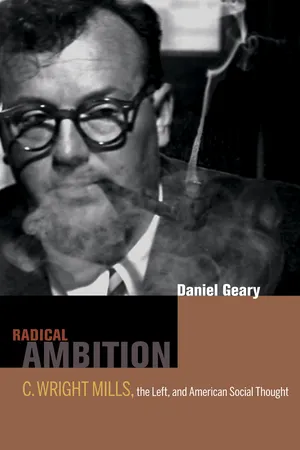 eBook - PDF
Radical Ambition
C. Wright Mills, the Left, and American Social Thought
- Dan Geary(Author)
- 2009(Publication Date)
- University of California Press(Publisher)
After an initial chapter outlining his argument, Mills began slowly, describing the historical shift of power in the United States from the local to the 152 The Politics of Truth national level. He then devoted multiple chapters to examining each portion of the power elite in turn: the “corporate rich,” the “warlords,” and the “political directorate.” Distinguishing his theory of the power elite from the “theory of balance” promulgated by liberal pluralists, Mills then described the interlocking nature of what he described as a “triangle of power.” 29 A thirteenth chapter discussed the “mass soci-ety,” reprising the analysis of White Collar, but also introducing Mills’s normative notion of a democracy based on widespread public discus-sion and participation. The final two chapters, based on earlier articles condemning the conservative mood among American intellectuals, denounced an irresponsible “higher immorality” among the elites. Mills’s “power elite” concept perplexed many of the book’s commen-tators, yet some of this confusion can be cleared up if we recall the prag-matist, historicist, and contextualist methodology Mills had espoused since his student years. As a theoretical concept, Mills’s “power elite” was deceptively straightforward: it referred to a minority of leaders who, though not omnipotent, held enough power to be demarcated sharply from the mass of citizens. Mills rejected the idea, which he attributed to the classic sociological theorists of elites — Vilfredo Pareto, Gaetano Mosca, and Robert Michels — that an elite always functioned as the operating force in history. According to Mosca, for instance, “In all societies . . . two classes of people appear — a class that rules and a class that is ruled. eBook - PDF
The Working-Class Tories
Authority, Deference and Stable Democracy
- Eric A. Nordlinger(Author)
- 2023(Publication Date)
- University of California Press(Publisher)
4 1 The Torment of Secrecy. 1956, pp. 49, 50. Also see Harry Street, The Indivi- dual and the Law. 1963, p. 85. • Op. cit., pp. 35-37. * The Crichel Down affair of 1954 is a great exception in two respects. First, because the maladroit behaviour of some civil servants in the Ministry of Agriculture was brought to light; and secondly, because the minister decided to resign in order to give the civil service a salutary shock. 4 The writer's definition of a democratic system, taken largely from Joseph Schumpeter, does not pre-empt the possibility of public power being exercised privately in a democracy; viz. a democratic system is one in which there is a regular competition for control of the government through an electoral process featuring universal suffrage. Also see below, Chapter 9. THE ELITIST POLITICAL SYSTEM 97 I. THE POLITICAL INFLUENCE OF THE WORKING CLASS The most important single feature of an elitist system is the relation- ship between the elite and the non-elite. Although it was argued that this relationship is a hierarchical one, it has not yet been shown that the workers view the political system in such terms. In order to elicit their beliefs about the relationship between the elite and the non- elite they were asked: 'Do you think that people like yourself have any say in how the country is run? Do people like you have a good deal of say, a little, or none at all?' Considering that 'people like your- self' are manual workers constituting two-thirds of the electorate, the responses not only refer to the worker's perceived political influence; they also imply a belief about the elite's responsiveness to the majority element in the population. The data in Table i clearly indicate that the workers perceive them- selves to be living in an elitist political system. Only 14 per cent of the Conservatives and 10 per cent of the Labour supporters replied that the workers have 'a good deal' of influence upon governmental de- cisions.
Index pages curate the most relevant extracts from our library of academic textbooks. They’ve been created using an in-house natural language model (NLM), each adding context and meaning to key research topics.

