Politics & International Relations

Essentialist Feminism
Essentialist feminism is a theoretical approach that emphasizes the biological and innate differences between men and women. It argues that these differences are the root cause of gender inequality and that women's unique qualities should be celebrated and valued. Essentialist feminists often advocate for traditional gender roles and believe that women's inherent characteristics should be the basis for their empowerment.
Written by Perlego with AI-assistance
Related key terms
1 of 5
9 Key excerpts on "Essentialist Feminism"
 eBook - PDF
Gender, Conflict and Peace in Kashmir
Invisible Stakeholders
- Seema Shekhawat(Author)
- 2014(Publication Date)
- Cambridge University Press(Publisher)
Feminism, International Relations and War 9 given entity.’ 50 Essentialism holds that for an entity, there is a set of ‘incidental attributes’ necessary to its identity and function. 51 The approach is based on the notion that things and beings have specific inherent and enduring qualities. These innate traits are crucial for distinguishing all non-living and living beings from each other, including men and women. Essentialist Feminism considers that all women are in essence similar. Women, irrespective of class, caste, race, religion and culture across time and space, share common characteristics. Elizabeth Grosz explains this approach as ‘the attribution of a fixed essence to women....Essentialism entails the belief that those characteristics defined as women’s essence are shared in common by all women at all times....Essentialism thus refers to the existence of fixed characteristics, given attributes, and ahistorical functions.’ 52 Notwithstanding disagreements as to what defines the essence that all women share, many scholars hold that gender identities are unchangeable due to permanent underlying, primarily biological, factors. In simple terms, you must be born a woman to be a woman. Nature and not nurture define gender differentiation, as elaborated by Inger Skjelsbaek: For men in power, the essentialist position can be taken to mean that there is something about men’s power status which originates in their gender identity – that is, the ‘true’ nature of men. The fact that women have stayed at home and taken care of the house and children is also explained in terms of women’s ‘true’ nature. This interpretation suggests that throughout history men and women have tended to do what they are naturally good at. Gender difference thus becomes a matter of nature rather than nurture. 53 Essentialist Feminism resonates with the difference feminism approach that contends that there are deep-rooted real gender differences. eBook - PDF
Women, Gender, and World Politics
Perspectives, Policies, and Prospects
- Peter R. Beckman(Author)
- 1994(Publication Date)
- Praeger(Publisher)
By virtue of her being oppressed, according to this view, a woman's "feminine perspective" pro- vides her with a less distorted and more truthful account of the world than a man's "masculine perspective" can. Such a claim is tenuous at best, and directly contradicts the Radical feminist observation that theory is always for someone and represents some interests, whether they be gender interests, class interests, or race interests. More importantly, the idea of a "feminine perspective" contrasts "woman" as nurturing, virtuous, and natural with "man" as aggressive, power seeking, and arrogant. This suggests that these differences are essen- tial, fundamental, and unchanging. Such an essentialist view not only can- not be sustained empirically, ignoring as it does important differences amongst women (and amongst men), but it is dangerously apolitical. 16 As Lynne Segal writes: "A feminism which . . . insists upon the essential dif- ferences between women's and men's inner being, between women's and men's natural urges and experience of the world, leaves little or no scope for transforming the relations between men and women." 17 A biologically determined relationship between women and men fixes those relation- ships firmly across time, place, and culture. Feminist politics in this con- text becomes a concerted effort to limit the damage inevitably done, to make the best of a bad world, and to hope that the more peaceful norms of "woman" may one day inform the practices of international decision makers. Other Radical feminists claim no biological determinism and argue in- stead that social practices such as mothering produce fundamental differ- ences between women and men. They also universalize those practices, cre- ating yet again an essentialist vision of feminine and masculine characteristics. One single activity such as mothering, by this view, pro- duces the same characteristics in women and men across time, place, cul- ture, class, race, and sexual orientation. eBook - PDF
Peace and Security in the Asia-Pacific
Theory and Practice
- Sorpong Peou(Author)
- 2010(Publication Date)
- Praeger(Publisher)
Part V Feminist Security Studies This page intentionally left blank 13 Essentialist and Liberal Feminism Political realism has come under attack from various feminists for its gender- blind emphasis on national security. For J. Ann Tickner (1992: 128), ‘‘genuine security requires not only the absence of war but also the elimination of unjust social relations, including unequal gender relations.’’ Security threats to individuals—both men and women (but especially women)—include war, rape, domestic violence, poverty, gender subordination, and ecological destruction. Security means freedom from violence against women in times of war as well as in times of peace (Mikanagi 2004: 97). If Valerie Hudson (2009: 71) is correct that more than 160 million women went missing in 2005 alone, it is important that we pay attention to the causes of this tragedy. Feminism, however, is a diverse movement based on many different theoreti- cal traditions: essentialist, liberal, cultural or radical, socialist (Marxism, Leninism, and Maoism), postcolonial, and postmodern. Although it is some- times difficult to classify feminist perspectives, some feminists appear to take essentialism seriously. Other studies tend to validate liberal feminism, which argues that women are capable of doing men’s jobs, including those in mili- tary forces. These two feminist perspectives, the focus of this chapter, have also been subject to growing criticism from other types of feminists, however. ESSENTIALIST AND LIBERAL FEMINISM IN A NUTSHELL According to essentialist feminists, it is biology that drives men to behave aggressively or to dominate others, especially women. Proponents have engaged in biological theorizing about natural sexual inequality between women and men. According to Sandra Lipsitz Bem (1993), biological essentialism has been advanced in sociobiology, prenatal hormone theory, Sigmund Freud’s theory of sexual object choice, and women-centered feminism. eBook - PDF
Beyond Identity Politics
Feminism, Power and Politics
- Moya Lloyd(Author)
- 2005(Publication Date)
- SAGE Publications Ltd(Publisher)
That intervention consisted in positing ‘truer’, more essentialism a risk worth taking? 65 accurate accounts of women’s natures (see also Oliver, 1998: 70–1). This too could be cast as strategic, not in the sense that it is a wilful deployment of essentialism but because it establishes women as spe-cific kinds of subject by its invocation. That is, the declaration that women shared qualities that are transcendent, unitary and stable and, thus, common to them all generated a notion of womanhood with which women came to identify and believe in and around which fem-inist activity was galvanized. As in the case of the Subaltern Studies Group who appropriated the role of the subject of history, so feminists appropriated the version of the subject sanctioned by the language of the dominators (albeit one corrupted by feminist vernacular), that is a subject bearing particular attributes deserving recognition. Political credibility, in other words, accrues to particular subjects to the degree that they exhibit the ‘right’ qualities. The appropriation of the terms of legitimacy – even as that appropriation is a subtle reconfiguration of those terms – has thus been a necessary moment in political struggle when its aim has been to garner similar rights for the excluded as those enjoyed by the included. 11 Strictly bifurcating essentialism and anti-essentialism into two sep-arate camps, I propose, bogs feminism down in an impossible debate where one must be either for or against essence. Concentrating on the agonistic space between essentialism and anti-essentialism opens up the debate by exposing one vital site of political activity. While the political realm is conceptualized as the realm of advocacy where par-liamentarians and political activists speak on behalf of others, then pol-itics requires that demands be couched in terms of the needs of particular constituencies. This is politics organized around interest rep-resentation, constituencies and parties. eBook - PDF
Democracy and Northern Ireland
Beyond the Liberal Paradigm?
- A. Little(Author)
- 2004(Publication Date)
- Palgrave Macmillan(Publisher)
Here the spotlight was moved from the shared capacities of men and women to what essentially dis- tinguished women from men, such as the ‘ethic of care’. The argu- ment, in short, was that patriarchal society valued masculine values and attributes over and above those that were more feminine. This was reflected in the organisation of both the public and private spheres and resulted in inequality for women. Thus, a schism appeared then between liberal feminists concerned with formal equality expressed through rights and difference feminists who wanted to highlight the distinctiveness of women. Within the feminist literature this divide generated a new range of problems that have emerged since the 1980s. The heart of the problem lay in the suggestion that there was an essence to womanhood, some- thing that all women shared by dint of their gender which differenti- ated them from men and which should form the basis of political thinking. Two key debates arose out of this foundational principle. Firstly, feminist writers such as Iris Marion Young criticised this kind of thinking as ‘essentialist’ insofar as it unified all women under its aus- pices and failed to recognise that the so-called essence of womanhood was not universal. In other words, for Young, women were different from each other and therefore did not all share characteristics such as a propensity for caring. From this perspective, essentialism homogenised women and hence marginalised those who did not share this con- 138 Democracy and Northern Ireland structed ‘essence’. The second debate, which complemented the first, was that the essentialist perspective constructed womanhood around the values of white, western, middle class women to the detriment of women in different parts of the world or those from different classes, cultures or ethnic groups. This argument is most commonly associated with black feminists such as bell hooks (1981). eBook - PDF
Being and Becoming
Gender, Culture and Shifting Identity in Sub-Saharan Africa
- Chinyere Ukpokolo(Author)
- 2016(Publication Date)
- Spears Media Press(Publisher)
They are part of a movement attacking essentialism in feminism’ (Weisberg, 1993: 335). For instance, one very important point against biological essentialism is that raised by Dave Elder-Vass. In his idea, one serious implication of biological essentialism, in relation to females and males, is that it assumes that ‘things What’s Wrong with Essentialism, Anyway? 21| fall unambiguously into kinds, that the members of those kinds are all the same, and therefore the members of those kinds are unchanging’ (Elder-Vass, 2012: 124) However, if, as biological essentialism claims, people’s personal and social identity are rooted in certain unchanging biological traits, then what happens when a transgendered person undergoes surgery to change his or her sex organs? In this instance, is such a person considered to be the same person or is the person considered a different person other than who he or she used to be? This, definitely, could not be answered by merely saying ‘no’ rather carelessly by a biological essentialist. This is because, for such a person, things like memory, beliefs and views about people and phenomena are likely going to remain unchanged. In feminism, ‘essentialism constitutes the view that all women are alike, sharing a common “essence” or certain “essential” traits that differentiate them from men (Weisberg, 1993: 335). Social constructionist feminists have seen essentialism as ‘the idea of an irreducible immutable, metaphysi-cal essence defining “woman”’ (Fuss, 1989: 39). They, as a result, reject the idea of an essence of womanness. This is because, according to the feminist critics of essentialism, the idea serves to foreclose the discussion of women’s specificity (Heyes, 2000: 51). On the other hand, essentialism has also been criticized for being politically exclusive and insensitive to power differences among women (Heyes, 2000: 51). eBook - PDF
International Relations and the Challenge of Postmodernism
Defending the Discipline
- D. S. L. Jarvis, Darryl S. L. Jarvis(Authors)
- 2021(Publication Date)
- University of South Carolina Press(Publisher)
113 Much as Ashley saw in positivism tyrannical structures of oppression, so in essentialism postmodern feminists see the subjugation of diversity amid universal nar-ratives. Yet the reification of difference as the penultimate ontological beginning and end point seems disingenuous in the extreme. The ques-tion is not whether there are differences—of course there are—but whether these are significant for International Relations, and if so in what capacity? Historically, the brief of International Relations has been to go out in search of those things that unite us, not divide us. Division, dis-unity, and difference have been the unmistakable problems endemic to global politics, and overcoming them the objective that has provided scholars with both their motivating purpose and moral compass. In vener-ating difference, identity politics unwittingly reproduces this problema-tique: exacerbating differences beyond their significance, fabricating disunity, and contributing to social and political cleavage. Yes, we are not all the same. But the things that unite us are surely more important, more Feminist Revisions of International Relations 167 numerous, and more fundamental to the human condition than those that divide us. We all share a conviction that war is bad, for example, that vio-lence is objectionable, global poverty unconscionable, and that peaceful interstate relations are desirable. Likewise, we all inhabit one earth and have similar environmental concerns, have the same basic needs in terms of developmental requirements, nutrition, personal security, education, and shelter. To suppose that these modernist concerns are divisible on the basis of gender, color, sexuality, or religious inclination seems specious, promot-ing contrariety where none really exists from the perspective of Interna-tional Relations. eBook - PDF
Between Feminism and Materialism
A Question of Method
- G. Howie(Author)
- 2010(Publication Date)
- Palgrave Macmillan(Publisher)
The anti-essentialist argu- ment is that the universal term “woman” depends on the assertion of essential properties or common natures between women, that such an assertion prioritizes sameness over differences between women, and that this priority has political consequences. In an attempt to reduce the anxiety over essentialism, Diana Fuss has pointed out that there is nothing inherently “bad” about essentialism, that, indeed, what it means to be “essentialist” is itself a moot point. In a similar vein, Vicki Kirkby argues that the construction of the debate in the mutually exclusive terms of “essentialism” versus “anti-essentialism” not only installs a dubious moral agenda but also oversimplifies the complexities of feminist controversy. 8 It is certainly true that the term “essentialism” is much used, and probably overused, within feminist theory. Cressida Heyes, for exam- ple, uncovers four distinct ways in which the term is deployed. Thus (i) “essentialism” can designate the metaphysical belief that certain properties are necessary to the identity of a thing or person or that an individual must have the property. The term can also apply (ii) to 90 BETWEEN FEMINISM AND MATERIALISM a biological or scientific account of those properties. Again (iii) it may be used when words or concepts are assumed to have fixed or invariant meanings. Finally (iv) it may be employed to highlight the ahistoric operation of categories of analysis within (social) scientific methodology. 9 Having articulated these distinctions as metaphysical, biological, linguistic, and methodological essentialism, Alison Stone argues that historically, within feminist debate, the term “essential- ism” has consistently been brought into play to designate metaphysi- cal essentialism, and its scientific counterpart. More particularly, she suggests, metaphysical essentialism insists on the universal nature of necessary properties, even when they are socially constructed.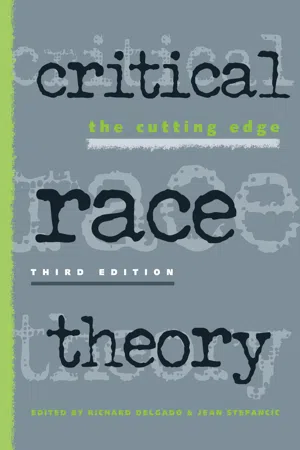 eBook - PDF
Critical Race Theory
The Cutting Edge
- Jean Stefancic, Richard Delgado(Authors)
- 2013(Publication Date)
- Temple University Press(Publisher)
Essentialism is intellectually convenient and to a certain extent cognitively ingrained. Essentialism also carries with it important emotional and political payoffs. Finally, es-sentialism often appears (especially to white women) as the only alternative to chaos, mindless pluralism (the Funes trap), and the end of the feminist movement. In my view, however, as long as feminists, like theorists in the dominant culture, continue to search for gender and racial essences, black women will never be anything more than a cross-roads between two kinds of domination or at the bottom of a hierarchy of oppressions; we will always be required to choose pieces of ourselves to present as wholeness. Modified Women and Unmodified Feminism: Black Women in Dominance Theory Catharine MacKinnon 15 describes her dominance theory, like the Marxism with which she likes to compare it, as “total”: “[T]hey are both theories of the totality, of the whole thing, theories of a fundamental and critical underpinning of the whole they envision.” 16 Both her dominance theory (which she identifies as simply feminism) and Marxism “fo-cus on that which is most one’s own, that which most makes one the being the theory addresses, as that which is most taken away by what the theory criticizes. In each theory you are made who you are by that which is taken away from you by the social relations the theory criticizes.” 17 In Marxism, the “that” is work; in feminism, it is sexuality. MacKinnon defines sexuality as “that social process which creates, organizes, ex-presses, and directs desire, creating the social beings we know as women and men, as their relations create society.” 18 Moreover, “the organized expropriation of the sexuality of some for the use of others defines the sex, woman.
Index pages curate the most relevant extracts from our library of academic textbooks. They’ve been created using an in-house natural language model (NLM), each adding context and meaning to key research topics.

