Politics & International Relations

Radical Feminism
Radical feminism is a feminist perspective that seeks to dismantle the patriarchal system by addressing the root causes of gender inequality. It emphasizes the need for fundamental societal change and challenges traditional gender roles and power structures. Radical feminists advocate for women's liberation through various means, including political activism and consciousness-raising efforts.
Written by Perlego with AI-assistance
Related key terms
1 of 5
12 Key excerpts on "Radical Feminism"
 eBook - PDF
Women, Gender, and World Politics
Perspectives, Policies, and Prospects
- Peter R. Beckman(Author)
- 1994(Publication Date)
- Praeger(Publisher)
I call this combination "Critical/Feminist Theory," or a "gender-in-International-Relations" per- spective. Liberal feminists have underscored the absence of women from both the practice and study of international relations. This absence has been used in the past to defend the supposed gender neutrality of the study of world politics. Criticizing it is therefore important. Liberal feminists challenge that claim and effectively give voice to women scholars and previously si- lenced practitioners of world politics, as well as expand the boundaries of the field. Similarly, Radical Feminism not only challenges the assumption that mainstream International Relations theory has been produced in a value- neutral way, but also points to the importance of expanding the arena of legitimate inquiry in world politics beyond its traditional focus on war and peace. Along with other critics of this tradition, Radical Feminism insists on exploring the constitutive elements of all international activity, not merely the surface appearance of interstate rivalry, which has been privi- leged through Realism. Finally, Feminist Postmodernists have emphasized the ways in which identity and meaning are contingent and socially constructed. This is im- portant in International Relations because it underscores the ways in which the topics that are considered important, the ways of posing questions, and the approach to studying them, are created rather than natural. A Critical/Feminist account of world politics that is sensitive to gender relations should attempt to incorporate many of the insights of the above types of feminist theorizing while overcoming their limitations. Like Lib- eral feminists, we are interested in documenting the underrepresentation of women in particular spheres, or describing the unfair burdens borne by women as a result of particular legislative practices.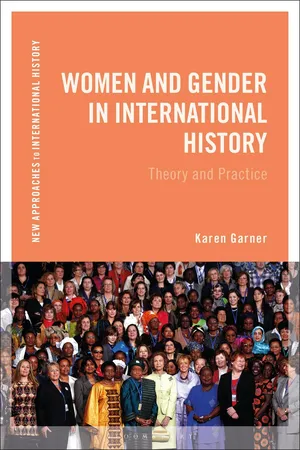 eBook - PDF
Women and Gender in International History
Theory and Practice
- Karen Garner(Author)
- 2018(Publication Date)
- Bloomsbury Academic(Publisher)
The international episodes recounted and issues raised in this textbook confirm that observation. Feminist foreign policy In the last few decades a new concept, a so-called feminist foreign policy, has entered the realm of international studies and the wider public debate, as scholars and activists have attempted to link feminist theory to practice. The foundational principles of a feminist foreign policy have been drawn from feminist IR critiques of conventional gender-blind IR theories and the entrenched power structures that have privileged Western-defined WOMEN, GENDER, AND IR THEORY 27 hegemonic masculinity in the contemporary international system. With those criticisms in mind, a feminist foreign policy must be transformative and reject the usual practice of elitist power politics. A feminist foreign policy elevates human security and freedom from physical or structural violence for all as the goal and raison d'etre of international relations. A feminist foreign policy, therefore, is based on an ethics of care and justice for all human life, and for all other forms of life on the planet. A feminist foreign policy includes women and other marginalized groups and their needs and concerns as participants and guiding subjects of international policy making, recognizing, and challenging linked hierarchies of power and oppression based on gender, race, class, nationality, sexuality, and so on. A feminist foreign policy champions human rights for all, with no distinctions between men’s human rights and women’s human rights. A feminist foreign policy promotes cooperative relationships, collective security arrangements, corporate social responsibility, and environmental sustainability. It criticizes militarized states and militarized economies that enable a first-resort response to violence to resolve conflicts at all levels of social interaction.
- C. Gormley-Heenan(Author)
- 2012(Publication Date)
- Palgrave Macmillan(Publisher)
Feminism is equated with ‘women’s liberation’ – primarily economic and reproductive – and seen as a relic of a bygone age. It is either viewed as unnecessary in a ‘post- feminist’ era, due to feminist ‘demands’ having been achieved (articulated primarily as the elimination of sexual discrimination and sexual harassment, and the recognition that domestic violence is unacceptable), or as having ‘gone too far,’ tipping the ‘balance’ towards ‘favouring’ women rather than ‘stopping’ at ‘true’ gender equality. Feminism is seen as synonymous with the special treatment of women (through quotas and affirmative action policies) and is argued to be antithetical to meritocratic and therefore democratic politics. The common argument that IR is ‘gender neutral’ because it is about neither men nor women but about states is often articulated in tandem with the notion that, while the personal may be political, it is not international. Feminist focus upon ‘women’s issues’ is understood to have relevance only in the domestic sphere; at the international level, this focus is seen to be marginal in impor- tance, inapplicable or a distortion of the way international politics ‘really’ works. For many students, the conceptual leap required to view gender as a power relation is a difficult and estranging experience; only a very few students self-identify as feminist, and this is usually a liberal conceptualization of femi- nism, typically an understanding that unproblematically connects feminism with women, gender with (women’s) bodies, and substantive feminist issues as primarily (or solely) concerned with issues of liberal democratic representation and participation in the economic and political arenas of the public sphere. In recent years, there has been much debate within academic feminism about the vitality of feminist politics (see, for example, Halley, 2006; McRobbie, 2009; Zalewski, 2010). eBook - PDF
Democracy and Northern Ireland
Beyond the Liberal Paradigm?
- A. Little(Author)
- 2004(Publication Date)
- Palgrave Macmillan(Publisher)
As it emerged through the writings of early theorists such as Mary Wollstonecraft, feminism was concerned with the extension of liberal rights to women on the same basis as men. Thus, for example, Wollstonecraft argues that women had the same abilities and capacities as men but that these 137 A. Little, Democracy and Northern Ireland © Adrian Little 2004 were not developed through inequalities in education. Systemic changes could enable women to realise their potential in the same way as men and therefore there was a case for women achieving equal rights to those enjoyed by men in liberal democracies. These ideas would remain (and still are) influential in feminist theory through the struggles for enfranchisement, reproductive rights and so on, but since the 1960s feminist politics has taken on a new dimension. Where tra- ditionally liberal feminism was egalitarian insofar as its primary concern was with rights and women’s equality with men, radical feminists began to challenge liberal strategies for the emancipation of women and broaden the scope of feminist theory to grapple with cul- tural issues and the nature of relations in what had up until this time been designated as the private sphere as well as the public world of pol- itics and economics. Radical feminists of the 1970s began to focus more directly not only on the equality of women with regard to men, but also what it was that differentiated women from men. Thus, the focus shifted from an egalitarian politics to one concerned with differ- ence, albeit without relinquishing the concern for formal equality that had animated earlier feminist politics. Here the spotlight was moved from the shared capacities of men and women to what essentially dis- tinguished women from men, such as the ‘ethic of care’. The argu- ment, in short, was that patriarchal society valued masculine values and attributes over and above those that were more feminine. eBook - PDF
- Diane Richardson, Victoria Robinson, Diane Richardson, Victoria Robinson, Linda Diane Richardson, Sandra Victoria Robinson(Authors)
- 2020(Publication Date)
- Bloomsbury Academic(Publisher)
As well as stressing the need to account for inter-sectional concerns, post-colonial and trans feminism offer an additional demand; to critique the legacies of feminism that have produced feminism itself as a project of colonialism and cis-normativity. The emphasis here is not merely one of inclusion but on the productivity of difference. These developments indicate the continued vibrancy of feminist theory as it continues to advance in the twenty-first century. This chapter examines key perspectives and theoretical shifts within feminist the-ory. It takes a broadly chronological approach; charting dominant ways of theorising from the inception of feminist theory in the 1970s through the 1980s, exploring key challenges to these understandings as they emerged through the 1990s, and consider-ing theoretical and political interventions over the last two decades. The chapter begins by outlining four approaches central to early feminist theorising of gender inequality: Radical Feminism, Marxist feminism, dual systems, or socialist feminism, and liberal feminism. FEMINIST AND GENDER THEORIES Sally Hines 2 25 FEMINIST AND GENDER THEORIES It moves on to reflect on the significant challenges to these over-arching theories of gender inequality brought first by the deconstructionist approaches of post- structuralist theory and queer theory, and subsequently from post-colonial and inter-sectional feminist activists and writers. The final part of the chapter draws on debates between feminism and transgender as a case study through which to hone in on these varied feminist approaches. Early feminist perspectives: radical, Marxist, dual systems theory and liberal feminism From a feminist perspective, gender is a socially and culturally constructed concept, which gives rise to distinct gendered experiences and gender roles. Feminist theory thus poses a direct challenge to a biological approach to gender difference (see Richardson in this volume). eBook - PDF
Gender, Conflict and Peace in Kashmir
Invisible Stakeholders
- Seema Shekhawat(Author)
- 2014(Publication Date)
- Cambridge University Press(Publisher)
Feminist perspectives create a standpoint to observe, analyse and criticize the traditional perspectives on IR. 12 The emphasis is, thus, on engendering IR. For Sarah Brown, a feminist theory of IR is an act of political commitment to understanding the world from the perspective of the socially subjugated. She argues, ‘there is the need to identify as yet unspecified relation between 4 Gender, Conflict and Peace in Kashmir the construction of power and the construction of gender in international relations.’ 13 Cockburn contends that feminist gender analysis is unified on the issue that ‘the differentiation and relative positioning of women and men is seen as an important ordering principle that pervades the system of power and is sometimes its very embodiment.’ 14 Different perspectives exist in feminist scholarship on the whys and hows of discrimination and subjugation and also on ways to overcome them. For instance, many feminists contend that patriarchy, simply understood as a male dominated structure, is the primary reason for the oppression of women. 15 Others argue that gender is only one among many reasons of subjugation. There are many other factors such as race, class, caste and ethnicity that lead to oppression. 16 Diversity exists within the scholarship though the focus remains same, that is, making IR gender inclusive. Sylvester elaborates on this unity in diversity: Feminist theories are diverse, but generally concur that the invisibility of gender issues within mainstream social theories, and of women in ‘important’ public domains of human existence, cannot be remedied simply by adding a pinch of women – to the state, to capitalist processes and to theories – and stirring. Visibility requires considerable analysis of the points in the international system, and in the theories which depict it, where women’s behaviors and contributions are choked off and men’s are taken as the norm. eBook - PDF
Perverse Politics?
Feminism, Anti-Imperialism, Multiplicity
- Ann Shola Orloff, Raka Ray, Evren Savci, Ann Shola Orloff, Raka Ray, Evren Savci, Julian Go(Authors)
- 2016(Publication Date)
- Emerald Group Publishing Limited(Publisher)
Stated differently, these critics shift the focus of the debate from the threat posed to the agency of individual women to the threat posed to feminism as a political emancipatory project. We note that these scholars work within, and usually seem to assume, a US context, but they are cited and taken up well beyond the borders of the United States. In the spirit of “provincializing” the United States, we present their critiques as most relevant for this country. However, we also want to open up the question of whether these analyses have applicability elsewhere, or if differing contexts require different analytic frameworks, or simply different conclusions about states, law, and feminism. 15 125 Feminism/s in Power: Rethinking Gender Equality CONCLUSION What are we to make of the critics of feminism in power ? We believe they have zeroed in on a phenomenon that feminists would do well to examine further. The critics of feminism in power shine a light on a change in femin-ism’s relation to institutions of state power and law as reflected in new poli-tical alliances forming between feminists and neoliberal and conservative elites, and the political and discursive uses to which feminist ideas and ideals have been put. Building on work on inequalities and hierarchies among women, these critics take up specifically political questions concern-ing the kind of feminist politics to be promoted in today’s changed gendered landscape. eBook - PDF
- Heather MacIvor(Author)
- 2019(Publication Date)
- University of Toronto Press(Publisher)
Women and men experience the world differently, and they think and reason differently as a result. Radical feminists also downplay the importance of rational thought, arguing that mental constructs like logic and the application of abstract rules are mas-culine in nature. Women are more intuitive and spiritual, in touch with nature and the earth. Finally, instead of focusing on the individual, radi-cal feminism examines the patriarchal structure of society to identify sys-temic discrimination against women based on their sex. History Although we have said that Radical Feminism emerged in the late 19605, this is not entirely true. During the first wave, as we have seen, many women involved in the various reform movements were moti-vated by their belief in the responsibilities and virtues of motherhood. This maternal feminism grew out of a conviction that women were morally superior to men, and that their biological drive to bear and nur-ture children made them natural enemies of warfare, poverty, alcohol, and other evils that afflicted Canada early in this century (and since, of course). One of the central figures in the suffrage movement, Nellie McClung, stated the case for maternal feminism succinctly: The woman movement... is a spiritual revival of the best instincts of woman-hood — the instinct to serve and save the race. ... Women are naturally the guardians of the race, and every normal woman desires children. ... It is woman's place to lift high the standard of morality. 23 Such sentiments (minus the words race and normal) are ex-pressed by many radical feminists today, particularly those active in the anti-nuclear and environmental movements. 24 The emergence of modern radical feminist theory in the 19605 and 19705 can be traced to three books. The first, Simone de Beauvoir's The Second Sex, was published in French in 1949 and in an English transla-tion in I953-25 The Second Sex broke new ground in feminism and in ex-istential philosophy. eBook - PDF
Female Masculinities and the Gender Wars
The Politics of Sex
- Finn Mackay(Author)
- 2021(Publication Date)
- I.B. Tauris(Publisher)
There is undoubtably a level of misogyny, sexism and ageism which fuels the blanket ridicule, dismissal and wilful ignorance about just what Radical Feminist theory even is, and what it isn’t. Second Wave has become a dirty word, an insult in many circles, and Radical Feminism emblematic of an out of date, politically incorrect and prissy feminism which will not be mourned when it dies out. However, a politics and theory as strong as Radical Feminism, a politics and theory that is truly radical in the revolutionary sense, will never die out; and in fact, its influence can be seen in much queer theory and activism today, proving, time after time and decade after decade, its prescience and relevance. Much classic Radical Feminist theory had standpoints on sex and gender that we might now say bear similarity to queer theory, and this work was profoundly forward thinking, although it would obviously not have been termed as queer theory in the 1960s and 1970s, before the academic field and term ‘queer theory’ had even emerged. To look at just a few limited examples, there are influential Radical Feminist theorists such as Andrea Dworkin, Shulamith Firestone and Kate Millett, all from the United States, who were hopeful about research into the social construction of sex roles. They deconstructed gender, wrote positively about androgyny and concluded 47 Feminist Revolution Now that biological sex is not as binary or as fixed as had been assumed. The French Radical Feminist Monique Wittig, for example, is quoted extensively in Butler’s classic Gender Trouble and enables much of that theorizing. If all Radical Feminist theories were exclusively anti-trans and all Radical Feminist activism anti-trans-inclusion, then there would have been no need for any specific term to distinguish activists who supported trans inclusion from those who did not. That term, well used today, is, of course, TERF – trans-exclusionary radical feminist. eBook - PDF
- J. Dean(Author)
- 2010(Publication Date)
- Palgrave Macmillan(Publisher)
As we saw at the end of Chapter 1, there is a problematic tendency to assume that the signifier ‘radical’ – to use Austinian parlance – refers constatively to particular types of political spaces or practices. In oppo- sition to this, I claimed that a (feminist) politics might be accurately construed as radical if it foregrounds the notions of equivalence and imagination as highlighted in this chapter. This entails a foregrounding of the performative dimension of political action, that is, the capac- ity for political action to contingently and unpredictably bring into existence new ways of seeing, understanding and acting in the world. A political action is therefore radical when it performatively – that is, imaginatively – names and brings into existence, through the construc- tion of chains of equivalence, new political possibilities, new political agendas and new ways of seeing that were previously unavailable. Recasting radicality in these terms is not an esoteric theoretical exercise, but has quite profound implications for how we might con- ceptualise the history of feminist politics, and indeed radical politics more generally. In contrast to accounts that typically see feminism’s radicality as inhering in autonomous anti-statist mobilisations, I want to propose that what was radical about Anglo-American second-wave feminism was its ‘world-building’ capacity to bring into existence new ways of understanding and seeing the world. For instance, the signifier ‘the personal is political’ acted as an empty signifier that performa- tively established equivalential linkages between various concerns that had previously been conceptualised as private or linked to individual pathologies. Similarly, the casting of domestic violence as a product of gendered power relations, rather than individual pathology, was also radical in that it performatively brought into existence a new way of thinking about gender relations in broad structural terms.
- Brooke A. Ackerly, Maria Stern, Jacqui True(Authors)
- 2006(Publication Date)
- Cambridge University Press(Publisher)
1 Feminist methodologies for International Relations Brooke A. Ackerly, Maria Stern, and Jacqui True Over the past two decades feminism has made refreshing, often radical contributions to the study of International Relations (IR). Feminism is no longer a rare import but a well-established approach within IR, as its inclusion in the core texts and scholarly collections of the field testifies. IR students today benefit from the theoretical and empirical space opened up by feminist scholars. Since the late 1980s, feminist scholars have paved the way for serious engagement with gender and theory in a previously gender-blind and theoretically abstract IR field. 1 Despite its increasing recognition, however, the progress of feminist international relations scholarship has been far from straightforward. In a state-centric discipline that is notorious for its lack of self-reflection, developing feminist methodologies and conducting feminist research have been major challenges. However, since all power relations are essential to feminist perspectives and to the feminist research process, feminist methodologies are highly relevant for the study of global politics. Feminist Methodologies for International Relations offers students and scholars of international relations, feminism, and global politics practical insight into the innovative methodologies and methods that have been developed – or adapted from other disciplinary contexts – in order to do feminist research for IR. Beginning with the first wave of feminist IR, scholars have been making theoretical breakthroughs. Attention to methodology has been vital to the development of feminist IR as a diverse, varied, and collective inquiry. While feminist research methods have been the subject of informal discussions, these have been largely unpublished. Most students and scholars are unaware of the methodo- logical rigor underpinning feminist IR research. eBook - PDF
International Relations and the Challenge of Postmodernism
Defending the Discipline
- D. S. L. Jarvis, Darryl S. L. Jarvis(Authors)
- 2021(Publication Date)
- University of South Carolina Press(Publisher)
16 In such a “chilly climate,” women have been sys-tematically “evacuated” from International Relations, forced into their assigned places at home, and even when they have managed to break free of such places, “their words have been lost, or covered-up and stored in the basement, . . . ignored because they are the views of people called women and ‘women’ have no place in the political places of ‘men.’” 17 Of “all the institutionalized forms of contemporary social and political analy-sis,” concludes R.B.J. Walker, International Relations is “the most gender-blind, indeed crudely patriarchal.” 18 At the center of this disciplinary bastion of male privilege and repres-sion, feminists identify an unreflective male-body-politic, one unknowingly prone to gendered or masculinist worldviews because of their unconscious male-sexuality. Underpinning much contemporary feminist theory is an implicit assumption of innate difference between men and women, where social inequalities stem as much from the hormonal/anatomical attributes of men as they do from social institutions like patriarchy or the thought Feminist Revisions of International Relations 145 practices associated with rational or positivist-based epistemologies. For many feminists, the litany of allegations also derive from psychoanalytic interpretation, where, for example, the arms race, strategic and military studies, comparative force assessment, military-industrial complexes, or studies of the new surveillance technologies represent a male obsession with hardware and high politics characteristic of the egocentric, aggressive, powerseeking, rational man who unconsciously transposes his phallocen-tric desires into war-hunting-sport-fighting-power-seeking pursuits. Using a type of neobiological cum psychosociological logic, males are seen to project a testosterone-induced aggression/violence indicative of hormonal dispositions or imprinted primeval genetic memories to protect food sources or territory, for example.
Index pages curate the most relevant extracts from our library of academic textbooks. They’ve been created using an in-house natural language model (NLM), each adding context and meaning to key research topics.

