Politics & International Relations

Patriarchy
Patriarchy refers to a social system where men hold primary power and dominate in roles of political leadership, moral authority, social privilege, and control of property. It is characterized by the reinforcement of traditional gender roles and the marginalization of women in decision-making processes and power structures. Patriarchy is often critiqued for perpetuating inequality and discrimination based on gender.
Written by Perlego with AI-assistance
Related key terms
1 of 5

12 Key excerpts on "Patriarchy"
 eBook - PDF
Patriarchal Theory Reconsidered
Torture and Gender-Based Violence in Turkey
- Filiz Akgul(Author)
- 2017(Publication Date)
- Palgrave Macmillan(Publisher)
A definition introduced by Lerner claims that “Patriarchy refers to the system historically derived from Greek and Roman law, in which the male head of household had absolute legal and economic power over his dependent female and male family members” (Lerner 1986: 217). A similar definition offered by Morrissey explains that Patriarchy is the relations of governance presided over by a father (Morrisey 2003: 24). Patriarchy is a concept that refers to power and control between an object and subject and subsumes, among others, the relationship between the father and the son; therefore, the ruler-subject binary. Additionally, this relationship could be observed between a hegemonic state and a developing country. It can be observed between two women, and it can be exercised against a queer individual. 30 F. AKGUL On the other hand, Patriarchy is also observed in the relations between a brother and a sister that is based on the construction of selfhood (Joseph 1994), as one defines their self-based relationship with others. This con- struction of selfhood is based on a certain type of love that enables people to define their masculinity and/or femininity based on their connection to one another (ibid). Girls are restricted and their behavior is nurtured, by their male kin, in order to ensure that men would not have to interfere in the name of preserving family honor. Since, at times and under certain circumstances, love is exercised and expressed in the form of control, women learn that male dominance is in fact a part of the nurturing felt in the nuclear family and equate control and dominance with love and intimacy. Although there is an element of governance in the relations between brothers and sisters, Patriarchy is observed through the efforts made by defining oneself through the action of another. eBook - ePub
- Hilaire Barnett(Author)
- 2013(Publication Date)
- Routledge-Cavendish(Publisher)
3 Patriarchy
DOI: 10.4324/9781843142720-3Aristotle, The Politics:1For the male is more fitted to rule than the female, unless conditions are quite contrary to nature…1 Aristotle, The Politics, Sinclair, TA (trans), 1962, London: Penguin, Bk I xii, 1259a37.Bacon, Abridgement of the Law:2…the husband hath by law the power and dominion over the wife, and may beat her, but not in a violent or cruel manner.2 1832.Luce Irigaray, ‘The bodily encounter with the mother’:33 Irigaray, L, ‘The bodily encounter with the mother’, in Sexes et Parentés, Macey, D (trans), 1993, New York: Columbia UP.Their discourses, their values, their dreams and their desires have the force of law, everywhere and in all things. Everywhere and in all things, they define women's function and social role, and the sexual identity they are, or are not, to have.While the theme of Patriarchy runs throughout this book, it is useful to focus on the concept at this early stage.4 Patriarchy and patriarchal theory, originating in ancient Greek thought, may be traced in English political theory at least to the seventeenth century which represented its high watermark. Notwithstanding its demise as a dominant political philosophy, however, Patriarchy remains evident in both the public and private spheres of life and in the laws and legal institutions regulating society.4 Patriarchy: a form of social organisation in which a male is the head of the family and descent, kinship, and title are traced through the male line; any society governed by such a system: Collins English Dictionary, 3rd edn, 1991, HarperCollins, p 1143.Explaining Patriarchy
Patriarchy represents one of the most conceptually and analytically complex theoretical constructs and lies at the heart of traditional jurisprudence and the feminist critique. Not only is the concept difficult, but there exist also differing contemporary interpretations of it. Thus liberal feminists, cultural feminists, radical feminists, Marxist-socialist feminists, black feminists, lesbian feminists all have perceptions regarding Patriarchy which while often overlapping, by no means converge into a coherent agreed definition. Thus the paradox exists: Patriarchy represents a core concept within feminist analyses of society and law, yet the content and meaning of that core concept remain contentious. eBook - ePub
Women Voters in Indian Elections
Changing Trends and Emerging Patterns
- Sanjay Kumar(Author)
- 2021(Publication Date)
- Routledge India(Publisher)
5 Internalized Patriarchy Socio-cultural and economic barriers to participation of women in politics Manjesh Rana In Theorizing Patriarchy (1990), Walby defines ‘Patriarchy’ as ‘a system of social structures and practices in which men dominate, oppress and exploit women’. The term refers to a social structure where men are considered to be superior to women, and, therefore, men’s actions and ideas dominate. This can be seen in the inequalities experienced by women in personal spaces, such as households, and in public spaces, including in the political sphere. In nearly all Indian households (as well as in households in many other countries), the eldest male is considered the ‘patriarch’ and, therefore, de facto the head of the family. Accordingly, Walby identified Patriarchy as having two distinct forms—private and public. Private Patriarchy is the household structure that can prevent women from taking part in family decision-making and from accessing public life eBook - PDF
Between Feminism and Materialism
A Question of Method
- G. Howie(Author)
- 2010(Publication Date)
- Palgrave Macmillan(Publisher)
The term was given political content and resonance within the woman’s movement of the 1970s and was mobilized to make sense of a variety of cultural and historical practices. It came to denote a general system of distribu- tion whereby social practices, institutions (family, state, church), and cultural images organize the power that men exert over women. For Christine Delphy, Patriarchy can be simply stated as “the oppression of women, here and now.” 7 Hartmann defines Patriarchy as a set of relations between men, which has a material base in the control of women’s labor power, and which, though hierarchical, establishes or creates interdependence and solidarity among men that enables them to dominate women and restrict their sexuality. 8 To which Ehrlich adds that the ideology of Patriarchy is the belief that men have a right to control the life circumstances of women. 9 More recently, we find the recognition that without a concept of Patriarchy the depth, pervasiveness, and interconnectedness of differ- ent aspects of subordination cannot be captured. 10 Attuned to these issues, Christine Battersby develops metaphysical arguments that might allow her to take the female as the norm, thereby toppling the patriarchal view that “thinks the human, sub-human and superhu- man essence in androcentric terms.” She defines Patriarchy in a fairly straightforward way as a form of social organization that takes male bodies and life-patternings as both norm and ideal in the exercise of Patriarchy 181 power. 11 Moira Gatens elucidates the body-as-lived, the imaginary or psychic body, and accentuates the fact that we are historically and cul- turally situated in a society that is defined and organized according to sex: that the representation and control of women’s bodies is a crucial stake in all other social struggles. 12 Butler would rather talk about instances of gender asymmetry than Patriarchy. eBook - PDF
The Democratic Gulag
Patriarchy, Leadership and Education
- Robert Bahlieda(Author)
- 2016(Publication Date)
We must hold them up to scrutiny and challenge their premises as well as their application. It is a tall order but not impossible, and it is abso- lutely imperative that we accomplish it. the legacy of Patriarchy 37 The Meaning and Influence of Patriarchy Taken literally, Patriarchy is defined as the rule of the father (Vavrus, 2002). Walby (1990) offers the following definition: “…a system of social structures and practices in which men dominate, oppress and exploit women” (p. 20). Monagan (2010) elaborates: The most commonly accepted definition of Patriarchy is the social structure of soci- ety based on the father having primary responsibility for the welfare of and authority over their families. However the true reach of Patriarchy extends far beyond the privacy of the familial realm. (p. 160) Von Werlhof (2007) adds: “For most women, it has simply meant the rule of men or fathers, within the family, the workplace, or the state. It is known that Patriarchy is older than capitalism” (p. 23). In practice it is a pervasive, idealized system of social power in which men dominate (O’Sul- livan, 2001)—values that permeate every aspect of our modern social being and are the foundation of our entire social fabric (Lerner, 1986; von Werl- hof, 2007). A. Johnson (2005) identifies the three salient characteristics of Patriarchy as follows: “A society is patriarchal to the degree that it promotes male privilege by being male dominated, male identified, and male centered. It is also organized around an obsession with control and involves as one of its key aspects the oppression of women” (p. 5). eBook - ePub
- Md. Muddassir Quamar(Author)
- 2022(Publication Date)
- Routledge(Publisher)
3. Exploring the Nexus between Democratisation, Authoritarianism and Patriarchy in Iran and Saudi Arabia Hussein Solomon and Simone BekkerIt was in the ancient Near East (specifically Mesopotamia), where Patriarchy first developed between 3100 BC and 600 BC (Lerner, 1986 , p. 8). It was, however, only in 1947 that Max Weber first used the term “Patriarchy” to describe a system of government where men used their positions as heads of households to rule societies. Radical feminists appropriated the term in the 1990s to refer to a “... system of social structures and practices in which men dominate, oppress and exploit women. The use of the term social structure is important here since it implies rejection both of biological determinism, and the notion that every individual man is in a dominant position and every woman in a subordinate position” (ibid., p. 20).There are three inter-related reasons why identifying Patriarchy in this way is important. First, reference to social structures and practices suggests that the practices of Patriarchy were constructed and can be deconstructed as the history of Western societies could attest to. Behaviour–both individual and institutional–therefore, can be unlearned (ibid., p. 6). Second, issues of gender are mediated through other variables like class, race, ethnicity, and religious affiliation. Thus, a poor rural woman from a marginalised ethnic or religious group will experience gender discrimination far more intensely than her wealthy, urban counterpart who belongs to the dominant ethnic or religious group. Third, Patriarchy viewed systemically allows one to understand the oppression of women from the workplace to the home, from issues of culture and faith to the administration of the state.Such an expanded view of Patriarchy is imperative if one considers the origins of this practice and its institutionalisation. Patriarchy is linked to issues of ownership and domination. Historically, the appropriation of women’s sexual and reproductive capacity by men was followed by the institutionalisation of private property and the emergence of class stratification. Similarly, the enslavement of women preceded the enslavement of other groups. The first states, meanwhile, owe their origins to the patriarchal family. Therefore, the earliest states had a vested interest in the subordination of women, and the earliest law codes institutionalised this subordination. By the second millennium BC, Babylon already had legislation controlling women’s sexuality (ibid., p. 89).
- Margaret F. Bello(Author)
- 2020(Publication Date)
- Society Publishing(Publisher)
Introduction to Patriarchy 1 CONTENTS 1.1. Patriarchy as a Deeply Embedded Social System ................................. 2 1.2. Male Domination of Politics and Political Systems .............................. 9 1.3. Masculinity In Moral Authority And Standards .................................. 16 1.4. Causes And Consequences of Male Social Privilege .......................... 23 1.5. Gendered Distribution And Control Over Property ........................... 28 Chapter 1 Summary ................................................................................. 32 Chapter Overview of Modern Patriarchy: A Subjective View of a Maledominated World 2 This introductory chapter will attempt to highlight some of the key components of a patriarchal system. In doing so, the chapter recognizes that there will be significant differences across societies. Therefore, some of the sections may indulge in generalities which must then be particularized in specific contexts. In the first section of the chapter, we will explore the ways in which Patriarchy has been systematically embedded within our societies hence making it difficult to eliminate its influence. The second section explores the ways in which politics has been turned into a uniquely masculine endeavor to the exclusion of other identities. This domination in morals and values is emphasized in the third section. The fourth section summarizes the origins and effects of male social privilege. The chapter will close with an overview of the gendered distribution of property rights. By the end of this chapter, the reader should have a broad view of how Patriarchy exists in our societies; always bearing in mind the specifics of each society which may manifest in differing ways. eBook - PDF
- Gerard Delanty, Engin F Isin, Gerard Delanty, Engin F Isin(Authors)
- 2003(Publication Date)
- SAGE Publications Ltd(Publisher)
Critics of ahistorical notions of Patriarchy tend to argue that the term is best confined to describing a particular form of early modern male-dominated social order which literally involved the rule of fathers. THEMES 342 Agreeing with much of their criticism (and without strong attachment to any particular words), I decided to use a technical term, ‘patriarchalism’, 4 to describe the social order(s) in question, to select other words to designate significantly different types of male-dominated societies, and to use ‘Patriarchy’ (somewhat in the way the term ‘class society’ is employed), as a collective designation of male-dominated social orders. This provi-sional scheme allows for the existence of sex-ually egalitarian societies, and puts the onus of specifying the precise dimensions of gender relations on to the researcher. By drawing attention to its role as a motive source of power, I tried to give patriarchalism analytical as well as descriptive content. By highlighting the double-edged effects of this power, I attempted to account for historical change: the rise and demise of one patriarchal order and its eventual displacement by another. A key argument of the book is that the dynamics of patriarchal governance provide a powerful conceptual link between two domi-nant perspectives guiding the study of early modern Western societies. One perspective centres on populations, agrarian cycles and economies, the other concentrates on war and the process of state formation. Both forms of explanation contain a persuasive depiction of the motive forces of historical change. The consolidation of patriarchalism in early mod-ern Europe, particularly as played out in the religious conflicts associated with the Reformation, was arguably fuelled by both of these processes. On the one hand, it was per-ceived to constitute the most effective way of safeguarding economic resources in a precari-ous balance between land and population. eBook - ePub
- Pavla Miller(Author)
- 2017(Publication Date)
- Routledge(Publisher)
Essential Midwifery Practice , for example, Mary Stewart (2010) depicts Patriarchy as an ideology which makes contemporary society profoundly unequal. Stewart passionately believes that feminist thought needs to form the basis of holistic midwifery care. This should start with carefully listening to women and supporting them in making decisions, as equals and partners in control of their own bodies. Stewart explains that there are now many different strands of feminism which, despite many disagreements, have a lot in common. They share a concern for and a desire to improve women’s lot in society, and generally agree that Western society is intrinsically patriarchal, hierarchical and unequal. Stewart defines Patriarchy as ‘an ideology that justifies and perpetuates male dominance and, within patriarchal social systems, power, benefits and burdens are unevenly distributed such that men, their values and characteristics are valued more highly than women’. The texts she refers to by Kirkley (2000) and Rafael (1996) define Patriarchy in a similar way, and in their turn refer to French (2002) and Lerner (1986). As Rafael (1996: 4) explains:Patriarchy may be thought of as an ideology that justifies and perpetuates male dominance through valuing men, their characteristics, and their activities while at the same time devaluing women and their characteristics and activities. Patriarchy has not always been the prevailing ideology but rather developed over a period of several millennia to be firmly in place by about 6000 BCE .A rupture in patriarchal systems of thought
In contrast to philosophical and ecofeminist work emphasising continuity of patriarchal systems of thought , the 1980s and 1990s also saw a number of publications focussed on profound discontinuities in patriarchal ideas and social relations. The Australian political philosopher Carole Pateman made a particularly influential and ambitious contribution to such work. In The Sexual Contract eBook - ePub
- Inger Skjelsboek, Dan Smith, Inger Skjelsboek, Dan Smith(Authors)
- 2001(Publication Date)
- SAGE Publications Ltd(Publisher)
The partnership process redefines, extends and expands Patriarchy within dominant groups to encompass the public as well as the private sphere. This is because their scope of authority and influence is expanded to encompass the subordinate groups. The rule of fathers in the family, lineage, or clan is extended to non-kin groups: political parties, trade unions, colleges, schools, corporations, the civil service etc. Accordingly, it is the men of the dominant groups who become the leaders of political parties, executives of corporations, heads of trade unions, heads of the civil service and top officers in the police force.The essence of this transformation is that these non-kin associations and organizations within the public sphere of the nation come to have the same structure as that of kinship collectives in the civil society. Patriarchy is transformed: from being a feature of tribal groups and kinship collectives, it takes on new forms within non-kin associations and organizations – as ‘fathers’ within the groups leading the nationalist charge or holding great economic resources seize or consolidate their places within the nation construct. The end result is the patriarchal state, political Patriarchy, corporate Patriarchy, trade union Patriarchy etc., as men of the dominant groups seize places in these areas within the public sphere in the nation.The movement away from the rule of fathers in blood-bonded collectives to that of men in political parties, corporations, trade unions, colleges, schools, and other non-kin organizations transforms Patriarchy from being the rule of fathers to being the rule of men. In the absence of filial relationships, the rule of fathers becomes the rule of men. Dahlerup (1987) has noted the emergence of the patriarchal state, observing that its defining feature is that it functions in the interest of men. My interpretation diverges slightly from this: I would say that the patriarchal state is commandeered by the men and women of the groups who control its mechanisms, to serve their interests and prerogatives. eBook - PDF
Women, Work, and Politics
The Political Economy of Gender Inequality
- Torben Iversen, Frances Rosenbluth(Authors)
- 2010(Publication Date)
- Yale University Press(Publisher)
2 THE STRUCTURE OF Patriarchy: HOW BARGAINING POWER SHAPES SOCIAL NORMS AND POLITICAL ATTITUDES As a natural consequence of our division of labor on sex-lines, giving to woman the home and to man the world in which to work, we have come to a dense prejudice in favor of the essential womanliness of the home duties. — Charlotte Perkins Gilman, Women and Economics, 1898, p. 111 Patriarchy — the dominance of males in social, economic, and po-litical organization — characterizes much of human history. If Mr. Cleaver from the 1950s in America were to time-travel back to an ancient agricul-tural village, he would, after the initial shock, take comfort in the stereo-typical roles of the male household head who rules over his wife and children. Even Mrs. Cleaver, in the subordinate role, would find her sta-tus in that ancient society familiar. Then as now, the variance in gender norms across societies remains within recognizable bounds. Patriarchy’s very universality has made it invisible to otherwise percep-tive philosophers and social critics from ages past. Jean-Jacques Rousseau, an early modern champion of equality, applied his logic only to men. Not only did Rousseau fail to argue for gender equality, but as Nannerl Keo-hane has pointed out, he elevated the power differential between men and women “into a ‘moral’ principle that becomes the foundation of an im-mense and complicated argument about how men and women should be-17 have in all aspects of their lives.” 1 Rousseau, of course, was validating an ancient belief rather than devising a new one. From the beginning of recorded history, men have not only been dominant, but societies have held that it is right that they should be so. The heavens smile, the cosmos is balanced, God is pleased. We single out Rousseau not because he was unusually chauvinistic.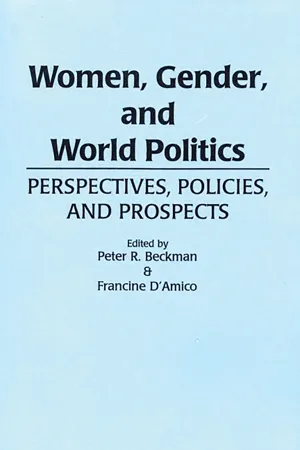 eBook - PDF
Women, Gender, and World Politics
Perspectives, Policies, and Prospects
- Peter R. Beckman(Author)
- 1994(Publication Date)
- Praeger(Publisher)
Women's opposition to internal factors has been generated by their opposition to national patriarchal structures, to class, to race, and to ethnic inequalities. National Patriarchy, despite its cultural variations, denotes male dominance over women's sexuality and labor, both in the private and public spheres. When women responded to the external world, they opposed international Patriarchy, as manifested by foreign interference, intervention, and domination. By international patriar- chy, I mean male dominance of world political conduct with far-reaching consequences for the control of women on a global scale. Whether or not women were responding to internal or external enemies (or to both), they have at times combined their oppositional voices with their own gender- specific interests. Third World women confront and resist the dilemma of a double-edged sword of internal and international Patriarchy. On the one hand, siding with national Patriarchy in defense of the nation against international ene- mies betrays women's demands for the degenderization of national politics. On the other hand, by demanding degenderization of national politics, women may appear to betray the nation during the onslaught of foreign powers. This is a dilemma that reflects conflicting national and interna- tional imperatives as experienced and expressed most intensely by many Third World women who participate in international conflicts. The dilemma of women who experience the double-edged sword of 94 • Perspectives domestic and international Patriarchy leads to the second proposition that is derived from the common experience of women: Women's interests are often subordinated to the interests of states, statesmen, or male revolution- aries. Many women are mobilized on behalf of the state or the nation. Many have echoed the voice of the male elite or of male revolutionaries. But only a few have expressed their own interests as women.
Index pages curate the most relevant extracts from our library of academic textbooks. They’ve been created using an in-house natural language model (NLM), each adding context and meaning to key research topics.

