Social Sciences

Gender Politics
Gender politics refers to the ways in which power dynamics, social norms, and institutions intersect with gender identity and expression. It encompasses the struggle for gender equality, the impact of gender on political decision-making, and the ways in which gender shapes societal structures and policies. Gender politics also involves the examination of how gender intersects with other social categories such as race, class, and sexuality.
Written by Perlego with AI-assistance
Related key terms
1 of 5
9 Key excerpts on "Gender Politics"
- Jane Bayes(Author)
- 2012(Publication Date)
- Verlag Barbara Budrich(Publisher)
Gender and Politics: Mapping the Terrain in the Age of Empire 137 and disentangle the multiple and varying power relationships between gen-der, class, race, ethnicity, nationality, and sexuality. In political science, this has been an important contribution of women of color – especially in the United States (Krause 2011, 105-111). A third division of the divided field of gender and politics consists of those in the political science or interdisciplinary subfields of Gender and In-ternational Relations, Gender and Development, and Gender and Globaliza-tion, and Gender and Democratization that have been concerned to define as political a variety of factors not particularly recognized as political by the dominant Enlightenment view; topics such as the organization of the econ-omy, the family, health, religious institutions, and public policy of all sorts– not necessarily electoral politics or formal political institutions such as par-liaments or bureaucracies or state departments. Much of the research in this area is based on the unmasking of gender biases and discrimination, but it is also concerned with theories of power, domination and subordination. Re-search in this category leans heavily on the conceptual critiques of the West-phalian Enlightenment view, but at the same time, attempts to incite to action or develop and advocate policy in areas other than electoral politics. Exam-ples would be peacekeeping efforts, rape counseling, agricultural initiatives, grant writing between the majority and minority worlds, reproductive health initiatives, social movements, transnational organizations, local/global con-nections, use of international law and structural adjustment policies. All three of these approaches to political science concern themselves with the majority and minority worlds although with varying frequency and focus. They are distinguished by their assumptions and by the focus of their investigations. eBook - PDF
The World of Political Science – The development of the discipline Book Series
The State of the Discipline
- Jane H. Bayes(Author)
- 2012(Publication Date)
- Verlag Barbara Budrich(Publisher)
Gender and Politics: Mapping the Terrain in the Age of Empire 137 and disentangle the multiple and varying power relationships between gen- der, class, race, ethnicity, nationality, and sexuality. In political science, this has been an important contribution of women of color – especially in the United States (Krause 2011, 105-111). A third division of the divided field of gender and politics consists of those in the political science or interdisciplinary subfields of Gender and In- ternational Relations, Gender and Development, and Gender and Globaliza- tion, and Gender and Democratization that have been concerned to define as political a variety of factors not particularly recognized as political by the dominant Enlightenment view; topics such as the organization of the econ- omy, the family, health, religious institutions, and public policy of all sorts– not necessarily electoral politics or formal political institutions such as par- liaments or bureaucracies or state departments. Much of the research in this area is based on the unmasking of gender biases and discrimination, but it is also concerned with theories of power, domination and subordination. Re- search in this category leans heavily on the conceptual critiques of the West- phalian Enlightenment view, but at the same time, attempts to incite to action or develop and advocate policy in areas other than electoral politics. Exam- ples would be peacekeeping efforts, rape counseling, agricultural initiatives, grant writing between the majority and minority worlds, reproductive health initiatives, social movements, transnational organizations, local/global con- nections, use of international law and structural adjustment policies. All three of these approaches to political science concern themselves with the majority and minority worlds although with varying frequency and focus. They are distinguished by their assumptions and by the focus of their investigations.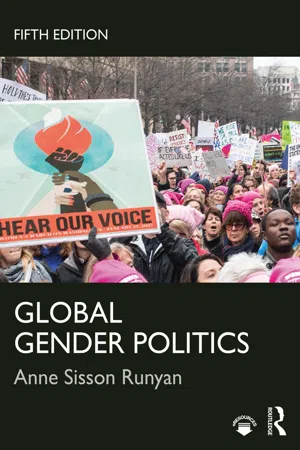 eBook - PDF
- Anne Sisson Runyan(Author)
- 2018(Publication Date)
- Routledge(Publisher)
A gender lens (explored more in the next chapter) reveals the political nature of gender as a system of difference construction, hierarchical dichotomy production, and norms enforcement that constitutes virtually all contemporary societies. Gender is about power, and power is gendered. How power operates in this way starts to become visible in an examination of the relationship between masculinity and femininity. Although the specific traits that mark gender-appropriate behavior vary cross-culturally, they constitute systems of politically significant structural power in the following interacting ways. First, males are expected to conform to models of masculinity (that are privileged) and females to models of femininity (which are subordinated). There are multiple models of masculinity within cultures, but one typically has hegemonic status as the most valued and esteemed model, and it is associated with elite (class, race, and culturally privileged) males. Within particular cultures, these expectations are taken very seriously because they are considered fundamental to who we are, how we are perceived by others, and what actions are appropriate. In this sense, gender ordering is inextricable from social ordering of power, authority, work, leisure, and pleasure. Second, because masculine activities are more highly valued or privileged than are feminine activities in most of the world most of the time, the identities and activities associated with men and women are typically unequal. Thus, the social construction of gender is actually a 4 Introduction: Gender and Global Politics system of power that not only divides the world into “men” and “women” and masculine and feminine, but also typically places some men and masculinity above most women and femininity. eBook - PDF
Making Sense of Cultural Studies
Central Problems and Critical Debates
- Chris Barker(Author)
- 2002(Publication Date)
- SAGE Publications Ltd(Publisher)
6 Identity, Equality and Difference: The politics of gender Central problem: Is gender equality possible and desirable? [T]he work that cultural studies has to do is to mobilize everything that it can in terms of intellectual resources in order to understand what keeps making the lives we live, and the societies we live in, profoundly and deeply antihuman in their capacity to live with difference. (Hall, 1996d: 343) I will be saddened if this book [ The Myth of Male Power ] is misused to attack the legitimate issues of the women’s movement – issues for which I spent a decade of my life fighting. The challenge is both to go beyond feminism and to cherish its contributions. And feminism’s contributions are many. (Farrell, 1993: 13) Introduction During the 1990s, cultural studies lent intellectual support, through its theo-rization of identity as discursive and without essence, to the political endeavours of feminists, gays, lesbians and others who commonly hold human sexuality and gender to be wholly malleable. The argument is that since sex and gender are social constructions, then they are entirely open to change. In turn, this posi-tion suggests that only the cultural power of men stands between women and social equality. In this chapter I want to explore some aspects of these debates. First, I want to ask about the meaning of ‘equality’ in the context of a conception of identity that stresses difference. Second, I want to investigate the argument that sex and gender are entirely plastic in the light of scientific evidence from the fields of genetics and biochemistry that suggests otherwise. Third, I want to inquire into the claim that men also suffer as a consequence of our culture’s gender expectations. Identity and difference The common-sense cultural repertoire of the self that is available to us in the western world describes persons as having a true self, an identity that we possess and that can become known to us. eBook - PDF
Contemporary Political Concepts
A Critical Introduction
- Georgina Blakeley, Valerie Bryson(Authors)
- 2002(Publication Date)
- Pluto Press(Publisher)
At the same time, the term now has quite widespread currency in much ‘malestream’ academic work and in public political debate. 108 This new awareness owes much to feminism; however, it tends to use the term in a very descriptive way or as a shorthand for women, and most public discussion of gender fails to recognise the complexity of the issues involved. In assessing the value of ‘gender’ as a political concept, it seems important to distinguish between the self-conscious reflections of theorists and the more casual use of the concept by political com-mentators and politicians. I will, however, argue that at both levels the concept has the potential for enhancing our understanding of the world, and that at both levels it must also be handled with great care if it is not to lose its radical edge and obscure more than it reveals. History: the distinction between sex and gender In feminist theory, gender, unlike sex, is defined as a socially con-structed role, which means that it is the result of political arrangements and is amenable to social and political analysis. (Tobias 1997:1; emphasis in the original) [Gender roles are] ... those learned social roles that a culture chooses to derive from its understanding of the nature of biological reproduction. (Rinehart 1992:15) [Gender studies are] ... investigations into the ways that sex and sexuality become power relations in our society. (Carver 1996:1) At least since the seventeenth century, some feminist writers have argued that what appears to be women’s nature is in fact the artificial and distorted product of their upbringing. In the celebrated words of the French writer Simone de Beauvoir, written in 1949, ‘One is not born but rather becomes a woman’ (1972:297). From the 1960s, this argument was often formalised in what has become known as the sex/gender distinction. eBook - PDF
Gender and the Politics of Gradual Change
Social Policy Reform and Innovation in Chile
- Silke Staab(Author)
- 2017(Publication Date)
- Palgrave Macmillan(Publisher)
Their rules and practices define the boundaries of social citizenship, regulate the relative weight of states, markets, individuals and households in social provision and contribute to the production or mitiga- tion of social hierarchies. GENDER, POLITICS AND SOCIAL POLICY: AN INSTITUTIONALIST PERSPECTIVE 21 Social policies are also archetypically gendered institutions in the sense that “gender is present” in their “processes, practices, images and ideolo- gies, and the distributions of power” they purport (Acker 1992: 567): they reflect and reproduce gendered assumptions about work and family life (Lewis 1992; Orloff 1993; Sainsbury 1996); they are based on gen- dered interpretations of need, worthiness and entitlement (Fraser 1987; Fraser and Gordon 1994; Haney 1997); and they draw lines between those issues that are considered a legitimate terrain for political interven- tion and those that remain private (Jones 1990). In other words, gender relations—“embodied in the sexual division of labor, compulsory hetero- sexuality, discourse and ideologies of citizenship, motherhood, masculinity and femininity” (Orloff 1996: 51)—are a constitutive element of welfare institutions. 1 By design or by default, definition or omission, these institu- tions shape men’s and women’s participation and position in the market, the polity, and the home in conspicuously gendered ways. A focus on rules, norms and practices enables us to investigate the specific channels through which gender and other social markers operate within and across policy areas. Some of these rules are formally inscribed into constitutions, laws, decrees, statutes and ministerial guidelines while others are enacted and enforced informally through everyday practices based on shared expectations (cf. Helmke and Levitsky 2006; Chappell 2006; Chappell and Waylen 2013; Lowndes and Roberts 2013). eBook - PDF
- Christine Skelton, Becky Francis, Lisa Smulyan, Christine Skelton, Becky Francis, Lisa Smulyan(Authors)
- 2006(Publication Date)
- SAGE Publications Ltd(Publisher)
This has meant that, more recently, work in the area of gender theory has expanded and diversified to include postmodernist/post-structuralist work. Gendered identities and identifications and shifts in social theory have produced a complexity of accounts that highlight fluidity as well as diversities within differ-ences. Factors of class, as well as race, sex and differences such as age, faith and sexuality, are involved in identity construction, and this complexity has been reflected in much of the related research (Datnow, 1998; Epstein et al ., 1998; Erskine and Wilson, 1999; Walkerdine et al ., 2001; Archer, 2003). Simultaneously, feminist research has continued to demonstrate the ‘enduring stability of the gen-der order in girl’s and women’s working lives, despite transformations in contem-porary gender relations’ (Dillabough, 2001: 24). GENDER AND MOVEMENT IN SOCIAL POLICY 115 In terms of gender theories, there has been a conceptual struggle, conducted over the last 50 years or so, in which gendered impacts were either overtly disre-garded, positioned as the reason for continued social and material inequalities, or seen as part of an interrelated combination of factors that have influenced patterns and forms of social reproduction. Differences within difference have been recog-nized, and identity and cultural studies have expanded to incorporate situated and contextualized gender theorization. The theoretical situation is now rich, complex and multifaceted: If class stratification and gender once stood at the center of the project of feminist repro-duction theorists, they now need to be seen as necessary but no longer sufficient concep-tual tools for the new theoretical landscape we inhabit today. (Dillabough, 2003: 379) The problem, of course, is that education policy making and education policy-in-action is often caught up in and limited by conceptual lags and gaps. Discourses of ‘merit’, liberalism and individualism still influence the policy process. eBook - PDF
- Elin Bjarnegård, Pär Zetterberg, Elin Bjarnegård, Pär Zetterberg(Authors)
- 2023(Publication Date)
- Temple University Press(Publisher)
Introduction / 9 This book aims to facilitate communication across disciplinary boundaries, regardless of what is normally counted, or discounted, as violence. Gender Gender is a concept and analytical category that contributes a critical lens on power positions and hierarchies, particularly as they pertain to inequal- ities between women and men, but also to nonbinary individuals. A gender perspective implies constant attention to the socially constructed character- istics associated with ascribed gender identities, such as being seen as a woman or a man, as well as to the power relationships between the sexes. A gender perspective is not the same as a focus on women. Instead, a comparative anal- ysis of gender relations illuminates, in the words of Weldon, “the systematic way that social norms, laws, practices, and institutions advantage certain groups and forms of life and disadvantage others” (2006, 236). Gendered power dynamics thus pertain to individual women and men, as well as to groups and societies more broadly. As such, applying a gender perspective is crucial to understanding power, and power is at the core of the dynamics of both politics and violence. As alluded to above, gendered vulnerabilities and entitlements intersect with other social and economic inequalities, including (but not limited to) ethnicity and race, socioeconomic status, disability, sexual identity, and geo- graphic location. These axes of advantage and disadvantage need to be contex- tualized, as they play out very differently in different countries and localities. This also implies that although gender is an important hub for understand- ing power, men and women are differentially positioned. Nonhegemonic men may well experience patterns of oppression that are similar to what the pat- terns some women experience. Intersectional studies allow for a greater de- gree of complexity. eBook - PDF
- Heather MacIvor(Author)
- 2019(Publication Date)
- University of Toronto Press(Publisher)
The relations be-tween men and women are based not on love and tenderness, but on power and submission. Men seek to control women's minds and bodies. They sometimes use physical force, but more often they use demeaning 34 I WOMEN AND POLITICS IN CANADA: PART ONE images of women in the mass media and pornography, lower pay, and the denial of reproductive freedom. Second, the phrase sexual politics breaks down the dichotomy be-tween the public and the private. It implies that the separation between the two is a fiction, one that perpetuates women's subordinate place in the family. Crimes such as wife battering and marital rape should be seen as legitimate subjects for legislation and public prosecution, not as per-sonal matters to be ignored by the state and the police. The idea that all men seek to dominate and control all women is highly problematic, as we will see in our discussion of radical feminism. But the phrase sexual politics retains some value, because it alerts us to the power imbalances that do exist between men and women. We will now turn to a brief discussion of two issues that are directly related to the concept of sexual politics: the question of sex versus gender, and the idea of patriarchy. Sex versus Gender One of the key issues in feminism is the distinction between sex and gender. Sex is generally understood as a biological phenomenon. Men and women differ from each other in their primary sexual and reproduc-tive characteristics, and in their secondary sexual characteristics (e.g., women have larger breasts and less body hair than men). Sexual defini-tion is therefore relatively straightforward, although there have always been a few individuals who defied easy categorization (hermaphrodites and, more recently, transsexuals). For the most part, a person is either male or female, and that's that.
Index pages curate the most relevant extracts from our library of academic textbooks. They’ve been created using an in-house natural language model (NLM), each adding context and meaning to key research topics.

